Bio lab notes
 View linked note
 Call Kai
 Learn
Learn Practice Test
 Spaced Repetition
 Match
Match Flashcards
 Knowt Play
1/36

Earn XP
Description and Tags
This set of flashcards covers key concepts, processes, and definitions related to cellular respiration and photosynthesis, helping students prepare for their upcoming exam.
Name | Mastery | Learn | Test | Matching | Spaced | Call with Kai |
|---|
No analytics yet
Send a link to your students to track their progress
37 Terms
What are photopigments?
Molecules that absorb light energy.
What is the most abundant photopigment in plants?
Chlorophyll a.
What is the general chemical equation for photosynthesis?
CO2 + H2O + light energy → glucose + O2.
What colors of light does chlorophyll a absorb?
Red and blue light.
What is chromatography?
A technique used to separate compounds based on their properties.
What does RF value represent in chromatography?
The ratio of the distance traveled by the substance to the distance traveled by the solvent.
What happens to an electron transport carrier when it gains an electron?
It is reduced.
What are the four steps of cellular respiration?
Glycolysis, bridge reaction, Krebs cycle, and electron transport chain.
What is the net ATP gain from glycolysis?
2 ATP.
Where does glycolysis occur?
In the cytoplasm.
What happens to pyruvates in the bridge reaction?
They are converted into acetyl CoA.
What product results from the decarboxylation of pyruvate?
Carbon dioxide.
What is produced for every acetyl CoA entering the Krebs cycle?
3 NADH, 1 FADH2, and 1 ATP.
What is the correct sequence of processes leading to ATP production?
Glycolysis -> Bridge Reaction -> Krebs Cycle -> Electron Transport Chain.
What happens to glucose during glycolysis?
It is split into two pyruvate molecules.
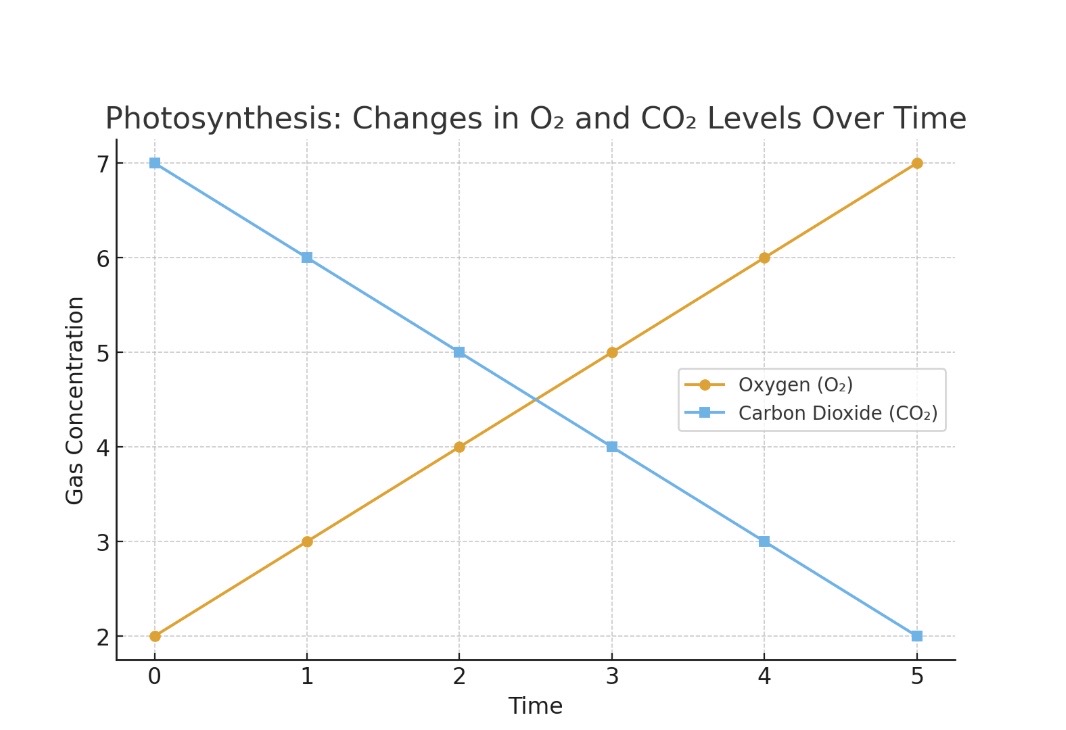
Which one is the O2?
O2 is the one that goes up over time
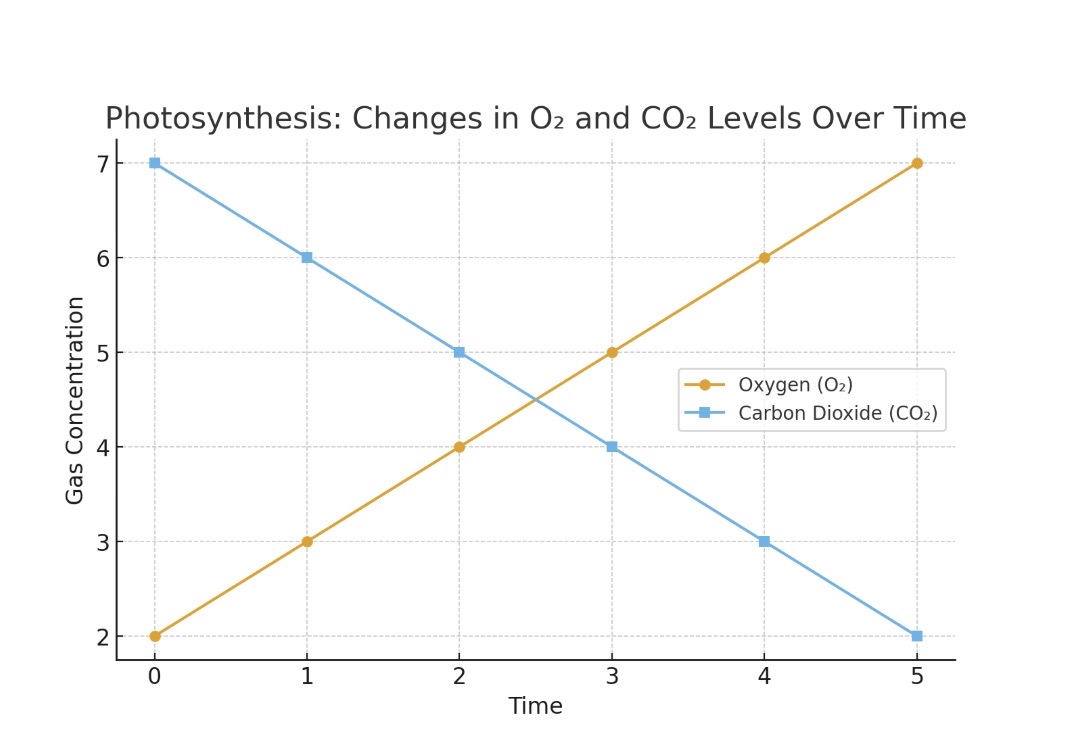
Which one is CO2?
CO2 is the one that goes down over time
What is the Rf value equation?
Rf value = (x) Photopigment migration/(x) solvent migration
How to know when the Rf values polar or more non-polar?
Polar solvents have higher Rf values, while non-polar solvents have lower Rf values.
What is the abundant photopigment?
Chlorophyll a, which plays a crucial role in photosynthesis.
In what scenario would accessory pigments be needed?
Accessory pigments are needed in situations where light intensity is low or when light conditions do not favor chlorophyll a absorption. They assist in capturing a broader spectrum of light for photosynthesis.
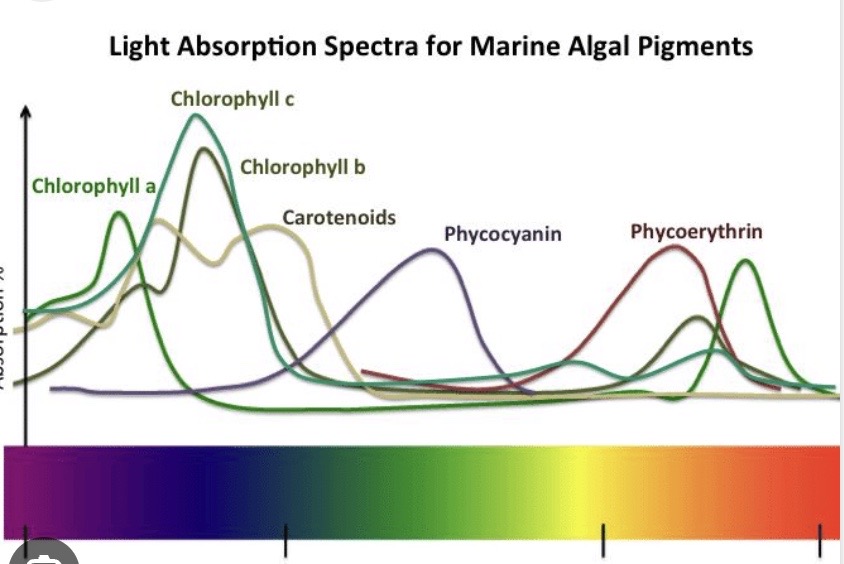
What colors are absorbed or reflected based on the graph for Chlorophyll a?
Chlorophyll a primarily absorbs blue and red light while reflecting green light, which is why plants appear green.
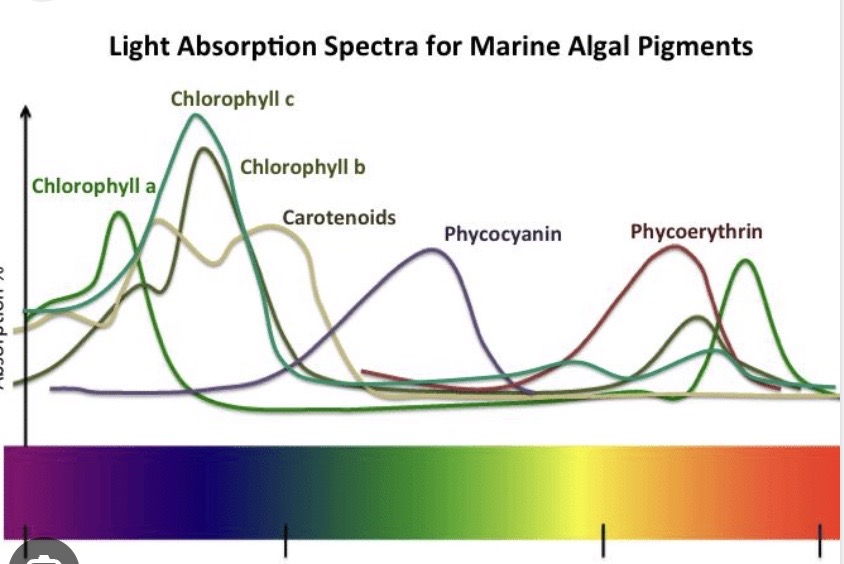
What colors are absorbed or reflected based on the graph for Chlorophyll b?
Chlorophyll b absorbs blue and red-orange light while reflecting green light, complementing Chlorophyll a in photosynthesis.
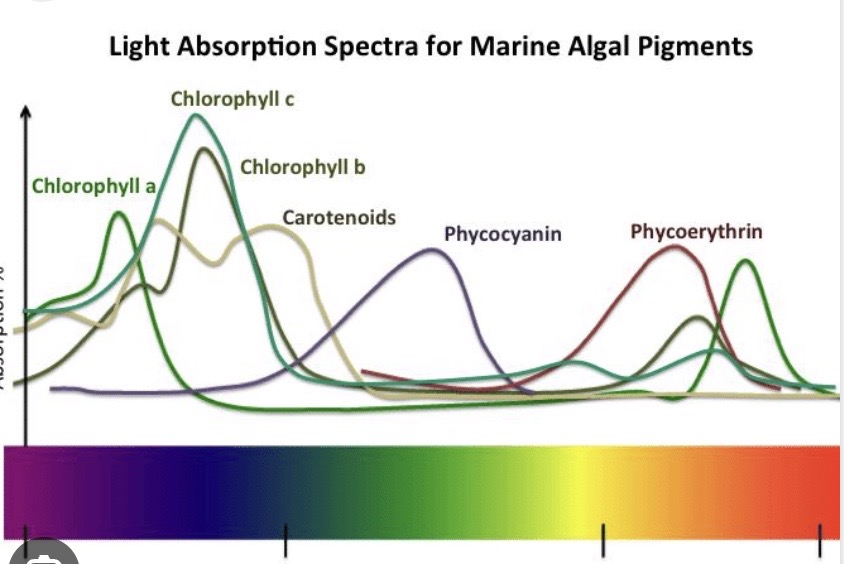
What colors are absorbed or reflected based on the graph for carotenoids?
Carotenoids absorb blue-green and blue light while reflecting yellow, orange, and red shades.
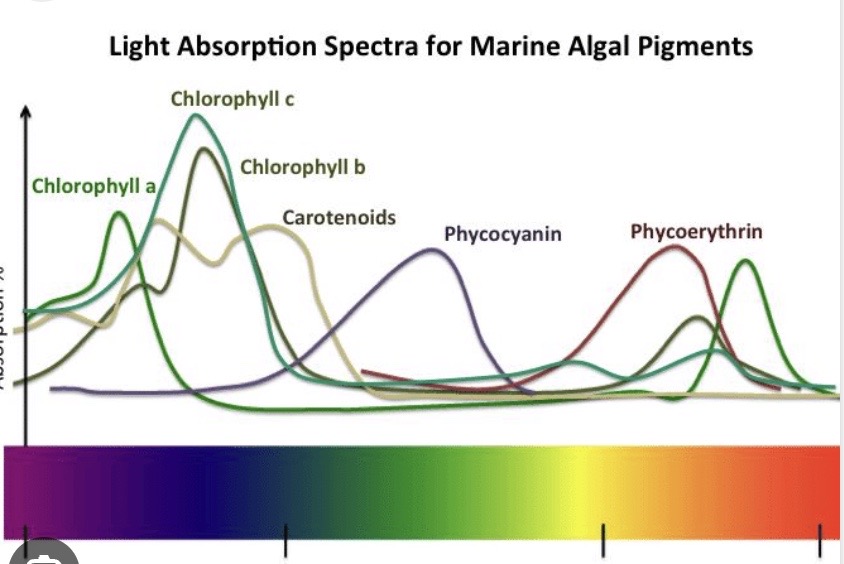
What colors are absorbed or reflected based on the graph for phycocyanin?
Phycocyanin absorbs orange and red light while reflecting blue light, contributing to the blue color of certain algae.
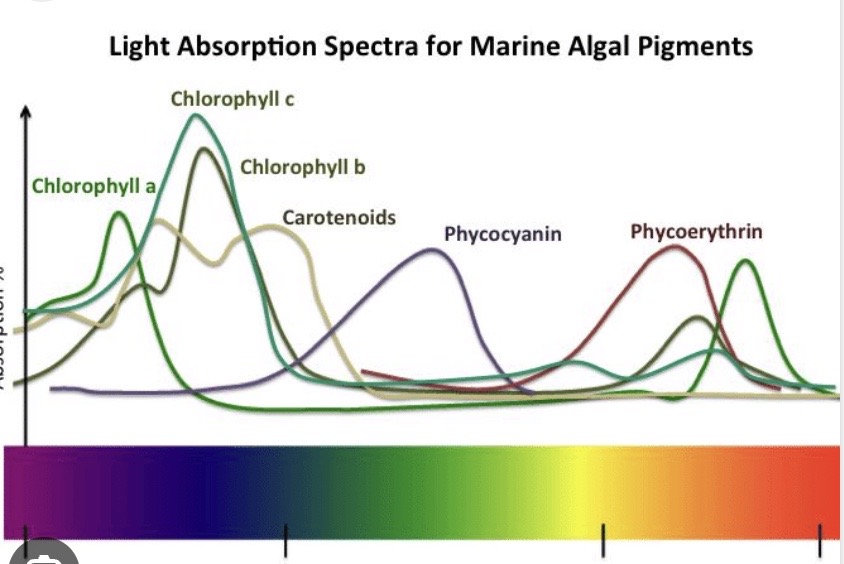
What colors are absorbed or reflected based on the graph for phycoerythrin?
Phycoerythrin absorbs blue and green light while reflecting red light, contributing to the red color of certain algae.
What does OIL RIG stand for?
Oxidation Is Lost (of e-‘s) Reduction is Gain (of e-‘s)
What is the photosynthesis general equation
6CO₂ + 6H₂O + light energy → C₆H₁₂O₆ + 6O₂,
Where does glycolysis occur?
Glycolysis occurs in the cytoplasm of the cell.
What are the reactants and products of glycolysis?
The reactants of glycolysis are glucose and ATP, while the products are pyruvate, ATP, and NADH.
Where does the bridge reaction occur?
occurs in the mitochondria, specifically in the mitochondrial matrix, where pyruvate is converted into acetyl-CoA.
What are the reactants and products of the bridge reaction?
The reactants of the bridge reaction are pyruvate and coenzyme A, while the products are acetyl-CoA and carbon dioxide.
Where does the Kreb Cycle occur?
In the mitochondria, specifically within the mitochondrial matrix, where acetyl-CoA is oxidized to produce energy carriers.
How many rounds of the Kreb cycle happens per 1 glucose molecule?
Two rounds occur, producing energy carriers.
What are the major reactant and products of cellular respiration?
The major reactants of cellular respiration are glucose and oxygen, while the products are carbon dioxide, water, and ATP.
What happens in the Electron Transport Chain?
Reducing electron transport carriers,
electrons shuttled through protein complexes,
O2 collects remaining electrons from Complex 4 to make H2O.
Hydrogens will go down its concentration gradient into ATP synthase resulting in the most ATP made.
Because of the complex shuttle system we can have what?
Hydrogen having a larger concentration in the inner membrane space.
