2amino acid neurotransmitters: glutamate and gaba
 Studied by 0 people
 Call with Kai
 Learn
Learn Practice Test
 Spaced Repetition
 Match
Match Flashcards
 Knowt Play
1/63

There's no tags or description
Looks like no tags are added yet.
Name | Mastery | Learn | Test | Matching | Spaced | Call with Kai |
|---|
No study sessions yet.
64 Terms
What type of receptor are ionotropic glutamate and GABA receptors? ligand gated or voltaged gated?
They are ligand-gated ion channels.
How are ionotropic receptors structurally described?
They are multisubunit and heterogeneous receptors.
What kind of effects do ionotropic receptors have on neurons?
They cause rapid cellular effects by directly controlling ion flow.
Why is the structure of ionotropic receptors important for pharmacology?
their multisubunit and heterogeneous structure affects how drugs interact with them.
What kind of receptors are metabotropic glutamate and GABA receptors?
They are G protein-coupled receptors (GPCRs).
What is the structural organization of metabotropic receptors?
They can form heterodimers or homodimers.
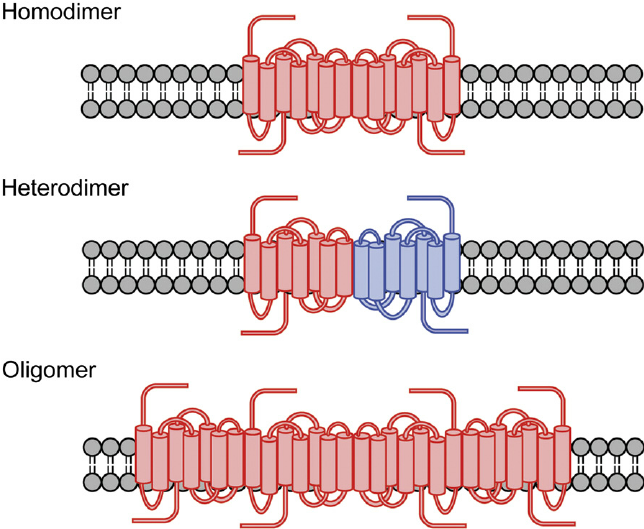
How do metabotropic receptors affect neurons?
They activate second messenger systems, causing slower effects on synaptic transmission.
What special role can metabotropic receptors have on presynaptic nerve terminals?
They may act as autoreceptors, regulating neurotransmitter release.
What kind of receptor opens ion channels in response to neurotransmitter binding?
Ionotropic receptors (ligand-gated ion channels).
How is the structure of ionotropic receptors typically described?
They are made up of multiple protein subunits and show structural diversity (heterogeneous).
what is the speed and nature of the effect produced by ionotropic receptors?
They produce fast, direct electrical responses in neurons.
How does the structure of ionotropic receptors influence drug action?
Their varied subunit composition affects how they respond to drugs, influencing their pharmacology.
What type of receptor works through G-proteins instead of directly opening ion channels?
Metabotropic receptors (G protein-coupled receptors).
How are metabotropic receptor units organized?
They form either pairs of the same (homodimers) or different (heterodimers) subunits.
How do metabotropic receptors influence synaptic activity?
They activate second messenger pathways, leading to slower but longer-lasting effects.
What function can some metabotropic receptors serve when located on the presynaptic terminal?
They can act as autoreceptors, helping to regulate the release of neurotransmitters.
What type of ion does the GABAa receptor channel allow into the neuron?
Chloride ions (Cl⁻)
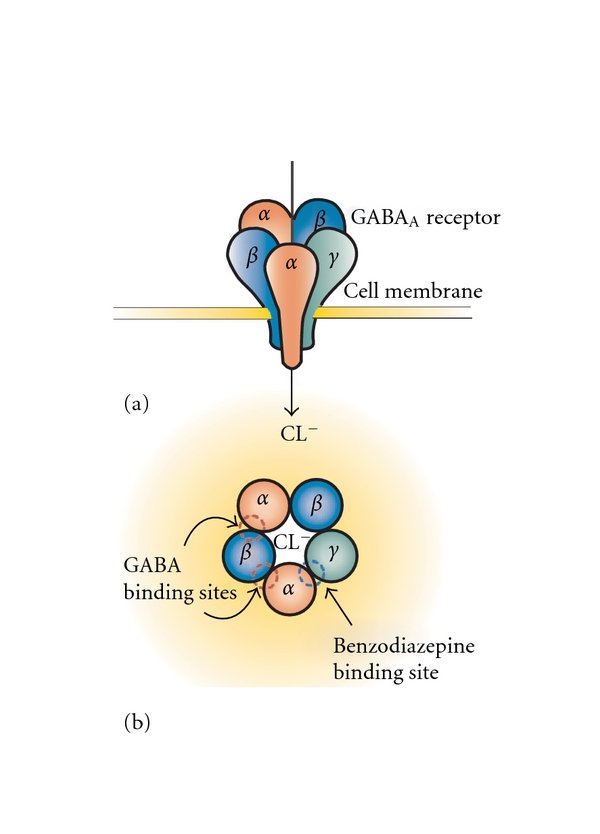
What happens when Cl⁻ enters the neuron through a GABAa receptor?
The neuron becomes hyperpolarized, making it less likely to fire — this causes inhibition.
What is GABA’s role at the GABAa receptor?
GABA binds to and activates the receptor, opening the Cl⁻ channel and causing inhibition
What is muscimol, and how does it affect GABAa receptors?
Muscimol is a GABAa agonist that mimics GABA by activating the receptor and producing inhibitory effects.
What does bicuculline do at the GABAa receptor?
Bicuculline is an antagonist that blocks the GABA binding site, preventing inhibition.
Are GABAa receptor effects fast or slow?
Fast — they produce effects within milliseconds (ms) because they are ion channels.
What is the overall effect of activating a GABAa receptor on a neuron?
It causes inhibition by hyperpolarizing the neuron through Cl⁻ influx.
What type of receptor is GABAb?
A G-protein-coupled receptor (GPCR) that works through second messengers.
How does GABAb receptor activation affect K⁺ and Ca²⁺ channels?
It opens K⁺ channels (causing hyperpolarization) and blocks Ca²⁺ channels (reducing neurotransmitter release).
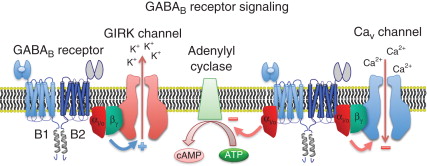
What is the natural neurotransmitter that activates GABA<sub>B</sub> receptors?
GABA
What is baclofen and how does it affect GABAb receptors?
Baclofen is a GABAb agonist that mimics GABA and is used to treat muscle spasticity.
What do saclofen and CGP compounds do at GABAb receptors?
They are antagonists that block GABAb receptor activation.
How fast are the effects of GABAb receptor activation?
They occur over milliseconds to minutes, making them slower than ionotropic responses.
What is the overall effect of GABAb receptor activation?
It is inhibitory — reducing neuron firing and neurotransmitter release.
What happens when Cl⁻ enters the neuron through GABA<sub>C</sub> receptors?
The neuron is hyperpolarized, making it less likely to fire — causing inhibition.
Which natural neurotransmitter activates GABA<sub>C</sub> receptors?
GABA.
What is muscimol and how does it affect GABAc receptors?
Muscimol is a GABAc agonist that mimics GABA and activates the receptor.
What is TPMPA and what does it do?
TPMPA is a GABAc antagonist that blocks the receptor and prevents inhibition
How quickly do GABAc receptors respond when activated?
Their effects occur in milliseconds — they act quickly.
What is the overall effect of activating GABAc receptors?
Inhibition of neuronal activity via chloride influx and hyperpolarization
What type of ion channel do ionotropic GABA receptors have?
they are ligand-gated chloride (Cl⁻) ion channels.
What is the main effect of ionotropic GABA receptor activation on neurons?
they cause fast hyperpolarization of neurons, leading to inhibition.
Where are ionotropic GABA receptors located in the brain?
They are located throughout the brain.
why is the pharmacology of ionotropic GABA receptors considered complex?
Because their different subunit compositions respond variably to drugs like benzodiazepines, barbiturates, and others.
What type of neurotransmitter is γ-aminobutyric acid (GABA)?
Inhibitory — it causes the postsynaptic neuron to become less likely to fire.
What is an IPSP?
An Inhibitory Postsynaptic Potential — a hyperpolarizing change in the postsynaptic membrane potential that makes it harder for the neuron to fire.
Where does the electrical impulse travel before neurotransmitter release?
Down the axon to the axon terminal of the presynaptic neuron.
What happens at the axon terminal during synaptic transmission?
neurotransmitter molecules (like GABA) are released into the synaptic cleft.
What does GABA do after being released into the synaptic cleft?
It binds to transmitter-gated ion channels (like GABAa receptors) on the postsynaptic dendrite.
What ion flows into the postsynaptic neuron when GABAa receptors are activated?
Chloride ions (Cl⁻) enter the cytosol of the postsynaptic neuron
What is the result of Cl⁻ influx through GABAa receptors?
The neuron becomes hyperpolarized, generating an IPSP, and is less likely to fire an action potential.
What is the orthosteric site on the GABAa receptor?
It’s the main site where GABA binds to activate the receptor and open the chloride channel.
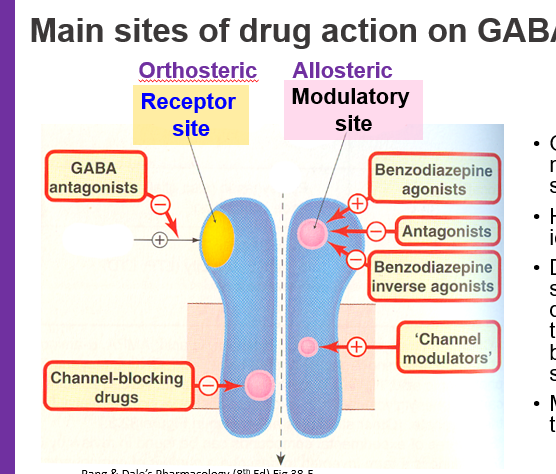
Where does GABA bind on the GABAa receptor to trigger inhibition?
GABA binds at the orthosteric site, the receptor’s primary activation point.
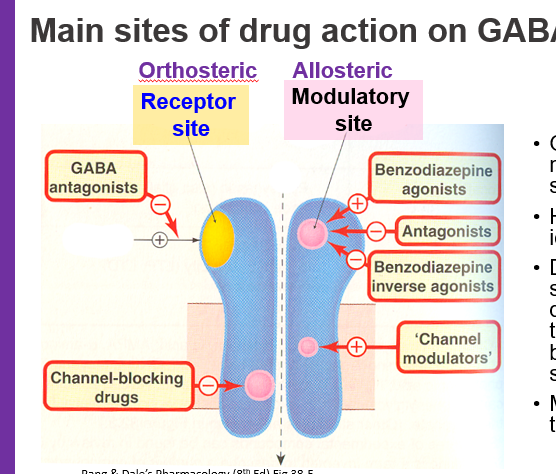
What effect do GABA antagonists have at the orthosteric site?
They block GABA from binding, preventing chloride channel opening and inhibitory signaling.
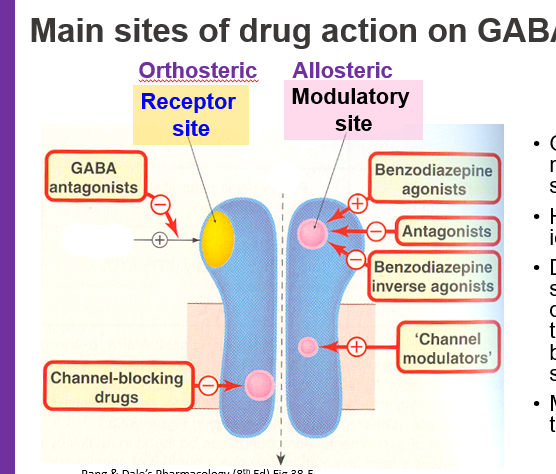
How do GABA antagonists affect receptor function?
By binding to the GABA site, they inhibit GABA’s action, stopping Cl⁻ flow and reducing inhibition.
What is the action of drugs that block the GABAa receptor pore?
They physically obstruct the Cl⁻ channel, overriding GABA’s effects.
What is an allosteric site on the GABAa receptor?
A secondary site where modulatory drugs bind to enhance or reduce the receptor’s activity — but only in the presence of GABA.
Where do benzodiazepines and similar modulators bind on GABAa?
At allosteric sites, which influence GABA’s action without directly activating the receptor.
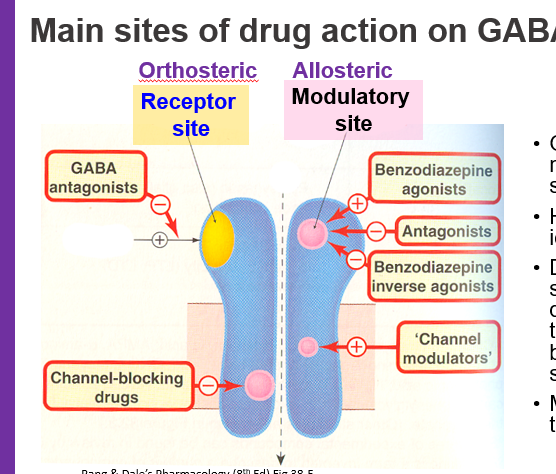
Q5: How do benzodiazepine agonists affect GABAa receptor activity?
They enhance GABA's effect, increasing the frequency of Cl⁻ channel opening → more inhibition.
What is the effect of benzodiazepine agonists on GABAergic signalling?
They boost GABA action, leading to stronger inhibitory currents.
What do benzodiazepine antagonists do at GABAa receptors?
They bind to the benzodiazepine site but do not change receptor activity; they block benzodiazepines from working.
What is the role of benzodiazepine antagonists?
They occupy the BZD site without activating it, reversing benzodiazepine effects.
What are benzodiazepine inverse agonists?
They bind to the BZD site and reduce GABA’s effect, causing less Cl⁻ flow — potentially leading to anxiety or seizures.
They bind to the BZD site and reduce GABA’s effect, causing less Cl⁻ flow — potentially leading to anxiety or seizures.
They turn down inhibition by weakening GABA’s ability to open Cl⁻ channels.
What’s the overall function of allosteric modulators on GABA<sub>A</sub> receptors?
They “turn up” or “turn down” the gating of Cl⁻ ions only when GABA is bound
How do drugs at allosteric sites affect GABAa channels?
They amplify or reduce the Cl⁻ response depending on the drug and require GABA to be present.
Why are GABAa receptors important drug targets?
They have multiple allosteric sites, allowing fine control over brain inhibition — useful in anxiety, epilepsy, and sedation.
What makes GABAa receptors valuable for therapeutic drugs?
Their complex structure and modulatory sites make them ideal for treating conditions needing enhanced or reduced inhibition.
 Note
Note  Flashcards (50)