Cardiopulmonary final ECG
 Call Kai
 Learn
Learn Practice Test
 Spaced Repetition
 Match
Match Flashcards
 Knowt Play
1/49

There's no tags or description
Looks like no tags are added yet.
Name | Mastery | Learn | Test | Matching | Spaced | Call with Kai |
|---|
No analytics yet
Send a link to your students to track their progress
50 Terms
(flip card for question)
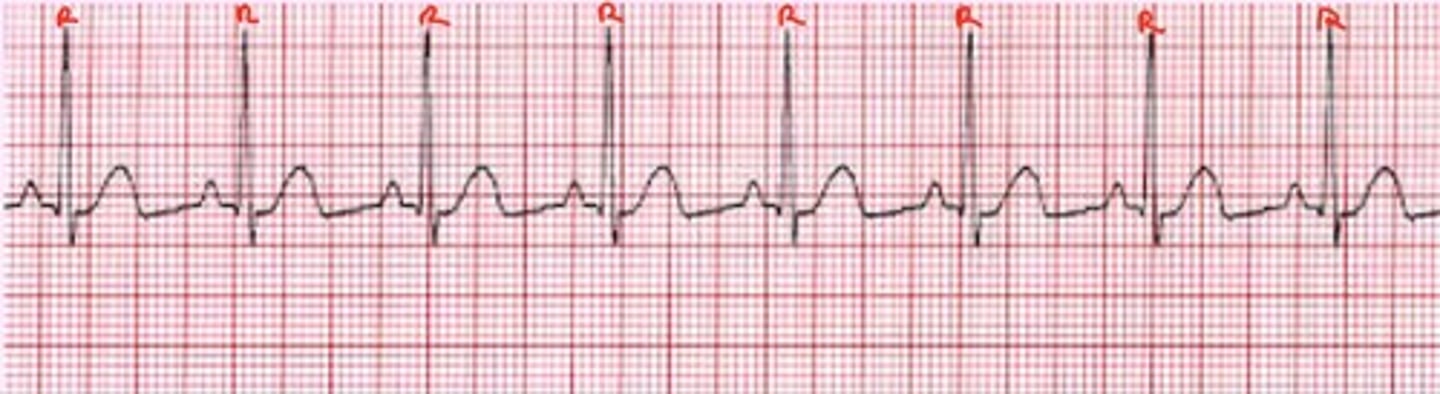
HR= 80bpm
1) count the big boxes (30 big boxes= 6 seconds)
2) 6 second strip x 10= 60 seconds total (1 minute)
3) count the R's in the sequence (total R's= 8)
4) 8 x 10= 80bpm
What is the heart rate of this ECG strip?
(flip card for question)
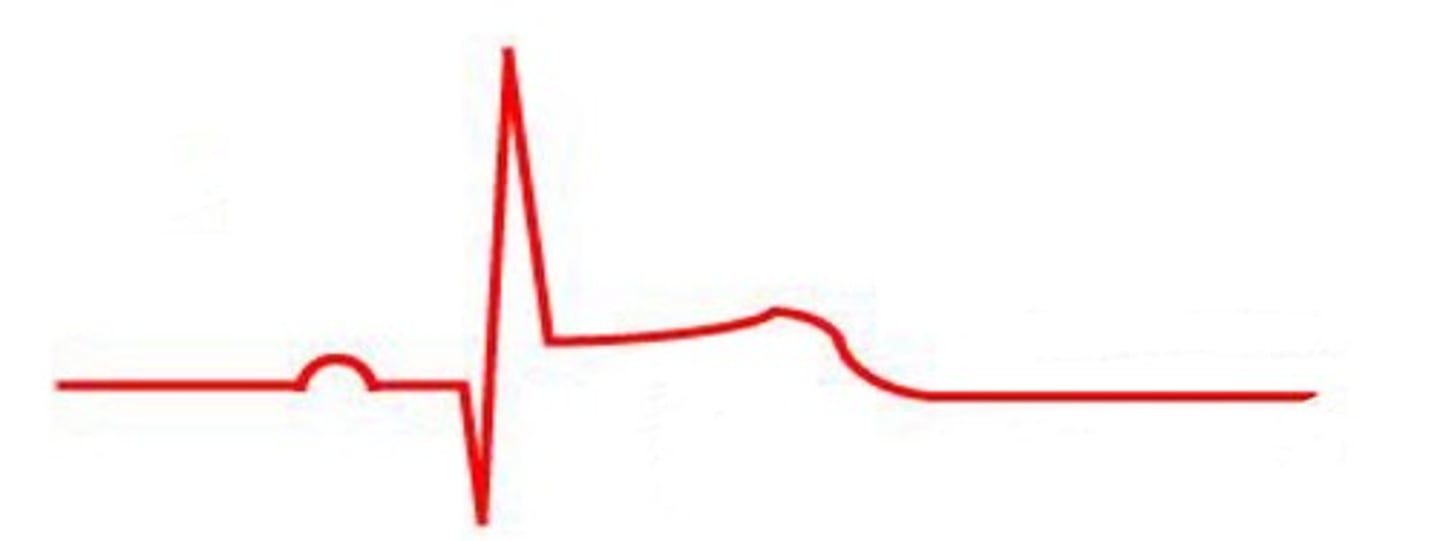
ST elevation
-heart attack= EMERGENCY!
Based on the ST segment, is this showing normal, ST elevation, or ST depression?
(flip card for question)
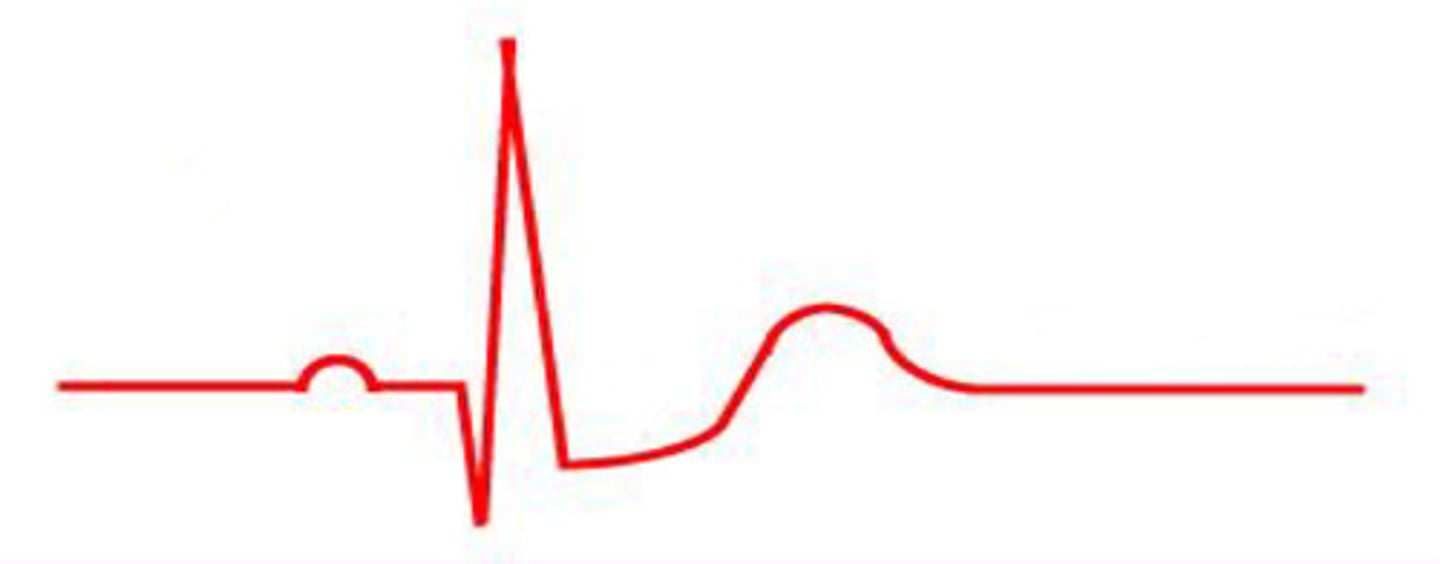
ST depression
-WOOP WOOP!
-decreased blood flow (ischemia)= chest pain, shoulder pain, etc.
-can be seen during an exercise tolerance test, requiring further testing
Based on the ST segment, is this showing normal, ST elevation, or ST depression?
(flip card for question)
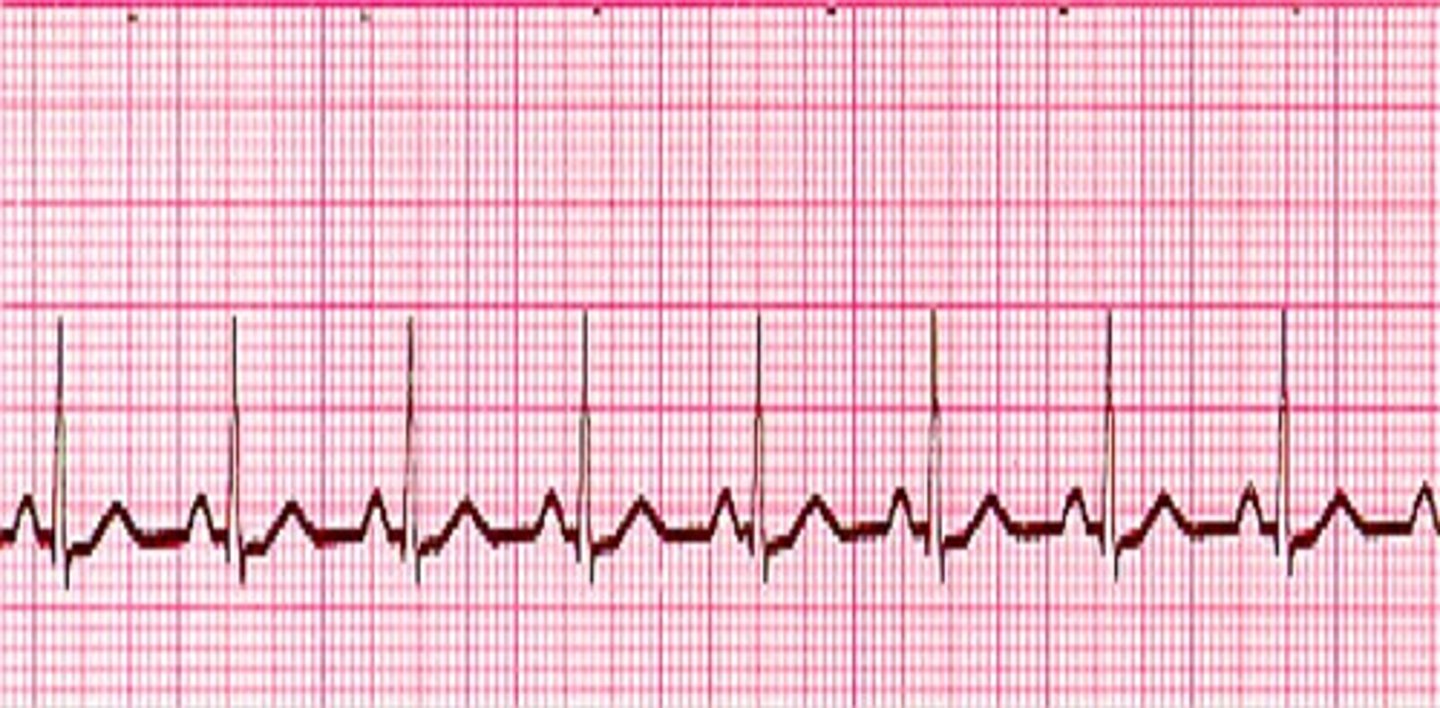
normal sinus rhythm
What does the ECG show?
(flip card for question)
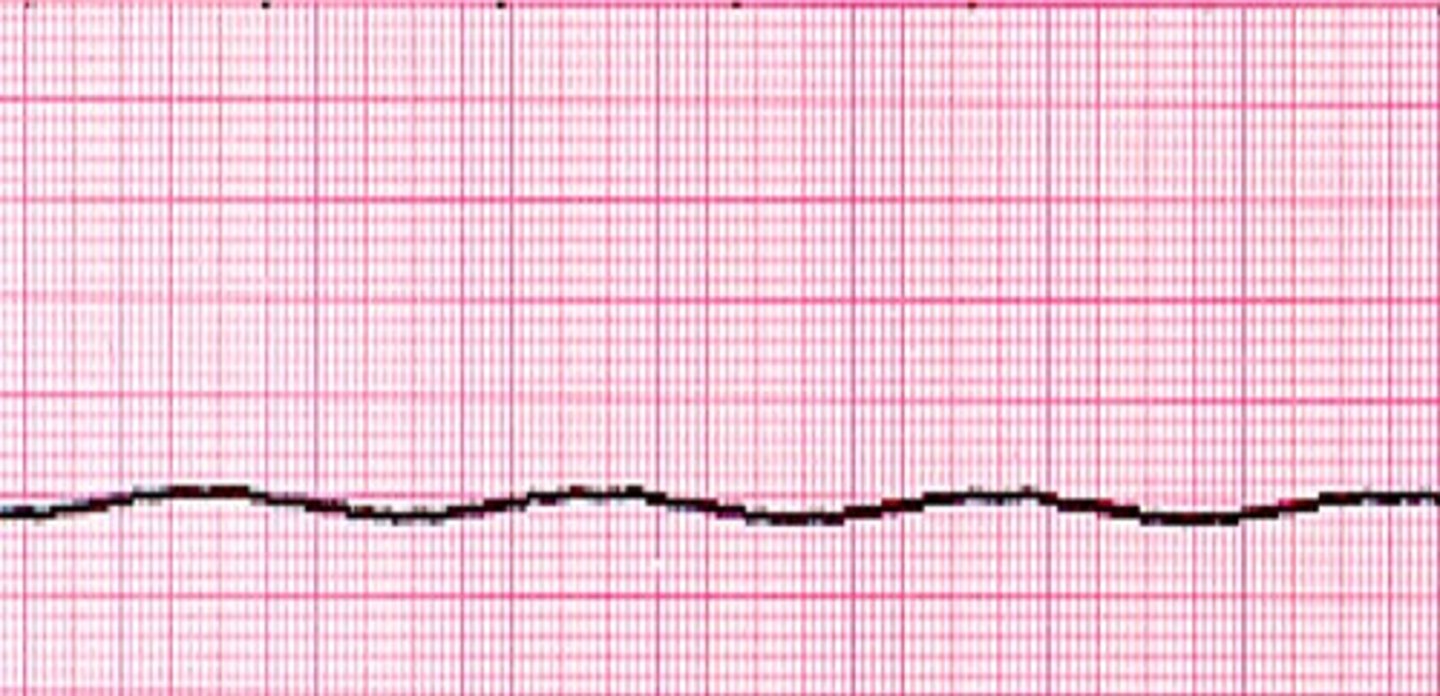
asystole
-"flatlining"= pt is dead or dying
-NOT a shockable rhythm= requires meds
-look for "history of fainting spells"
What does the ECG show?
(flip card for question)
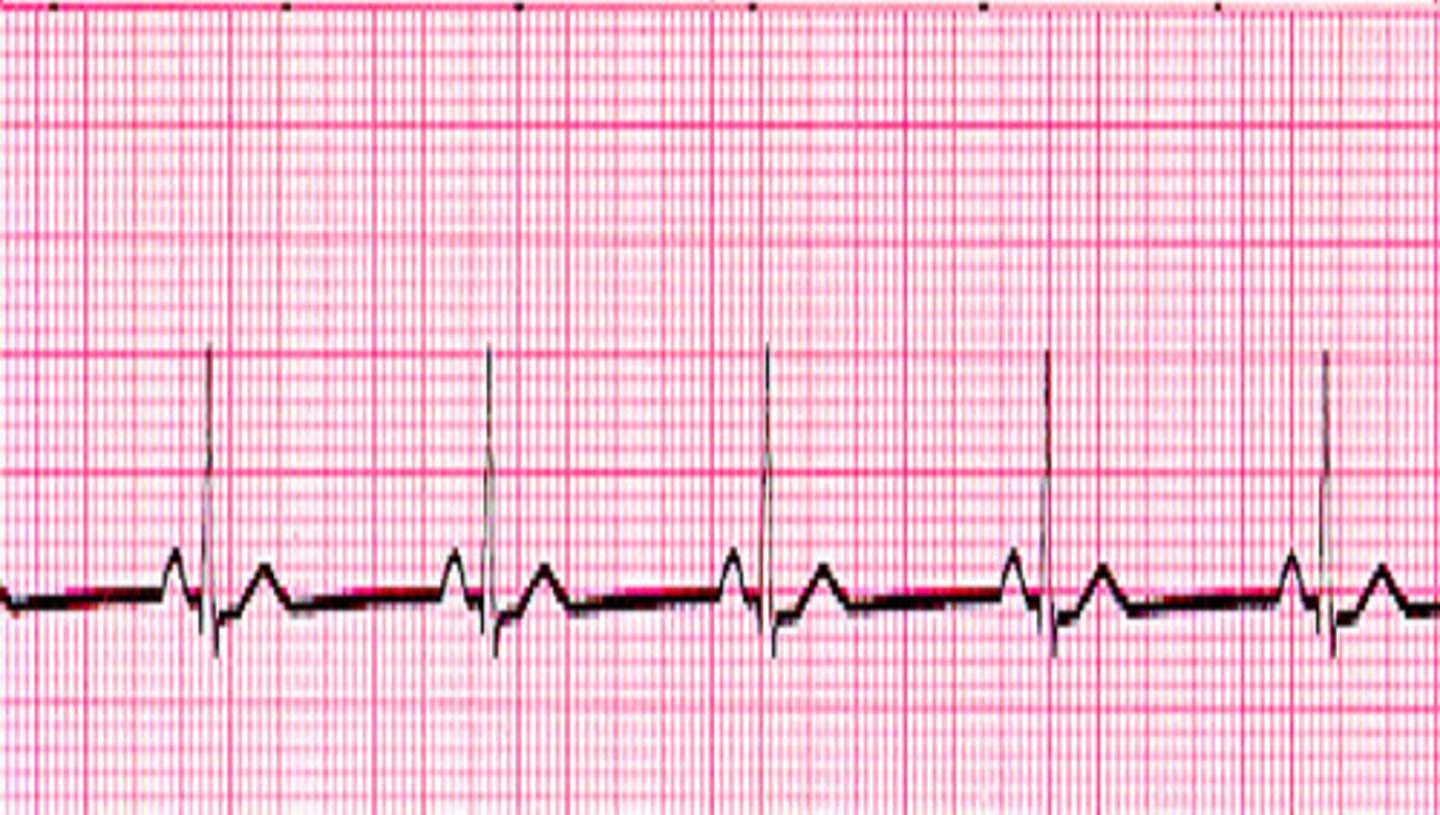
sinus bradycardia
-HR<60 bpm
-s/s: feels like the person is going to pass out (or does), tired, no energy, decreased QoL-> call doctor
What does the ECG show?
(flip card for question)
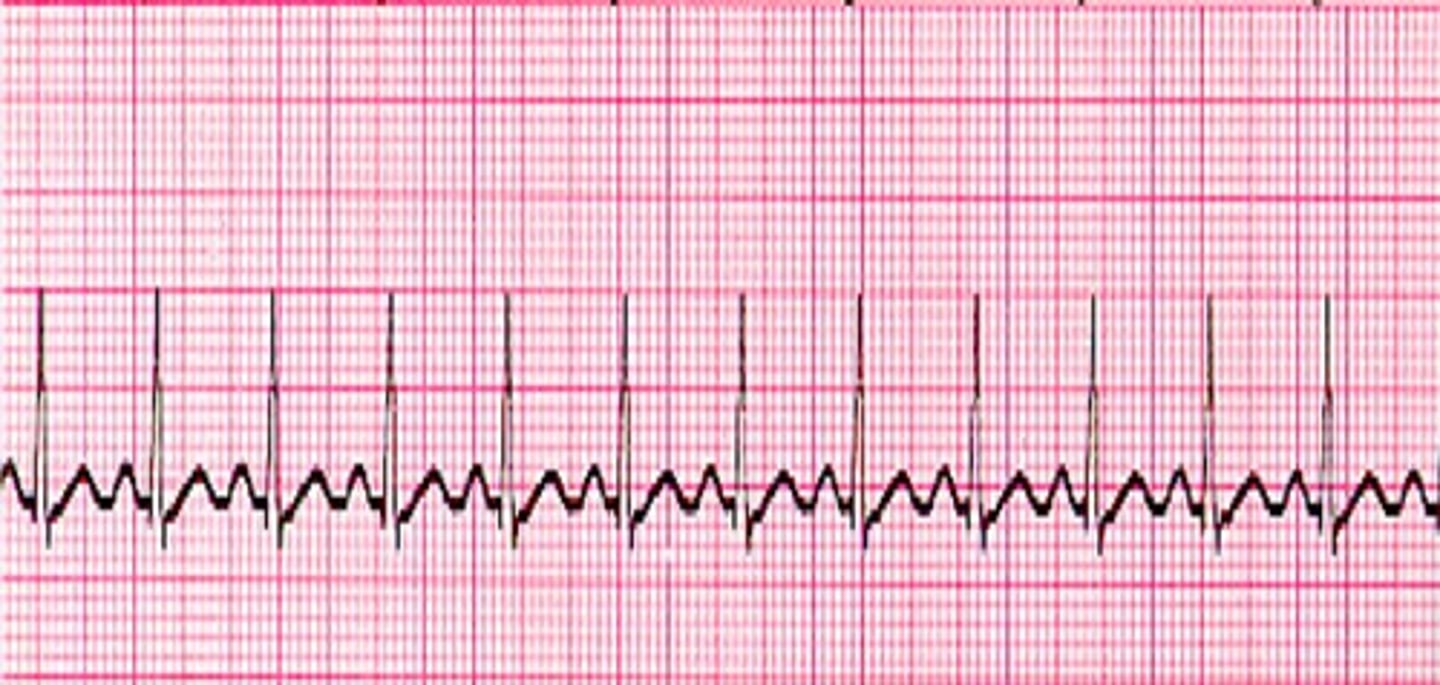
sinus tachycardia
-HR> 100 bpm (normal response during exercise= +10 bpm per MET)
-normal occurrences: pain, stress, exercise
-irregular pulse-> call doctor
What does the ECG show?
(flip card for question)
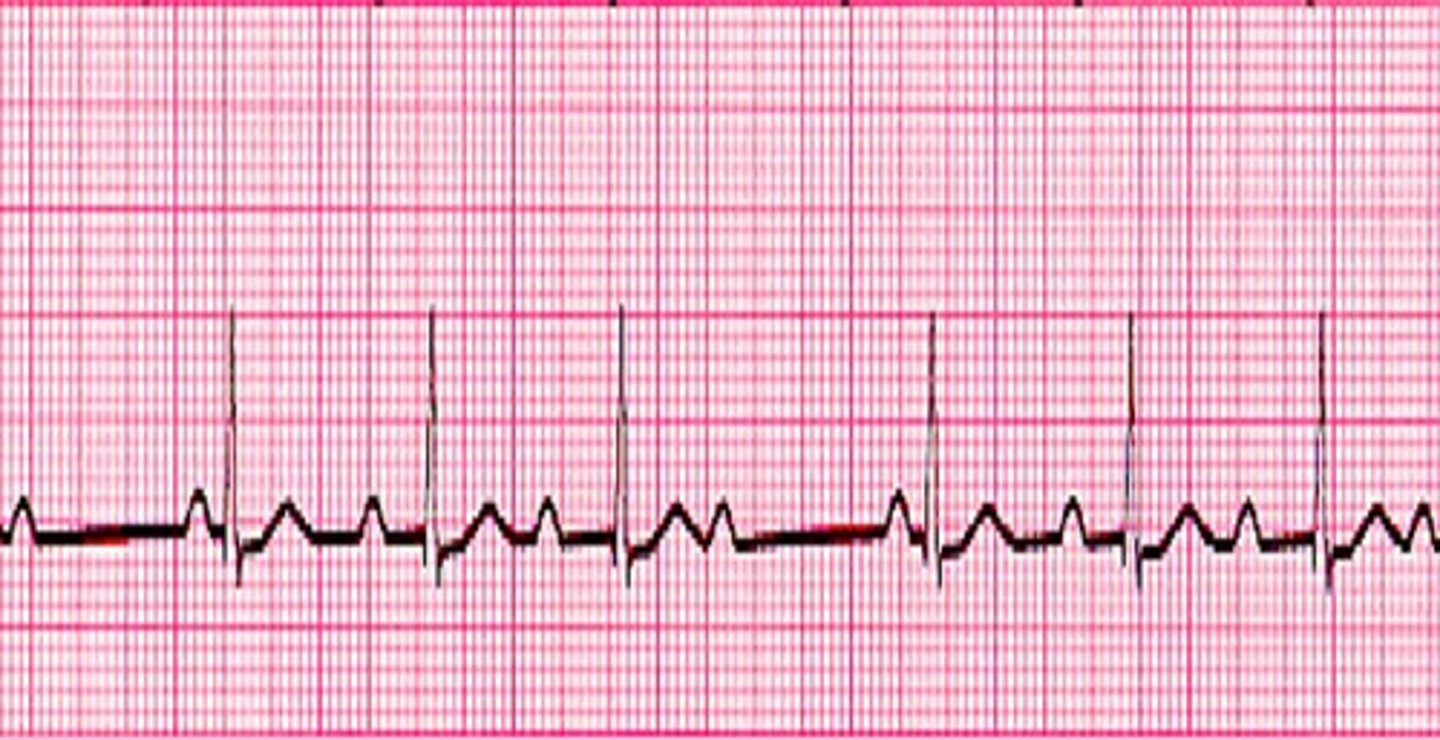
arrhythmia
-look at the R's!
-"skip-lub-dub"
-atria is not communicating with the ventricle
What does the ECG show?
(flip card for question)
second-degree AV block
-slow HR
-chest discomfort
-lightheaded
-tx: meds or solving the cause of the problem
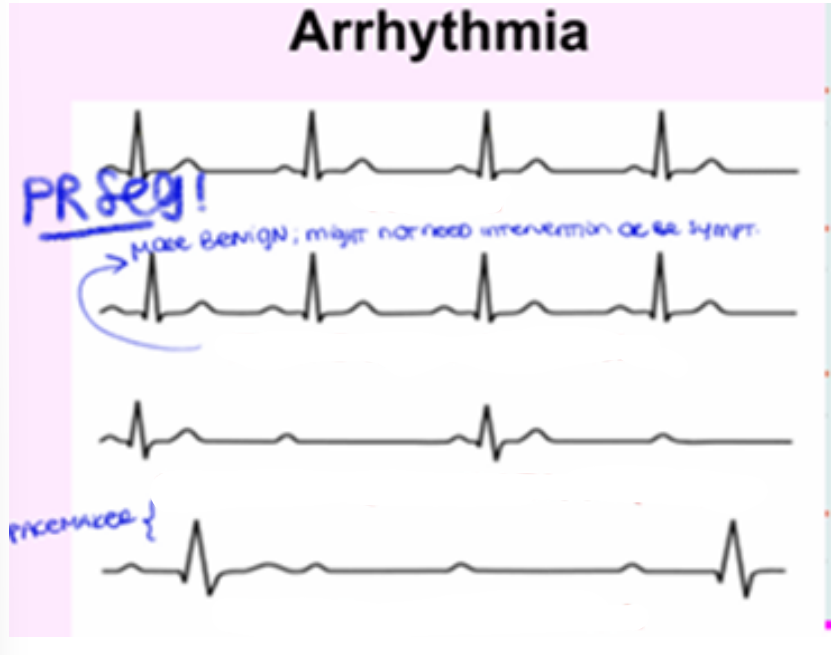
Which type of arrhythmia is this?

(flip card for question)
third-degree AV block
-will require a pacemaker
Which type of arrhythmia is this?

First-degree AV block
Prolonged PR interval
Second-degree AV block
Type 1: Prevents conduction through AV node
Type 2: Non conduction of an impulse to the ventricles without change in PR interval
Progressive prolongation of PR interval until 1 pulse is not conducted through ventilation
Requires temporary or permanent pacemaker
Third-degree AV block
Complete block
No communication between atria and ventricles
Permanent pacemaker/ 911!
For each ECG in the photo, state what arrhythmia is each (normal, first degree, second degree, third degree)
First degree AV block is defined by what?
Second degree AV block, what are the two types and what do they do? Requires?
Third degree AV block is a ______ block between what two structures? Requires?
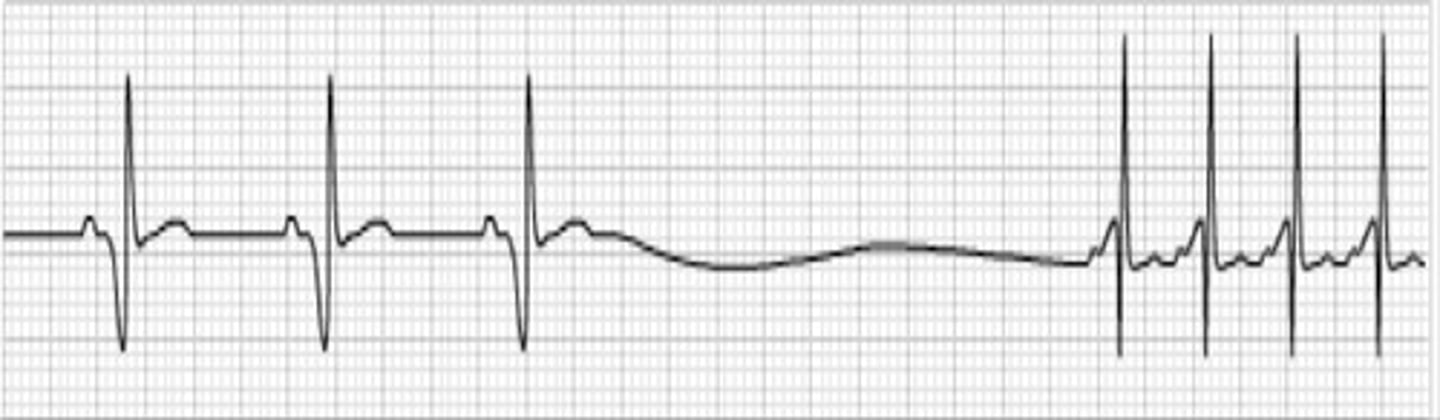
(flip card for question)
sick sinus syndrome (SSS)
-brady> pause> tachy
What does the ECG show?
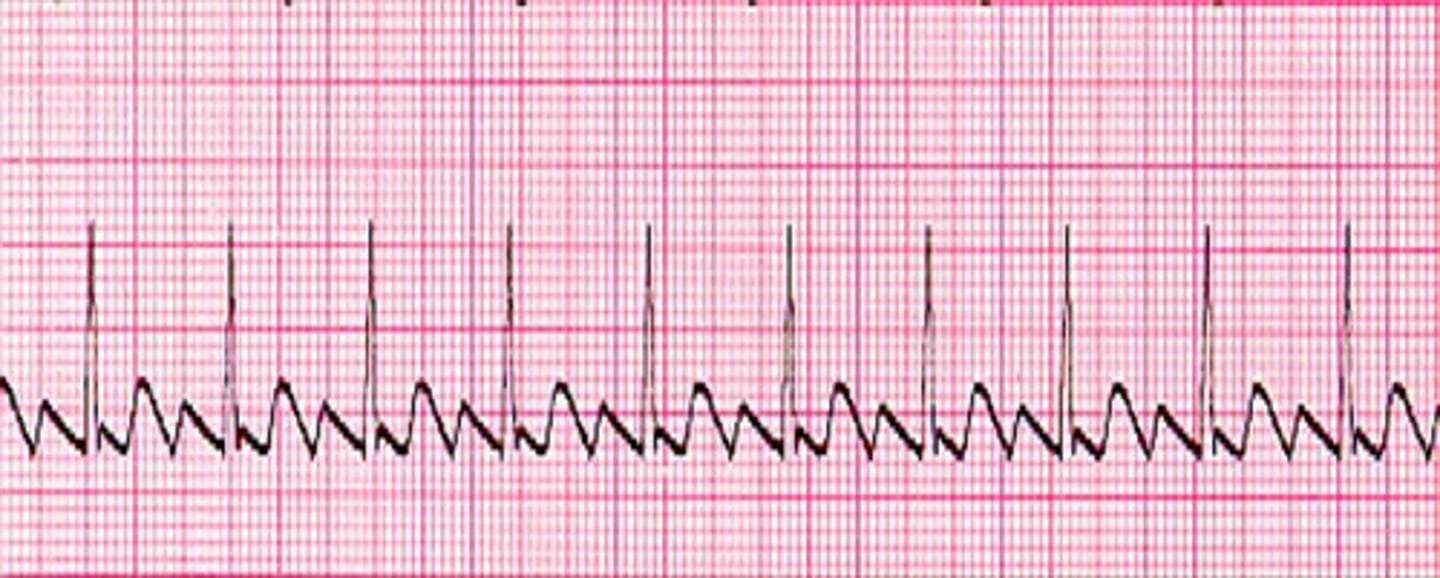
(flip card for question)
atrial flutter
-"Sawtooth"
-atria not coordinated but still beating
-not common
-watch carefully bc it can turn into a-Fib
-resting HR>100 bpm & taking meds= safe to exercise (being controlled)
What does the ECG show?
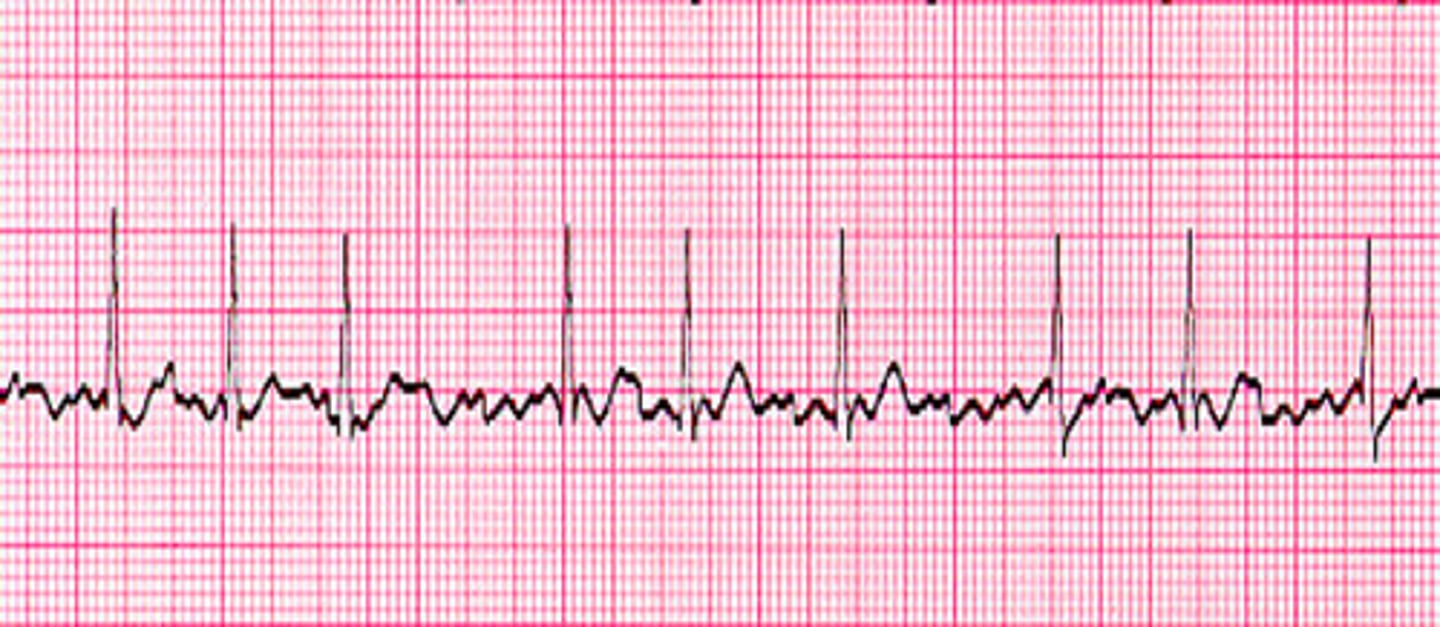
(flip card for question)
atrial fibrillation (a-Fib)
-no contraction/squeeze (more of a quivering of the heart)
-lacking atrial kick (will impact cardiac output)-> blood hanging around= clot formation -> STROKE
-resting HR> 100 bpm = get the nurse!
What does the ECG show?
(flip card for question)
supraventricular tachycardia
-can occur in all age groups
-s/s: HR= 190 bpm -> "heart is running out of my chest" (sudden onset)
-quick tx: cough or Valsalva (activation of the vagus nerve-> parasympathetic response kickstart)
What does the ECG show?
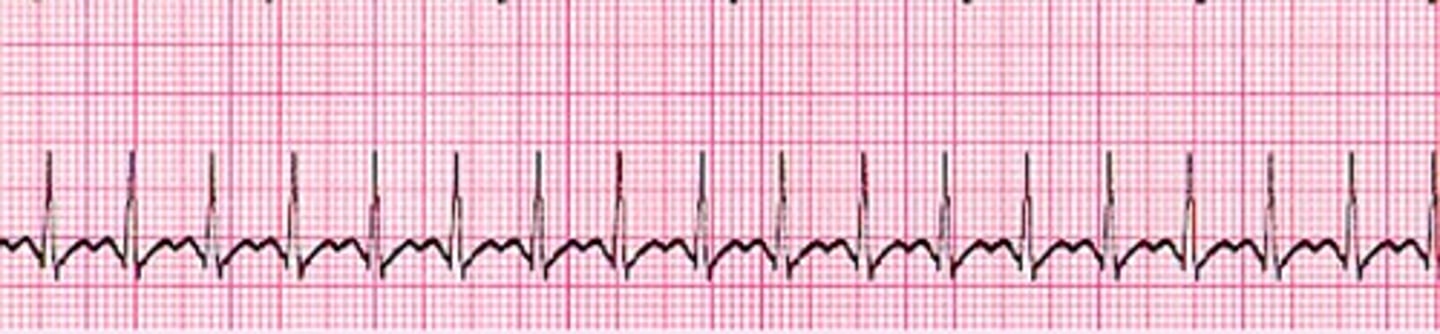
(flip card for question)
unifocal premature ventricular complex (PVC)
-wide and bizarre
-unifocal= same shape
-skipped beats in pulse
What does the ECG show?
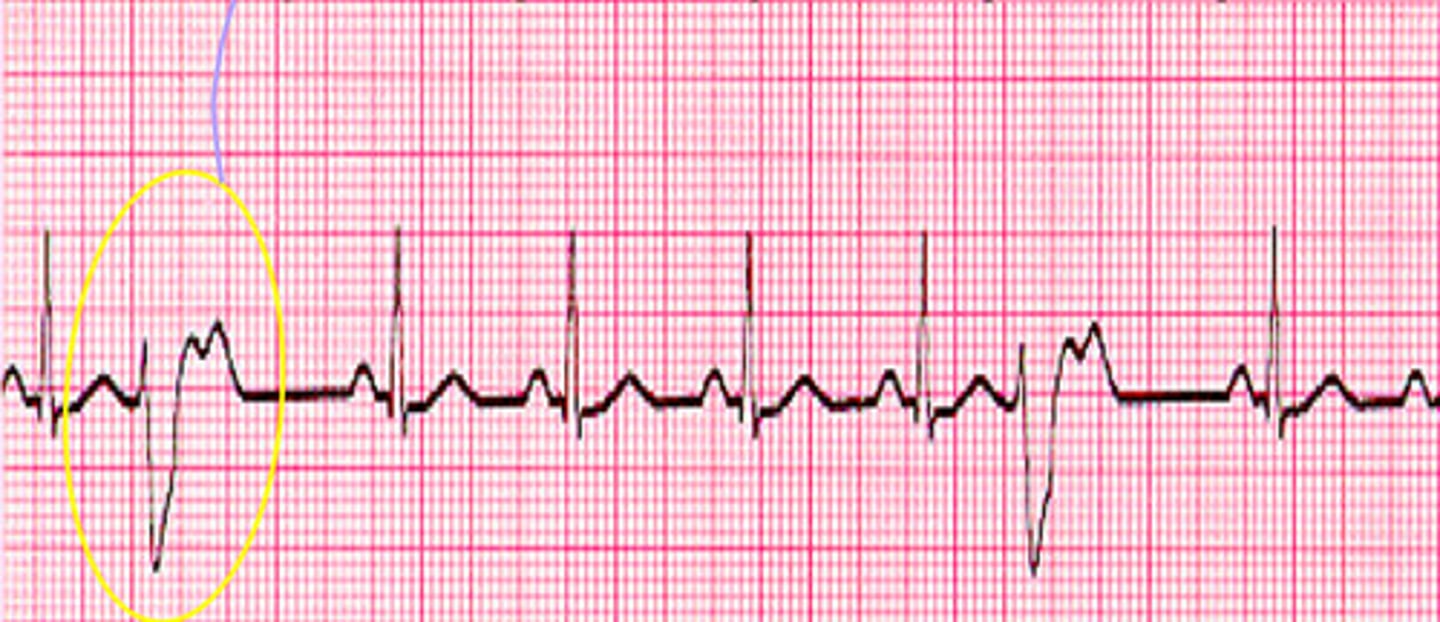
(flip card for question)
multifocal PVC
-more than one shape
What does the ECG show?
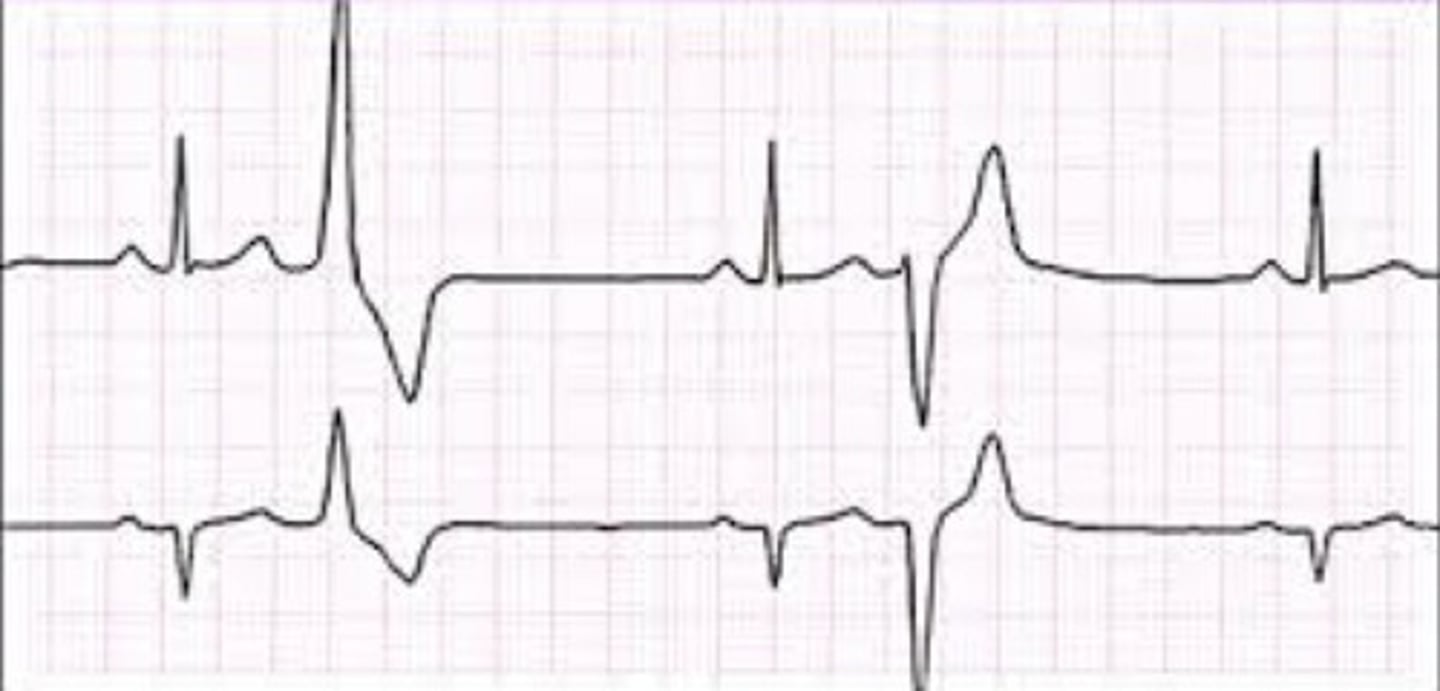
(flip card for question)
ventricular bigeminy
-"every other R"
-worse of the two
What does the ECG show?
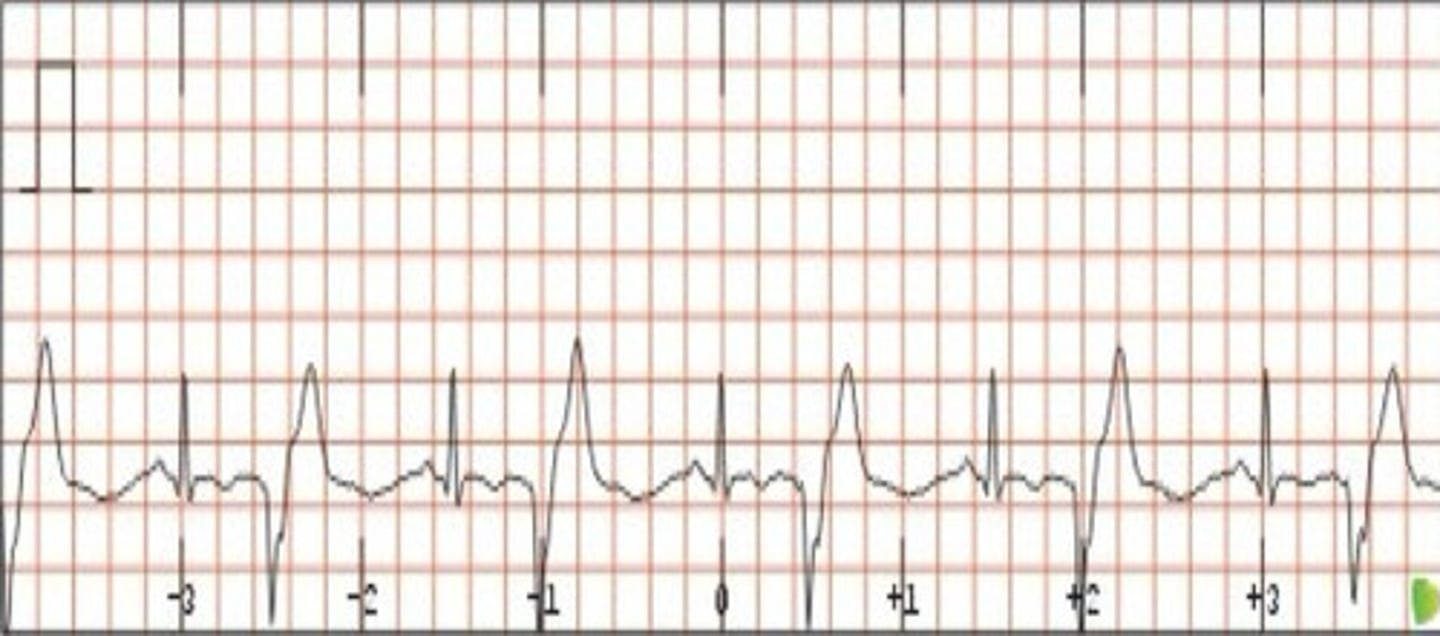
(flip card for question)
ventricular trigeminy
-"every third R"
What does the ECG show?
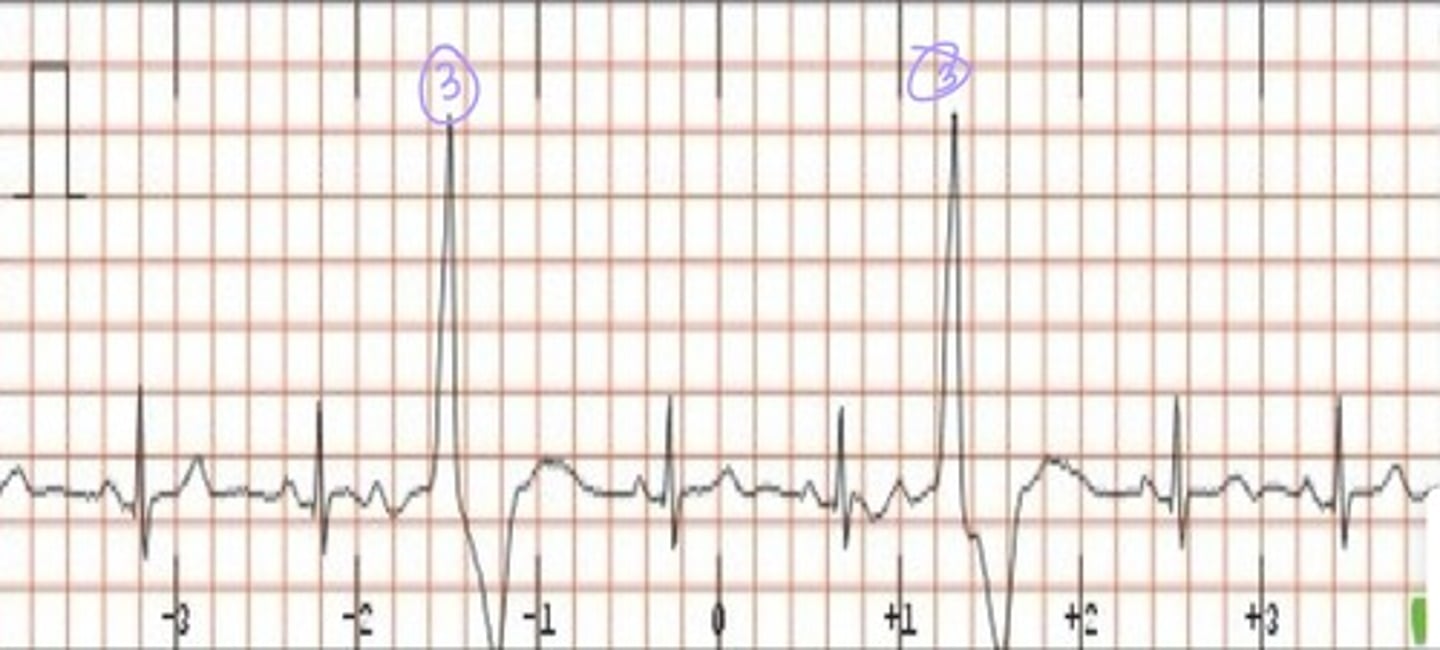
(flip card for question)
coupled PVC
-occurs in pairs
-STOP EXERCISE and call the nurse!
What does the ECG show?
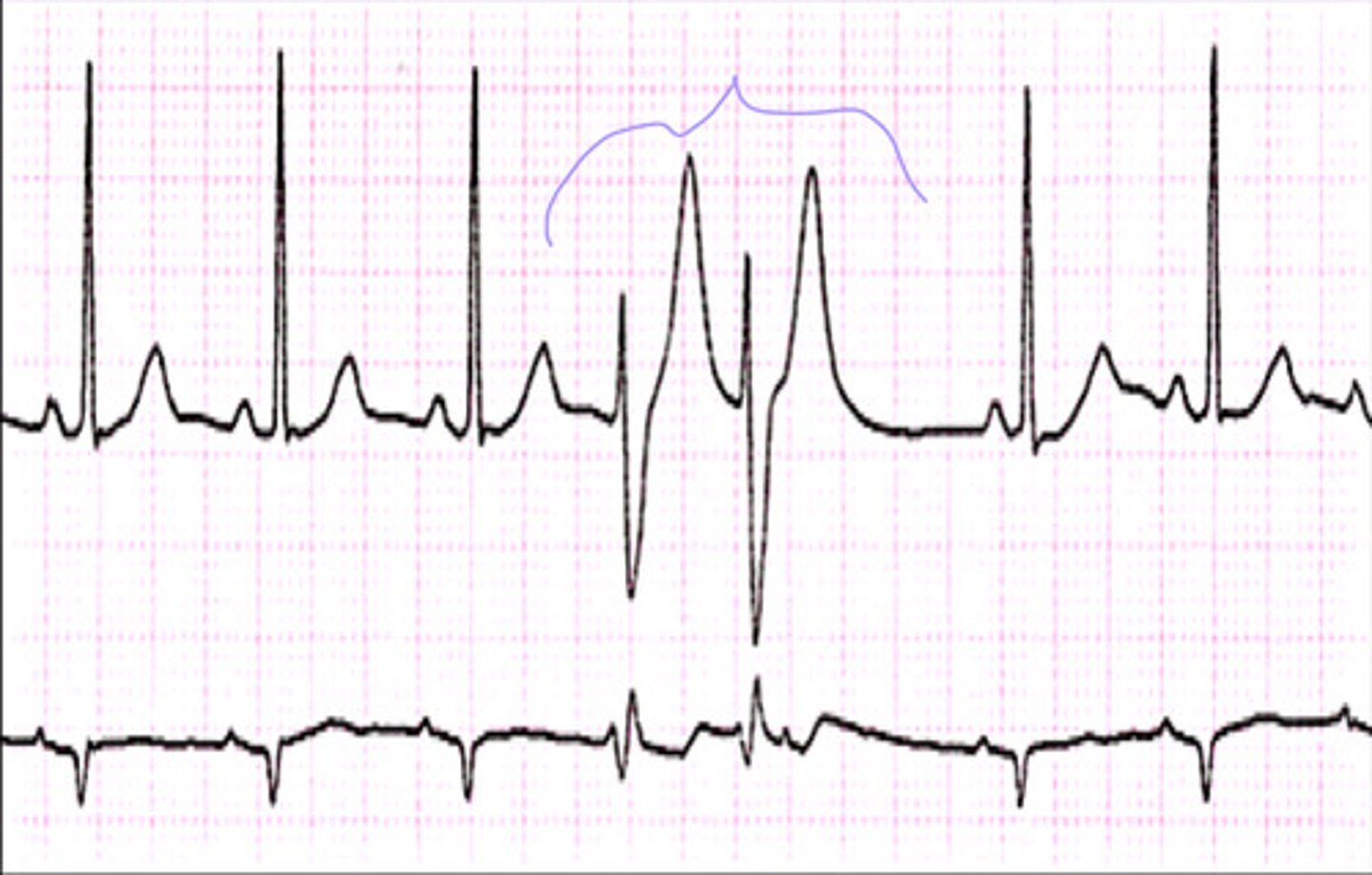
(flip card for question)
triplet PVC
-occurs in groups of three
-STOP EXERCISE and call the nurse!
What does the ECG show?
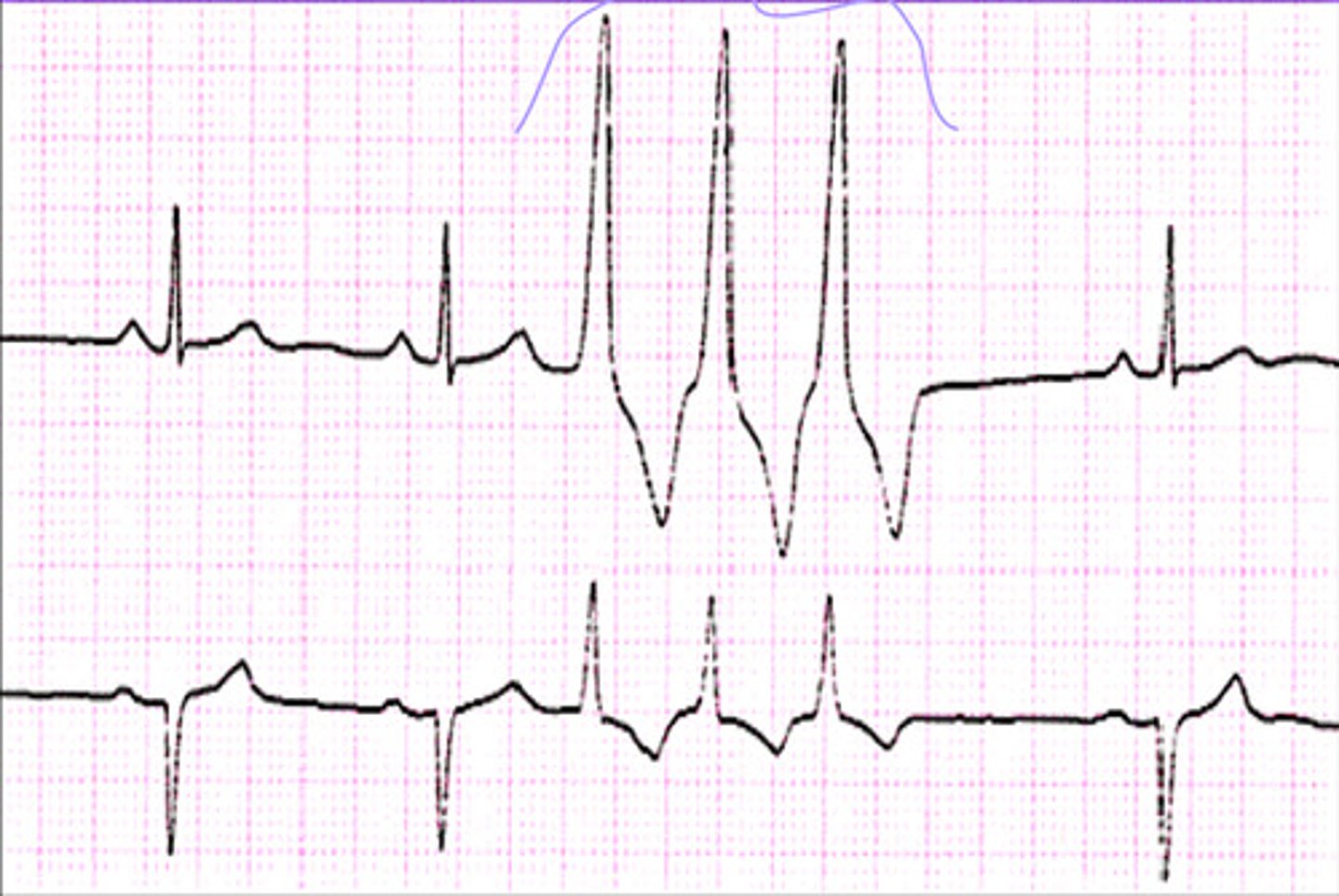
Triplet PVC can turn into what?
ventricular tachycardia
(flip card for question)
ventricular tachycardia
-pt has anxiety, internally knowing that "this is bad"
-SHOCKABLE RHYTHM!
-call code! (life threatening)
-can pass out and go into cardiac arrest
What does the ECG show?
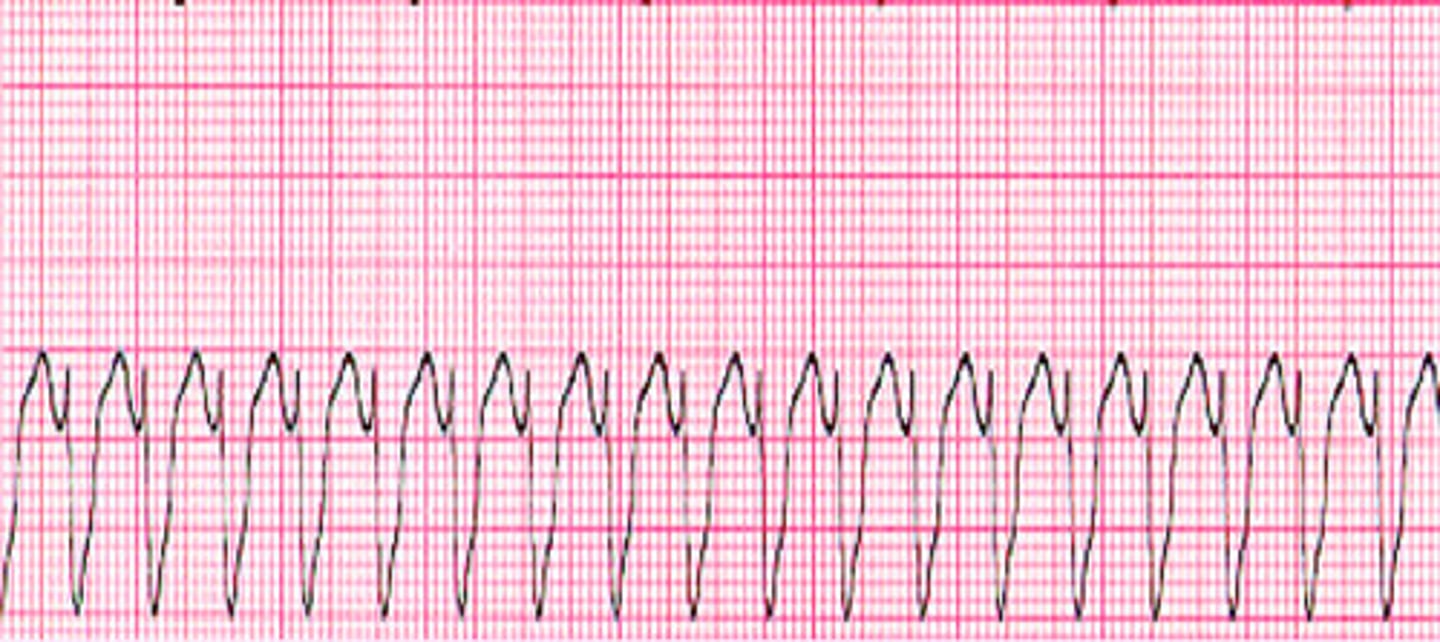
(flip card for question)
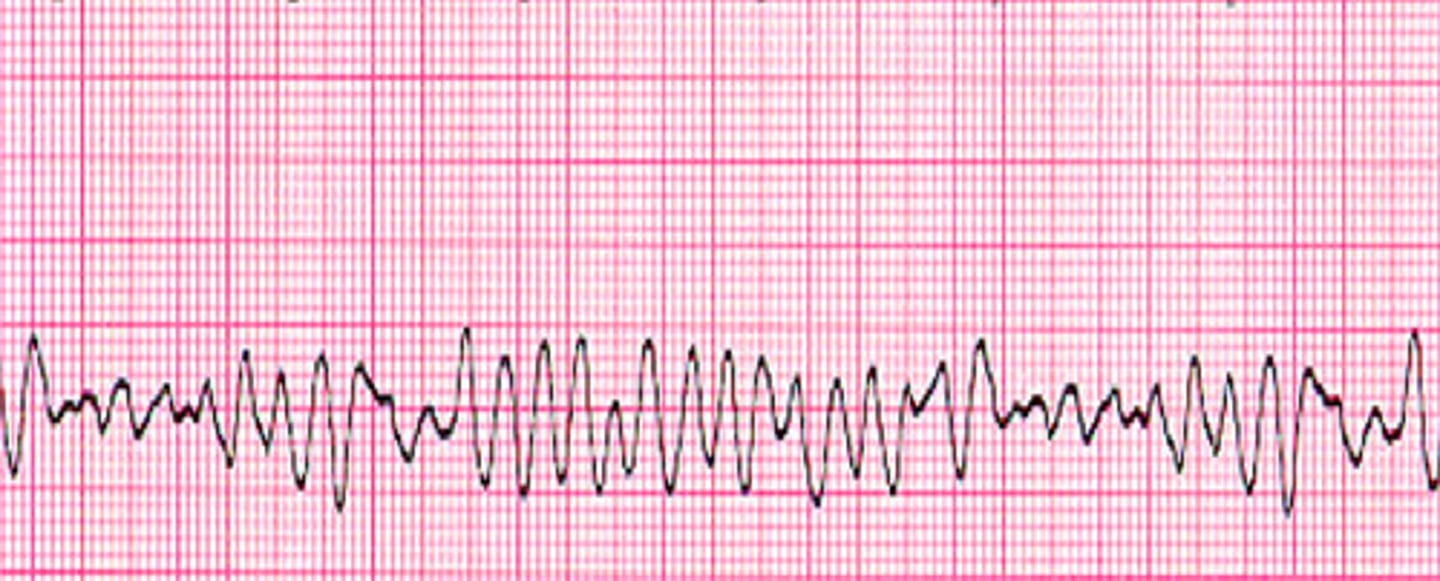
ventricular fibrillation (v-Fib)
-cardiac output is essentially 0 (in the process of dying)
-SHOCKABLE RHYTHM!
-crash cart is already on its way
-CALL CODE!
-can pass out and go into cardiac arrest
What does the ECG show?
When reading a 12-Lead ECG, if the rhythm strip is absent, which lead do you refer to in order to get a sense of what is happening?
Lead 2
Cholesterol Lab Values
LDL (bad) cholesterol: <100 mg/dL (190+ = VERY HIGH)
HDL (good) cholesterol: ≥ 60 mg/dL
Triglycerides: <150 mg/dL (500+ = VERY HIGH)
Total Cholesterol (HDL+LDL+ 20% Triglycerides): <200 mg/dL (240+ = HIGH RISK)
Arterial Blood Gas Values
pH: 7.35-7.45
pCO2 (partial pressure of CO2): 35-45 mmHg
HCO3- (bicarbonate ion): 21-28 mEq/L
pO2 (partial pressure of O2): 80-100 mmHg
O2 saturation: 95-100%
Hematocrit (Hct) Normal Values
Male: 42-52%
Female: 37-47%
think in the 40s
Hemoglobin (Hgb) Normal Values
Male: 14-18 g/dL
Female: 12-16 g/dL
think 14
International Normalized Ratio (INR) Normal Values
0.8 to 1.1
for those on Coumadin/Warfarin, should be 2.0 to 3.0
-INR too low= risk of clotting
-INR too high= risk of bleeding
Precautions for Exercise with Low Blood Counts
Hematocrit
-no exercise: <25%
-light exercise: >25%
-resistive exercise: >35%
Hemoglobin
-no exercise: <8 g/dL
-light exercise: 8-10 g/dL
-resistive exercise: >10 g/dL
Platelet
-no exercise: <10,000 mcL
-light exercise: 10,000- 20,000 mcL
-resistive exercise: >20,000 mcL
WBC
-no exercise: <500 mcL
-light exercise: >500 mcL
-resistive exercise: >500 mcL
INR (international normalized ratio)
-no exercise: >5.0
-light exercise: 4.0-5.0
-resistive exercise: <4.0
Normal Glucose Value (Adult) for a Fasting Blood Sugar
70-100 mg/dL
140= Type II DM
120= prediabetic
Hemoglobin A1C (Adult) Normal Values
4.0% to 5.6%
if person already has diabetes, try to keep A1C below 7%
Normal Potassium Values
3.5-5.0 mEq/L
Normal Sodium Values
135-145 mEq/L
Normal Calcium Values
9-11 mg/dL
Normal Magnesium Values
1.5-2.5 mEq/L
Blood Urea Nitrogen (BUN) Normal Values
adults: 6-20 mg/dL
older adults (greater than 60): 8-23 mg/dL
Beta Blockers (-lol)
-decrease HR during rest and with exercise
-may mask symptoms of hypoglycemia
treatment for:
-hypertension
-cardiac arrhythmias
-glaucoma
-hyperthyroidism
-mitral valve prolapse
-various neurologic disorders such as migraine headaches, anxiety
Human-BNP (Nesiritide)- improves hemodynamics and increases cardiac output (vasodilator/diuretic)
Calcium Channel Blockers
-prevent smooth muscle contractions within the coronary artery (such as coronary spasm)
-dilates the arterial walls for blood to go through
side effect: ankle swelling
used for:
-arrhythmia control, particularly supraventricular tachycardia
-BP control
-reducing the incidence of re-infarction in pts with non-Q wave infarcts
-improving oxygenated blood flow
Nitrates
-decrease myocardial demand (anti ischemic medication)
-venodilator, decreasing venous return (preload)
-arteriodilator, decreasing venous afterload
-relaxant for coronary artery smooth muscle
routes of administration:
-sublingual (absorbed into the bloodstream)
-lingual spray
-transdermal patch
side effects:
-headache
-hypotension
-reflex tachycardia
-flushing of the skin
-N/V
What is a typical dose of nitroglycerin tablets in response to angina?
1) take one and wait 5 minutes
2) ask pt how they feel....if symptoms continue, take another and wait 5 minutes
3) pt can take up to 3 tablets in 15 minutes
4) if symptoms continue after 15 minutes, CALL 911 and notify doctor
What effect does the combination of Viagra and nitroglycerin have on the patient's blood pressure?
decrease in BP (life-threatening hypotension)
Thrombolytic Agents
-destroy or decrease blood clot
-example: t-PA (tissue Plasminogen Activator)
-caution to avoid situations of potential tissue trauma bc the pt's clotting ability is altered during this period
side effects:
-cerebrovascular accidents
-genitourinary bleeding
-GI bleeding
-ventricular arrythmias are common with the acute time frame following thrombolysis, through to be in response to tissue reperfusion
Antiplatelet Agents
-salicylic acid (aspirin)
-prevent thrombus formation; decreasing the platelet's ability to adhere and aggregate at the site of injury
Anticoagulants
-prevent blood clot formation; inhibit the formation of thrombin, negating the influence of thrombin on fibrinogen
-Heparin sodium (Heparin, Liquaemin Sodium)
-Enoxaparin sodium (Clexane, Lovenox)
-Warfarin (Coumadin)
-Dabigatran (Pradaxa)
-Rivaroxaban (Xarelto)
-Apixaban (Eliquis)
Diuretics
-decrease circulating blood volume, thereby decreasing preload
o pee a lot during PT exercise session
o DASH diet resembles diuretics
-Furosemide (Lasix)
Angiotensin-Converting Enzyme (ACE) Inhibitors (-pril)
-decrease the excess intravascular volume that occurs as a result of sodium and water retention
o decrease in volume= decrease in preload
o decreases myocardial oxygen demand and may improve contractility
-Captopril (Capoten)
-Enalapril (Vasotec)
-Lisinopril (Zestril)
Morphine
-decreases preload via venodilation and mild arterial vasodilation
Antiarrhythmic Agents
-suppress arrythmias by altering cell membrane permeability to specific ions (sodium, calcium)
-monitor vital signs during PT session to make sure this is not causing another arrhythmia
-prolong warm up and cool down
Explore top notes

