Exam 4: ECHINODERMATA
 Studied by 0 people
 Call Kai
 Learn
Learn Practice Test
 Spaced Repetition
 Match
Match Flashcards
 Knowt Play
1/174

There's no tags or description
Looks like no tags are added yet.
Name | Mastery | Learn | Test | Matching | Spaced | Call with Kai |
|---|
No analytics yet
Send a link to your students to track their progress
175 Terms
Q: What does the name Echinodermata mean?
A: "Spiny skin" - from Greek echinos (spiny) and derma (skin).
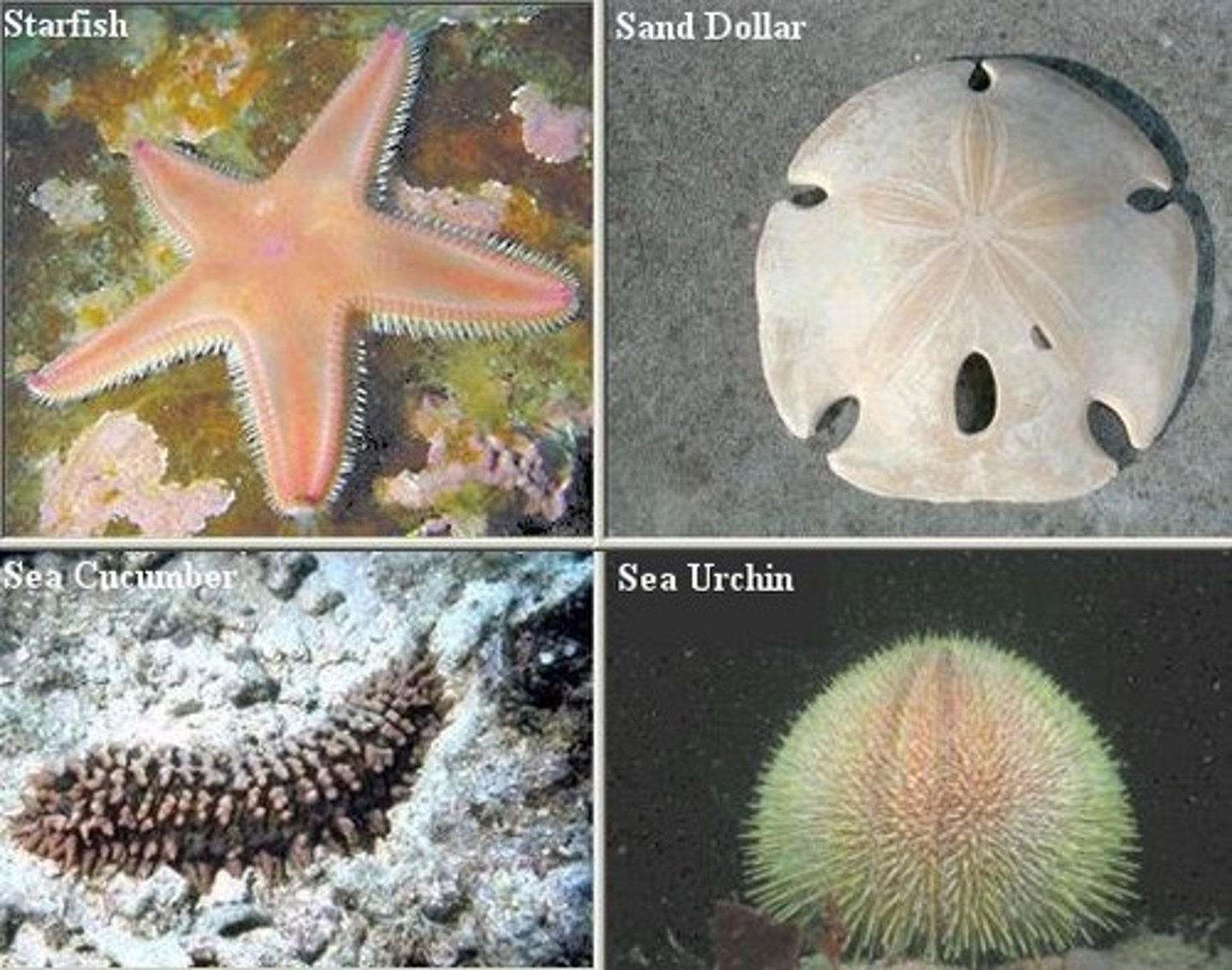
Q: Are echinoderms protostomes or deuterostomes?
A: Deuterostomes (blastopore becomes the anus).
Q: What type of symmetry do echinoderms exhibit as adults?
A: Pentaradial symmetry (five-part radial symmetry).
Q: What type of symmetry do echinoderm larvae have?
A: Bilateral symmetry.
Q: What is unique about echinoderms' endoskeleton?
A: It is made of calcareous ossicles (small calcium carbonate plates) beneath the skin.
Q: What type of coelom do echinoderms have?
A: True coelom (eucoelomate).
Q: Name the system that echinoderms use for locomotion
feeding, and respiration.,A: Water vascular system.
Q: How does the water vascular system function?
A: It uses a network of canals filled with seawater and tube feet; hydraulic pressure extends and retracts tube feet.
Q: What is the madreporite?
A: A sieve-like plate on the aboral surface that allows seawater to enter the water vascular system.
Q: What are tube feet
and what do they do?,A: Small, flexible, hollow appendages used for locomotion, feeding, and gas exchange.
Q: How do echinoderms feed?** (examples)
• Sea stars: evert stomach to digest bivalves externally
• Sea urchins: scrape algae with Aristotle's lantern (a jaw-like structure).
• Sea cucumbers: use tentacles to sweep in food particles.
Q: Do echinoderms have a circulatory system?
A: They have a coelomic system that circulates nutrients; no true heart.
Q: How do echinoderms excrete waste?
A: Diffusion through tube feet and papulae (skin gills).
Q: Do echinoderms have a nervous system?
A: Yes, a nerve ring around the central disk with radial nerve cords; no brain.
Q: Can echinoderms regenerate lost parts?
A: Yes, many can regenerate arms; some species can regenerate an entire body from a single arm if part of the central disk is attached.
Q: Name the main classes of echinoderms.
1. Asteroidea - sea stars
2. Ophiuroidea - brittle stars
3. Echinoidea - sea urchins and sand dollars
4. Holothuroidea - sea cucumbers
5. Crinoidea - sea lilies and feather stars
Q: Give a distinctive feature of Asteroidea.
A: Broad arms with tube feet on the oral side; evert stomach for external digestion.
Q: Give a distinctive feature of Ophiuroidea.
A: Slender, flexible arms distinct from central disk; tube feet lack suckers; mostly suspension feeders or scavengers.
Q: Give a distinctive feature of Echinoidea.
A: No arms; rigid test (shell); use Aristotle's lantern to feed.
Q: Give a distinctive feature of Holothuroidea.
A: Soft, elongated body; reduced ossicles; tentacles surround mouth for deposit feeding; can eviscerate internal organs as defense.
Q: Give a distinctive feature of Crinoidea.
A: Sessile or semi-sessile; feather-like arms for suspension feeding; mouth and anus on oral surface.
Q: How do echinoderms reproduce?
A: Mostly sexual with separate sexes; external fertilization. Some can reproduce asexually by fragmentation/regeneration.
Q: Are echinoderms important ecologically?
A: Yes, they are key in marine ecosystems:
• Sea stars control bivalve populations.
• Sea urchins graze algae and influence reef communities.
• Sea cucumbers recycle sediments.
Q: How many living species of echinoderms are there?
A: Over 7,000 living species.
Q: How many fossil echinoderm species have been described?
A: Approximately 15,000 fossil species.
Q: Where do echinoderms live?
A: All are marine or estuarine, from the upper intertidal zones to the deep ocean.
Q: Have any echinoderm groups gone extinct?
A: Yes, many extinct groups exist in the fossil record.
Q: Do echinoderms have a head or tail?
A: No, echinoderms lack a distinct head or tail.
Q: What type of symmetry do echinoderms exhibit as adults?
A: Radial symmetry, usually pentamerous (five-part).
Q: How are the surfaces of echinoderms described?
A: They have an oral surface (where the mouth is located) and an aboral surface (opposite the mouth).
Q: Do echinoderms exhibit bilateral symmetry at any stage?
A: Yes, larvae are bilaterally symmetrical, showing their evolutionary link to bilaterians.
Q: What unique system do echinoderms use for locomotion
feeding, and respiration?,A: The water vascular system, a network of fluid-filled canals that extend into tube feet (appendages).
Q: How many parts does the radial symmetry of adult echinoderms usually have?
A: Five-part (pentamerous) radial symmetry.
Q: What forms the echinoderm endoskeleton?
A: Calcareous ossicles, small calcium carbonate plates embedded in the body wall.
Q: What is unique about echinoderm connective tissue?
A: It can shift between stiff and fluid-like states, allowing the animal to change body rigidity quickly (mutable connective tissue).
Q: Why is the water vascular system important?
A: It powers tube feet for movement, feeding, gas exchange, and sometimes sensory functions.
Q: Can echinoderms change their body shape without muscles?
A: Yes, because of mutable connective tissue that can become rigid or soft under nervous control.
Q: What is the water vascular system?
A: A hydraulic system of fluid-filled canals unique to echinoderms that powers locomotion, feeding, respiration, and sensory functions.
Q: How does water enter the system?
A: Through the madreporite, a sieve-like plate on the aboral surface.
Q: What is the main canal after the madreporite?
A: The stone canal, which connects the madreporite to the ring canal around the central disk.
Q: What does the ring canal do?
A: It encircles the central disk and distributes water into the radial canals that run along each arm.
Q: What extends from the radial canals?
A: Lateral canals, which connect to tube feet (podia).
Q: How do tube feet work?
A: Water pressure extends the tube feet; muscles and connective tissue retract them, allowing movement, attachment, and feeding.
Q: What is the ampulla?
A: A bulb-like structure inside the body connected to each tube foot that contracts to push water into the foot.
Q: How does the water vascular system assist in feeding?
A: Tube feet can hold prey, pry open shells, and even help evert the stomach in species like sea stars.
Q: How does the system aid in respiration and excretion?
A: Tube feet and skin gills (papulae) allow gas exchange and diffusion of wastes.
Q: Is the water vascular system unique to echinoderms?
A: Yes, it is a synapomorphy (defining feature) of the phylum.
Q: What is radial symmetry?
A: A type of body symmetry where body parts are arranged around a central axis, like spokes on a wheel.
Q: How is radial symmetry expressed in adult echinoderms?
A: Most adult echinoderms exhibit pentamerous (five-part) radial symmetry, meaning the body can be divided into five equal sections around the central axis.
Q: Which surface is considered the central axis reference?
A: The oral-aboral axis:
• Oral surface - contains the mouth
• Aboral surface - opposite the mouth(often has the madreporite)
Q: Do echinoderms have bilateral symmetry?
A: Yes, but only in the larval stage. Adult echinoderms revert to radial symmetry.
Q: Why is radial symmetry advantageous for echinoderms?
A: It allows them to:
• Reach out in all directions with arms or tube feet
• Sense and capture food from any direction
• Remain anchored while interacting with the environment
Q: Give an example of pentaradial symmetry in a class of echinoderms.
A: Asteroidea (sea stars): five arms radiate from a central disk.
Q: Are all echinoderms strictly five-part?
A: Most are pentamerous, but some (like some sea urchins) may show secondary modifications.
When did echinoderms first appear?
A: In the Cambrian period, over 500 million years ago.
Q: How diverse were early echinoderms?
A: They were highly diverse, with many forms that are now extinct. Fossil records show ~15,000 extinct species.
Q: What was different about early echinoderm symmetry compared to modern forms?
A: Many early echinoderms had bilateral symmetry or asymmetry rather than the pentaradial symmetry seen in most adults today.
Q: What are some examples of early echinoderm groups?
• Cystoidea - stalked, globular body with plated skeleton
• Blastoidea - stalked suspension feeders
• Eocrinoidea - early forms with primitive stalks and feeding arms
Q: Were early echinoderms sessile or mobile?
A: Many were sessile, attached to the substrate by a stalk; some were motile.
Q: How did early echinoderms feed?
A: Mostly filter or suspension feeders, using brachioles or arms to capture food particles from water.
Q: What was the skeleton of early echinoderms made of?
A: Calcareous plates or ossicles, like modern echinoderms, but often more primitive and sometimes irregularly arranged.
Q: How are early echinoderms important for understanding evolution?
A: They show:
• The transition from bilateral larvae to radial adults
• The development of water vascular system
• Early diversification of endoskeletons and feeding strategies
Q: Did all early echinoderm lineages survive?
A: No, many early groups like cystozoans and blastoids are now extinct, while only modern classes (Asteroidea, Echinoidea, etc.) survived.
Q: What forms the echinoderm endoskeleton?
A: Calcareous ossicles - small calcium carbonate plates embedded in the body wall.
Q: What is the rigid shell of a sea urchin called?
A: The test, made of fused calcareous ossicles.
Q: Which echinoderm classes have a prominent endoskeleton?
A:• Asteroidea (sea stars) - ossicles form a flexible skeleton allowing arm movement.
• Echinoidea (sea urchins) - ossicles fuse to form a rigid test.
• Holothuroidea (sea cucumbers) - ossicles are reduced and microscopic making the body soft and flexible.
Q: What is the function of the echinoderm endoskeleton?
A: Provides:
• Support for the body
• Protection of internal organs
• Attachment points for muscles and connective tissue
Q: How does the endoskeleton interact with connective tissue?
A: The mutable connective tissue can shift between stiff and soft states, working with ossicles to change body rigidity.
Q: What is mutable connective tissue?
A: Specialized connective tissue in echinoderms that can rapidly change stiffness under nervous control. Also called catch tissue.
Q: Why is it called "catch tissue"?
A: Because it can "catch" a position by stiffening without continuous muscle contraction, saving energy.
Q: How does mutable connective tissue assist in autotomy?
A: It allows echinoderms to detach arms, spines, or other body parts easily as a defense mechanism.
Q: What can echinoderms regenerate using this tissue?
A: They can regenerate arms, tube feet, spines, and even parts of the intestine after autotomy or injury.
Q: Give an example of autotomy in echinoderms.
A: Sea stars can drop an arm when threatened; the arm can later regenerate.
Q: Why is mutable connective tissue important for survival?
A: It: • Allows energy-efficient support
• Enables defense mechanisms (autotomy)
• Facilitates body flexibility for movement and feeding
Do echinoderms have a brain?
A: No, echinoderms lack a centralized brain.
Q: How do echinoderms coordinate movement and responses?
A: Through an extensive nervous system composed of Nerve ring around the central disk and Radial nerve cords extending along each arm
Q: What is the function of the radial nerve cords?
A: They coordinate movement of tube feet and arms and transmit sensory information.
Q: Do echinoderms have sensory structures?
A: Yes, they have basic eyespots at the tips of arms in some classes (e.g., Asteroidea).
Q: What can echinoderm eyes detect?
A: Light and dark, helping them orient to the environment and detect predators or obstacles.
Q: How do echinoderms respond to stimuli without a brain?
A: The nerve ring and radial cords allow localized reflexes, so arms can move independently while coordinated.
Are echinoderms typically dioecious or hermaphroditic?
A: Most are dioecious (separate sexes), though a few species are hermaphroditic.
Q: How do echinoderms usually release gametes?
A: Sperm and eggs are released into the water for external fertilization.
Q: What type of larval stage do echinoderms have?
A: A planktonic larval stage, which is bilaterally symmetrical and part of their dispersal strategy.
Q: Do all echinoderms have planktonic larvae?
A: No, some species brood their young instead of releasing them into the water column.
Q: Why are sea urchins important in developmental biology?
A: They are a model system for studying development, fertilization, and embryology.
Q: Can echinoderms reproduce asexually?
A: Yes, some species can reproduce by fragmentation, where parts of the body regenerate into a new individual.
Q: Give an example of asexual reproduction in echinoderms.
A: Sea stars can regenerate a whole animal from a single arm with part of the central disk.
How many Crinoidea are there
A: About 700 living species, with a large fossil record.
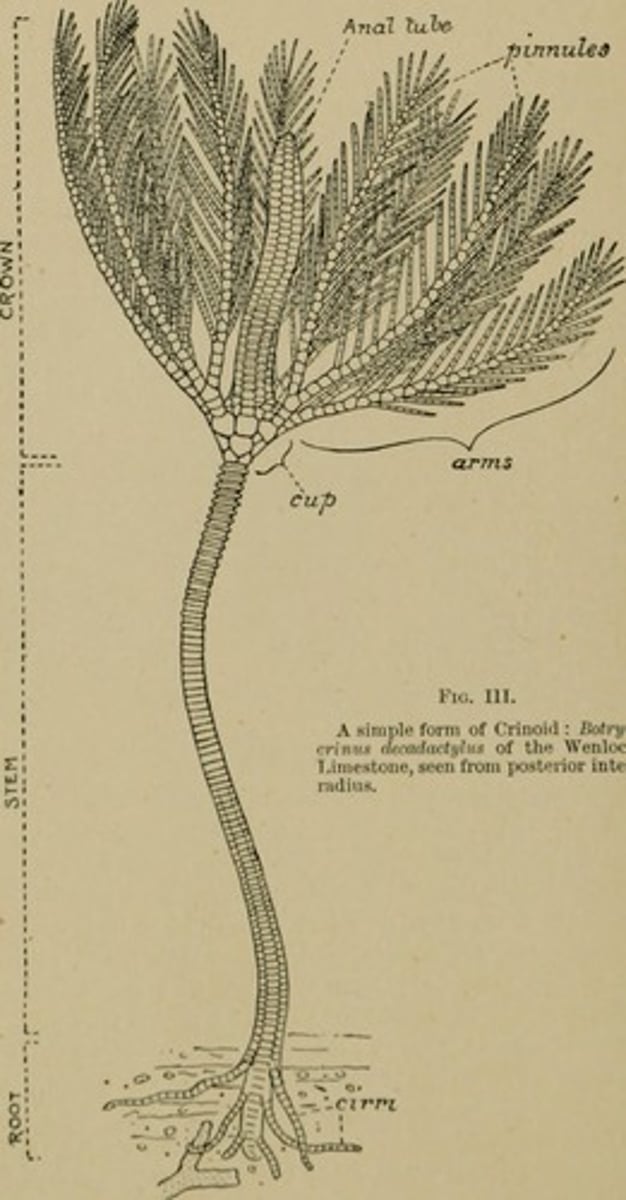
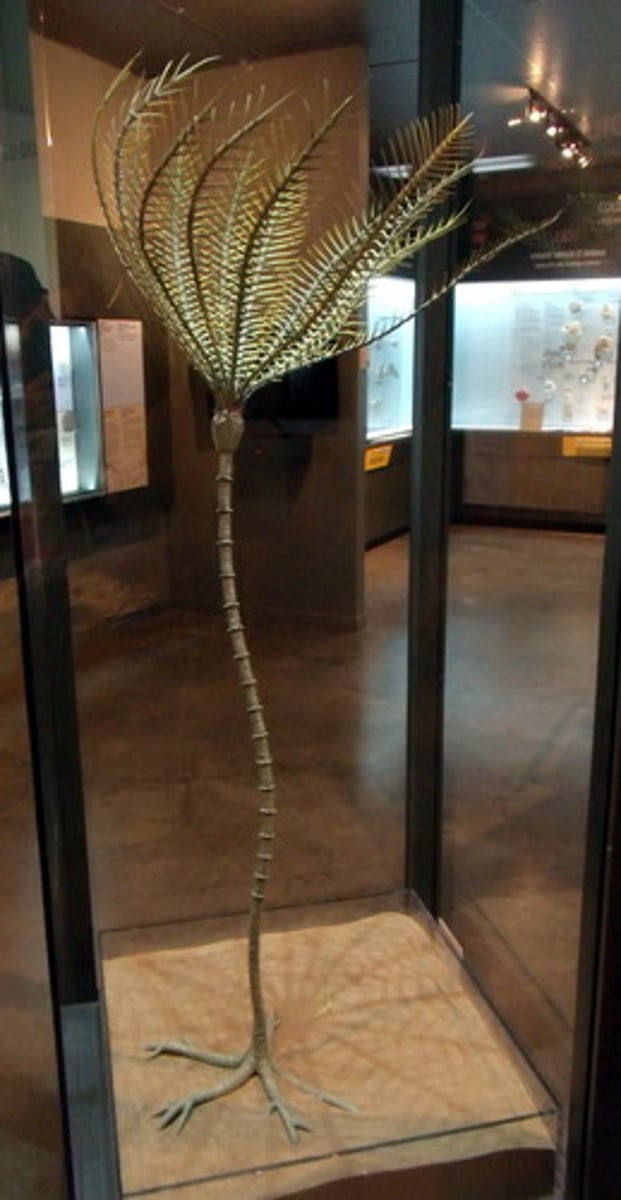
Q: What are Crinoidea commonly called?
A: Sea lilies (stalked) and feather stars (unstalked, free-swimming).
Q: How do crinoids feed?
A: They are suspension feeders, capturing food particles from water using feather-like arms.
Q: Which way does the oral surface face in crinoids?
A: Upwards toward the water column.
Q: What are pinnules?
A: Small lateral branches on crinoid arms that bear rows of translucent podia (tube feet) for food capture.
Q: What is the function of the podia on pinnules?
A: They trap and move food particles toward the mouth.
Q: Are crinoids sessile or mobile?
A: Sea lilies are mostly sessile, attached by a stalk. And Feather stars are motile, capable of swimming or crawling.
Q: Why do crinoids have a large fossil record?
A: Their calcified endoskeleton preserves well, making them abundant in Paleozoic and Mesozoic fossils.
Q: How many species of Ophiuroidea exist?
A: Approximately 2,100 species.
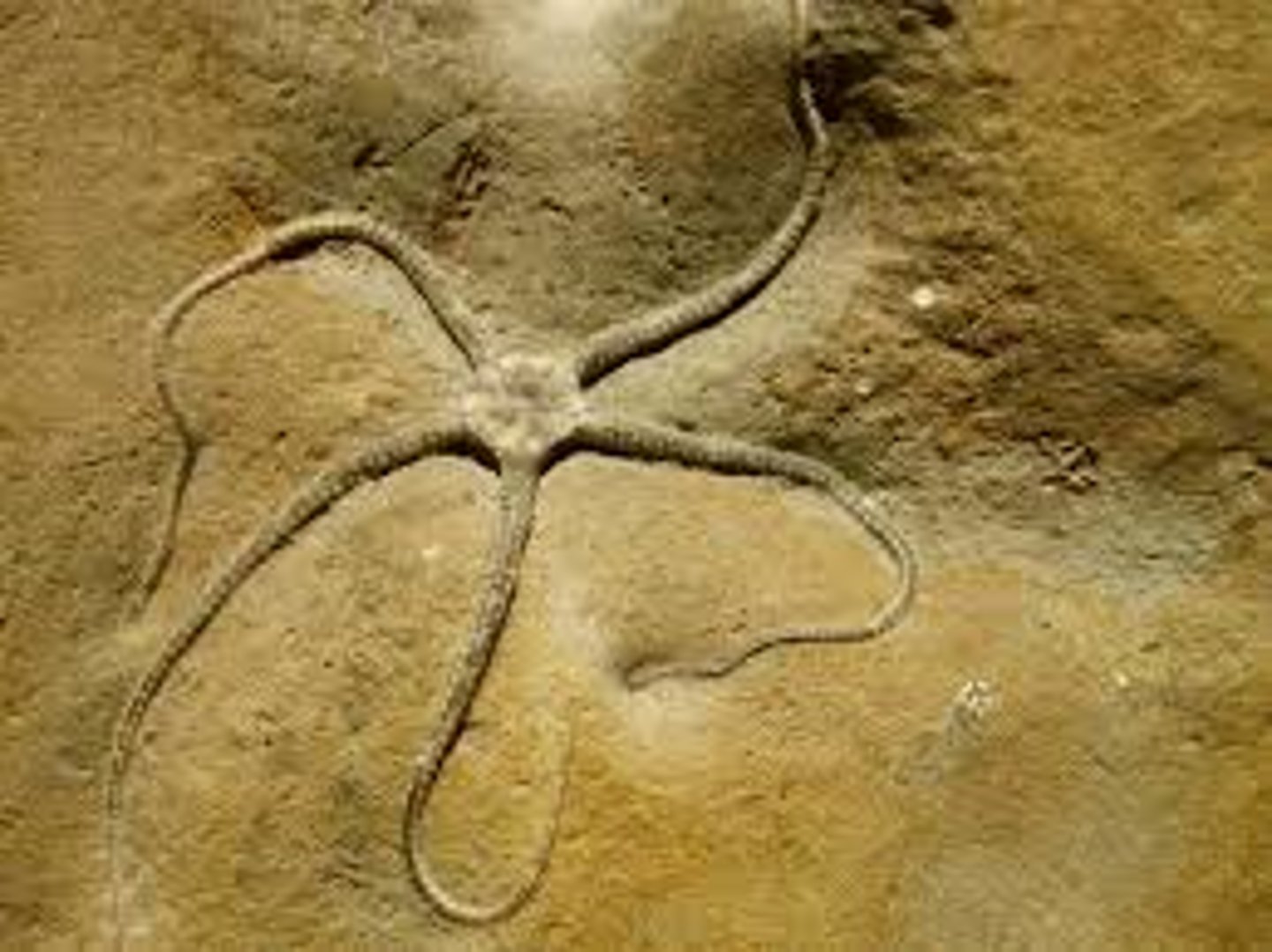
Q: What are the two major clades of Ophiuroidea?
A: Brittle stars (typical slender-armed forms) and basket stars (highly branched arms).
Q: What is a common defense mechanism in brittle stars?
A: They will drop arms (autotomy) to escape predators.
Q: What structures are used in respiration and reproduction?
A: Bursae - pouches located near the central disk.
Q: What types of feeding do Ophiuroidea exhibit?
A: Deposit feeders - ingest sediment to extract organic matter and Suspension feeders - capture food particles from water and Predators - some feed on small invertebrates
 Note
Note  Flashcards (31)