GCSE Physics P6: Waves
 Call Kai
 Learn
Learn Practice Test
 Spaced Repetition
 Match
Match Flashcards
 Knowt Play
1/42

There's no tags or description
Looks like no tags are added yet.
Name | Mastery | Learn | Test | Matching | Spaced | Call with Kai |
|---|
No analytics yet
Send a link to your students to track their progress
43 Terms
period
frequency
amplitude
time taken for a whole wave to comepletely pass a single point
the number of waves that pass a single point per second
maximum displacement of a point on a wave away from its undisturbed position
velocity equation
velocity = frequency x wavelength
relationships
increase frequency, velocity increases
wavelength increases, velocity increases
period is inversly proportional to frequency
smaller period, higher frequency, greater velocity
transverse and longitudinal waves
Transverse:
light, em wave
has peaks and troughs
waves oscillate perpindicular to the direction of travel of energy transferLongitudinal:
sound waves, compressions, rarefraction
waves oscillate parallel to the direction of travel of energy transferthey dont transfer matter but they transfer energy
the wave travels, not the water ripples or the air
measuring velocity of the sound in air
Make a noise at ~50m from a solid wall, and record time for the echo to be heard, then use speed = distance/time
Have two microphones connected to a datalogger at a large distance apart, and record the time difference between a sound passing one to the other – then use speed = distance/time
measuring velocity of the ripples on water surface
Use a stroboscope, which has the same frequency as the water waves, then measure distance between the ‘fixed’ ripples and use v = f x lamda
Where v is the wave speed in metres per second m/s, f is the frequency in hertz Hz and λ is the wavelength in metres m.
Move a pencil along the paper at the same speed as a wavefront, and measure the time taken to draw this line – then use speed = distance/time
Reflection
Waves will reflect off a flat surface
The smoother the surface, the stronger the reflected wave is
Rough surfaces scatter the light in all directions, so they appear matt and not reflective.
The angle of incidence = angle of reflection
Light will reflect if the object is opaque and is not absorbed by the material
The electrons will absorb the light energy, then reemit it as a reflected wave
Transmission
Waves will pass through a transparent material
The more transparent, the more light will pass through the material
It can still refract, but the process of passing through the material and still emerging is transmission
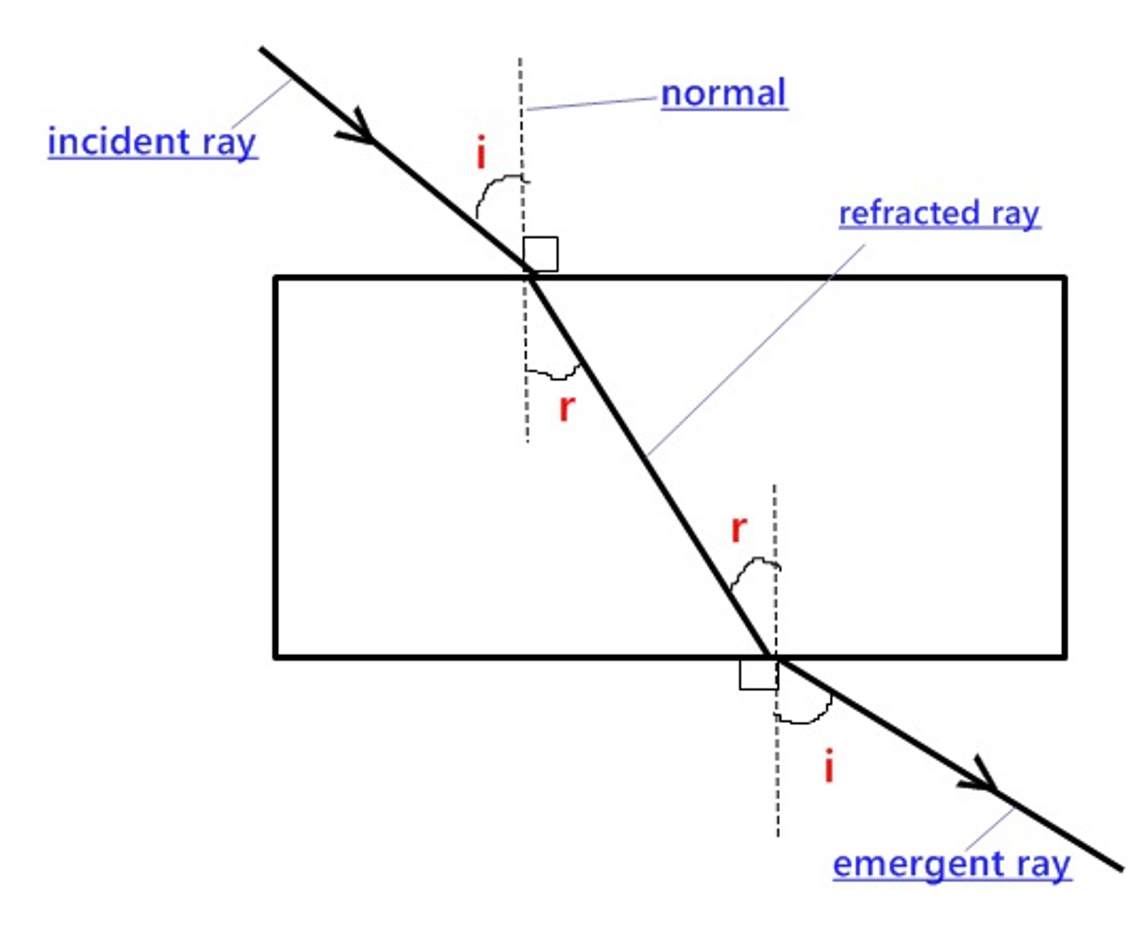
Ray Diagrams
absorption
if the frequency of light matches the energy levels of the electrons
the light will be absorbed by the electrons and not reemitted
they will be absorbed and then reemitted over time as heat
so that particular frequency has been absorbed
if a material appears green, only green light has been reflected and the rest of the frequencies in visible light have been absorbed
Sound waves
sound enters the ear canal
causes eardrum vibrates
these vibrations are amplified by ossicles and passed into the cochlea
inside the cochlea, hair cells detect the vibrations and convert them into electrical impulses
this is sent to the brain and interpreted as sound
the conversion of sound waves to vibrations of solid works over limited frequency range
this restricts limits of human hearing
limitations
humans cannot hear below 20Hz above 20kHz
in the cochlea, the hairs attuned to the higher frequencies die or get damaged
can be due to constant loud noise damaging these hairs over the years
or can be due to the changes in the inner ear as you grow older
smoking, chemotherapy, diabetes are also causes
so high frequencies cannot be heard as we get older
we have evolved to hear this range of frequencies as it gives us the greatest survival advantage
we cannot hear ultrasound as we do not use sonar to hunt. we have accurate vision instead
Ultrasound
frequency higher than the upper limit of hearing for humans
partially reflected back when they meet boundary between two different media and the remaining waves continue and pass through
the time taken for the reflections to reach a detector can be used to determine how far away the boundary is
allowing ultrasound waves to be used for both medical and industrial imagine
Infrasound (seismic waves)
a sound wave with frequency lower than 20Hz (seismic waves)
used to explore the earth’s core
P-waves:
longitudinal
can pass through solids and liquidsS-waves:
transverse
only passing through solids
move slower than p-waveson the opposite side of the earth to an earthwuake, only p-waves are detected suggesting the core of the earth is liquid hence no s-waves can penetrate it
Sonar
pulse of ultrasound sent below a ship and the time taken for it to reflect and reach the ship can be used to calculate depth
this is used to work out whether there is a shoal of fish below the ship
or how far the seabed is below the ship
Electromagnetic Waves
when frequency increases, wavelength decreases it goes in this order:
Radio, microwave, infared, visible, ultraviolet, x-ray, gamma raythey are transverse waves
do not need particles to move
in space or air (vacuums) all waves have the same velocity (speed of light)
they can transfer energy from a source to absorber
examples to illustrate the transfer of energy by em waves
microwave source to food (heating food)
sum emits energy to the earth
How does heating up food works
Microwaves are a type of electromagnetic waves that transfer energy to food by radiation. Inside the microwave oven, a magnetron produces microwaves which reflect off the metal walls and pass into the food.
The microwaves are absorbed mainly by water molecules in the food. These molecules are polar, so they rotate and vibrate when exposed to the microwaves. This increases their kinetic energy.
As the molecules move faster, they collide with other particles in the food, transferring energy. This increases the thermal energy of the food, causing its temperature to rise and the food to heat up.
Heating is not always even because microwaves can form standing wave patterns, creating hot and cold spots, and because different parts of the food contain different amounts of water.
explain why white light is dispersed when travelling through the prisms
When white light travels through a prism, the red light refracts less than the blue light and so the white light is spreads out or splits into a spectrum. This is because there is a different refractive index for each colour, meaning they travel at different speeds.
relationships in waves
as speed is constant for all EM waves
as wavelength increases, frequency must increase
as frequency increases, energy of the wave increases
eyes
our retina can only detect visible light, a small part of the em spectrum
Refraction
if entering a denser material, it bends towards the normal
if entering a less dense material it bends away from normal
substances will asborb, transmit, refract or reflect certain em waves depending on wavelength
e.g glass will transmit/refract visible light
absorb UV radiation
reflect IR radiation
the material interacts differently for different parts of EM spectrum because the wavelengths and frequencies are different
some effects are due to differences in velocity
when light enters a denser medium, it slows down
shorter wavelengths slow down more than longer wavelengths
radio waves
produced by oscillations in electrical circuts.
when radio waves are absorbed they may create an alternating current with the same frequency as the radio wave itself
so radio waves can ,themselves, induce oscillations in an electrical circut
Atoms and em radiation
if an electron gains enough energy it can leave the atom to form an ion so gamma rays originate from changes in the nucleus of an atom as when electrons change orbit higher/lower they absorb or emit em radiation
changes in atoms and the nucleu of atoms can result in em waves being generated or absorbed over a wide frequency range.
gamma rays originate from changes in the nucleus of an atom
Hazards of EM waves
UV, X-ray and gamma have hazadous effects on human body tissure
effects depend on type of radiation and size of dose
radiation dose: how much exposure leads to harm for a person
UV: skin ages prematurely, increases risk of skin cancer
sunscream prevents over-exposure in summerx-ray and gamma are ionising radiation that can cause the mutation of genes causing cancer
minimal exposure should be ensured
how do em waves cause cancer
Electromagnetic waves can cause cancer if they are ionising (e.g. gamma rays and X-rays). These waves have high energy and remove electrons from atoms, causing ionisation.
Ionisation can damage DNA in cells, leading to mutations. If mutations occur in genes controlling cell division, this can cause uncontrolled cell growth and tumour formation (cancer).
Non-ionising waves (like microwaves) do not cause ionisation but can heat body tissue at high exposure.
Therefore, higher frequency EM waves are more dangerous because they are ionising and can directly damage DNA.
uses of EM waves
radio: tv and radio
long wavelength, can travel far without losing qualitymicrowave: satellite communication, cooking food
can penetrate atmosphere to reach satellitesIR: cooking food, infared cameras
transfers thermal energyvisible: fibre optics
best reflection/scattering in glass (other have too long/short wavelengths)UV: sun tanning, energy efficient lamps
radiates the least heat but more energyx-ray: medical imaging and treatment (and gamma)
very high in energy and can penetrate material easilygamma: sterylise medical equipment
Lenses
forms an image by refracting light
if light passes through centre of lens, it does not change direction
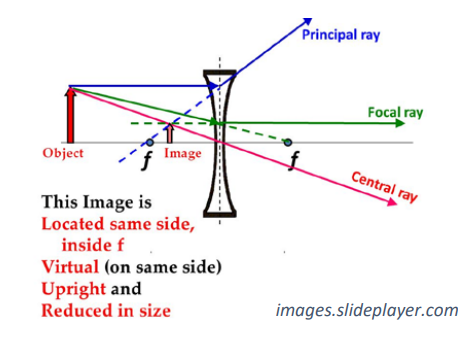
Concave Lenses
spreads light outwards: to correct short sightedness as light is focused in front of the retina so needs to be spread out slightly to be able to be focused onto retina
only have virtual images
light comes from focal point
represented with arrows pointing inwards
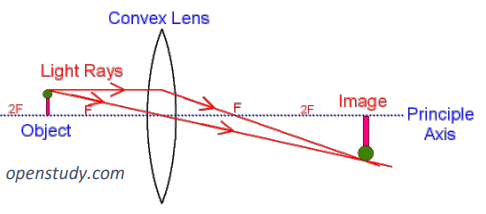
convex lens
focus light inwards
have virtual or real images (appear to be on same or opposite side as the real object)
used for magnifying glasses, binoculars
used to correct long sightedness as it focuses the rays closer
represented with arrows pointing outwards
magnification
image height/ object heigh
visible light
each colour within the visible light spectrum has its own narrow band of wavelength and frequency
blue has a shortwer wavelength and high frequency than red
sunlight is a mix of all colours and this mix appears white
types of reflection
specular - smooth surface gives a single reflection
diffuse - reflection off a rough surface causes scattering
colour filters
work by only absorbing certain wavelengths through and transmitting other wavelengths as the filter absorb every other colour
opaque colours
if it has a colour, determined by the strength of reflection for different wavelengths
wavelengths which are not reflected are absorbed
if all wavelengths reflect equally it is white in colour
if all wavelengths are absorbed it is black
the wavelength which is absorbed = colour which it appears
objects that transmit light are ether transparent or translucent (scatter most light and let some through)
colours lighting
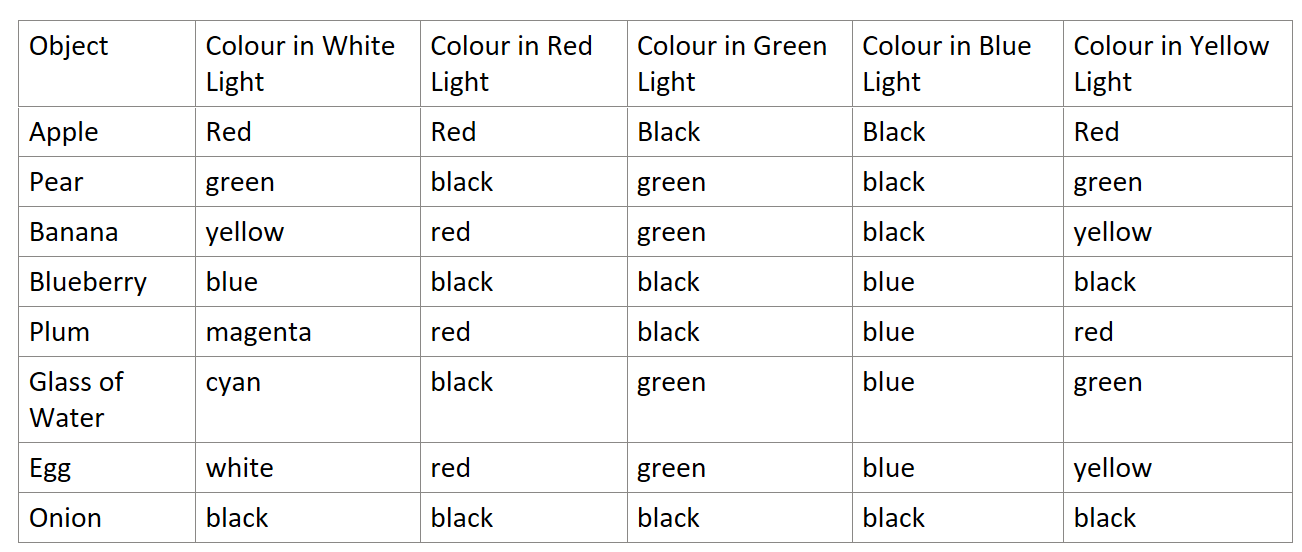
RGB mixing

black body and space
all objects, no matter what temperature, emit and absorb IR radiation. the hotter the body:
the more IR it radiates in a given time
the greater amount of shorter wavelength radiation released (waves with more energy e.g. x-rays)the intensity and wavelength distribution of any emission depends on the temp of the body
black body
does not reflect or transmit any radiation and absorbs all the radiation it receives
- as a good absorber is also a good emitter, a perfect black body would be the best possible emitter
body at diff temps
at constant temp it is still absorbing radiation at the same time as it is emitting radiation
the temp of a body increases when the body absorbs radiation faster than it emits radiation
when it cools down energy is released at a greater rate than it absorbs
Earth
temp of the earth depends on: rate of absorption and emission of radiation, reflection of radiation into space
sun’s energy is mostly absorbed by the earth’s atmosphere and some is reflected
the amount of energy re-radiated and absorbed leads to the earth’s temp
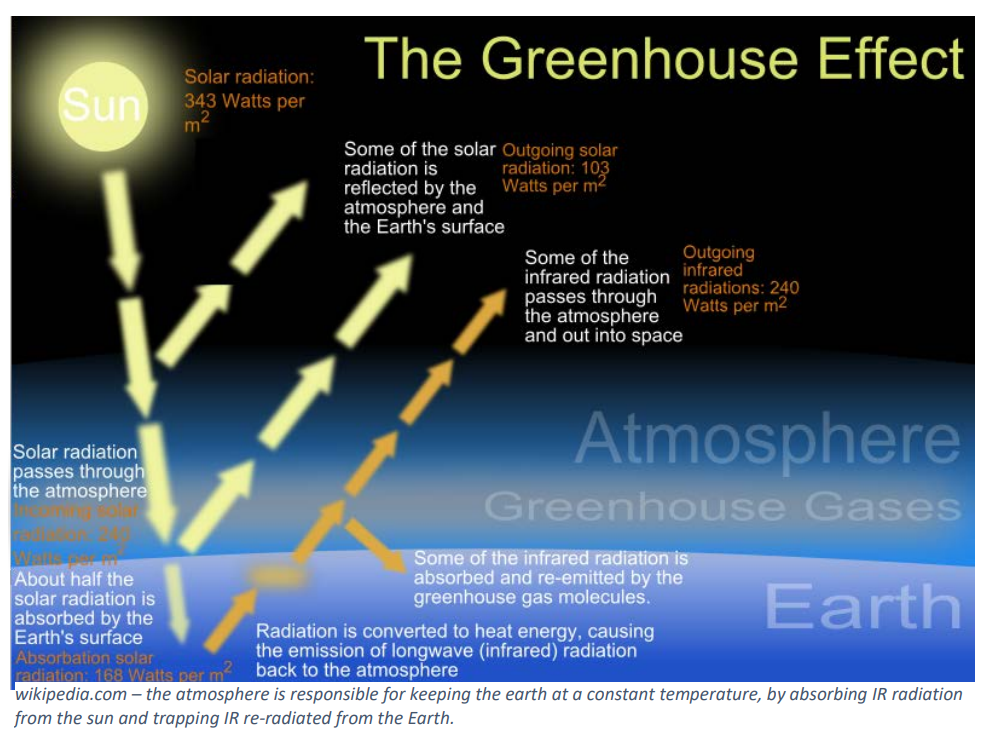
Greenhouse effect
The greenhouse effect is the warming of Earth caused by greenhouse gases in the atmosphere, such as carbon dioxide and methane.
Short-wave radiation from the Sun passes through the atmosphere and is absorbed by the Earth’s surface. The surface then emits long-wave infrared radiation.
Greenhouse gases absorb this infrared radiation and re-emit it in all directions, including back towards Earth, trapping heat in the atmosphere.
This increases the Earth’s average temperature. Human activities (like burning fossil fuels) increase greenhouse gas levels, enhancing the greenhouse effect and causing global warming.
leslie’s cube
A Leslie cube is a hollow metal box made of steel and emission of radiation. The cube has different surface finishes on four of the faces. Typically these are:
Matt black surface
Shiny silver surface
White surface
Shiny black surface
The cube is filled with hot water.
metal cube is filled with boiling water from the kettle, so it is all at the same temperature
a radiant heat thermometer is pointed towards the different surfaces making sure it is at the same distance from each - this works by detecting the infra-red radiation emitted from each surface
Explore top notes

Explore top flashcards
