Electric current (9.1)
 Call Kai
 Learn
Learn Practice Test
 Spaced Repetition
 Match
Match Flashcards
 Knowt Play
1/4

There's no tags or description
Looks like no tags are added yet.
Name | Mastery | Learn | Test | Matching | Spaced | Call with Kai |
|---|
No analytics yet
Send a link to your students to track their progress
5 Terms
What is an electric current?
Electric current - a flow of charged particles - rate of flow charged particles - measured in amp(ere)s (A)
In a wire these charged particles are electrons
How is current measured?
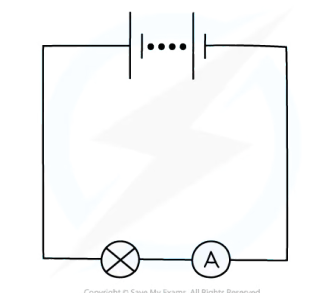
Current is measured using an ammeter
Ammeters should be connected in series with the part of the circuit you want to measure the current through
How can charge on charge carriers be characterised?
The charge on charge carriers is quantised:
This means that the values it can take are restricted to specific so that it can only assume discrete magnitudes.
Charge comes in definite bits - e.g. a single proton has a single positive charge, whereas a single electron has a single negative charge
This means that when we say something has a given charge, the charge is always a multiple of the charge of an electron
The charge of an electron is -1.60 × 10⁻¹⁹C
The charge of a proton is 1.60 × 10⁻¹⁹C (this is known as elementary charge (e) and measured in coloumbs (C))
How can charge be calculated?
Since current is the rate of flow of charge:
I = Q/t
Q = It
Where Q is charge (C)
Where I is current (A)
Where t is time (s)
How can current be measured in a current-carrying conductor?
I = nAvq
Where I is current (A)
Where n is number density of charge carriers (m-3)
Where A is cross sectional area of conductor (m2)
Where v is the drift velocity (ms-1)
Where q is charge of each charge carrier (C) - usually e - if in a solution, ions could be charge carriers. So if MgSO4 was used it would become Mg2+SO42- so q would be 2e for each equation (as the Mg and SO4 ions conduct ‘different’ currents - add them to get total current)
Drift velocity - the average speed the charge carriers are travelling through the conductor which is quite slow but since n is so high current flow still happens instantaneously.
Calculating number density of charge carriers:
n = N/V
Where n is number density of charge carriers (m-3)
Where N is the number of charge carriers
Where V is the volume (m-3)

