Role of blood in maintaining homeostasis within the internal environment
 Call Kai
 Learn
Learn Practice Test
 Spaced Repetition
 Match
Match Flashcards
 Knowt Play
1/26

There's no tags or description
Looks like no tags are added yet.
Name | Mastery | Learn | Test | Matching | Spaced | Call with Kai |
|---|
No analytics yet
Send a link to your students to track their progress
27 Terms
What type of tissue is blood
A fluid connective tissue
What are the three major components of blood
Plasma
Buffy coat
Haematocrit (RBCs)
What is plasma and what percentage of blood does it make up
Plasma is the liquid portion of blood; it makes up 55% of total blood volume
What is plasma composed of
Mostly water
Dissolved solutes
Plasma proteins
What is the buffy coat
What percentage of blood is the buffy coat
What percentage of blood is the buffy coat
Less than 1% of total blood volume
What is haematocrit
The percentage of total blood volume made up of red blood cells (RBCs)
What is the normal haematocrit range for males and females
Males: 47 ± 5%
Females: 42 ± 5%
(Average ≈ 45%)
How does RBC structure enable efficient gas transport
Biconcave shape
Lack of organelles
Flexibility maximises surface area
Haemoglobin content
Movement through vessels
Why is the biconcave shape of RBCs important
Large surface area relative to volume for rapid gas exchange
Allows RBCs to stack (rouleaux formation)
Helps them move smoothly through capillaries
Why do RBCs lack organelles
To create more space for haemoglobin, the protein that binds oxygen and some carbon dioxide
Why must RBCs be flexible
To bend and squeeze through narrow capillaries without rupturing
What is the key protein inside RBCs
Haemoglobin — binds O₂ and some CO₂ for transport
What are the three major functions of blood
Distribution
Regulation
Protection
What does blood distribute
Oxygen
Nutrients (e.g., glucose)
Hormones
Waste products (e.g., CO₂)
What internal conditions does blood help regulate
Interstitial fluid composition (e.g., electrolytes)
pH
Body temperature
Water balance and pressure
How does blood provide protection
Infection control (immune cells, antibodies)
Prevention of blood loss (clotting)
How do the functions of blood relate to homeostasis
The functions of blood maintain the internal environment within normal limits, allowing homeostasis to be maintained
Why is blood essential for maintaining stable internal conditions
Blood transports substances, regulates internal variables, and protects the body—keeping the ECF within its normal range so cells can function
How does the distribution function of blood support homeostasis
By delivering O₂, nutrients, and hormones, and removing wastes (e.g., CO₂), blood keeps internal conditions stable for cell survival
How does blood help regulate the internal environment
Blood regulates pH, temperature, water balance, and electrolyte composition of interstitial fluid—key variables for homeostasis
How does the protective function of blood support homeostasis
Blood prevents infection and blood loss, helping maintain stable internal conditions necessary for normal function
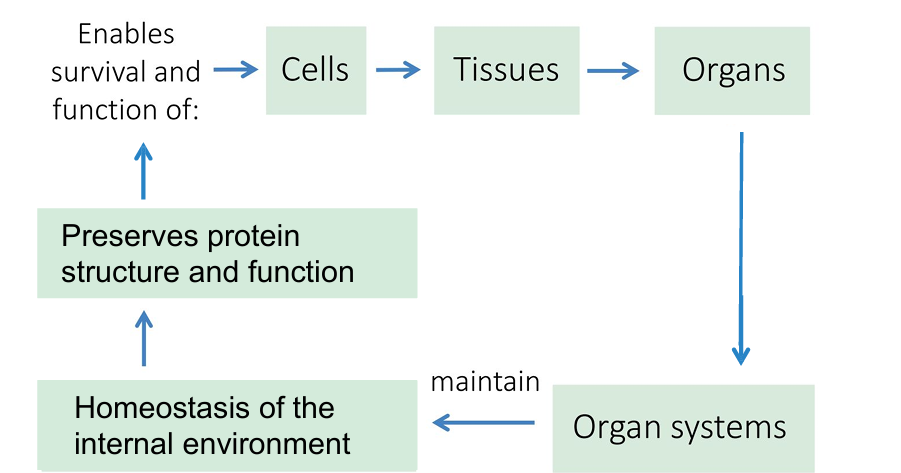
What are the levels of structural organisation in the body
Cells → Tissues → Organs → Organ systems
What does the internal environment do for cells
It enables the survival and normal function of cells
What do organ systems do for the internal environment
They maintain the internal environment by regulating variables within their normal range
How are cells, tissues, organs, and organ systems linked to homeostasis
Cells form tissues
Tissues form organs
Organs form organ systems
Organ systems maintain the internal environment
The internal environment keeps cells alive and functioning
This creates a continuous loop that supports homeostasis.
Why is the relationship between organ systems and the internal environment essential
Because stable internal conditions allow cells to function, and functioning cells allow organ systems to operate — maintaining life