Supply And Demand
0.0(0)
Studied by 1 person View linked note
 Call Kai
 Learn
Learn Practice Test
 Spaced Repetition
 Match
Match Flashcards
 Knowt Play
Card Sorting
1/17

There's no tags or description
Looks like no tags are added yet.
Last updated 6:55 PM on 8/30/23
Name | Mastery | Learn | Test | Matching | Spaced | Call with Kai | Chat |
|---|
No analytics yet
Send a link to your students to track their progress
18 Terms
1
New cards
Demand
The different quantities of goods that consumers are willing and able to purchase.
2
New cards
Inverse relationship between price and quantity demanded
When the price increases, the demand decreases, and when the price decreases, the demand increases.
3
New cards
Substitution Effect
When the price of a product goes up, consumers buy less of it and more of a substitute product (and vice versa).
4
New cards
Income Effect
When the price of a product goes down, consumers purchase more of it.
5
New cards
Law of diminishing marginal utility
As you consume more of a product, the additional satisfaction you get from each additional unit consumed decreases.
6
New cards
Factors that influence the demand for a product, including taste and preferences, number of consumers, price of related goods, income, and future expectations.
Determinants of the demand curve
7
New cards
Supply
The different quantities of a good that sellers are willing and able to sell at different prices.
8
New cards
Shift in supply curve
Caused by anything but **PRICE**
9
New cards
Factors that influence the supply of a product, including the cost of production of inputs, number of sellers, technology, and government actions.
Determinants of the supply curve
10
New cards
Equilibrium
The point where the quantity demanded equals the quantity supplied in the market.
11
New cards
Consumer Surplus
The economic benefit or gain that consumers receive when they are able to purchase a product at a price lower than what they are willing to pay.
12
New cards
Producer Surplus
The total amount that a producer benefits from producing and selling a quantity of a good at the market price.
13
New cards
Tariffs
Taxes imposed on imported goods.
14
New cards
Price ceiling
The maximum price legally allowed for a product, set to make it more affordable by preventing the price from reaching equilibrium.
15
New cards
Price floor
The minimum legal price a seller can sell a product, set to keep the price high by preventing it from falling to equilibrium.
16
New cards
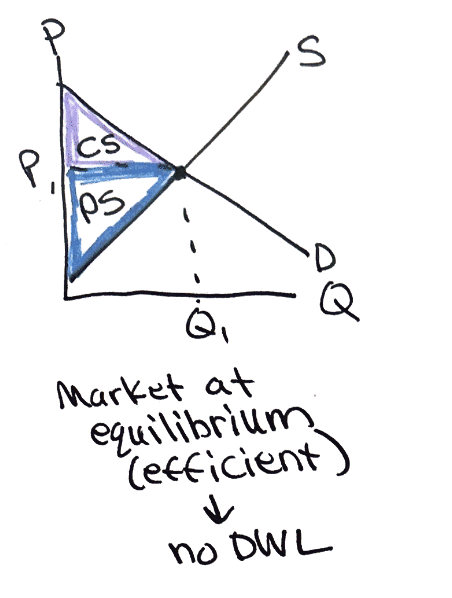
\
without trade
17
New cards
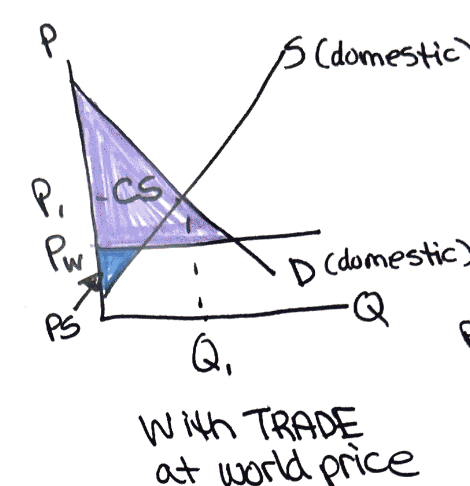
with trade
18
New cards
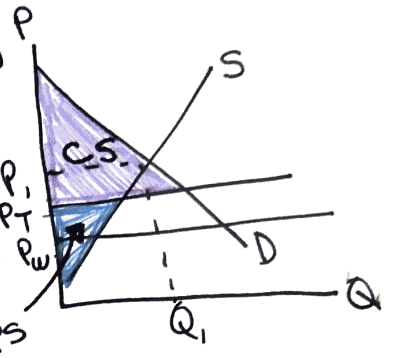
with tarriff