Environment and population
 Call Kai
 Learn
Learn Practice Test
 Spaced Repetition
 Match
Match Flashcards
 Knowt Play
1/32

There's no tags or description
Looks like no tags are added yet.
Name | Mastery | Learn | Test | Matching | Spaced | Call with Kai |
|---|
No analytics yet
Send a link to your students to track their progress
33 Terms
How do birth rates differ globally?
- All of the high birth rate subjects are in Africa and are either LICs or NEEs
- This could be perhaps due to a lack of contraception or the need for a larger workforce (mainly based in agriculture) in LICs
- All of the low-birth rate countries are in Europe or East Asia and are HICs
What is the IPAT question?
I = P x A x T
(Environmental) Impact = Population x Affluence x Technology
- environmental impact is in terms of resource depletion or waste accumulation
- population is the size of the human population
- affluence is the level of consumption by that population
- technology is the processes used in obtaining resources and manufacturing them into products and wastes
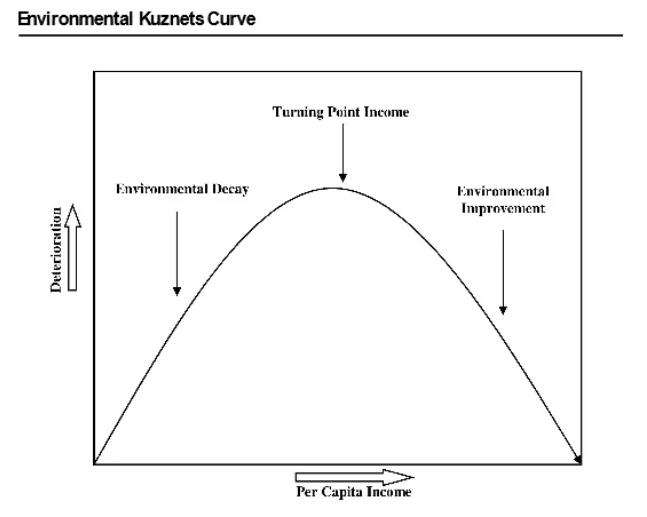
Draw and explain Kuznet’s curve
- Initially used to show how economic opportunities change as a country develops, the curve can also show changes in environmental degradation
- In summary, Kuznet says that in early development the priority is economic development, and after a country is developed it can begin to invest to become more environmentally sustainable
Define ecological footprint
Ecological footprint is the sum of all the cropland, grazing land, forest and fishing grounds required by a country to produce the food, fibre, and timber it consumes to absorb the wastes emitted when it uses energy and to provide space for infrastructure.
Define an agricultural system
An agricultural system is a primary industrial system with inputs (both physical and human), processes, and outputs in which the overall aim is to produce crops for human consumption and/or commercial sale.
- Physical inputs are dependent on the type of agriculture undertaken (arable or livestock)
- Human inputs are dependent on both the type of agriculture and the physical characteristics/ conditions of the area in which the agriculture is undertaken
Define subsistence farming, commercial farming, pastoral, arable farming, dairy farming, organic farming, shifting farming, plantation farming, market gardening, Mediterranean farming and grain farming
Subsistence farming involves only rearing enough animals and/ or growing enough crops to support the immediate household for sale.
Commercial farming is for the purpose of making a profit. This often involves the production of a monoculture – where all resources are invested in the specialized production of a single crop, such as coffee.
Pastoral farming is the keeping or grazing of livestock, mainly sheep or cattle.
Arable farming is the production of crops.
Dairy farms are devoted chiefly to the production of milk (and potentially the manufacture of butter and cheese).
Organic farming relies on ecosystem management rather than external agricultural inputs in order to improve sustainability and limit negative environmental impact; they do not use chemical fertilizers or pesticides.
Shifting farming is a form of agriculture in which an area of ground is cleared and cultivated for a few years. It is then abandoned for a new area until its fertility has been naturally restored.
Plantation farming is an extensive form of agriculture involving large areas of land where a single crop is grown for profit.
- semi-skilled and unskilled laborers are often employed by a central (often foreign-owned company) to undertake all aspects of the crop production process
Market gardening is a relatively small-scale production of fruits, vegetables, and flowers, sometimes referred to as horticulture, for commercial sale and profit creation.
Mediterranean farming is a mixed form of farming in which cereals, vegetables, fruits (especially olives, figs, and dates), and livestock are produced.
- highly specialized
Grain, also known as cereals, is the commercial and subsistence production of the seeds of grasses such as wheat, oats, rice, and corn.
Give a location and climate description of polar tundra
Location:
- Found in both northern and southern hemispheres (above 66 latitude)
- includes the Arctic Circle and the continent of Antarctica
Climate:
- very low mean annual temperatures
- range from -40 to 10 degrees Celsius in the Arctic
- can reach -80 degrees Celsius in Antarctica
- precipitation less than 100 mm annually (making them polar deserts), and precipitation is mainly snow
- Tundra are the areas of permafrost that fringe the ice caps at the poles.
Describe the human activities which occur in Polar tundra
- The Arctic Circle has a population of around 4 million people (the largest settlement being in Russia)
- Indigenous groups, such as the Sami and Inuit, migrate with the seasons to be closer to food sources
- agriculture is mainly pastoral, using traditional methods of fishing, hunting, and reindeer herding
- adventure tourism during the summer months brings income to local economies
- commercial fishing can occur in the summer months in the Arctic (as the ice melts to allow ships to pass)
- natural resource reserves (oil and gas) to be extracted and burned for fuel
- Antarctica has no permanent residents
- permafrost makes the development of buildings and roads incredibly difficult
- thin frozen soils mean arable agriculture is incredibly challenging, and can not support lots of people
- anaerobic conditions within the soil
What are the threats to polar tundra
- climate change is causing the melting of glaciers
- also creates the threat of extinction for animals such as polar bears
- much pressure to exploit the natural resource reserves for profit
Give a location and climate description of the tropical monsoon climate
Location:
- Mainly on the Eastern sides of continents in the tropics between 5- 20 N and S
- Determined by the annual movement of the Inter Tropical Convergence Zone
Climate:
- Hot, average temperature of 30 degrees Celsius
- High humidity
- Wet monsoon season and cooler dry season (over 1000 mm yearly)
- Frequent tropical storms at the end of the monsoon season
Describe the human activities that occur in the tropical monsoon climate
- The warm and wet climate produces high yields from arable agriculture, supporting larger populations
- over 4 billion people live in the Asian countries with a monsoon season
- no need for artificial irrigation
- rice and tea crops are examples of crops produced in this climate
- dairy farms rely on monsoon rains to feed the cows
- India is the world’s largest milk producer in the world
- Monsoon climate provides the opportunity for hydroelectric power plants, to produce electricity- The warm and wet climate produces high yields from arable agriculture, supporting larger populations
- over 4 billion people live in the Asian countries with a monsoon season
- no need for artificial irrigation
- rice and tea crops are examples of crops produced in this climate
- dairy farms rely on monsoon rains to feed the cows
- India is the world’s largest milk producer in the world
- Monsoon climate provides the opportunity for hydroelectric power plants, to produce electricity
What are the threats to the tropical monsoon climate?
- heats have become more extreme due to global warming
- tropical storms become more frequent and unpredictable
- risks of flooding and damage to infrastructure
How is food production changing the plant ?
- More than half of the global population lives in cities at present; t*his number is expected to swell by 3 billion people by the end of the century*. This means more agriculture will need to occur nearer to cities, especially is LICs and MICs with lots of urban growth.
- Aquaculture directly competes with the natural environment: marine fish farms often need the shelter of bays/ estuaries to avoid damage; this takes the habitat of other marine life and wild fish who also need this shelter. European fish farms have been placed in migratory routes of wild salmon, and mangroves in Asia and Latin America have been cleared to make space for shrimp farms.
- Big food producing countries, such as the US, China, India, Pakistan, Australia and Spain, are close to reaching or have reached the limit of their renewable water sources. Partly, this is a result of unsustainable and wasteful water consumption, such as leaking irrigation or cultivating crops unsuitable for the environment.
- Farming accounts for 70% of total water consumption. In addition, agriculture is a major polluter of water sources; run off from fertilizers and manure disrupt local ecosystems.
- Unsustainable agriculture is leading to the loss of 12 million hectares of productive land, due to desertification. Land degradation affects an estimated 30% of the global land area.
Desertification is land degradation in arid, semi-arid, and sub-humid areas, resulting from several factors including climatic variations and human activities.
- Area of land used for agriculture globally is unlikely to increase greatly, but this is at the expense of more intensive land use practices which can cause land degradation.
- Agriculture is responsible for increased rates of soil erosion, due to the clearing of natural vegetation and exposed topsoil being washed or blown away. For example, Brazil loses 55 million tonnes of topsoil every year, reducing soil fertility.
- Agriculture is among the greatest contributors to global warming, emitting more greenhouse gases than all of our cars, lorries, trains and airplanes combined. These emissions are largely from methane (released by cattle and rice farms), nitrous oxides for fertilized fields, and CO2 for deforestation.
How and why is food production likely to change in the future?
- Climate change - altered temperatures and precipitation patterns, and increased potential for extreme events such as droughts and floods, is likely to decrease yields and increase production risk.
- Lower income countries are more vulnerable to the effects of climate change owing to the predominance of agriculture within their economies and limited availability of capital for adaptation and mitigation of risk
- Farming already covers 38% of the world’s land area and 50% of habitable land area. It is predicted that in developing countries, a further 120 million hectares of natural habitats will be converted to farmland to meet the demand of a growing population.
- Prosperity is driving an increased demand for meat, eggs, and dairy. This also increases pressure to grow more corn and soybeans in order to feed the animals. If this continues, population growth and richer diets will require us to double the amount of crops grown by 2050.
- Over the past 20 years, a group of more than *40 ‘least developed countries’ have seen a* 10% decrease in domestic food production
- Economic development has increased average incomes, and the amount of food consumed per person. Greater consumption increases demand and puts greater pressure on agricultural systems.
- Global warming means that more places will have warmer temperature which are more suitable for agriculture, and so brings benefits. Growing seasons will also lengthen, and overall yields will increase. Similarly, warming of grasslands may increase pasture productivity as there is less need to supplement livestock feed.
- Extreme events like coastal flooding or droughts may decrease productivity and increase rates of evaporation (extreme heats), reducing soil moisture and fertility. Agricultural pests are also more likely to flourish.
Draw a diagram of the soil levels
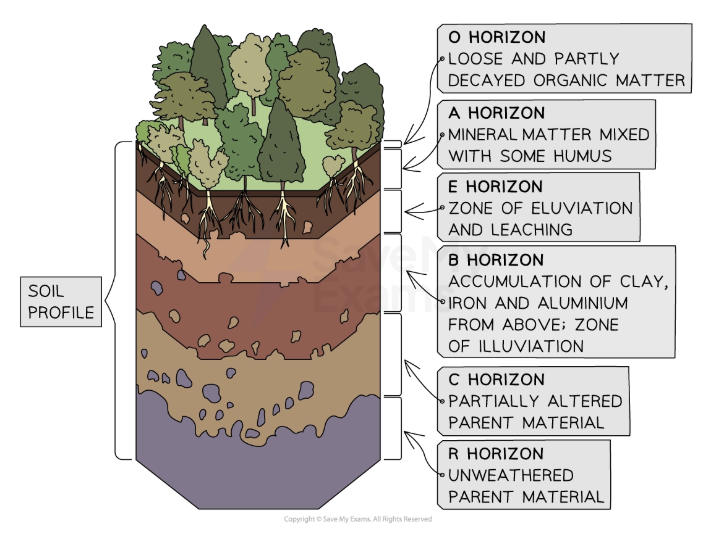
What are zonal soils?
Zonal soils have been under development for a very long period of time and therefore show characteristics clearly attributable to the biome in which they are found.
How do zonal soils form?
Tropical climates, with high temperatures and high rainfall, yield deep, strongly weathered and leached soils with a low nutrient content. Lush vegetation is almost the only source for replenishing nutrients
Arid climates (low rainfall and high evaporation) have soils with variable amounts of easily soluble components (e.g. calcium carbonate), which are left behind after the evaporation of water. Nutrient content is limited by the vegetation density
Soil formation in temperate climates is more or less restricted to the warmer part of the year, resulting in less weathered and shallower soils compared to tropical regions.
The technical term for soil formation is pedogenesis.
Explain soil problems and management
Soil erosion is the wearing away of nutrient-rich topsoil by the natural physical forces of water or wind, or by farming.
- topsoil is the most fertile layer because it contains the most organic, nutrient-rich materials.
- water erosion is judged to be more serious than wind erosion
Causes: deforestation, flat land
Waterlogging is the saturation of soil with water, to a point where enough pore spaces in the soil are occupied by water rather than air for there to be insufficient oxygen for plant respiration.
- lack of oxygen causes root tissues to decompose
- surface-fed waterlogging happens when precipitation, irrigation water, or river floodwater exceeds the combination of evapotranspiration and percolation so that water remains on the soil surface.
- Groundwater-fed waterlogging is caused when the rate of rising groundwater is not matched by the rate of evapotranspiration.
- this can be either a natural rise of caused by seepage from irrigation canals.
Salinization is the process by which non-saline soil becomes saline, occurring when water evaporates at high temperatures, which draws salt from the soil water to the surface.
- salt can be directly toxic to plants
- it’s biggest effect is that it decreases the osmotic potential of soil
- excessive irrigation can also contribute towards salinization
Treatment: flushing the soil with lots of water can remove the salt, but results in the salinisation of rivers and groundwater.
Structural deterioration means that the soil compacts, reducing poor space so that water drainage and gaseous exchange are limited. It is also harder for plant roots to penetrate the soil.
- often heavy machinery can cause this
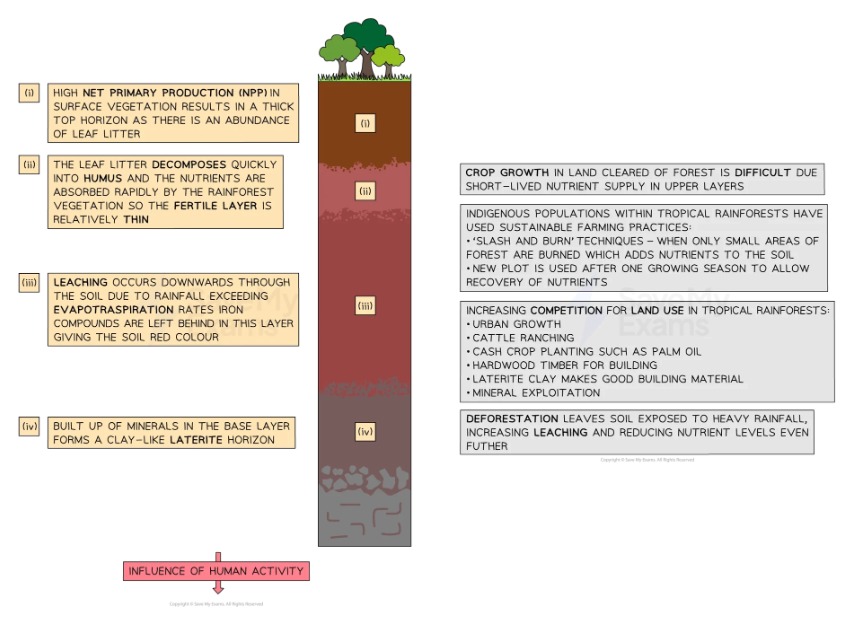
Draw a diagram of latosols and describe them
Latosols are deep, intensely weathered soils found in tropical regions.
- they occupy 6% of the Earth’s continental land surface (mainly in Brazil, the Congo River Basin, Guinea, and Madagascar)
- often red or yellow
- low soil pH promotes the build-up of iron and aluminum compounds in the B horizon
- this restricts access to nutrients in the lower soil levels
- iron oxides in the B horizon also contribute to the accumulation of clay
- most nutrients are in organic matter deposited on the surface
- these are either quickly taken up by roots or leached away (due to high rainfall)
- removal of vegetation removes most of the nutrients in the ecosystem
- well-drained, meaning they are less vulnerable to soil erosion but more vulnerable to drought conditions
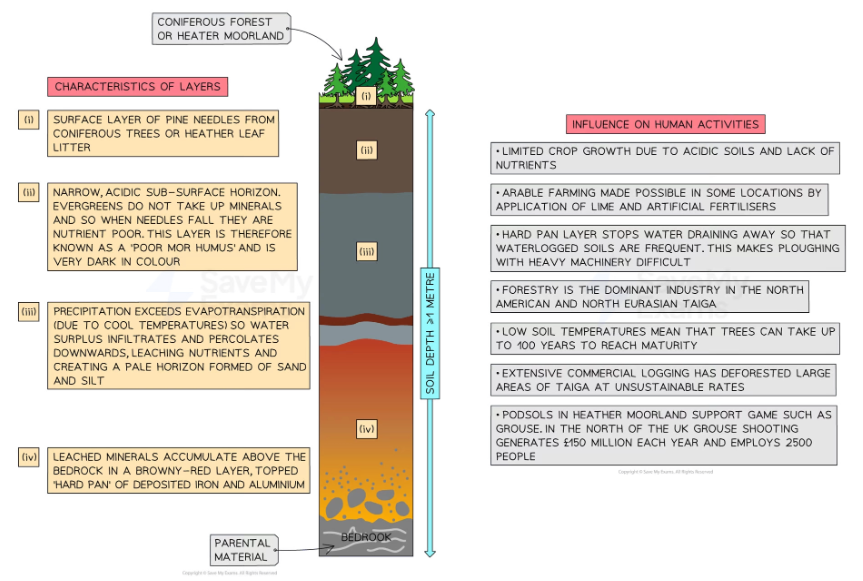
Draw a diagram of podzols and describe them
Podzols are mature soils that take between 3000 and 5000 years to develop. They have clearly defined horizons and are found in places with high precipitation and cool temperatures.
- they occupy almost 4% of the total continental land area, such as in Scandinavia, Russia, Canada, South America, Australia, and Indonesia
- mix of dark and ash-grey horizons, sometimes with red iron compounds
- low pH
- evergreen trees grow well and deposit litter throughout the year
- nutrients stored for a long time in the O and A horizons
- cool temperatures mean a low rate of decomposition
- Severe leaching occurs between A and E horizons (zone of eluviation)
- podzols are low in nutrients and very acidic, making them unsuitable for arable farming
- instead, podzols can be used for forestry, recreation, or extensive grazing
Define food security and list the three pillars
Food security exists when all people at all times have access to sufficient, safe, nutritious food to maintain a healthy and active life.
This relies on the following three pillars:
- Food availability: sufficient quantities of food available on a consistent.
- Food access: having sufficient resources to obtain appropriate foods for a nutritious diet.
- Food use: appropriate use based on knowledge of basic nutrition and care, as well as adequate water and sanitation.
What is the green revolution?
The Green Revolution is a large-scale technological approach to a worldwide food shortage focused on the tropics and sub-tropics (where principal food crops were rice, wheat, and maize). This happened in places such as Mexico, India, China and Indonesia.
What did the green revolution involve?
Biochemical changes-
- hybrid seed selection, which led to increased yields of wheat, rice, and maize
- fertilizers, increasing yields
- herbicides and pesticides, which controlled weeds and pests
Mechanical changes-
- irrigation by diesel and electric pumps, which control the water supply
- tractors and farm mechanization, which increases arable land and reduces the labour force
- transport roads and vehicles mean crops can move quicker to the markets
Social changes-
- land reforms mean some farm consolidation and more incentive
- facilities to borrow money means farmers can obtain better seeds and machinery
- changes in distributive systems mean there are increased incentives
What were the successes of the green revolution?
- High yield varieties meant yields of rice and wheat virtually doubles between 1970 and 1990
- Increased income meant farmers could buy more land, and so grow more food
- Increased availability meant rice and wheat became more affordable
- Poverty declines from nearly 3 out of 5 Asians in 1975 to less than 1 in 3 Asians by 1995
- Less land needs to be used for farming
What were the problems with the Green Revolution?
- Environmental degradation from excessive use of fertilizers and pesticides
- Critics argue that larger farms felt the largest impact from the Green Revolution, because of the technology they already had such as fertilizers and irrigation systems
- Pushed unnecessary mechanization, reducing employment
- Only implemented in areas with irrigation or high rainfall, worsening regional inequalities
- Technologies too expensive or inappropriate for much of Africa
How have scientific innovations affected farming?
Nutrient harvesting and use (e.g. hydrogen, nitrogen):
- These are nutrients required by plants for growth, but soils often lack nitrogen due to erosion
Fertilizers and pesticides:
- Improve nutrient availability in the soil and reduce crop loss from pests and diseases
- e.g. the Green Revolution
How have technological innovations affected farming?
Use of geothermal energy:
- geothermal energy can be harvested to heat greenhouses
- especially where temperatures are to low to grow crops
- can be used in aquaculture
- reliable source of energy
- e.g. Iceland
Use of artificial heat and light:
- the use of greenhouses lengthens the growing season by maintaining consistent heat and light to maximize photosynthesis
- e.g. the Netherlands, the 2nd largest exporter of agricultural produce, has 25 square miles of greenhouses
Describe how pulses are important
Pulses, such as edible beans, dried peas, chickpeas, and lentils, are high in: protein, B vitamins, and micronutrients, and low in cholesterol. Pulses can be eaten by the farmer, as well as sold by them (unlike crops such as coffee). Crop residues are also useful for animal fodder and fertilizer, allowing farmers to expand into livestock farming.
Describe edible insects and their importance
In Cameroon, people farm the jungle for insects such as grasshoppers, which are high in protein, and turn them into stews of burgers. They are especially good for when the harvest is bad. Insects have a lot of potential for use as farm feed.
Describe floating gardens and their importance
In Bangladesh, farmers can adapt to flood conditions (6 months each year, the fields are covered in water). A Raft-type structure, constructed from water hyacinth, can be used to grow crops in/on. This is a biodegradable and readily accessible material that can support families, houses, and livestock during the flooded months. This means livelihoods and food supply can be maintained all year round.
Describe sandbar cropping and their importance
In Northwest Bangladesh, farmers move cultivation to areas of deposition (after river flooding) as these soils are higher in nutrients.
Describe floating gardens and their importance
In Bangladesh, farmers can adapt to flood conditions (6 months each year, the fields are covered in water). A Raft-type structure, constructed from water hyacinth, can be used to grow crops in/on. This is a biodegradable and readily accessible material that can support families, houses, and livestock during the flooded months. This means livelihoods and food supply can be maintained all year round.
Describe WTO Aid for Trade
Transformation of transport of mangoes from Mali, reducing shipping times from 25 to 12 days. This can be done by increasing storage facilities and improving testing facilities, so they can meet international standards.
Explore top notes

