Ch 44 - Osmoregulation & Excretion
 Studied by 0 people
 Call Kai
 Learn
Learn Practice Test
 Spaced Repetition
 Match
Match Flashcards
 Knowt Play
1/120

Earn XP
Description and Tags
for final purposes concept - KNOW 44.1-4!!
Name | Mastery | Learn | Test | Matching | Spaced | Call with Kai |
|---|
No analytics yet
Send a link to your students to track their progress
121 Terms
What does osmoregulation control?
osmoregulation controls solute concentrations and balances water gain and loss
what does excretion do ?
excretion rids the body of nitrogenous metabolites and other waste products
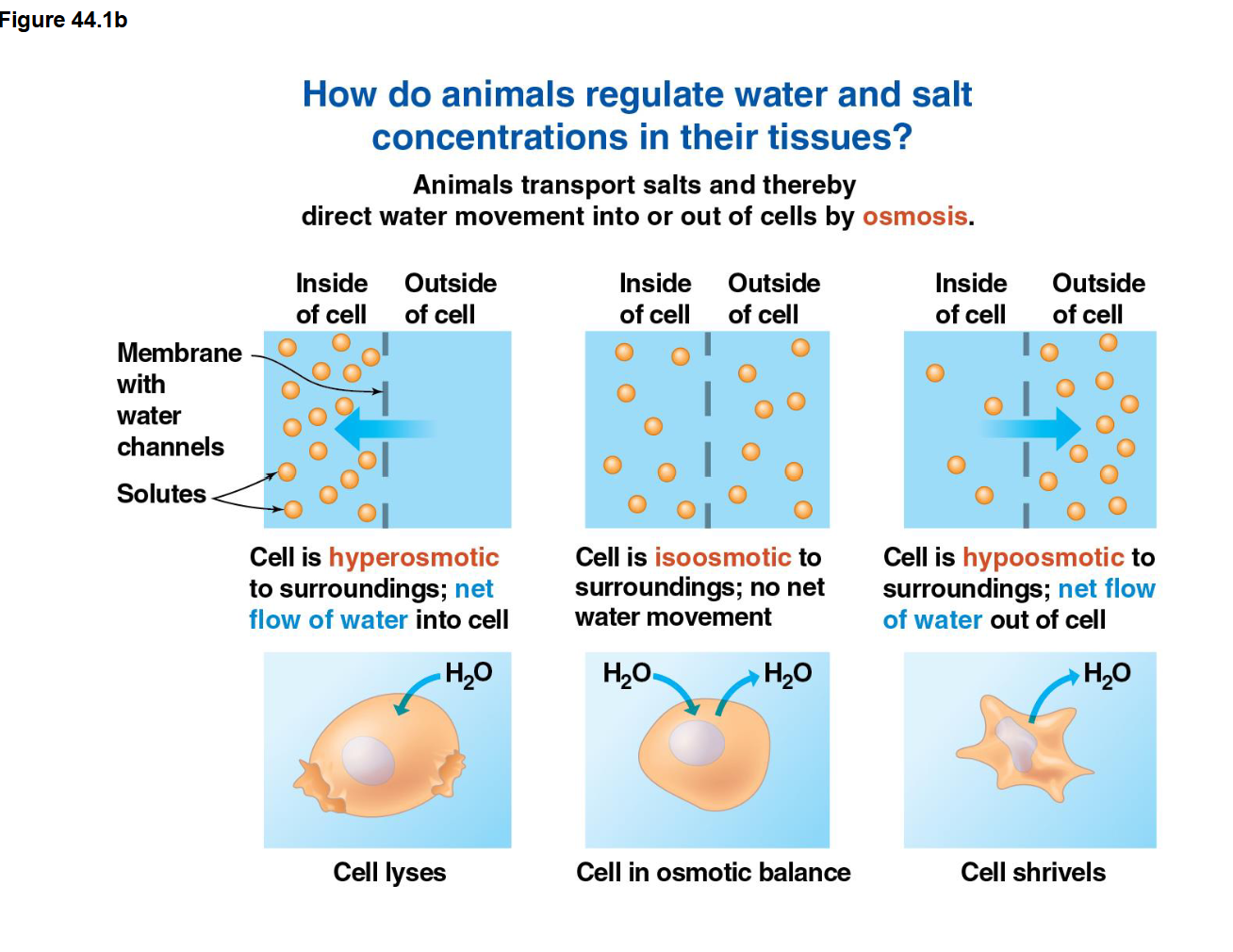
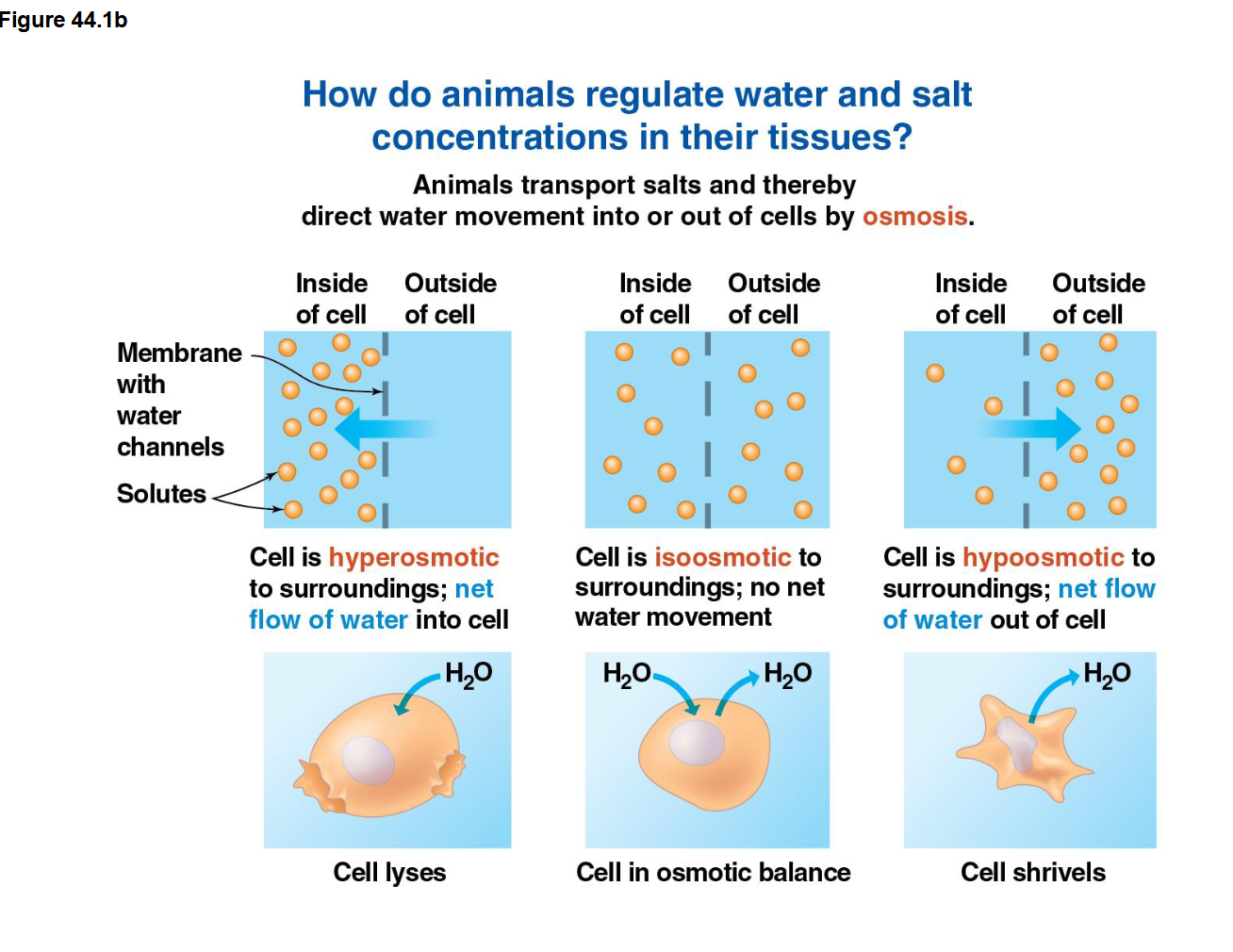
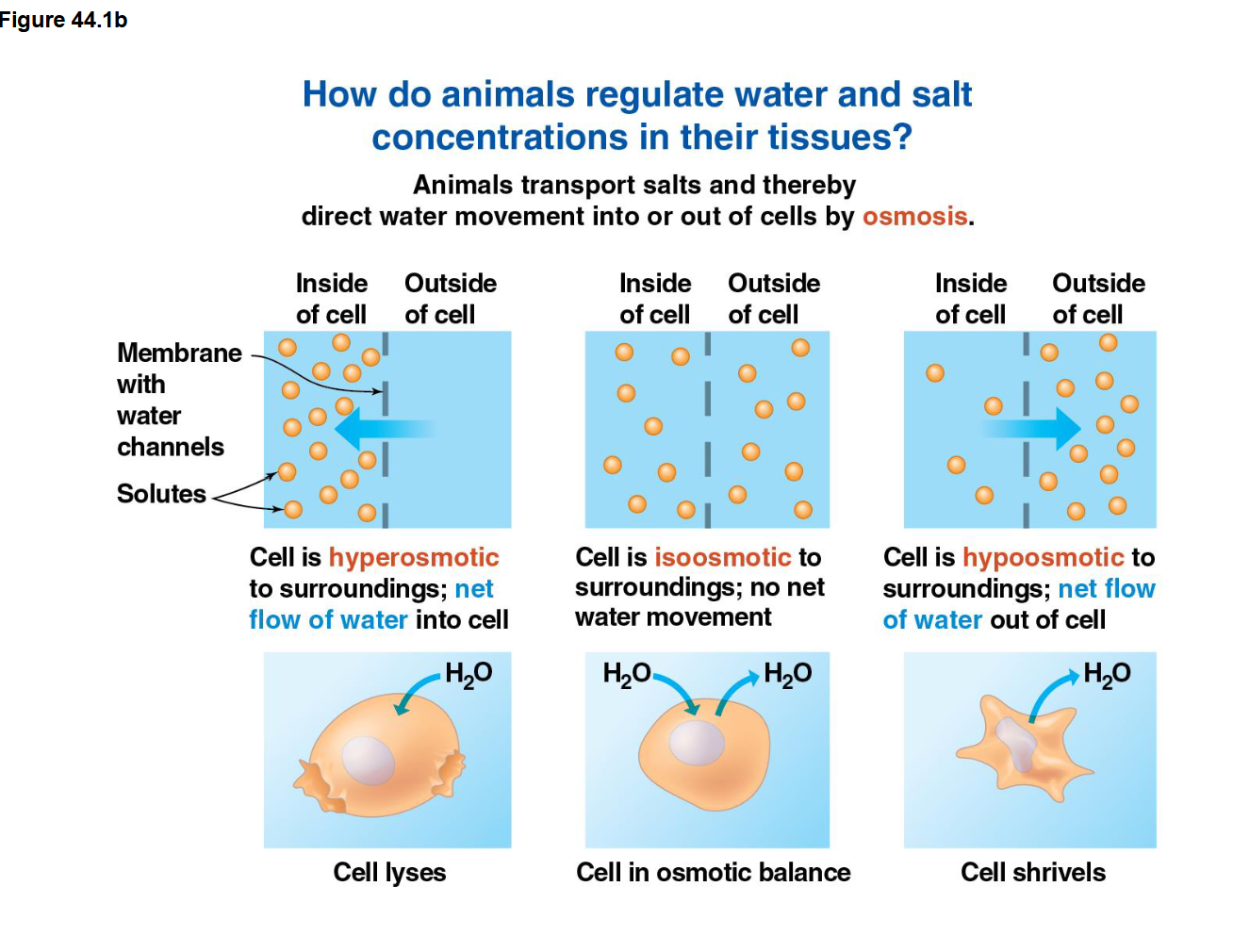
water enters and leaves cells by what process?
osmosis
what is osmolarity ?
the solute concentration of a solution, which determines the movement of water across a selectively permeable membrane.
if two solutions are isosmotic what happens to water molecules
if two solutions are isosmotic, water molecules will cross the membrane at equal rates in both direction
What is Bohr shift?
The Bohr shift is when increased CO2 lowers blood pH, reducing hemoglobin’s affinity for O2, which is released to tissues.
How does exercise affect hemogloblin-O2 binding?
During exercise, tissues produce more CO2 → lower pH, causing hemoglobin to release more O2 (bigger O2 drop between lungs and tissues)
Hemoglobin affinity for O₂ at lower pH
Hemoglobin affinity for O₂ at lower pH
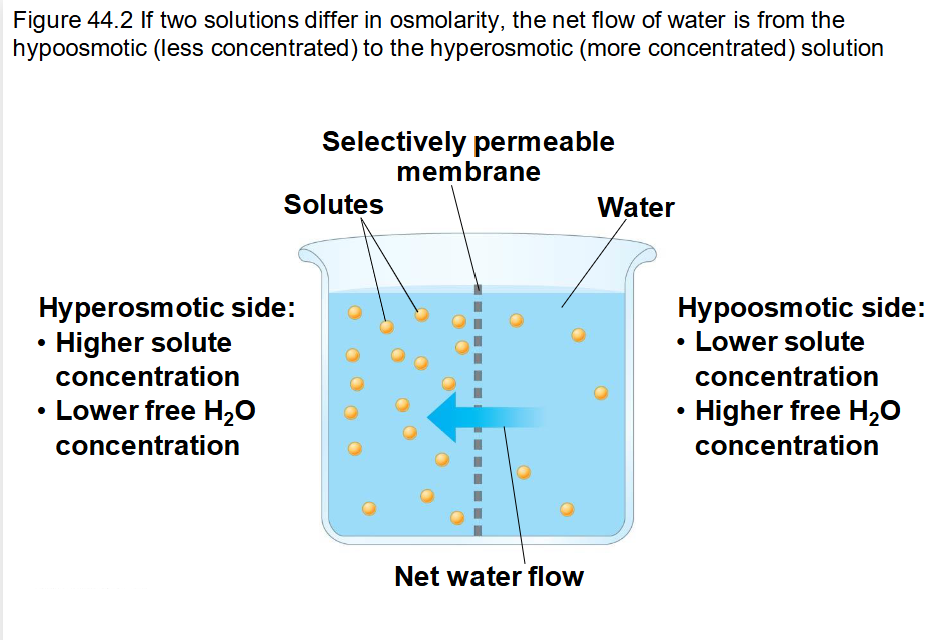
What happens to water movement when two solutions differ in osmolarity?
Water always moves by osmosis from the hypoosmotic (less solute, more free water), side to the hyperosmotic (more solute, free les water) side across a selectively permeable membrane
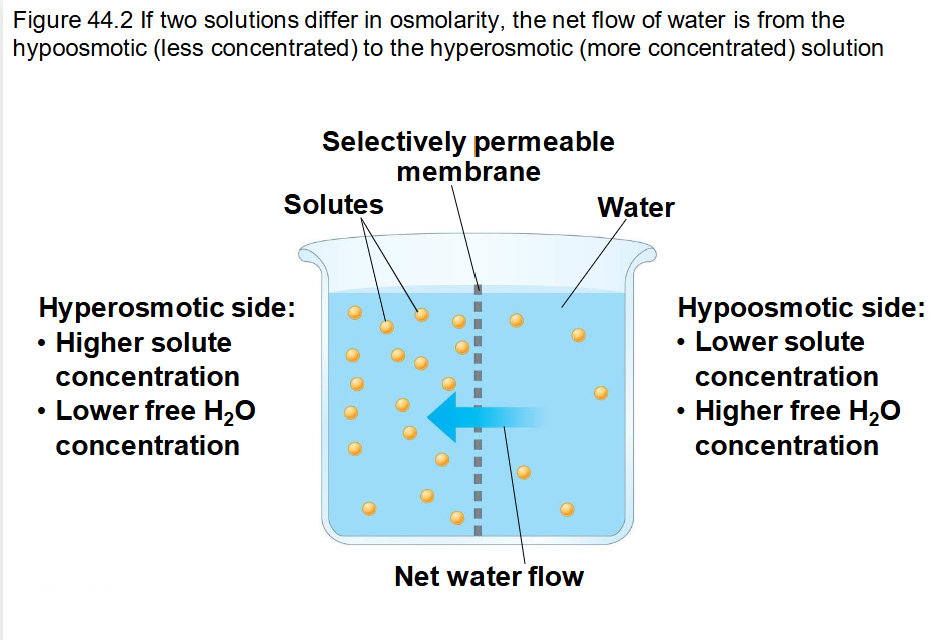
what describes hyperosmotic vs hypoosmotic sides?
Hyperosmotic side: higher solute concentration = lower free H2O
Hypoosmotic side: lower solute concentration = higher free H2O
(water flows toward they hyperosmotic side)
In what one of two ways can animals maintain water balance?
Osmoconformers and Osmoregulators
what are osmoconformers
are isoosmotic with their surroundings and do not regulate their osmolarity
what are Osmoregulators
expend energy to control water uptake and loss in a hyperosmotic or hypoosmotic environment
why cannot most animals tolerate substantial changes in external osmolarity
because most animals are stenohaline
Euryhaline animals can survive large fluctuations in?
external osmolarity
osmoconformers or osmoregulators: most marine invertebrates
osmoconformers
osmoconformers or osmoregulators: many marine vertebrates and some marine invertebrates
osmoregulators
Are marine body fishes hypoosmotic or hyperosmotic to seawater
hypoosmotic
how do marine animals balance water loss
they balance water loss by drinking large amounts of seawater and eliminating the ingested salts through their gills and kidneys.
How is osmoregulation connected to nitrogen waste?
it is often coupled with the elimination of nitrogenous wastes like urea
how do sharks tolerate high urea levels in their bodies?
they use TMAO (trimethylamine oxide) to protect proteins from urea’s harmful effects
How do sharks manage water and salt balance?
They gain water by osmosis and food, excrete excess water in urine, and remove diffused salt through urine.
Why do freshwater animals gain water constantly?
Their environment is hypoosmotic, so water enters their bodies by osmosis
How do freshwater animals maintain water balance
they do drink almost no water and excrete large amounts of dilute urine
how do freshwater animals replace salts lost by diffusion
from food and active salt uptake across the gills
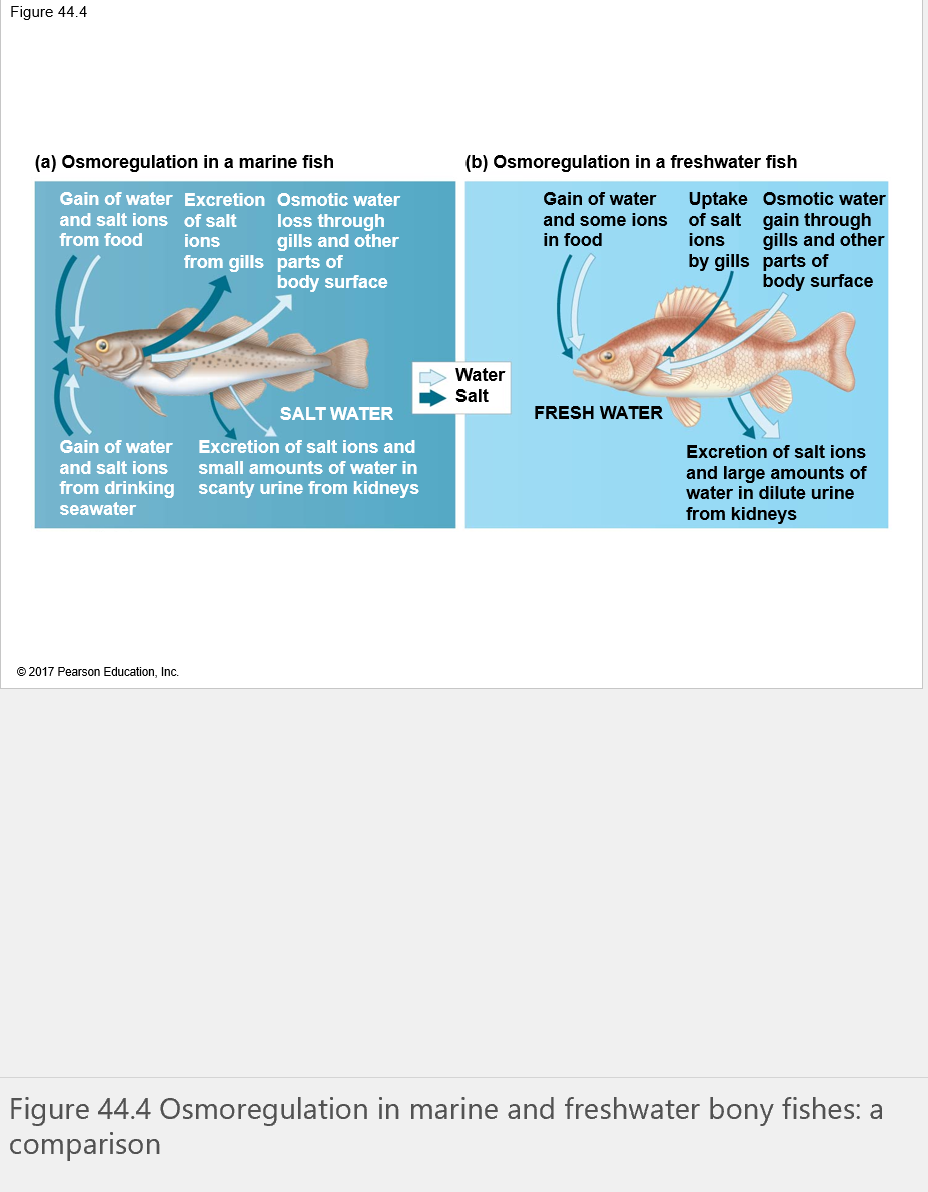
Marine body fish osmoregulation strategy?
Drink seawater → excrete salts at gills → small, concentrated urine
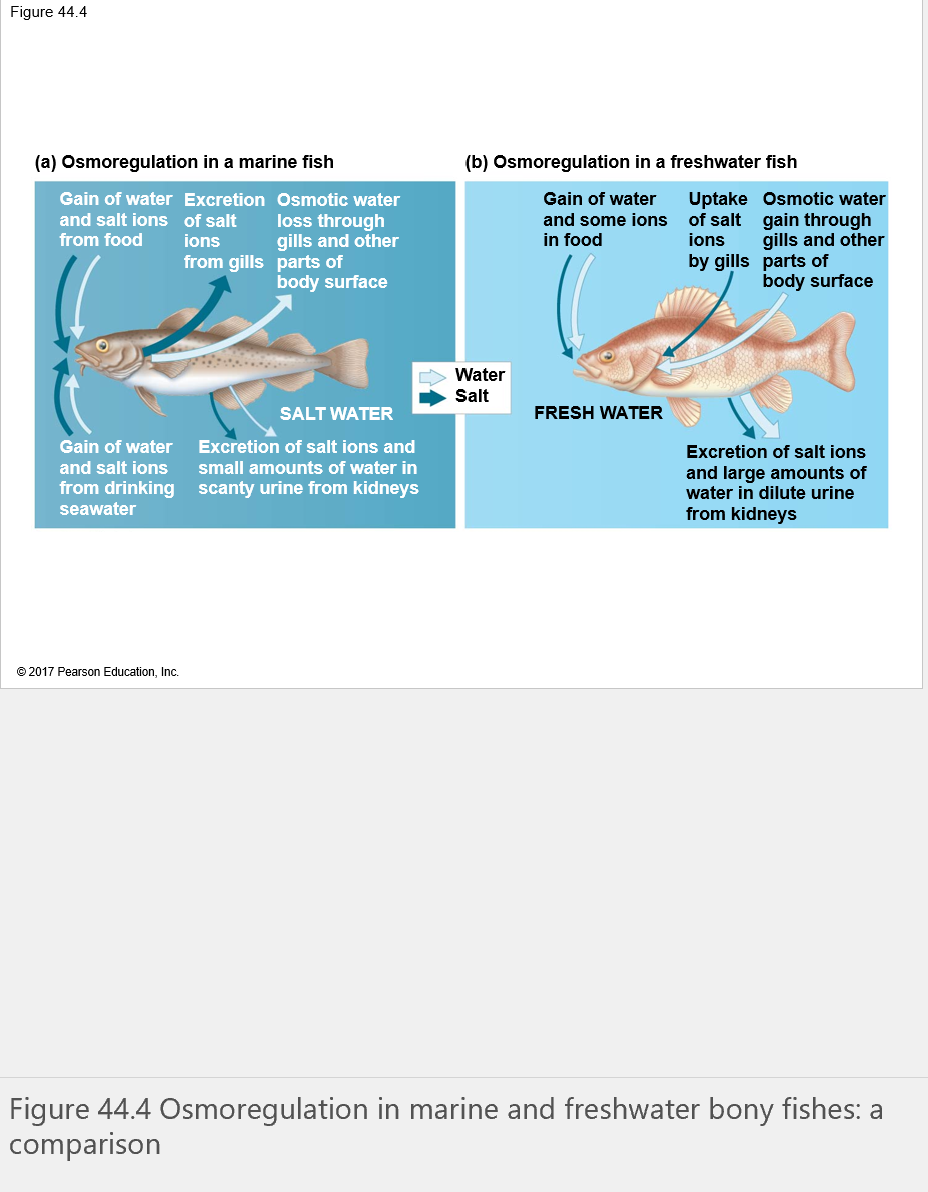
Freshwater bony fish osmoregulation strategy
Don’t drink water → uptake salt at gills → large, dilute urine
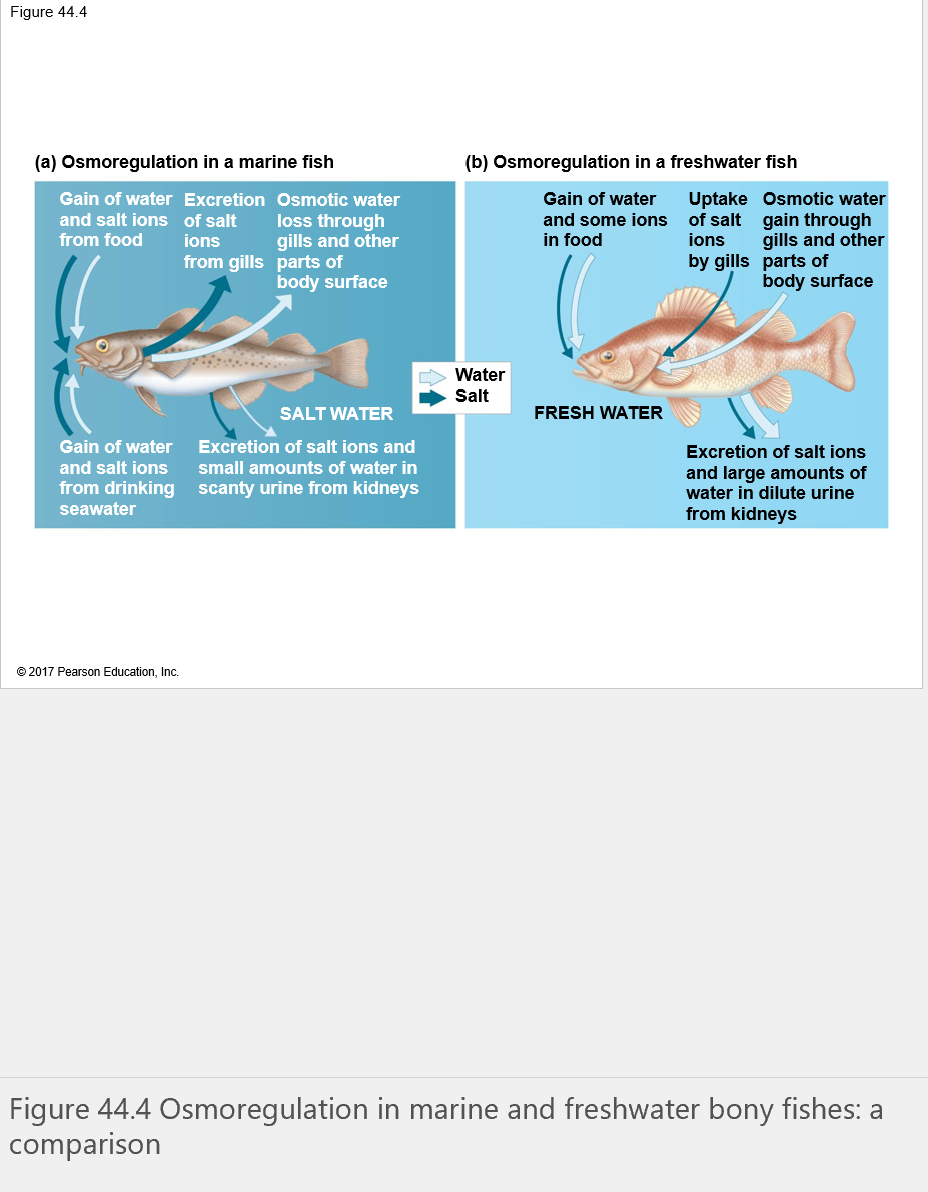
main challenge for marine vs. freshwater fish
marine = lose water, gain salt
freshwater= gain water, lose salt
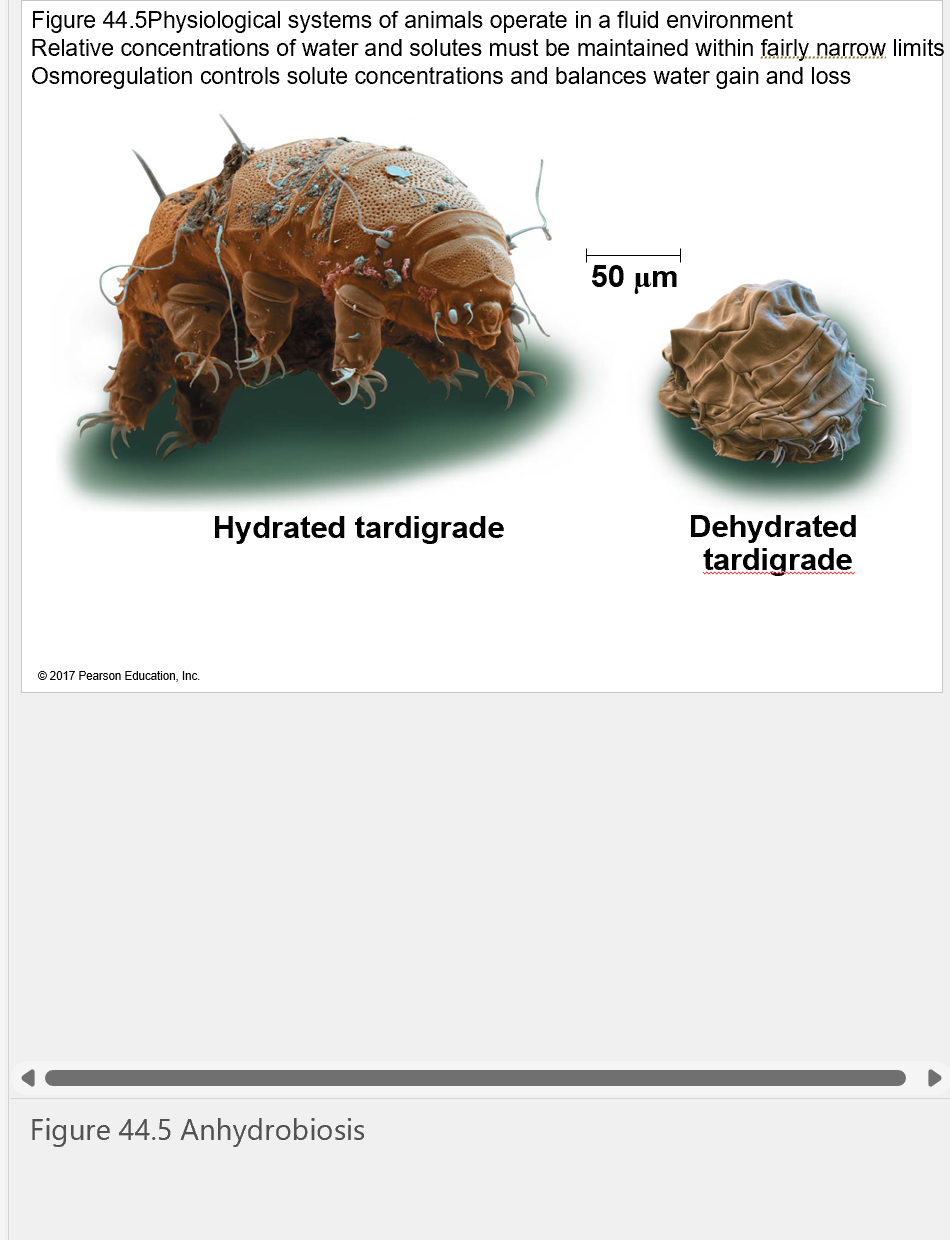
what is anhydrobiosis?
a state where animals (like tardigrades) survive extreme dehydration by losing almost all body water

why is osmoregulation important in animals
it keeps water and solute concentrations within tight limits to maintain normal physiological function
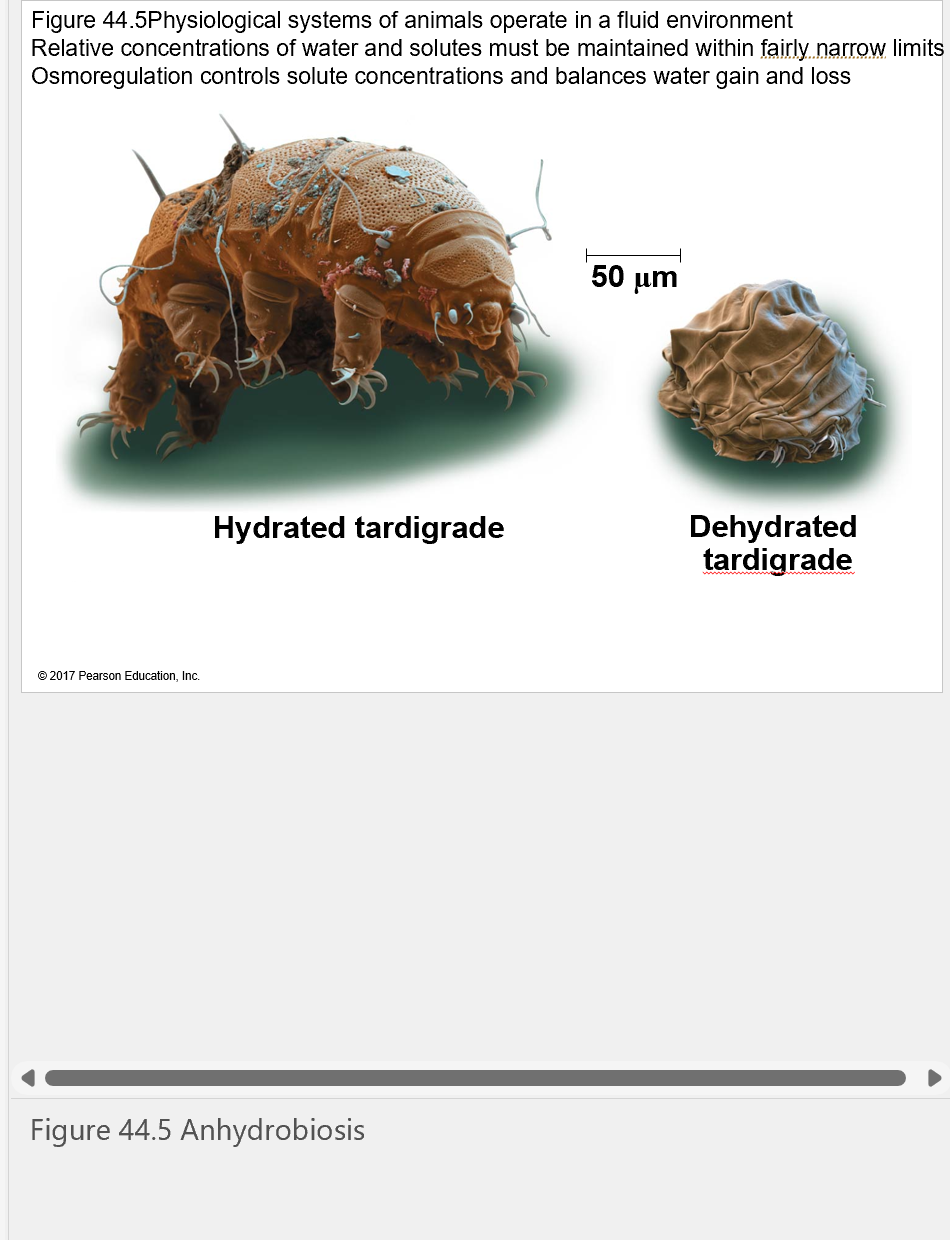
what happens to a tardigrade when dehydrated?
it shrinks into a dormant state but can revive when rehydrated
What is key for survival in terrestrial animals regarding water?
adaptations that reduce water loss
how do land animals prevent dehydration?
body coverings (skin, shells, etc ) and behavioral adaptations (like being nocturnal)
How do land animals maintain water balance?
eating moist food and producing metabolic water from cellular respiration
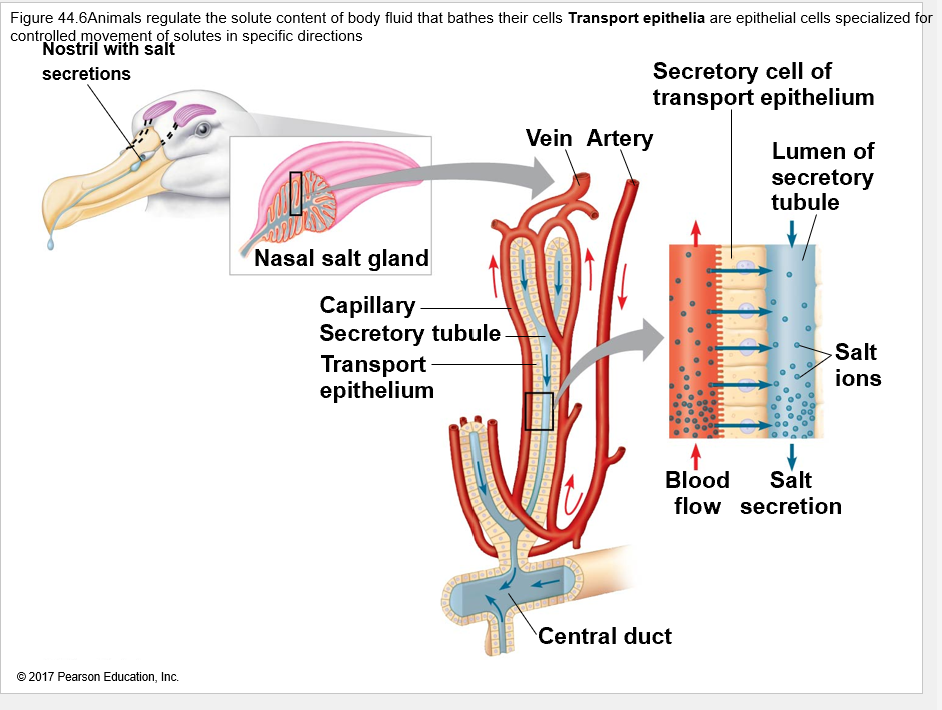
what is the role of nasal salt glands in marine birds?
they excrete excess salt from the bloodstream
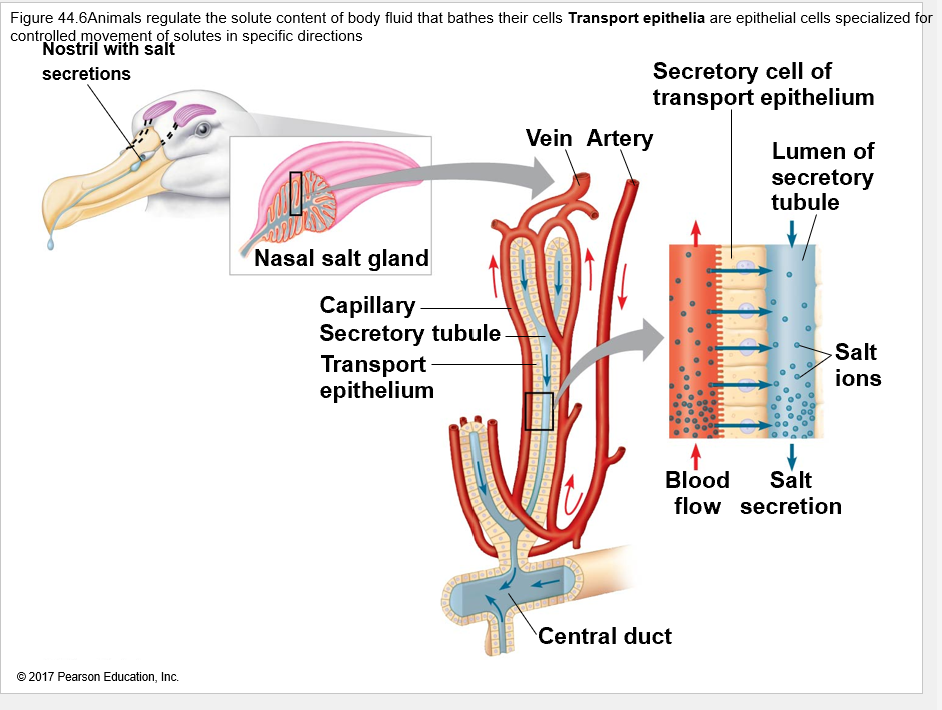
what types of cells allow salt secretion in these glands?
transport epithelium specialized for moving salt ions out of the blood
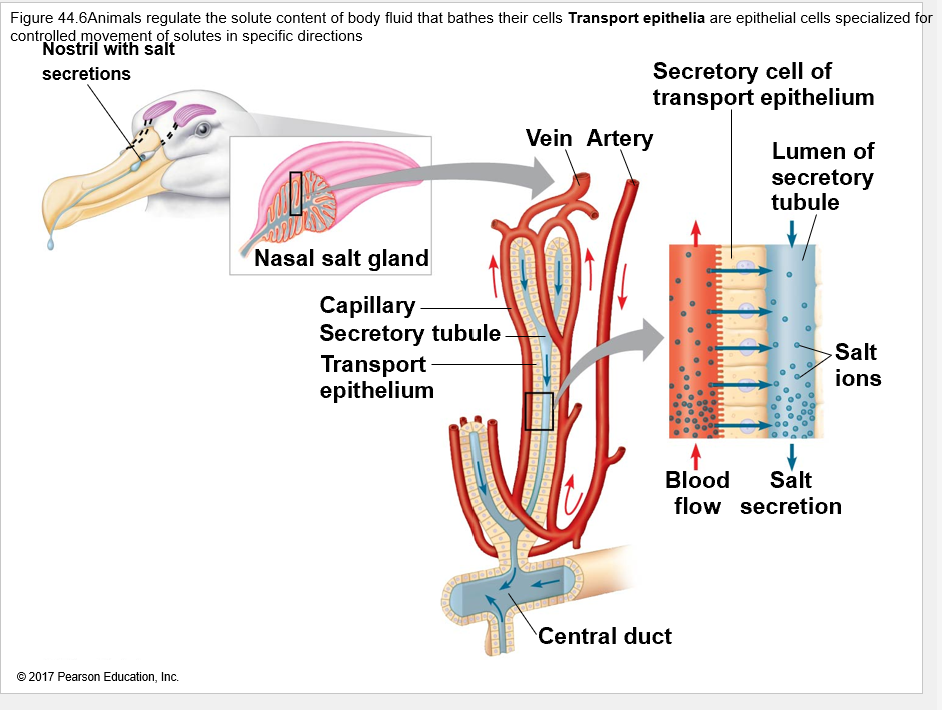
where does the secreted salt exit the body?
through the nostrils as salty fluid
What determines the type of nitrogenous waste an animal produces?
Its phylogeny (evolutionary history) and habitat.
Why are nitrogenous wastes important in osmoregulation?
Their type and amount strongly affect water balance.
Why do some animals convert ammonia to other compounds before excretion?
Ammonia is highly toxic, so many animals convert it to less toxic forms.
What do animals that excrete ammonia require?
Lots of water, because ammonia is very toxic and must be diluted.
how is ammonia released in many invertebrates?
across the entire body surface
Which animals excrete urea and why?
Most terrestrial mammals and many marine species → urea is less toxic than ammonia.
Where is urea produced and how is it removed?
Liver produces urea → blood carries it to kidneys → excreted in urine.
What is the trade-off of using urea?
Costs more energy to make but saves more water than ammonia excretion.
which animals excrete uric acid>
Insects, land snails, and many reptiles/birds
Why is uric acid useful for water conservation?
It is nontoxic, poorly soluble, and excreted as a paste with minimal water loss.
What is the cost of producing uric acid?
It is more energetically expensive than making urea
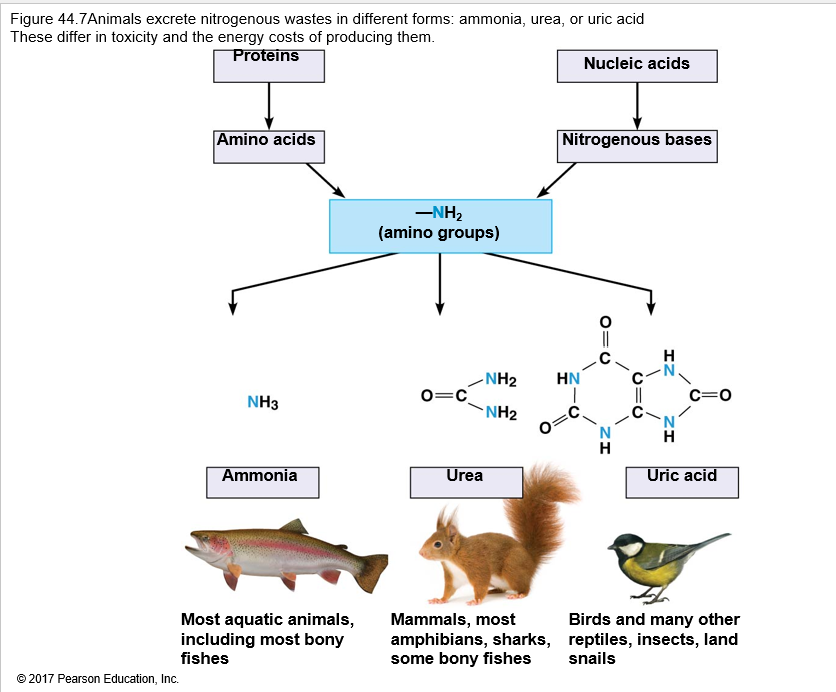
What produces nitrogenous waste?
Breakdown of proteins and nucleic acids → amino groups (NH₂).
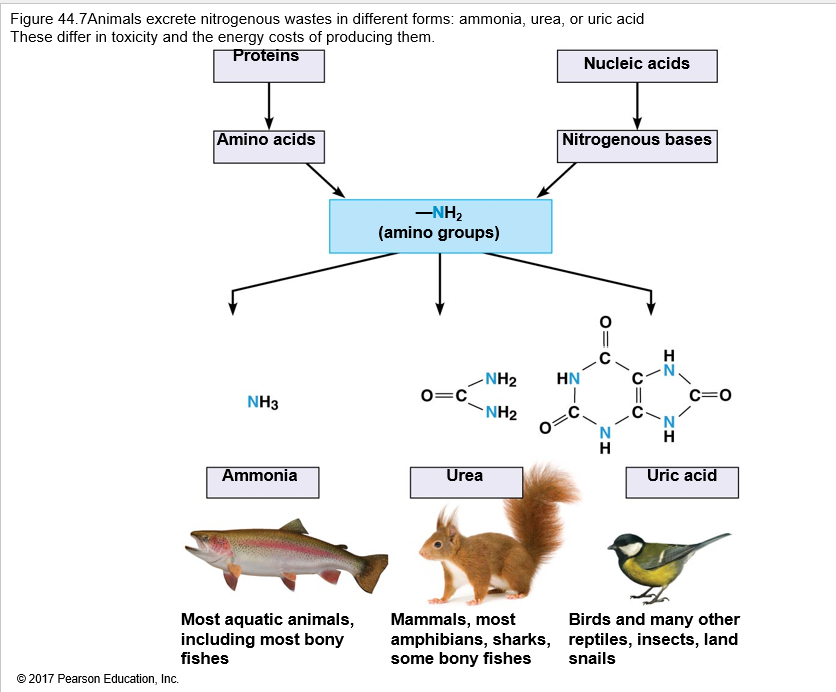
Which animals primarily excrete ammonia, urea, or uric acid?
Ammonia: most aquatic animals
Urea: mammals, amphibians, sharks
Uric acid: birds, reptiles, insects, land snails
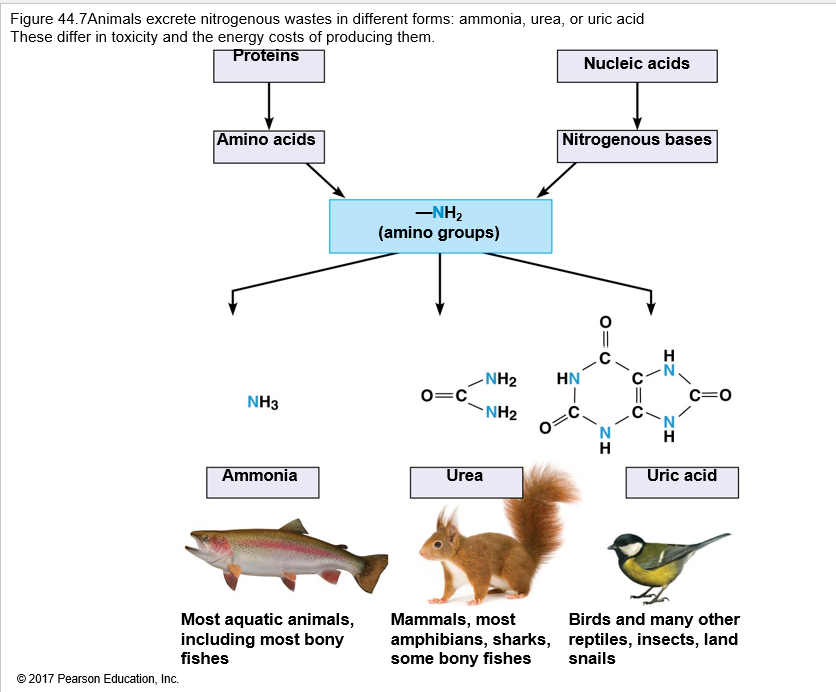
how do the three nitrogenous wastes differ?
Toxicity and energy cost of production
What determines which nitrogenous waste an animal excretes?
Evolutionary history + habitat, especially water availability.
Why does the type of egg environment matter?
Eggs with limited water must excrete less toxic forms (like uric acid).
How is nitrogenous waste linked to energy use?
The amount and type of waste ties into the animal’s energy budget.
What is the main function of excretory systems?
Regulate solute movement between body fluids and the environment.
Why are excretory systems important?
they are essential for homeostasis
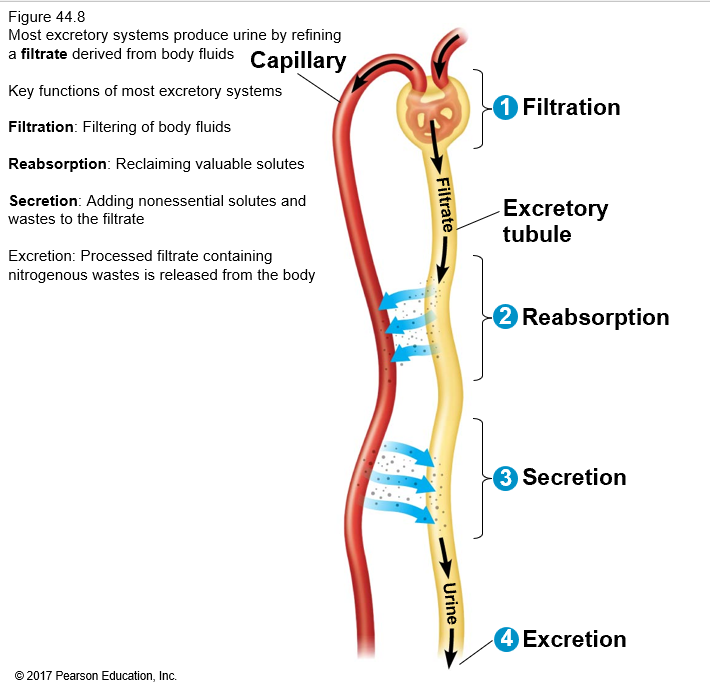
What are the 4 key steps of excretory system function?
Filtration → Reabsorption → Secretion → Excretion
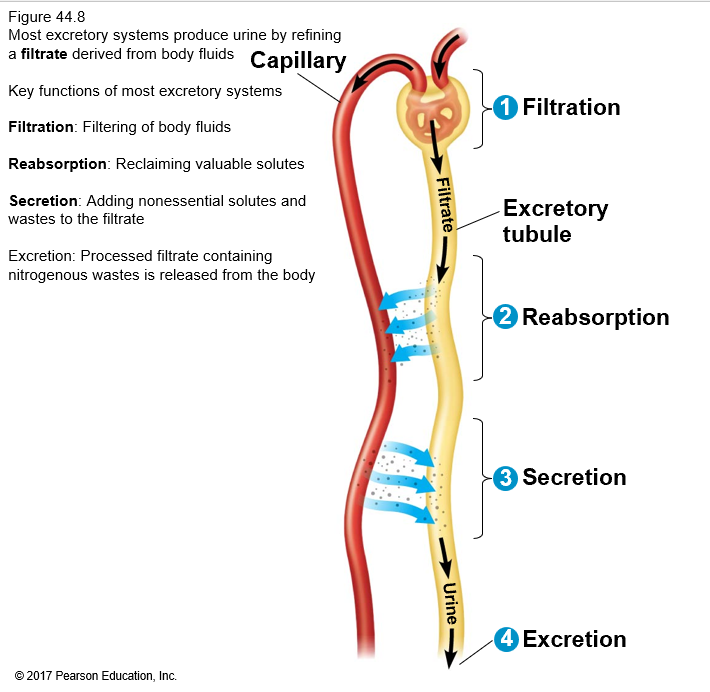
What happens in filtration?
Body fluids are filtered to form filtrate.
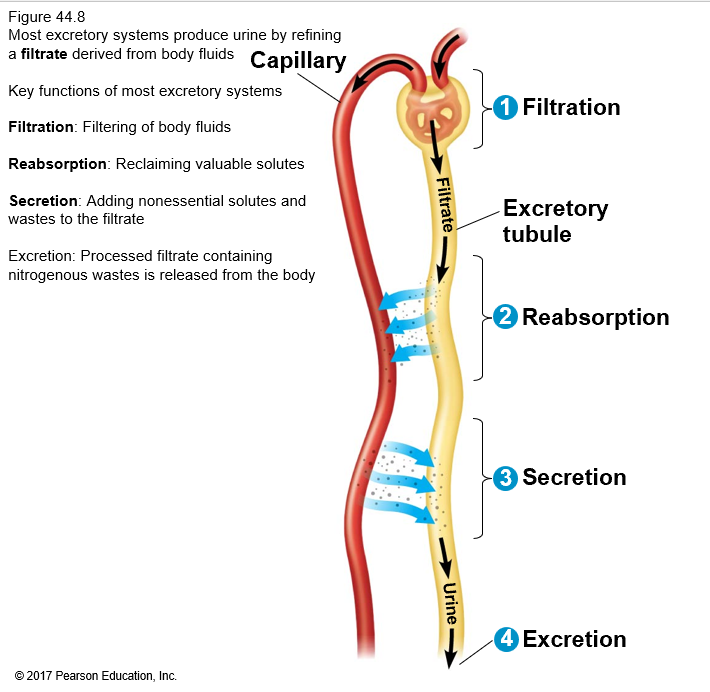
What happens in reabsorption vs secretion?
Reabsorption = reclaim valuable solutes
Secretion = add wastes/nonessential solutes to filtrate
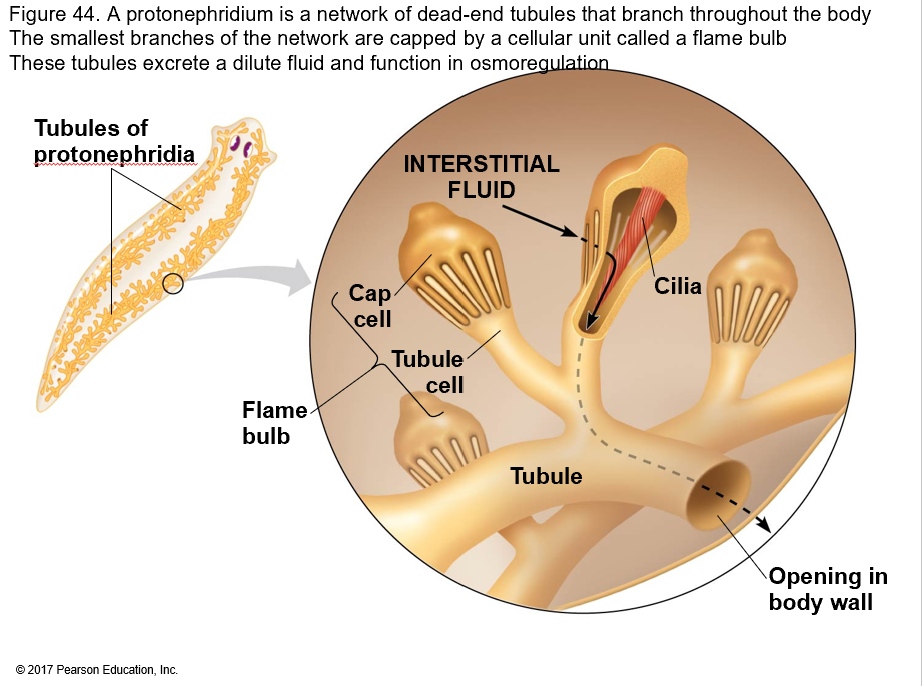
What do protonephridia excrete?
A dilute fluid through openings in the body wall to maintain water balance.

What are protonephridia and where are they found?
Networks of dead-end tubules used for excretion/osmoregulation in flatworms (planarians).
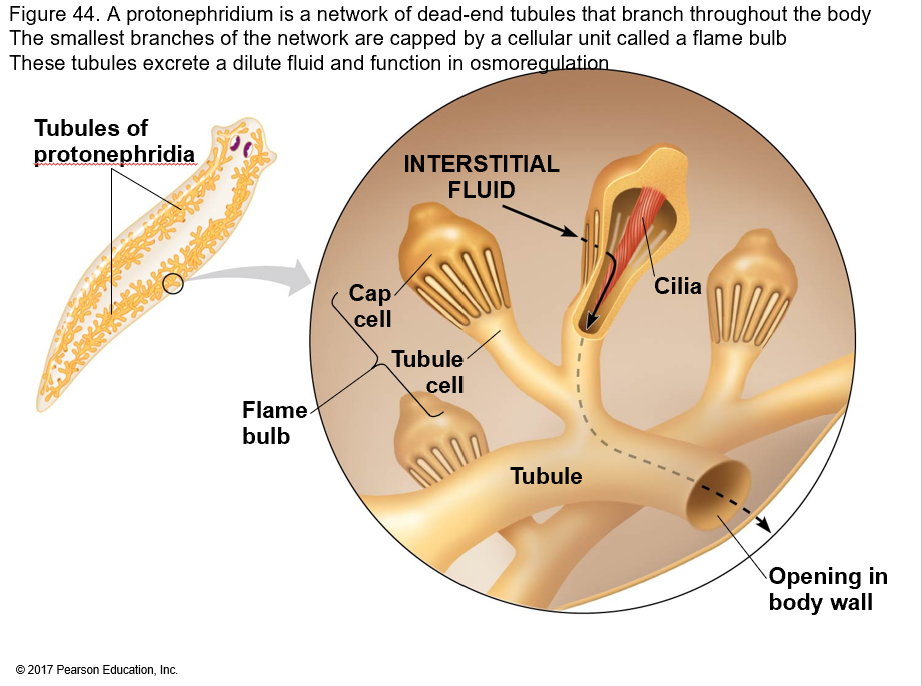
What is a flame bulb?
A cellular unit with cilia that draws fluid into the tubules.
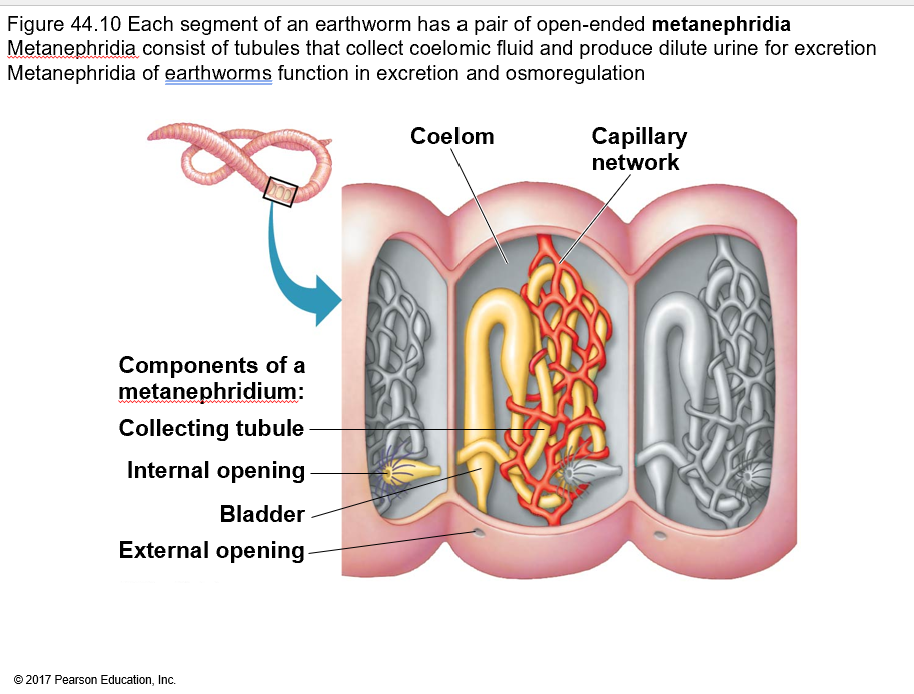
What are metanephridia and where are they found?
Excretory tubules in earthworms, one pair per segment.
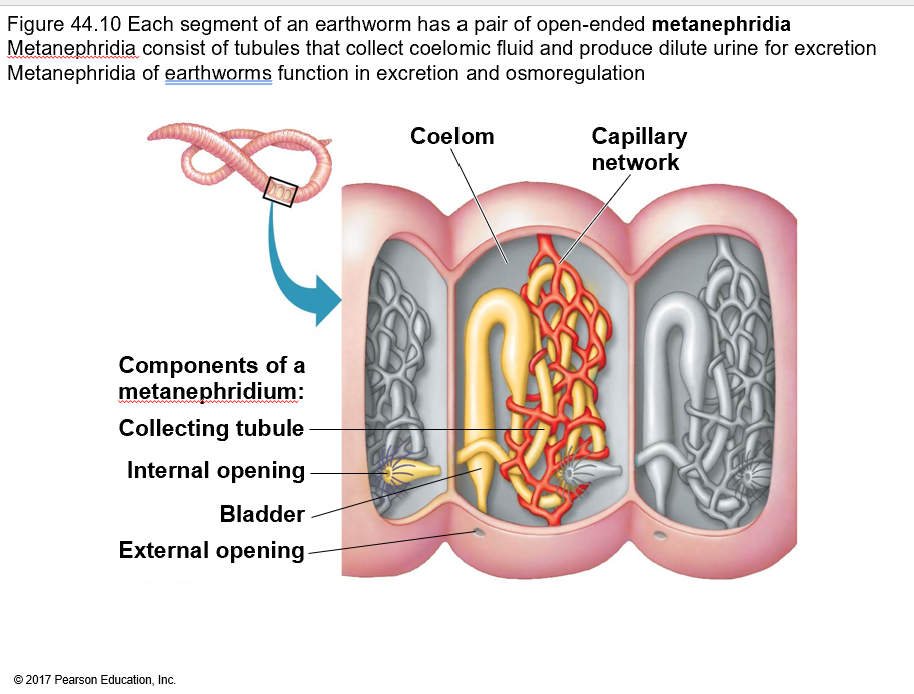
What fluid do metanephridia collect and process?
Coelomic fluid → produce dilute urine.
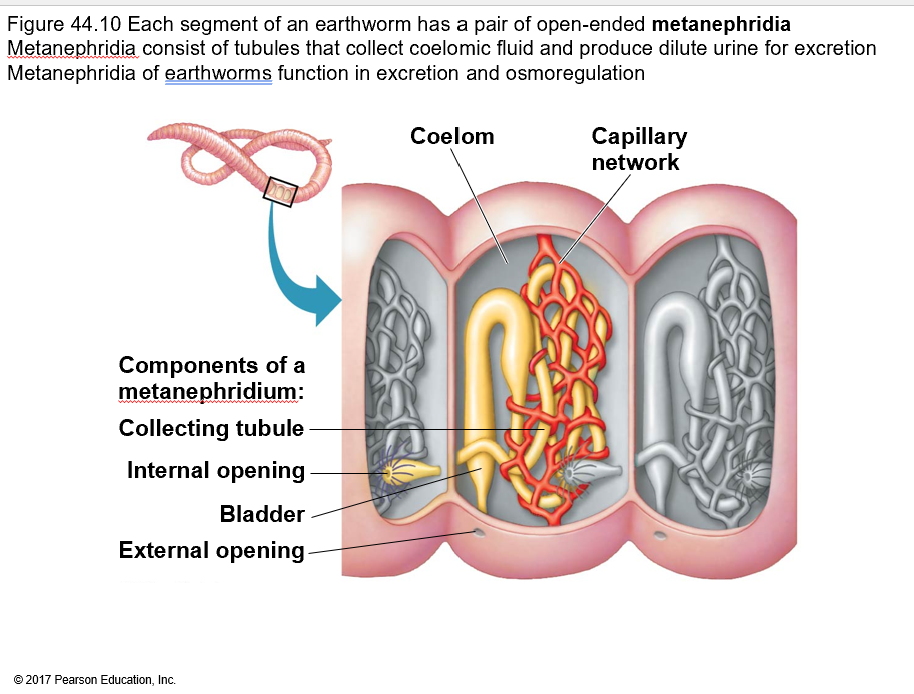
What functions do metanephridia serve?
Excretion and osmoregulation.
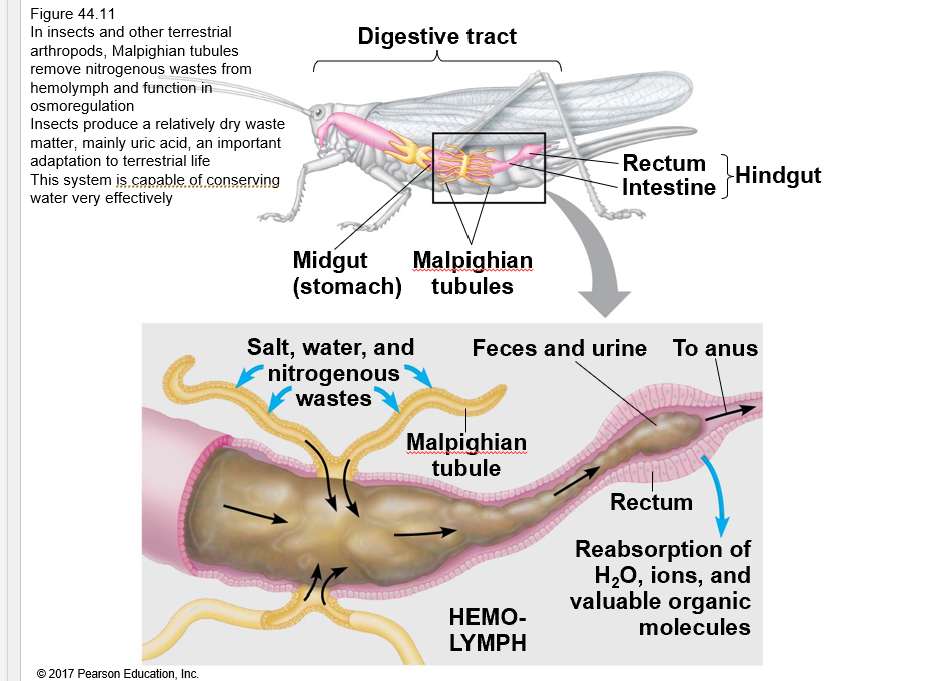
What do Malpighian tubules do in insects?
Remove nitrogenous wastes from hemolymph and help in osmoregulation.
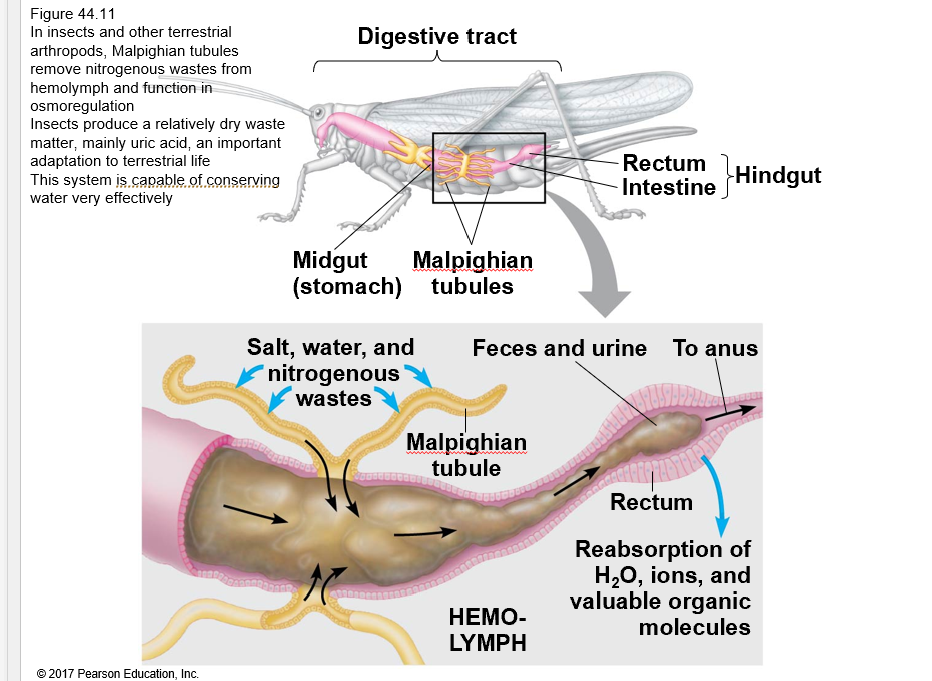
How do insects conserve water using Malpighian tubules?
Wastes enter tubules → in the rectum, water, ions, and valuable molecules are reabsorbed → very dry uric acid waste exits
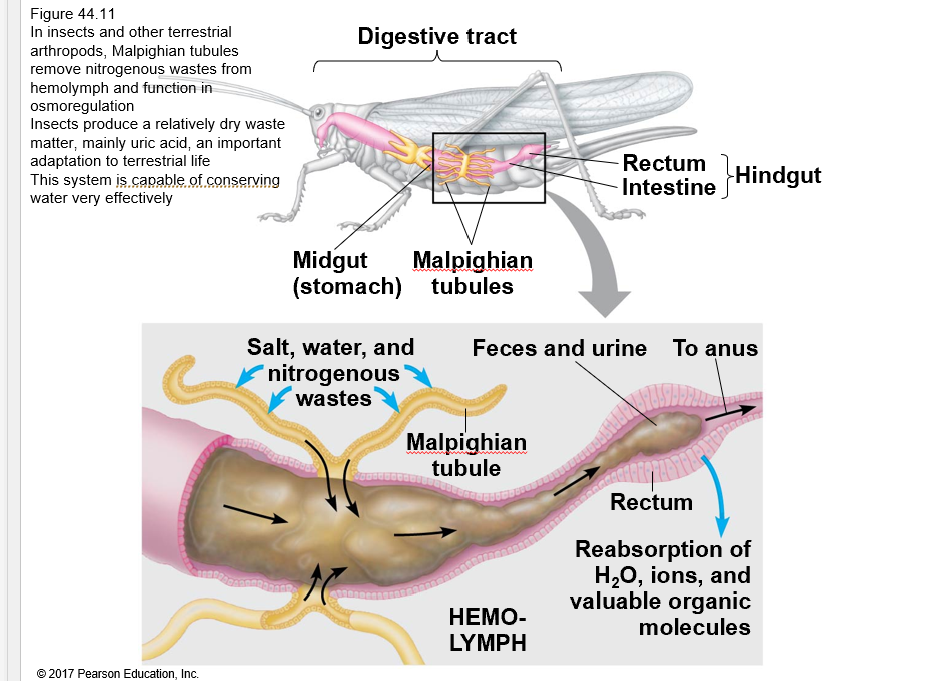
Why is this system good for terrestrial life?
It conserves water very effectively.

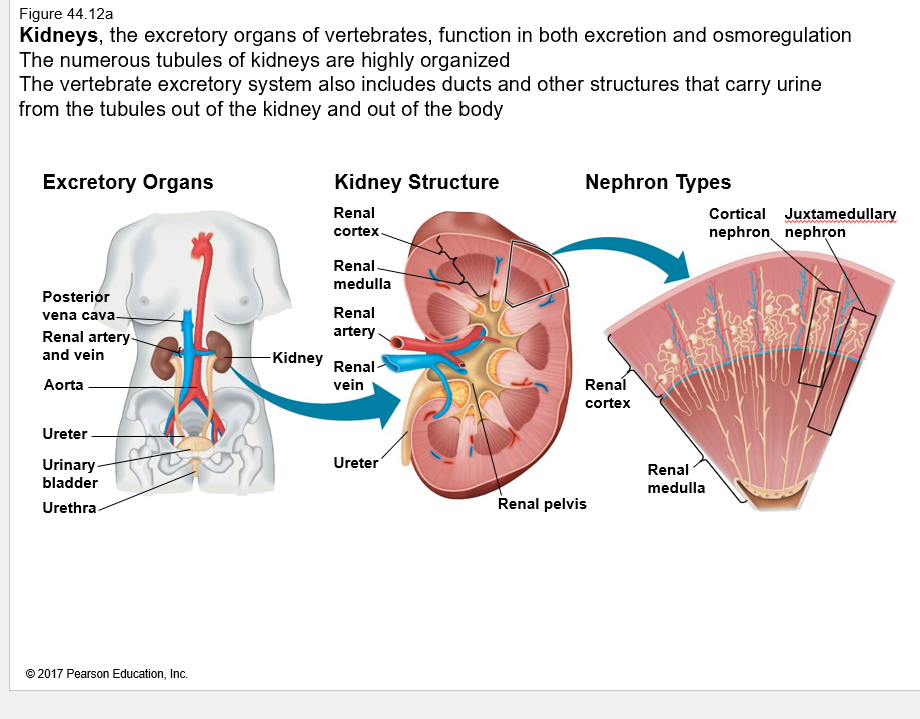
What are the functions of kidneys in vertebrates?
Excretion of wastes + osmoregulation of water/solutes.
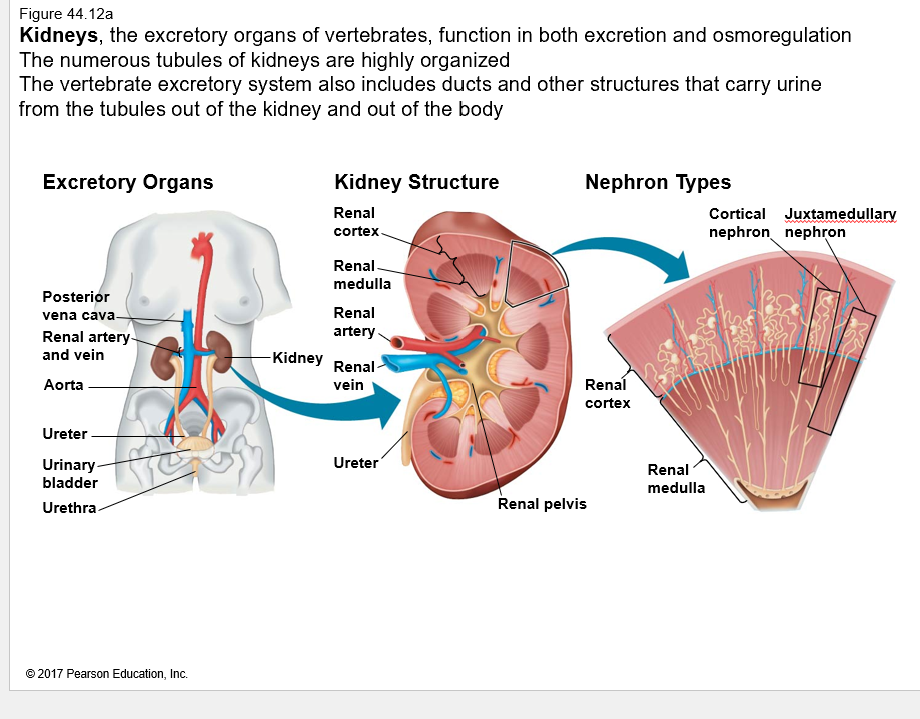
Where are nephrons located in the kidney?
In the renal cortex and renal medulla.
What are the two types of nephrons?
Cortical (short loops) and juxtamedullary (long loops → concentrated urine).
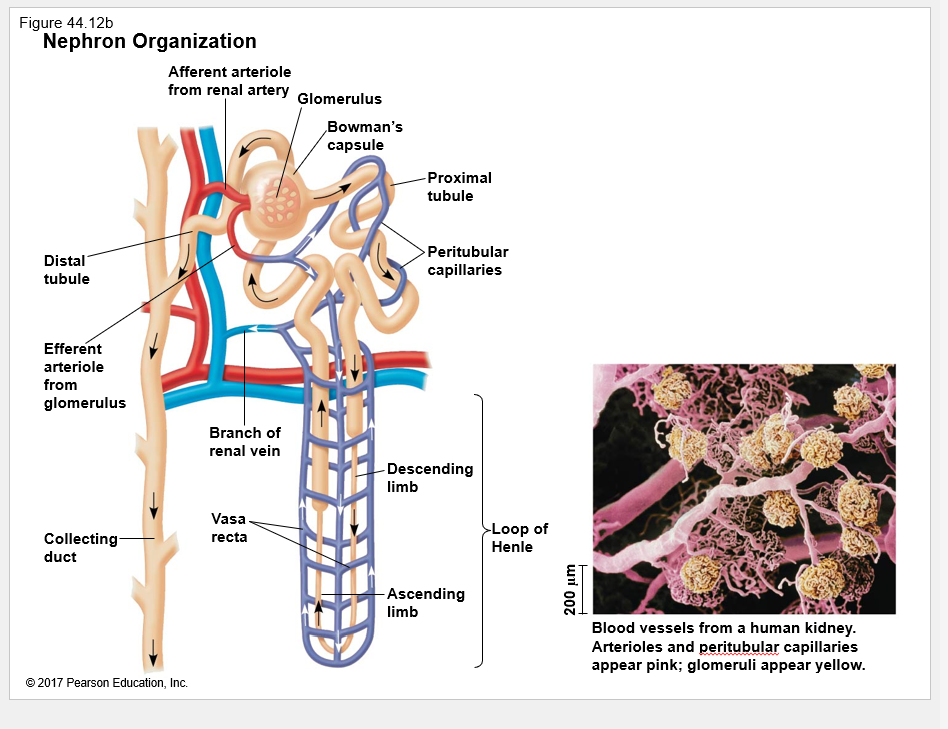
What are the major parts of a nephron?
Bowman’s capsule → Proximal tubule → Loop of Henle → Distal tubule → Collecting duct
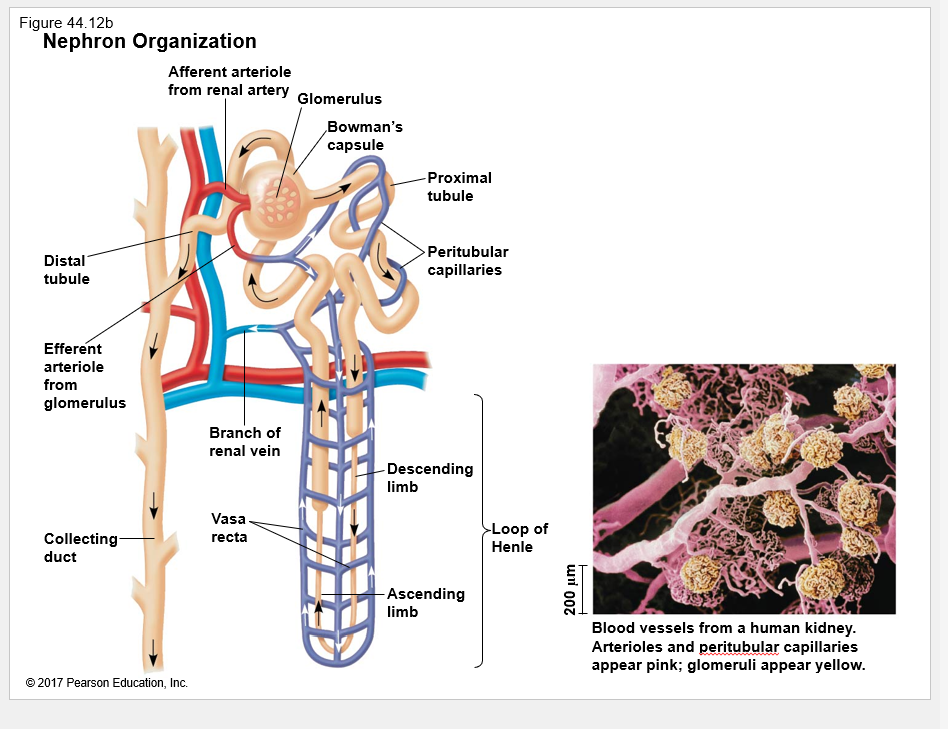
What are the blood vessels associated with the nephron?
Glomerulus, then peritubular capillaries or vasa recta (around Loop of Henle).
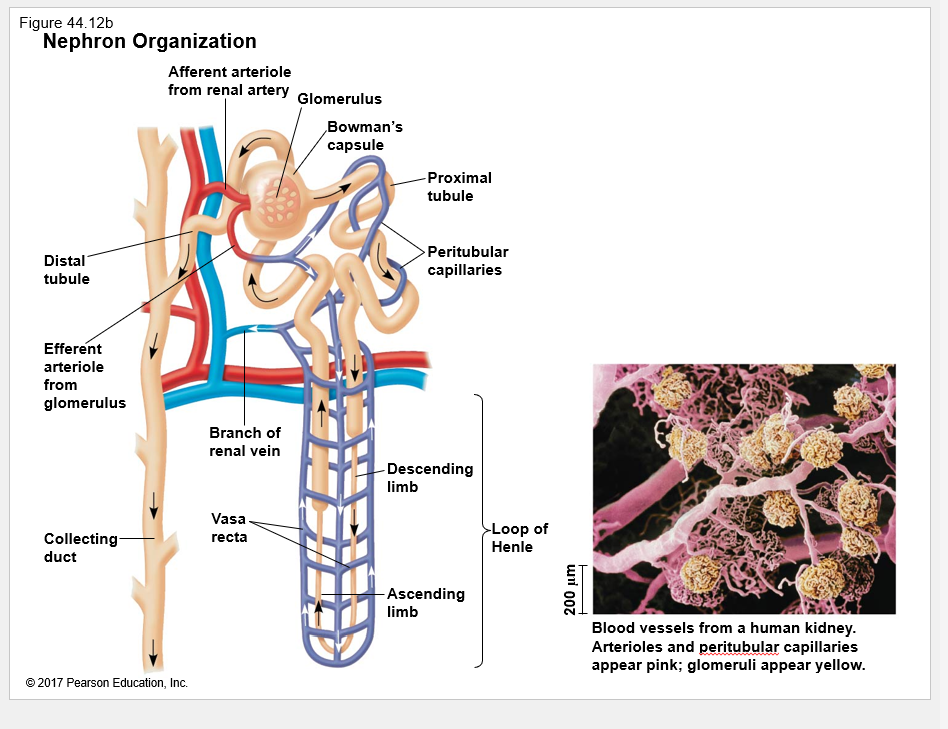
What enters and exits the glomerulus?
Afferent arteriole enters → Efferent arteriole leaves.
What is a nephron?
The functional unit of the kidney that filters blood and makes urine.
What are the two main goals of the nephron?
Excrete wastes & regulate water/solute balance (osmoregulation).
What are the three main processes that occur in a nephron?
Filtration, Reabsorption, Secretion → then urine Excretion.
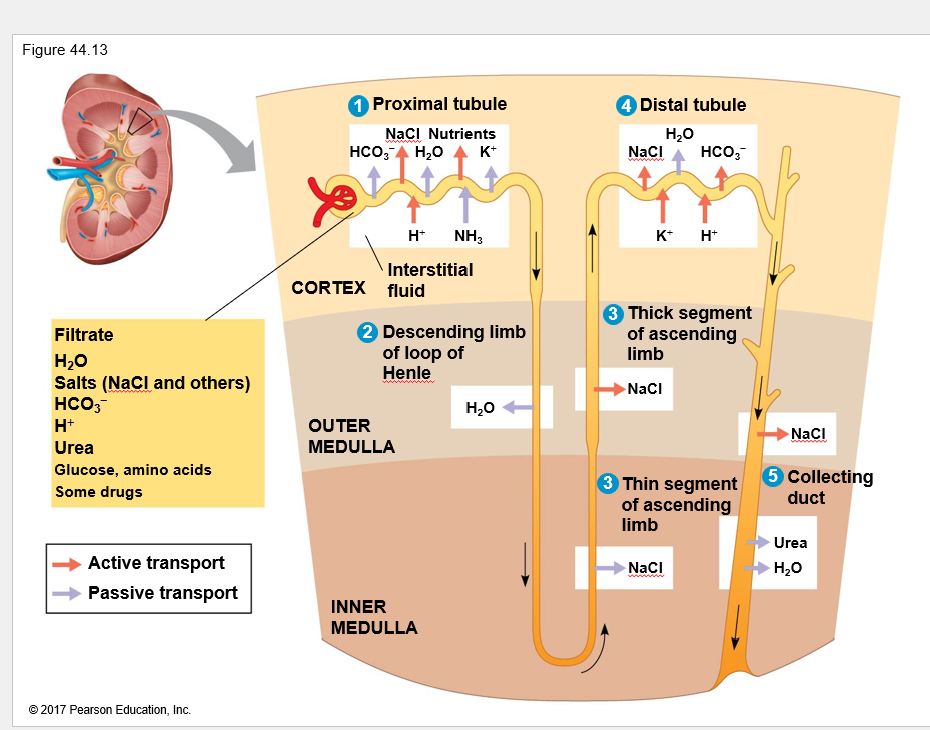
What happens in the proximal tubule?
Reabsorbs water, NaCl, nutrients; secretes H⁺ & NH₃.
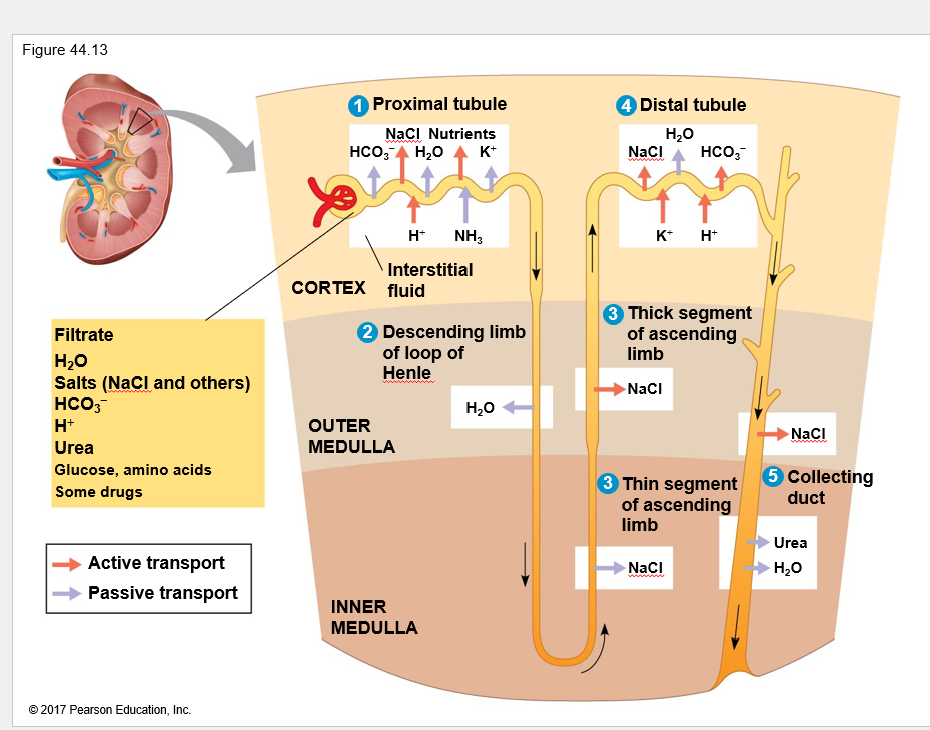
What are the opposite permeabilities in the Loop of Henle?
Descending limb = water leaves
Ascending limb = salt leaves (no water)
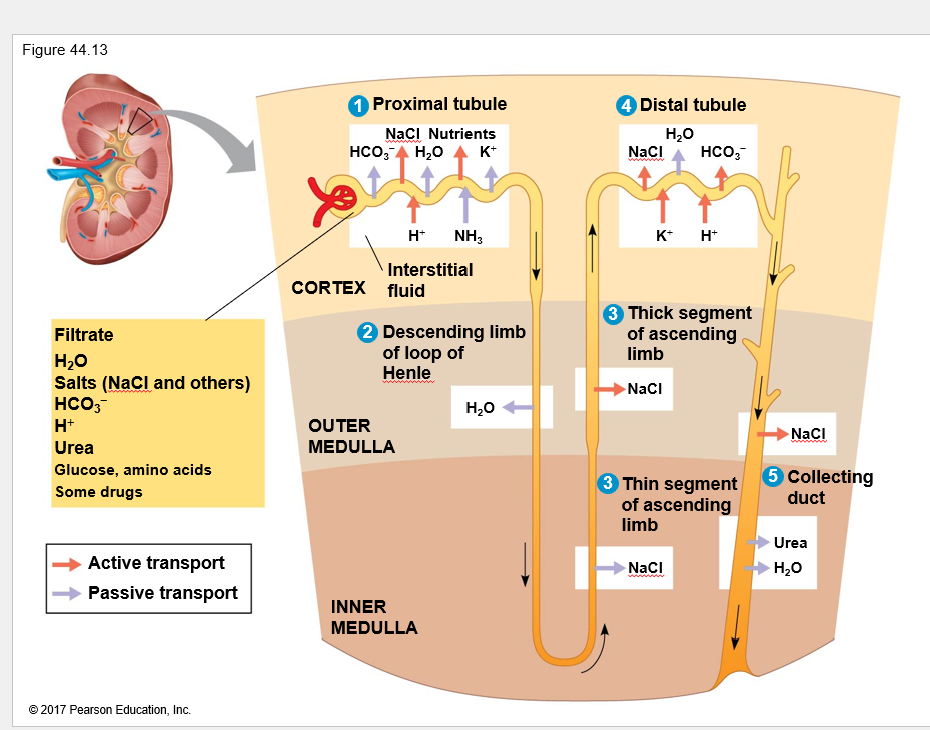
What does the collecting duct regulate?
Final urine concentration by reabsorbing water (and some urea).
What is filtered in Bowman’s capsule and how?
Blood pressure forces water + small solutes (Na⁺, glucose, amino acids, urea) into the filtrate.
What does NOT enter Bowman’s capsule?
Blood cells and large proteins → they stay in the bloodstream.
What is the structure inside Bowman’s capsule that filters blood?
The glomerulus — a ball of capillaries.
What happens in the descending limb of the Loop of Henle?
Only water is reabsorbed (permeable to H₂O, not salt).
What happens in the ascending limb?
Salt (NaCl) is reabsorbed, no water movement (impermeable to H₂O).
Why is the Loop of Henle important?
It creates the medullary osmotic gradient needed to make concentrated urine.
What does the collecting dust regulate?
The final concentration of urine, by controlling how much water is reabsorbed.
Which hormone increases water reabsorption in the collecting duct?
ADH — adds aquaporins → more water leaves, urine becomes more concentrated.
What waste can diffuse out of the collecting duct in the inner medulla
Urea, which helps maintain the medullary osmotic gradient.
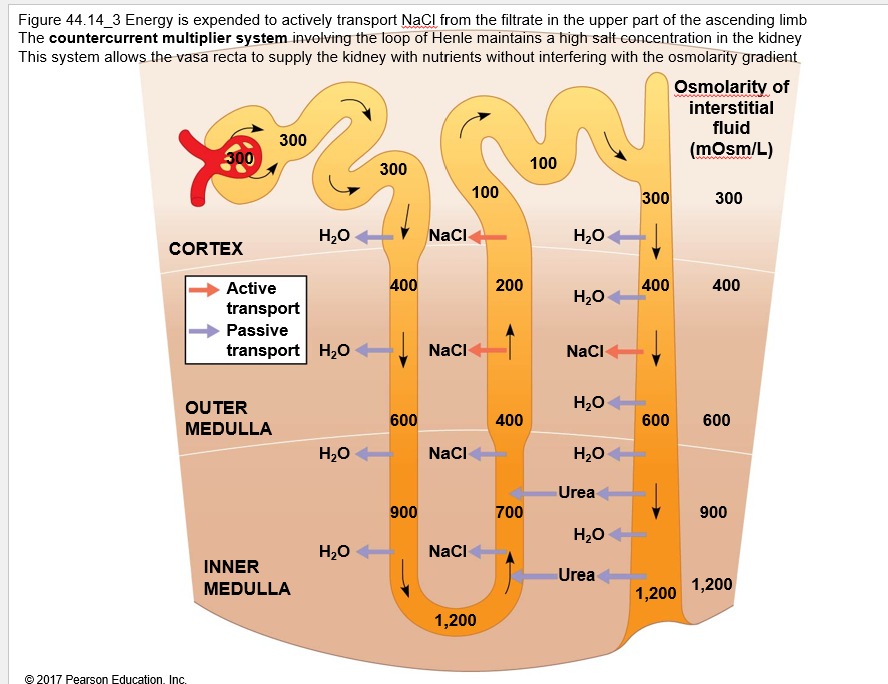
What creates the high salt concentration in the medulla?
The ascending limb actively pumps out NaCl, building the osmotic gradient.
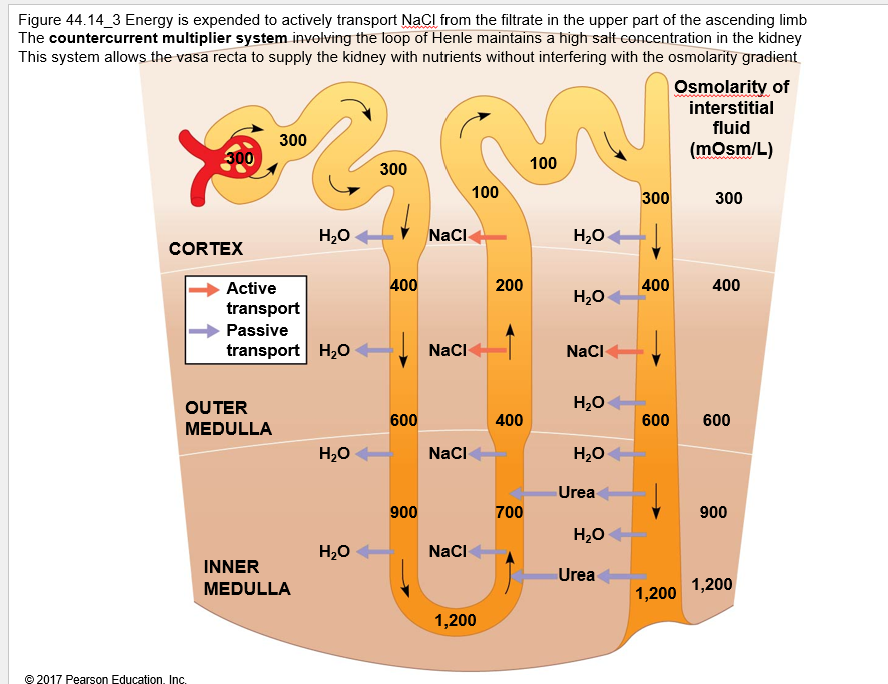
Why does water leave the descending limb of the Loop of Henle?
The medulla gets progressively saltier → water moves out by osmosis.
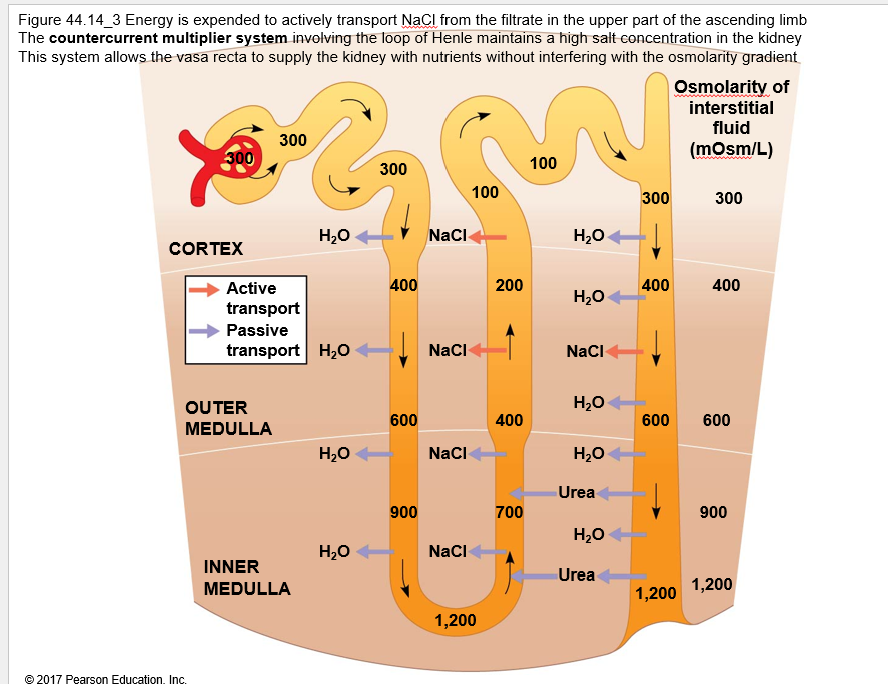
Why is this system called a countercurrent multiplier?
Opposite flow directions multiply the gradient, allowing the kidney to make concentrated urine.
What creates the medullary osmotic gradient that concentrates urine?
The Loop of Henle — descending limb loses water, ascending limb loses salt → gradient increases deeper into medulla.
What is the role of the collecting duct in concentrating urine?
It reabsorbs water when ADH is present → filtrate becomes very concentrated as it moves through the salty medulla.
How does urea help maintain concentrated urine?
Urea diffuses out of the collecting duct into the medulla → reinforces high osmolarity → helps drive water reabsorption.
Why do vampire bats produce dilute urine while feeding?
They drink a lot of blood water → must shed excess water quickly to stay light for flying.
What happens after a vampire bat returns to its roost?
It switches to making very concentrated urine to save water.
What does this show about the mammalian kidney?
It is highly adaptable, shifting between dilute and concentrated urine as needed.
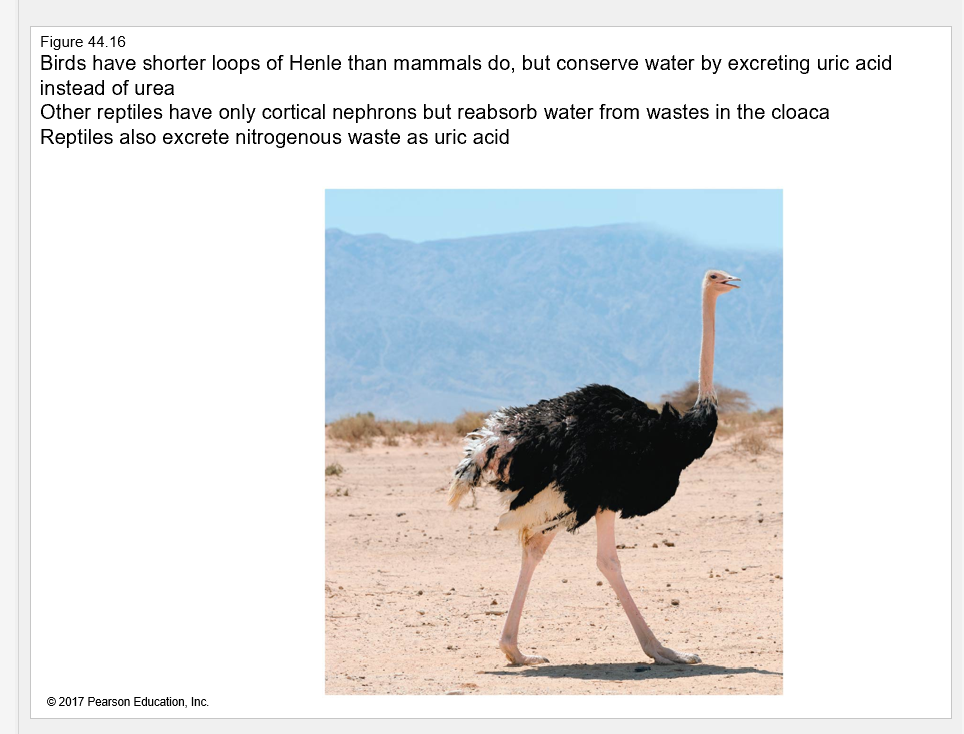
How do birds conserve water even with shorter Loops of Henle?
They excrete uric acid instead of urea → minimal water loss.
 Note
Note  Flashcards (46)