Biology - infection and response
 Studied by 0 people
 Call Kai
 Learn
Learn Practice Test
 Spaced Repetition
 Match
Match Flashcards
 Knowt Play
1/111

Earn XP
Description and Tags
Name | Mastery | Learn | Test | Matching | Spaced | Call with Kai |
|---|
No analytics yet
Send a link to your students to track their progress
112 Terms
pathogens (definition)
- pathogens are microorganisms that enter the body and cause disease (communicable infectious disease)
- both plants and animals can be infected by pathogens
pathogens - bacteria
- bacteria are very small cells which can reproduce rapidly inside your body.
- they can make you feel ill by releasing toxins (poison) that damage your cells and tissue
- e.g. salmonella bacteria
pathogens - virus
- viruses are not cells (smaller than bacteria)
- they reproduce rapidly inside your body
- they live inside your cells and replicate themselves using the cells machinery to produce many copies of themselves.
- The cells will burst, releasing all the new viruses. the cell damage is what will make you feel ill.
- e.g. HIV
pathogens - protists (only some protists are pathogens)
- there are lots of different types of protists but they are eukaryotes and most of them are single celled.
- some are parasites and some are pathogens
pathogens - fungi
- some fungi are single celled. others have a body which is made up of hyphae.
- these hyphae can grow and penetrate human skin and the surface of the plant, causing disease.
- The hyphae can produce spores as well which can spread to other plants and animals
Pathogens can be spread in a variety of ways: here are a few you need to know about.
- water: can be picked up by drinking or bathing in dirty water e.g. cholera is spread by drinking contaminated water
- Airborne transmission: carried in the air and then breathed in e.g. influenza/flu is carried by droplets produced when you cough or sneeze in the air
- Direct contact: picked up by touching contaminated surfaces, including the skin e.g. athletes foot is a fungus that makes skin itch and flake off, spread by touching the same things as an infected person such as shower floors and towels
-infection cause by pathogens in blood stream and tissues.
viral disease - measles
- spread through droplets from an infected persons cough or sneeze.
- symptoms are red skin rash, and they will show signs of a fever (high temp)
- can be fatal if there are complications (can lead to pneumonia)
- most people are vaccinated against it when they are young
viral disease - HIV
- spread by sexual contact
- or exchanging bodily fluids (sharing drug needles)
- causes flu like symptoms for a few weeks
- virus attacks cells weakening the immune system so it cant cope with other infections.
-This is known as late stage HIV, or AIDS
viral disease - tobacco mosaic virus
- affects plants only (e.g. tomatoes)
- leaves a mosaic pattern on leaves and becomes discoloured
- this means the plant cant carry out photosynthesis, so virus affects growth.
fungal disease - rose black spot
- causes purple or black spots to develop on the leaves of rose plants
- they then turn yellow and drop off.
- this means that less photosynthesis occurs so the plant doesn't row very well
- spreads by water or wind
protist disease - malaria
- part of the malarial protist cycle takes place inside the mosquito
- the mosquitoes are vectors which means they pick up the malarial protist when they feed on an infected animal
- it infects by inserting the protist into the animals blood vessels
- causes repeated episodes of fever
- the spread of malaria can be reduced by stopping mosquitoes from breeding (mosquitoes breed in standing water)
- ways you can prevent malaria : insect repellent, medicine, vaccine
bacterial diseases - salmonella food poisoning
- symptoms: fever, stomach cramps, vomiting, diahorrea
- these symptoms are caused by the toxins that the bacteria produce.
bacterial disease - gonnorhea
- STD
- symptoms: painful urination, thick yellow or green discharge from vagina or penis
- originally treated with an antibiotic called penicillin but has become trickier now because of the strains so some have become resistant to penicillin.
way to reduce and prevent the spread of disease 1
being hygienic
- simple hygiene measures e.g. thoroughly wash hands before preparing foods
way to reduce and prevent the spread of disease 2
destroying vectors
- some protist diseases are carried by vectors
- by getting rid of these, we can prevent the disease from being passed on
- e.g. insecticides
way to reduce and prevent the spread of disease 3
isolating infected individuals
- if you isolate someone who has a communicable disease, it prevents them from passing it on to anyone else.
e.g. ebola
way to reduce and prevent the spread of disease 4
vaccination
- vaccinating children and animals aganist communicable diseases measn that they cant develop the infection and then pass it on to someone else.
the bodys defences (defenition)
in order to cause disease, pathogens need to enter the body first. The human body has got features that stop a lot of nasties getting into he body in the first place.
- These are called non-specific defense systems
The bodys defences (examples)
- The skin is a barrier to pathogens. It also secretes antimicrobial substances, which kill pathogens
- Hairs and mucus in your nose trap particles that could contain pathogens
- The trachea and the bronchi secrete mucus to trap pathogens
- The trachea and the bronchi are lined with cilia. These are hair-like structures, which waft the mucus up to the back of the throat, where it can be swallowed
- The stomach produces hydrochloric acid. This kills pathogens that make it that far from the mouth
-tears help by physically flushing them away and chemically attacking them with antimicrobial proteins
-blood clotting helps by forming a physical barrier (a scab) that stops pathogens from entering the blood stream
the immune system
if pathogens do make it into your body, your immune system kicks in to destroy them, The most important part of your immune system is your white blood cells.
white blood cells
They travel around your blood and crawl into every part of you constantly patrolling for microbes. When they come across an invading microbe they have three lines of attack
white blood cell - steps to killing foreign cell (pathogen)
- consuming them: engulf foreign cells and digest them. This is called phagocytosis
- producing antitoxins: these counteract toxins produced by the invading bacteria
- producing antibodies: every invading pathogen has unique molecules (antigens) on its surface. White blood cells will start to produce antibodies on any foreign cell to lock onto the invading cells, so that they can be found and destroyed by other white blood cells.
antibodies
- Antibodies are complementary to the antigen.
- Antibodies are produced rapidly and carried around the body to find all similar bacteria or viruses
- If the person is infected with the same pathogen again, white blood cells will rapidly produce antibodies to kill it.
- the person is naturally immune to that pathogen and won't get ill
- a memory cell remembers all the different antibodies that have been created by hite blood cells so the white blood cell can remember it
- it will only hold onto the antibody for 10 years
vaccinations
- when you are infected with a new pathogen, it takes your white blood cells a few days to learn how to deal with it. But by that time you can be pretty ill. Vaccinations can stop you from feeling ill in the first place
- Vaccinations involve injecting small amounts of dead or inactive pathogens. These carry antigens, which cause your white blood cells to produce antibodies to attack them, even though the pathogen is harmless (since dead or inactive)
- then, if live pathogens of the same type then appear at a later date, the white blood cells can rapidly mass produce antibodies to kill of the pathogen. The vaccinated person is now immune to that pathogen and wont get ill
the MMR vaccine
it contains weakened versions of the virus that causes measles, mumps and rubella (german mealses) all in one vaccine.
vaccination pros
- help control lots of infectious diseases that were once common in the uk e.g. polio, measles, whooping cough (smallpox is extinct in the uk and polio has fallen by 99%)
- Big outbreaks of disease (called epidemics) can be prevented if the majority/large percentage of the population is vaccinated. That way even people who aren't vaccinated are unlikley to catch the disease because fewer people are able to pass it on.
vaccination cons
- doesn't always work; sometimes don't give you full immunity
- you can sometimes have a bad reaction to a vaccine e.g. swelling and in some very rare cases, fever or seizures.
balancing the risks
deciding whether to have a vaccination means balancing risks; the risk of catching disease if you dont have a vaccine, against having a bad reaction if you do. As always, you need to look at the evidence e.g. if you get measles there is a 1 in 15 chance there will be complications and you get pneumonia and about 1 in 500 people who actually die from measles compared to 1 in 1000000 who have a bad reaction to the vaccine.
communicable diseases definition
illnesses caused by a virus or bacteria that people spread to each other through contact with contaminated surfaces, bodily fluids, the air, or insect bites
non-communicable diseases defenition
a disease that is not transmissible from one person to another
how does bacteria cause disease
The bacteria divide (binary fission) and sometimes produce toxins that make you feel ill.
how do viruses cause disease
they multiply inside the cell and damage cells and tissues and release toxins.
Why do communicable diseases spread faster after a natural disaster
- lack of safe water (exposed to harmful bacteria in unsafe water) and less food available, which leads to malnutrition, so more vulnerable to disease
Why do the numbers of bacteria on an agar plate eventually stop growing
limited available nutrients
Why is it important to use an uncontaminated culture plate
reduces the chance of growing harmful pathogens
makes the final result clearer and easier to read and get results
Why do we need each rule to prepare, incubate, and dispose of safely
So we don't get ill from the harmful bacteria growing on the agar plate and contaminate other surfaces
When would an antiseptic be used
on a cut or graze on the skin to kill any harmful bacteria and prevent infection
When would antibiotics be used
to treat or prevent a bacterial infection inside the body
when would a disinfectant be used
to clean surfaces after harmful bacteria have contacted them, or if there are vulnerable people in the house
How can the spread of diseases be prevented or reduced
- sterilizing water
- preparing food hygenically
- washing
- vaccination
- barrier contraception
how does mealses affect the infected organism
Fever and skin rash are the most common symptoms, but if there are complications, it can lead to infections of the ear, eye, respiratory system and brain which can cause brain damage
how soes HIV affect the infected organism
The symptoms for the first few weeks are flu like and then they go away and the disease can stay for years with no symptoms apart from a weakened immune system from the disease atacking your white blood cells. This makes it easier to get diseases like tuberculosis and some types of cancer.
how does tobacco mosaic virus affect the infected organism
it leaves a pattern on the leaves of a different colour making it difficult for the plant to absorb enough sunlight to photosynthesize so it can stunt growth
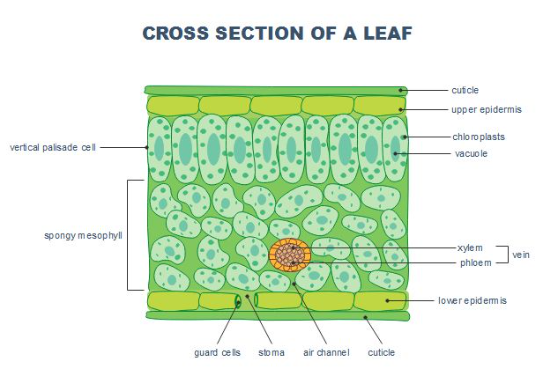
cross section of a leaf
similarities of salmonella and gonnohrea
- both communicable diseases
- both can be treated with antibiotics because both a bacterial infections
how does rose black spot affect the plant
does not kill the plant directly but limits photosynthesis and weakens plant making them more susceptible to other stresses and winter damage
how is rose black spot treated
As soon as you see signs of rose black spot disease, rake up and destroy all infected leaves and plant parts.
how to tell if a plant is diseased
changes in the leaves
methods used to identify the cause of a plant disease
- visual inspections
- researching on Google
- samples under a microscope
- culture tests
- Use testing kits to identify the pathogen using monoclonal antibodies
how do diseases damage a plant
diseases spread pathogens such as viruses or bacteria and they secrete proteins that cause damage to the host plants.
mineral ion deficincies
Plants use nitrates as a supply of nitrogen, which is needed to make proteins for healthy growth. Plants absorb nitrates in water through their roots. Nitrates are present in high levels in plant fertilisers.
Without nitrates, the amount of chlorophyll in leaves reduces. This means leaves turn a pale green or yellow colour. This reduces the plant's ability to photosynthesise and grow properly, which reduces the farmers' crop yield. Farmers or gardeners can add chemical or natural fertilisers, such as manure to increase nitrate levels.
- some diseases cause plants to have mineral deficiencies causing some of these symptoms
plants - deficiency diseases
plants need mineral ions from the soil. If there arent enough, lants suffer deficincy symptoms.
- nitrates are needed to make proteins and therefore for growth. A lack of nitrates causes stunted growth
- Magnesium ions are needed for making chlorophyll, which is needed for photosynthesis. Plants without enough magnesium suffer from chlorosis (when not enough chlorophyll is made) and have yellow leaves.
plants - diseases caused by pathogens
plants can be infected by viral, bacterial and fungal pathogens.
-infestation with pests:
plants can also be infested and damaged by insects. For example, aphids are an insect that can cause huge damage to plants. Infestations of pests are easy to spot, you should be able to see them on plants
detecting plant diseases:
stunted growth
spots on leaves
patches of decay (rot)
abnormal growths
malformed stems or leaves
discolouration
plant chemical defences
- releasing a chemical to deter a herbivore
- some can produce antibacterial chemicals that kill bacteria such as witch hazel
- e.g, nettles, mint, chilli
plant physical defences
- a physical barrier that will stop a microorganism from getting
into the plant, often it is a layer of dead cells around the stem e.g. bark
- most plants have a waxy cuticle, which provides a barrier to stop pathogens entering
plant mechanical defence
- a structure on the plant that will deter a herbivore e.g thorns on a rose bush
- it can also have hairs to stop animals eating and touching them.
- other plants droop or their leaves curl when something touches them so they can prevent themselves from being eaten and it can also knock insects off
- it can also mimic other organisms like rocks and insect eggs.
what is an antibody
a protein that protects you when an unwanted substance enters your body
It can either directly destroy pathogens or facilitate their removal
phagocytosis
the process where the pathogen is engulfed by the white blood cell (phagocyte) and destroyed/broken down
what is an antigen
any substance that causes your body to make an immune response against that subsatnc
how do antibiotics work
they kill the harmful bacteria inside our body and prevet them from spreading
what is meant by antibiotic-resistant bacteria
when harmful bacteria develop defences against the antibiotics trying to kill th
why is it so difficult to develop drugs for viral infections
because they mutate quickly, and new strains of the virus can be created very quickly that are immune to the drug/antiviral
How are antibiotics tested for effectiveness
on a culture plate in a lab
examples of viruses
- flu
- HIV
- tobacco mosaic virus (tmv)
examples of bacteria
- salmonella
- e.coli
- colora
example of fungi
athletes foot
thrush
bacteria divide by binary fission
growth/rate of reaction is affected by:
- temp
- nutrients available
- oxygen levels
- PH
to prevent bacterial growth
- raise or lower temp
- use chemicals to stop growth
- disinfectants
- antibiotics
- antiseptics
phagocytes
- a white blood cell
- englufs pathogen
- relelases antitoxins to counteract poisons produced by pathogen
- produces antibodies that attach to the antigens, and the antigen stops working
-enzymes to break down the pathogen
lymphocytes
acts as a memory cell
- remembers the antibodies we made in the past
antigen
foreign non self protein that causes an immune response
pain killer
relieves pain and most symptoms but does not kill pathogen
e.g. paracetemol, ibuprofen
anti-inflammatory
reduces swelling
e.g. aspirin, ibuprofen
antiseptic
kills pathogens on skin surface
e.g. savlon, TCP
antibiotics
kills bacteria inside the body
e.g. penicillin, erythromycin
why cant antibiotics kill virus
Because viruses are inside body cells so antibiotic would have to kill body cell first in order to kill the virus therefore doing more harm than good
disinfectant
kills pathogens on surfaces like tables or floors
e.g. bleach, dettol
why dont antibiotics damage your body
because they weaken cell walls - bacteria have cell walls and we dont
how have antibiotic-resistant strains of bacteria developed
1. random mutaton in the DNA
2. bacteria now resistant to antibiotic
3. bacteria that is resistant survives and reproduces
4. and passes on resistance gene
5. population of resistance strain increases
this is basically natural selection
slowing down the development of antibiotic resistance
To slow the rate of development of antibiotic-resistant strains, doctors need to avoid overprescribing antibiotics.
So you wont get them for a sore throat, only something more serious.
Its also important that you finish the whole course of antibiotics and you dont just stop once you feel better to ensure your infection is completely treated
digitalis
- comes from foxgloves
- strengthens the heart
aspirin
- comes from willow trees
- pain killer and anti-inflammatory
a good medicine needs to be:
-effective
-stable
-safe
-successfully taken in
The origin of drugs
Plants produce a variety of chemicals to defend themselves against pests and pathogens. Some of these chemicals can be used as drugs to human diseases or relieve symptoms. A lot of our current medicines were discovered by studying plants used in traditional cures. But some drugs are extracted from microorganisms
Alexander Fleming and penicillin
Fleming was clearing out some petri dishes containing bacteria when he noticed one of the dishes of bacteria also had mould on it and the area around the mould was free of bacteria. he found the mould (penicillium notatum) was producing a substance killing the bacteria - this substance was penicillin
drug testing
New drugs are constantly being developed. But before they can be given to the general public, they have to go through a thorough testing procedure to mkae sure they are safe and effective,
There are three main stages in drug testing -
pre clinical testing on human cells and tissues,
pre clinical testing on live animals and
clinical testing on healthy human volunteers.
pre clinical trials - cells and tissues
In pre clinical testing, drugs are tested on human cells and tissues in the lab. However, you cant use human cells and tissues to test drugs that effect whole or multiple body systems, e.g. testing a drug for blood pressure must be done on a whole animal because it has a circulatory system.
pre clinical trials - live animals
The next step in pre clinical testing is to test drugs on live animals. This is to test
efiicacy (whether the drug works and produces the effect your looking for),
to find out about its toxicity (how harmful)
to find out the best dosage (the concentration that should be given and how often it should be given)
animal cruelty argument
The law in Britain says that any new drug must be tested on two different live mammals. Some people think its cruel to test on animals, but others believe this is the safest way to make sure a drug isnt dangerous before its given to humans. Other people think that animals are so different from humans that testing on animals is pointless.
Clinical trials
If the drug passes the test on animals then it is tested on human volunteers in a clinical trial.
First, the drug is tested on healthy volunteers. This is to make sure that it dosent have any harmful side effects when the body is working normally. At the start of the trial, a very low dose of the drug is given and is gradually increased.
If the results on the tests on healthy volunteers are good, the drug can be tested on people suffering from the illness. The optimum dose is found. this dose is the drug that is the most effective and has fewest side effects
Placebos
To test how well the drug works, patients are randomly put into two groups. One is given the drug and the other is given a placebo (looks, smells, and tastes exactly the same but doesn’t do anything). This is so the doctor can see the actual difference the drug makes.
the ‘placebo effect’
If you know you are getting a new ‘wonder drug’ you might expect to get better or get side effects.
Studies show this happens even if you don’t actually take the real drug – just taking a sugar pill can make you feel better.
A placebo is a fake drug used in clinical trials. It should be as similar to the real drug as possible, but not contain the active ingredient
Blind trials
Clinical trials are blind - the patient in the study dosen’t know whether they are getting the drug or the placebo.
double blind trials
In fact, they are often double blind - neither patient or doctor knows who has the drug until the results have been gathered. This is so the doctors monitoring the patients and analysing the results arent subconsciously influenced by their knowledge
The importance of drug testing
Its really important that drugs are tested thoroughly before being used to make sure they are safe, An example of what can happen when drugs arent thoroughly tested is thalidomide.
The case of thalidomide
it was intended as a sleeping pill and then they discovered it was good for morning sickness for pregnant women. It wasnt tested and it affected 10,000 babies who were born dis-formed and sometimes without any limbs. Only about half of them survived
advantages of animal derived drugs
fewer side effects than synthetic alternatives
disadvantages of animal derived drugs
ethical and religious conflicts
risk of allergic reaction or contamination
disease transmission (can easily happen if not properly regulated)
ways of controlling the spread of malaria
bug spray
reducing mosquito population
vaccine or drugs/pills prescribed
malaria life cycle
a mosquito (vector/host) bites an infected human and picks up the protist.
They can carry it and not be affected by symptoms
then they bite an non infected human and passes the protist onto them.
the cells invade body cells, multiply and cause the cell to burst,
thid can cause flu-like symptoms and can lead to breathing probelms later on
 Note
Note  Flashcards (100)