Neural Communication, Synapses, and Spinal Cord Functions in Human Physiology
 Call Kai
 Learn
Learn Practice Test
 Spaced Repetition
 Match
Match Flashcards
 Knowt Play
1/21

There's no tags or description
Looks like no tags are added yet.
Name | Mastery | Learn | Test | Matching | Spaced | Call with Kai |
|---|
No analytics yet
Send a link to your students to track their progress
22 Terms
How do we differentiate a light touch from a firmer touch?
By the frequency of impulses generated and the number of sensory neurons activated.
What is a synapse?
A functional junction between one neuron and another or between a neuron and an effector such as a muscle or gland.
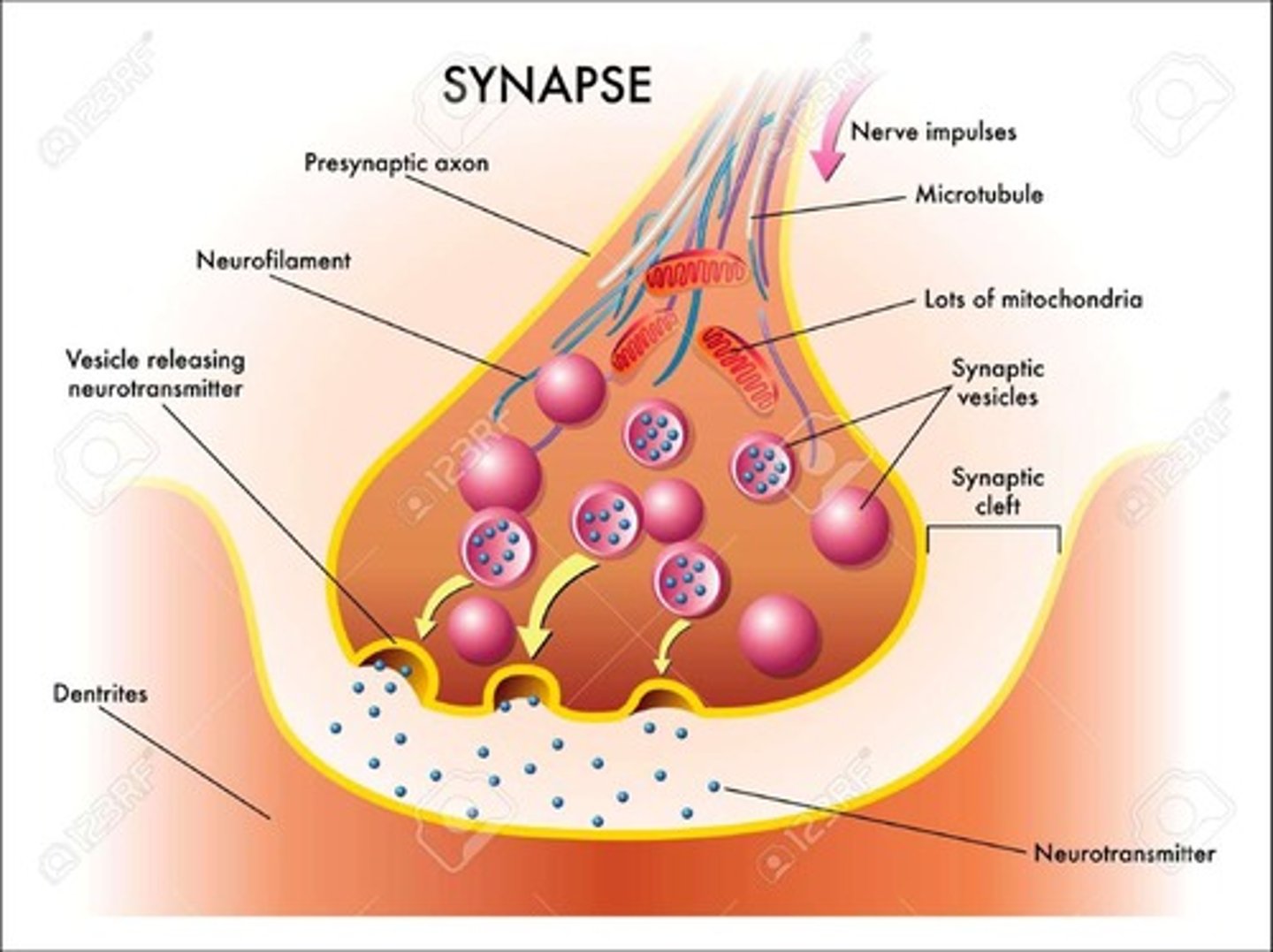
What are the two types of synapses?
Electrical and Chemical synapses.
Describe electrical synapses.
They allow ionic current to spread to the next cell through gap junctions, enabling faster, two-way transmission.
Describe chemical synapses.
They involve one-way information transfer from a presynaptic neuron to a postsynaptic neuron.
What triggers the release of neurotransmitters in chemical synapses?
The influx of Ca+2 ions when an action potential reaches the end bulb.
What is an excitatory post-synaptic potential (EPSP)?
A depolarizing postsynaptic potential resulting from the opening of ligand-gated Na+ channels.
What is an inhibitory post-synaptic potential (IPSP)?
An inhibitory postsynaptic potential that results from the opening of ligand-gated Cl- or K+ channels.
How is neurotransmitter removed from the synapse?
Through diffusion, enzymatic degradation, or uptake by neurons or glial cells.
What is the role of Prozac in neurotransmitter activity?
It is a selective serotonin reuptake inhibitor (SSRI) that prevents the uptake of serotonin, keeping it in the synapse longer.
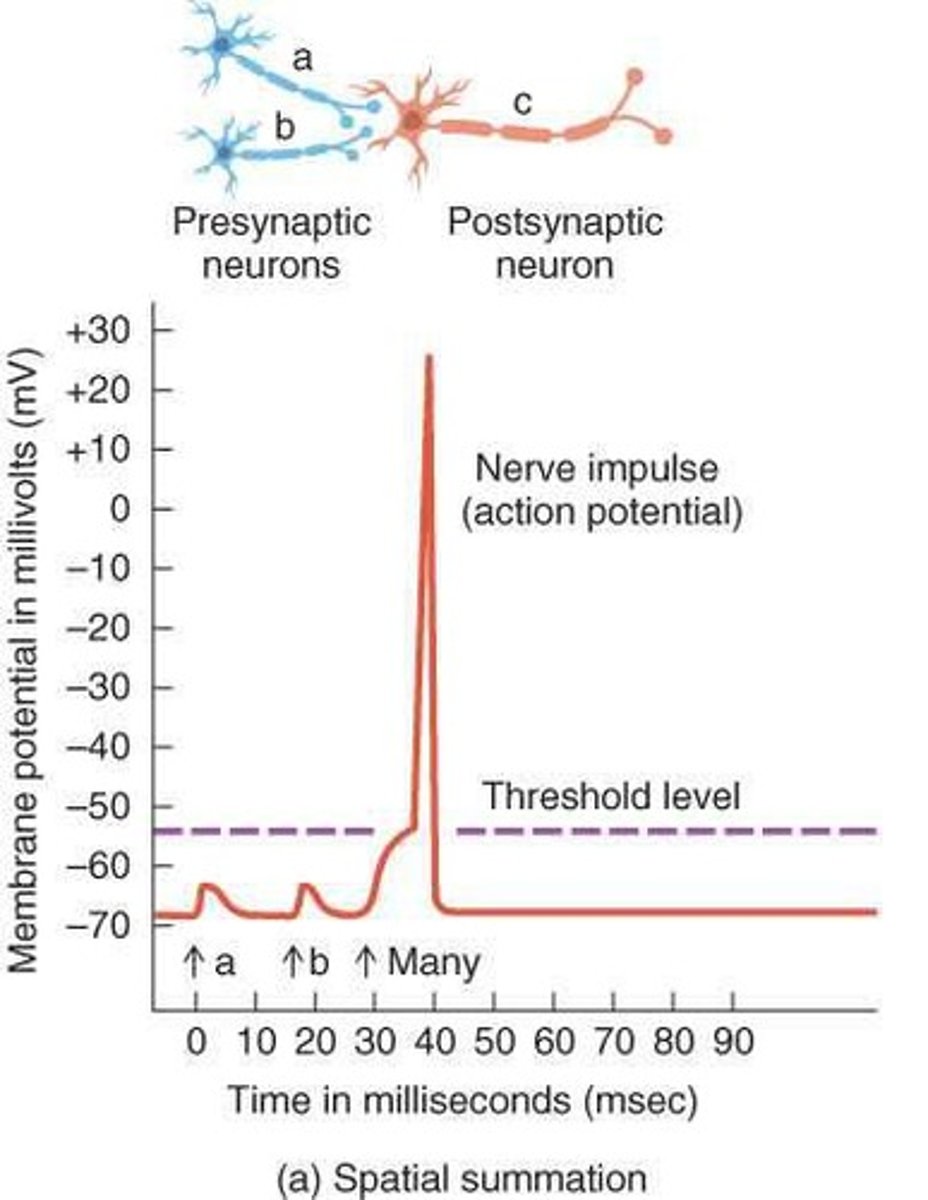
What is spatial summation?
The summation of effects of neurotransmitters released from more than one presynaptic neuron.
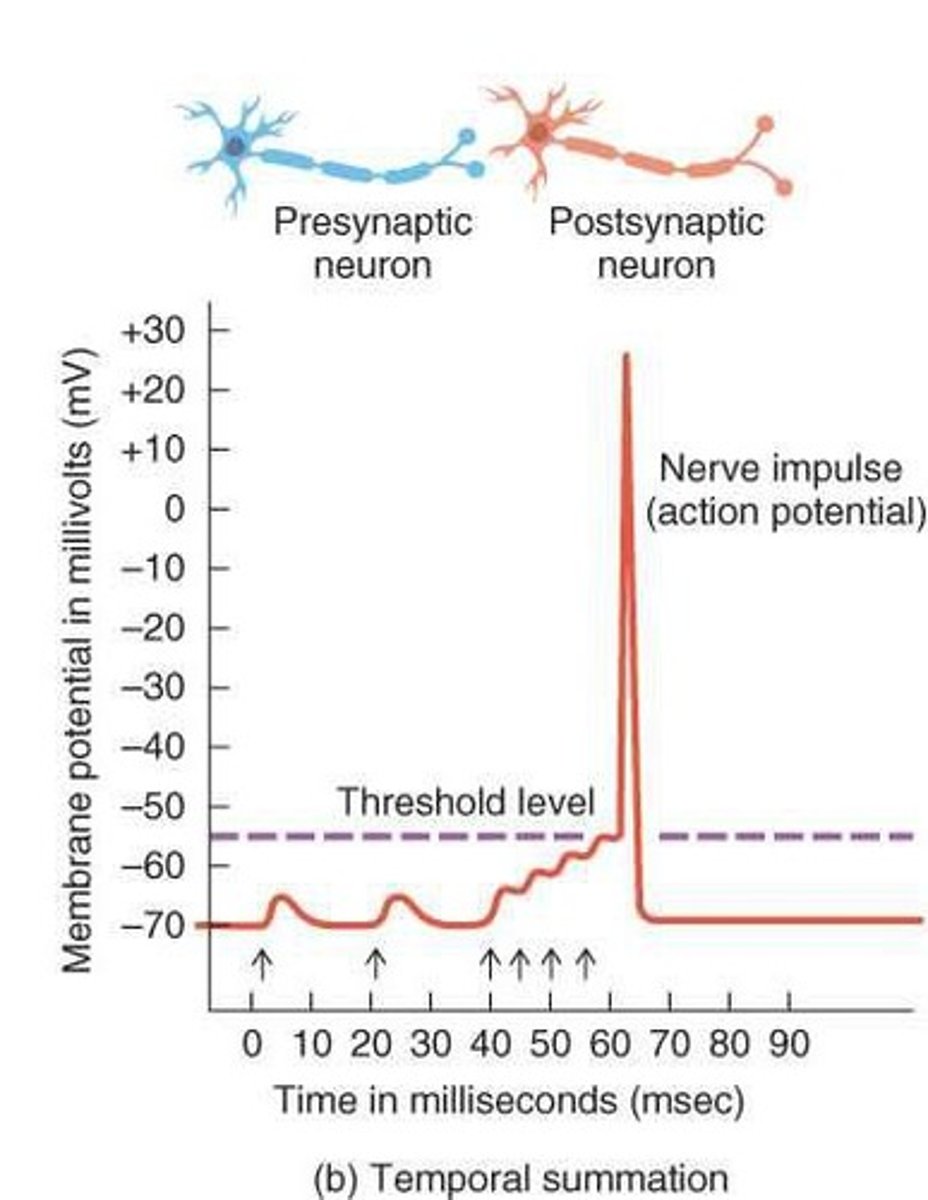
What is temporal summation?
The summation due to the buildup of neurotransmitter released by a single presynaptic neuron multiple times in rapid succession.
What happens if the excitatory effect is greater than the inhibitory effect but less than the threshold?
It results in a subthreshold EPSP, making it easier to generate a nerve impulse.
What is the effect of an inhibitory effect greater than the excitatory effect?
The membrane hyperpolarizes (IPSP) and fails to produce a nerve impulse.
What are agonists and antagonists in neurotransmitter function?
Agonists enhance a neurotransmitter's effects, while antagonists block its action.
What is the role of acetylcholine (ACh) in neurotransmission?
It is released by many PNS neurons and some CNS neurons, being excitatory at neuromuscular junctions but inhibitory at others.
What is the function of GABA in the brain?
It is an inhibitory neurotransmitter for about one-third of all brain synapses.
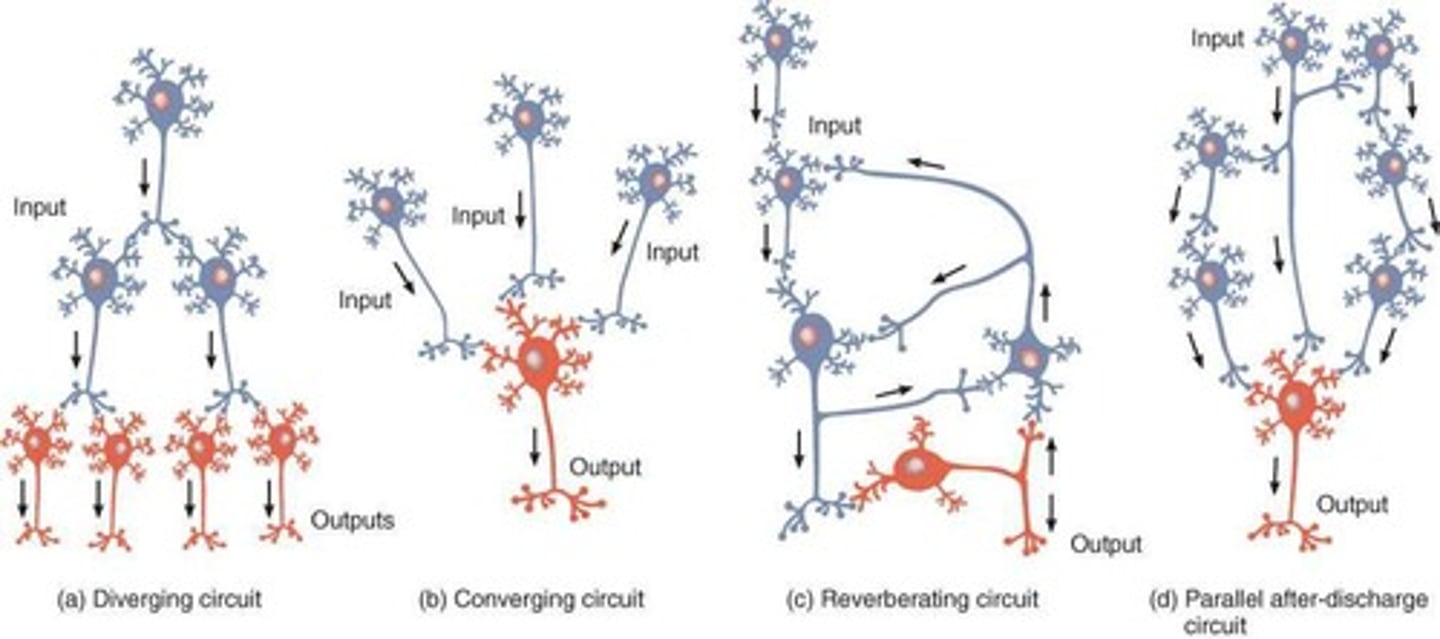
What are the types of neuronal circuits?
Diverging, converging, reverberating, and parallel-after-discharge circuits.
What is the significance of neuronal plasticity?
It allows for the sprouting of new dendrites and changes in synaptic contacts, maintaining adaptability throughout life.
What is Multiple Sclerosis (MS)?
An autoimmune disorder causing destruction of myelin sheaths in the CNS, leading to muscular weakness and other symptoms.
What characterizes epilepsy?
Short, recurrent attacks initiated by electrical discharges in the brain, affecting about 1% of the population.
What are the primary functions of the spinal cord?
Processing reflexes, integrating EPSPs and IPSPs, and serving as a conduction pathway for sensory and motor nerve impulses.

