AP Econ unit 4
 Call Kai
 Learn
Learn Practice Test
 Spaced Repetition
 Match
Match Flashcards
 Knowt Play
1/33

There's no tags or description
Looks like no tags are added yet.
Name | Mastery | Learn | Test | Matching | Spaced | Call with Kai |
|---|
No analytics yet
Send a link to your students to track their progress
34 Terms
Commodity Money
something that performs the function of money and has intrinsic value (ex. gold coin)
Fiat money
something that serves as money but has no other value or uses (ex. paper dollar)
Functions of money
medium of exchange: must be easily used to buy goods & services with no complication of a barter system
unit of account: must measure the value of all goods and services
store of value: allows you to store purchasing power for the future
Liquidity
ease with which an asset can be accessed and used as a medium of exchange
M1
money in circulation, checkings accounts, and savings accounts
most liquid
M2
ANYTHING IN M1 plus certificates of deposits and money market accounts
money with restrictions on it that make it less accessible
Monetary base
total amount of money in circulation and in bank reserves
financial sector
network of institutions that link borrowers and lenders
financial intermediary
an institution that transforms the savings from individuals into financial assets (for the saver) and liabilities (for the borrower)
ex. banks, credit unions, etc
asset
a resource with economic value
financial: bank deposits, stocks, bonds, loans
real: real estate, collectibles, etc (physical things)
interest bearing: asset that earns interest over time
Interest rate
the amount a lender charges borrowers for borrowing money
the price of a loan
stocks
represent ownership of a corporation
an asset!
bonds (securities)
loans that represent debt the government (or business/individual) must repay to the lender
when interest rates rise the price of previously issued bonds will decrease because they will earn less interest than the current bonds
relationship between risk and liquidity
inverse!
the more liquid something is (like cash) the less risky it is
nominal interest rates
rates that are paid on a loan and is not adjusted for inflation
rates you see when doing business with a financial institution
Real interest rate
rates adjusted for inflation
real rate of return earned on a financial asset or paid back on loans
NIR= RIR+inflation
fractional reserve banking
practice of keeping a percentage of demand deposits on hand and loaning out the rest
demand deposits
money deposited in a commercial bank that can be taken out at any time
reserve requirement
legal obligation to keep a minimum amount of reserves
excess reserves
the remainder of the deposited money that banks are not required to keep on hand
t accounts
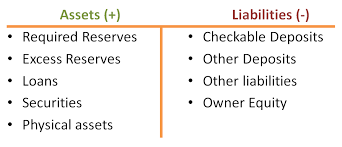
tool for describing the financial position of a business by showing assets on the left and liabilities on the right
each side must equal each other
money multiplier
1/ reserve requirement
money multiplier x FIRST increase in the money supply= max potential change
money from the fed is not in the money supply
motives to have liquid money
transaction motive: need for liquid money for every day transactions
asset motive: people hold money since it is less risky than other assets
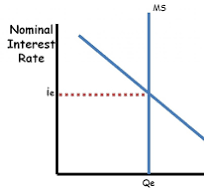
Money Market graph
(liquid) Money Demand curve: downward sloping because as interest rates decrease people are less likely to convert cash into interest earning assets
Money supply curve: vertical because it is not affected by NIR
factors that shift money demand curve
change in price level
change in national income
changes in technology
Monetary policy
a central banks policies of influencing interest rates to achieve economic goals
interest rates impact the price level, real output, and unemployment through shifts in AD
policy rate
rate banks charge each other for loans
known as federal funds rate in the US
Discount rate
rate the fed charges banks for a loan
expansionary monetary policy
decrease NIR in the short run to help increase AD and pull economy out of a recessionary gap
contractionary policy
Increase NIR to decrease AD and help pull economy down from an inflationary gap
Limited reserve system
required reserve ratio → decrease allows banks to lend out more excess reserves (inc M1) or an increase reduces the amount of money that is loaned out (dec M1)
discount rate → decrease encourages banks to lend more (inc M1) or increasing discourages lending (dec M1)
Open Market Operations → buying bonds increases banks excess reserves (inc M1) selling bonds decreases excess reserves (dec M1)
buy bonds bigger, sell bonds smaller
Ample reserves system
a banking system where…
reserves are abundant
the required reserve ratio is 0
changing the money supply no longer leads to changes in NIR
banks do not loan out all of their reserves
ample reserve tools
interest on reserves: the interest rate commercial banks earn on the reserves they store with the fed
discount rate: interest rate charged to banks to get loans from the fed
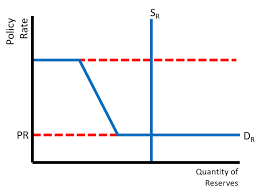
ample reserve market graph
y axis: Policy rate
x axis: reserve quantity
curves: reserves demand curve and reserves supply curve
floor: IOR
ceiling: discount rate