Immunity + Cancer
 Call Kai
 Learn
Learn Practice Test
 Spaced Repetition
 Match
Match Flashcards
 Knowt Play
1/29

There's no tags or description
Looks like no tags are added yet.
Name | Mastery | Learn | Test | Matching | Spaced | Call with Kai |
|---|
No analytics yet
Send a link to your students to track their progress
30 Terms
Describe the inflammatory response: 2
Damaged tissues release histamines.
This causes vasodilation, swelling and increased permeability to phagocytes.
Why is phagocytosis considered a non-specific defence mechanism?
Because it responds in the same way to all pathogens with no antigen specificity.
What is the role of T-helper cells?
T-helper cells release cytokines that activate B cells, cytotoxic T cells and phagocytes.
Role of Cytotoxic T cells
Cytotoxic T cells release perforin, creating pores in the cell membrane of the pathogen causing lysis and making it freely permeable
How do antigen-presenting cells activate T-lymphocytes? - 2
Antigen-presenting cells display antigens on MHC proteins, allowing the T cells with complementary receptors to bind.
This activates the T cell by co-stimulation.
Why are cell mediated responses ineffective against toxins?
This is because T cells require infected cells displaying antigens to be activated, not free-floating toxins.
Describe clonal selection in T cells - 2
In lymph nodes, thousands of T cells circulate.
CD4+ T-helper and CD8+ T-killer cells will only bind onto the APC if its receptor is complementary to the antigen.
A second signal from the APC (co-stimulation) is released which confirms that the pathogen is real and dangerous. This prevents inappropriate activation (which could cause autoimmunity.)
Myeloma cell
A cancerous cell
Hybridoma
The fusion of an antibody-producing B cell and a myeloma/ cancerous cell.
How to produce Monoclonal Antibodies - 7
Inject mouse with vaccine of specific pathogen.
Isolate B cells
Fuse the B cells with myeloma cells
Hybridoma cells are formed.
Screen
Cloned
Antibodies are harvested.
Describe the structure of an antibody - 4
Y-shaped protein
Two heavy and two light chains
Variable and constant region
Held by disulfide bonds.
How do antibodies lead to the destruction of pathogens - 3
Neutralisation
Agglutination
They are marked for destruction (by being coated by opsonin), for phagocytosis.
Difference between primary and secondary response.
Primary:
Slower
Lower antibody levels
Secondary:
Faster
Stronger due to memory cells
Role of memory cells
Memory cells enable rapid, larger antibody production on re-exposure.
Role of plasma cells
Plasma cells secrete large quantities of specific antibodies.
Why are booster vaccinations sometimes needed?
Booster vaccinations are sometimes needed because antibody levels can decline over time and memory cell responses may weaken.
How is attenuation used in vaccine production?
(attenuation - the reduction of the force, effect or value of something)
Pathogens are weakened so they do not cause disease but still trigger immunity.
Why may vaccines not be effective against a constantly mutating virus? - 2
Mutation causes antigens to change.
This means the antibodies produced from the memory cells in response to the vaccine will no longer be complementary to the antigens.
How does HIV lead to immunodeficiency?
HIV leads to immunodeficiency as it destroys T-helper cells, which precents the activation of B cells, cytotoxic T cells and phagocytes, causing immune suppression.
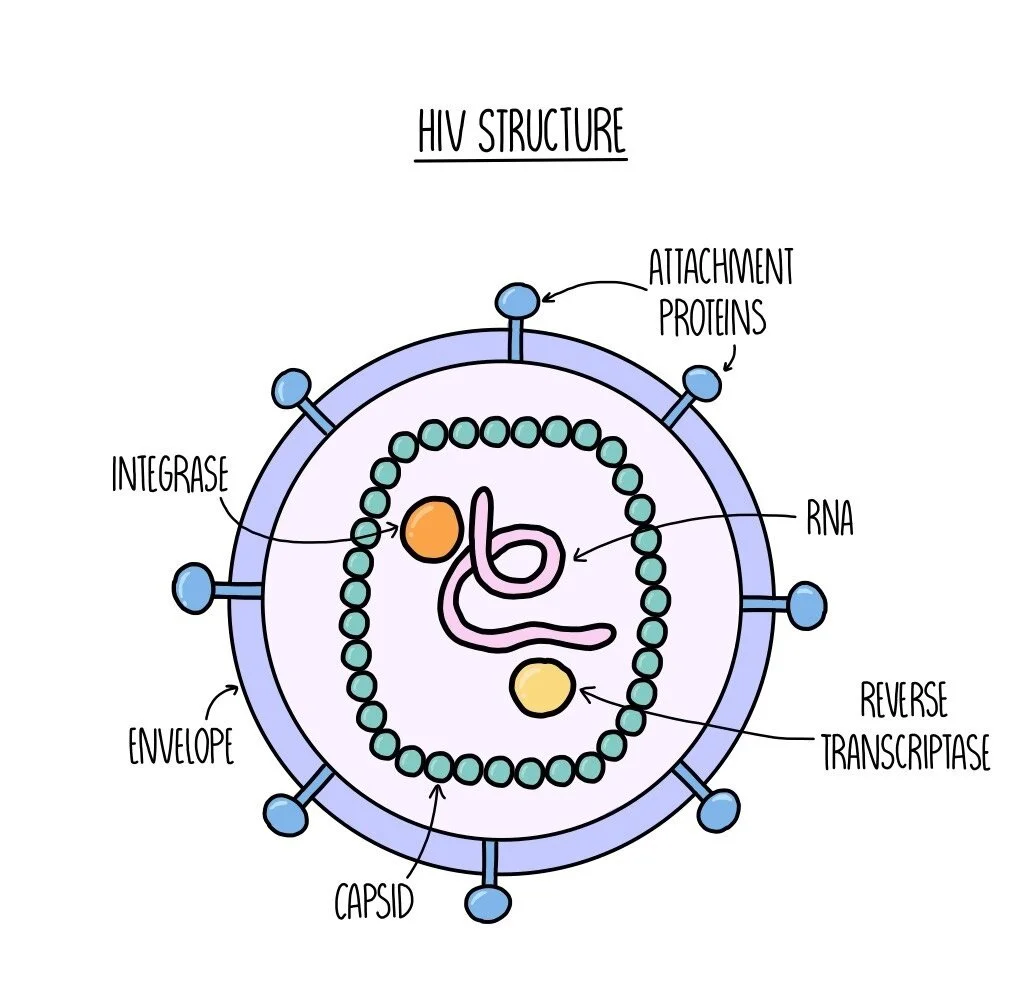
Describe the structure of HIV
RNA
Capsid
Reverse transcriptase
Integrase
Lipid envelope
Attachment proteins
How is HIV transmitted? - 3
Blood
Intercourse fluids
Breast milk
How are monoclonal antibodies used to treat cancer? - 2
Mabs binds specifically to cancer antigens.
This blocks growth signals or delivers toxins/ drugs to destroy cancer cells.
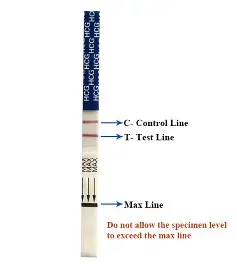
How is Mabs used in pregnancy tests? - 3 main steps
.
The reaction zone contains monoclonal antibodies that are complementary to hCG (hormone only present in urine if female pregnant).
These antibodies are attached to a coloured dye.
If hCG is present in urine, it binds to these mobile antibodies, forming an antibody-hCG complex.
.
As the urine moves along the test strip by capillary action, the antibody-hCG complex reaches the test line.
This line contains immobilised monoclonal antibodies, also specific to hCG.
They bind to the hCG-antibody complexes, trapping the dye and producing a visible coloured line.
This indicated a positive result.
.
Further along the strip is a control line with immobilised antibodies which are complementary only to the mobile antibodies, regardless of whether hCG is present.
This produces a second coloured line, showing the whole test has worked correctly.
What happens when the pregnancy strip test is negative? - 3
If no hCG is present in urine:
No antibody-hCG complexes form.
The test line does not appear.
The control line still appears.
Why are cancer cells recognised as non-self by the immune system?
Cancer cells have abnormal antigens on their surface due to mutations.
How are checkpoint inhibitors helpful in treating cancer?
Checkpoint inhibitors help treat cancer as they block proteins that restrain T cells, allowing stronger anti-tumour activity.
How do cancer cells evade the immune system? - 2
Cancer cells evade the immune system by downregulating their antigens or by secreting immunosuppressive molecules.
How does the immune system respond to abnormal body cells?
Cytotoxic T cells detect abnormal antigens and induce apoptosis.
What are the 3 ways mutations can lead to the formation of cancer cells.
A mutation can cause proto-oncogenes to become oncogenes so that they continue to stimulate cell division, even when it is not needed, leading to rapid, uncontrolled mitosis.
Tumour suppressant genes normally slow cell division or cause apoptosis in faulty cells. A mutation can deactivate the tumour suppressor gene so that the cell no longer stops dividing and faulty cells are not destroyed. This also results in uncontrolled cell division.
Mutations can disrupt proteins such as cyclins or CDKs, which regulate progression through the cell cycle. This means checkpoints fail, allowing cells with DNA damage to continue dividing.
Why do autoimmune diseases occur?
The immune system mistakenly targets self-antigens.

