AP US Government - Executive Branch
 Studied by 1 person
 Call Kai
 Learn
Learn Practice Test
 Spaced Repetition
 Match
Match Flashcards
 Knowt Play
1/39

There's no tags or description
Looks like no tags are added yet.
Name | Mastery | Learn | Test | Matching | Spaced | Call with Kai |
|---|
No analytics yet
Send a link to your students to track their progress
40 Terms
Presidential Qualifications
- Must be 35 years old
- Must be a natural born citizen
- Must have lived in the U.S. for 14 years
Presidential Terms of Office (22nd Amendment - rat.1951)
- The President and V.P. are elected to 4 year terms
- The 22nd amendment limits the president to two terms or no more than 10 years.
- I'm Franklin Delano Roosevelt?
Presidential Succession Act (25th Amendment)
- Vice-President of the United States
- Speaker of the House
- President pro tempore
- Cabinet secretaries in order of department origin (State, Treasury, Defense)
Presidential Powers
- Commander in Chief of the Armed Forces
- Grant reprieves & pardons for federal offenses
- Call special session of Congress
- Receive ambassadors
- Execute laws
- Appoint officials to lesser offices
Powers Shared with Senate/House
Senate
- “Advice and Consent”
- Make Treaties
- Appoint Ambassadors, Judges, high officials
House
- Approve Legislation
- Pass the Budget
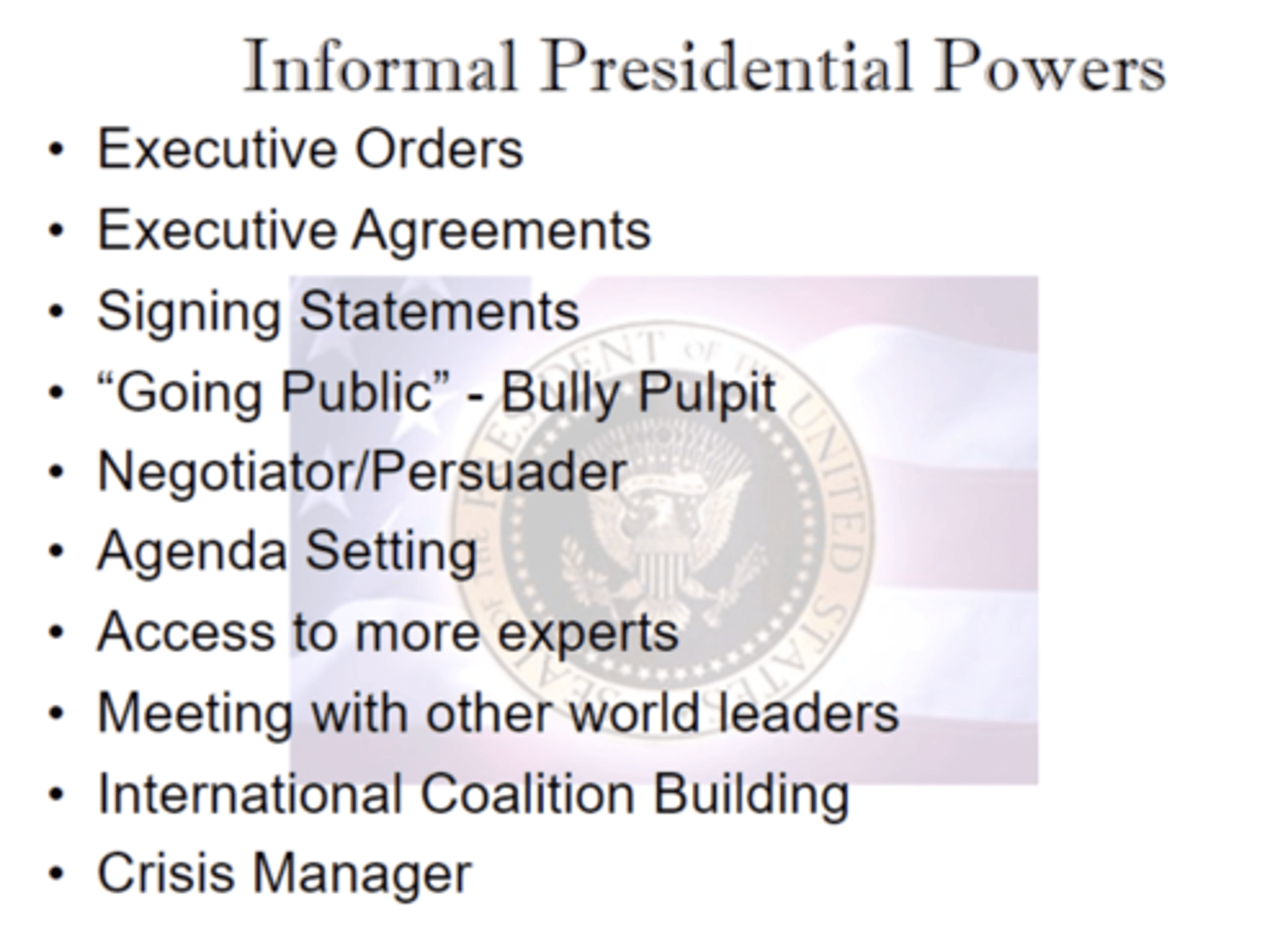
Informal Presidential Powers
Presidential Mandate
When a President receives a significant majority of votes he is said to have received a "Mandate" from the people. It empowers him and obligates him to pursue the promises he made in the campaign that resulted in the significant victory
Presidential Bully Pulpit
Refers to the President's use of their position to advocate for policies and reforms.
Executive Orders
Formal orders issued by the president to direct action by the federal bureaucracy.
Executive Agreements
Agreements with other countries that do not need senate approval
Article II Constitution
This article describes the role and power of the Executive Branch. The President and Vice President.
Fed 70
Strong executive does not contradict republican government
Good government= energy (power, influence, flexibility, quick execution of powers- protect national security) in the executive branch
Energy needed to
-carry out laws
-protect property
-prevent anarchy
-national security
-protect liberty
-make quick decisions
-have secrecy
-take action
need energy= energy means unity= unity equals one person
Plurality in CONGRESS good- promotes deliberation
Plurality in executive would slow decision making
70=energy
US v. Nixon
The Supreme Court does have the final voice in determining constitutional questions; no person, not even the President of the United States, is completely above law; and the president cannot use executive privilege as an excuse to withhold evidence that is 'demonstrably relevant in a criminal trial
Impeachment
Charges against a president approved by a majority of the House of Representatives
Presidential Transition
Three month long period beginning with the election of a new president in November. During this time period, the president will present his foreign policy orientation, agenda, and level of involvement, the appointment of executive branch personnel, and the organization of the foreign policymaking process.
Executive Privilege
The power to keep executive communications confidential, especially if they relate to national security.
Bureaucracy
An administrative system, especially in a government, that divides work into specific categories carried out by special departments of non elected officials
Characteristics of a Bureaucracy
Hierarchical Authority Structure
Power flows top down and responsibility flows bottom up
Task specialization
Run by experts!
Rules
Impersonal, may seem harsh, but intent is to ensure a totally equal experience
Merit Principle
Jobs are earned and promotions are based on merit - not nepotism
Impersonality
Clients are treated impartially
Basic Functions of Bureaucracy
Implementation: Carry out the laws of Congress and Executive Order of the President
----> Congress doesn’t legislate, it delegates
Regulation: Issues rules and regulations that impact the public
Ex: EPA sets clean air standards
Adjudication: Holds hearings to determine if regulations have been violated and can impose fines/punishments if deemed necessary
Administration: Routine administrative work on a national level
Ex: Social Security Administration (SSA sends out checks to beneficiaries)
Cabinet Departments
- 15 departments
- President's Cabinet are the heads of Departments
- Secretary of Defense oversees Department of Defense
Executive Agencies
- Independent executive agencies of the U.S. federal government are those that are self-governed and not directly controlled by the President.
- Given a specific mandate by congress and generally perform a service function, not a regulatory one.
Key Features of Executive Agencies
Presidential Control:
- The President appoints the heads of these agencies.
- They are generally subject to presidential direction, unlike independent regulatory commissions, which are more insulated.
Not Cabinet Departments:
- They are independent in structure (not part of a Cabinet department) but still report to the President.
Ex: NASA is independent, not under the Department of Defense or Commerce.
Specialized Mission:
- Focused on specific tasks or areas that require expertise.
- Usually administrative or service-oriented rather than regulatory
Independent Regulatory Commissions
- Created by an act of Congress that are independent of the executive departments.
- Meant to impose and enforce regulations free of political influence.
-------> Once appointed and seated, members cannot be removed without cause
Ex: Securities and Exchange Commission
Key Features of Independent Regulatory Commissions
Independence:
- Leaders usually serve fixed terms (longer than a presidential term) and cannot be easily removed by the President (except for cause).
Regulatory focus:
- They make and enforce rules for specific industries or areas, often involving licenses, standards, or oversight.
Bipartisan structure:
- Commissioners often cannot all be from the same political party to ensure balance. Expected to be experts in the areas they manage
Ex: Federal Communications Commission (FCC) — regulates broadcasting and telecommunications
Bureaucratic Agencies - Quasi Legislative
- They make specific rules, that have the force of laws, in order to implement the Congressional program
the agency gets the power to interpret the legislation
Bureaucratic Agencies - Quasi Judicial
- Administrative Adjudication
- They can hear cases dealing with issues on their rules and they issue verdicts usually resulting in fines
Government Corporations
- Blend of Government Agency and private business
- Provide a market-oriented public service and to produce revenues that meet or approximate its expenditures
Ex: Amtrak/USPS
Key Features of Government Corporations
Provide services for a fee
- They charge customers (like a business would) and often generate revenue.
- However, they are not profit-driven — their main goal is public service.
Created by Congress
- Congress establishes government corporations to manage services that need consistent, reliable delivery nationwide
Delegated Discretionary Authority
An agency's ability to decide whether or not to take certain courses of action when implementing existing laws.
spoils system
A system of public employment based on rewarding party loyalists and friends.
Pendleton Act
This legislation created the Civil Service Commission to administer the personnel service.
Created because:
- President James A. Garfield was assassinated by Charles Guiteau when he became frustrated because he could not get a federal job
- Act pushed by President Chester A. Arthur as a result (even though he had been a Prince of Patronage
Civil Service Reform Act 1978
Law that replaced the Civil Service Commission with the Office of Personnel Management and the Merit Systems Protection Board.
These agencies are responsible for enforcing existing civil service laws, coordinating the testing of applicants, setting up pay scales, and appointing people to federal jobs.
Office of Personnel Management
Improve the quality of individuals hired by agencies and the Merit Systems Protection Board (MSPB) to regulate the relations between agencies and employees.
- In charge of hiring for most of the federal agencies
- Director of OPM is appointed by the president and confirmed by the Senate
- Once an individual has passed the civil service exam their name will be on an OPM list; when a job opens in a federal agency - OPM sends the agency three names - unless there is an unusual circumstance one of those three individuals will be hired.
Hatch Act
- The law's purposes are to ensure that federal programs are administered in a nonpartisan fashion
- To protect federal employees from political coercion in the workplace
- To ensure that federal employees are advanced based on merit and not based on political affiliation.
Office of Management and Budget
Created during the Civil Service Reform Act of 1978
Main tasks:
- Oversees the implementation of the President’s vision across the Executive Branch
- Budget development: Drafting annual Federal Budget
- Monitor how the federal agencies are spending their money
- Management, including oversight of agency performance
General Services Administration
An independent agency of the United States government, was established in 1949 to help manage and support the basic functioning of federal agencies
Acts as a central hub for government functions by providing everything from office supplies and IT solutions to managing federal buildings and acquiring property.
Congressional Oversight
Congress is primarily concerned that bureaucratic agencies actually implement the laws as they intended
Two ways to do this:
1. Committee Hearings
Get a reasonable understanding of an issue
Call agencies to task for the public record
EX. Judiciary Committee will call FBI to task for failures
2. Power of the Purse
Agency cannot spend any money until they receive an authorization of spending
Agency is in failure - less funding
------> Budget and Impoundment Control Act
Executive Oversight
Since the bureaucracy falls under the auspices of the President there are many avenues for oversight
Formal:
Appointment - new heads of agencies
- Can’t fire regulatory agency heads willy nilly - must have “just cause”
- Can hire/fire others at will (Cabinet)
- Office of Management and Budget (OMB)
Informal:
Presidents ideological leanings impacts how bureaucracy carries out administration's goals
- Executive Order to bring bureaucracy into alignment with policy agenda
Ex: Civil Rights (Affirmative Action)
Judicial Oversight
People can appeal to the courts to challenge rules and regulations established by bureaucratic agencies to determine Constitutionality
Judicial Review
Most cases court rules in favor of agency
Compliance Monitoring
How Bureaucracy Holds Itself Accountable
Checking if individuals, corporations, or other government entities follow established laws, regulations, and policies, involving activities like audits, data collection, and inspections to ensure adherence to external requirements and proper use of public funds.
It's a core function of bureaucratic agencies to hold others (and themselves) accountable for implementing legislative mandates.
 Note
Note  Flashcards (56)