3B: Human Gas Exchange
 Call Kai
 Learn
Learn Practice Test
 Spaced Repetition
 Match
Match Flashcards
 Knowt Play
1/78

There's no tags or description
Looks like no tags are added yet.
Name | Mastery | Learn | Test | Matching | Spaced | Call with Kai |
|---|
No analytics yet
Send a link to your students to track their progress
79 Terms
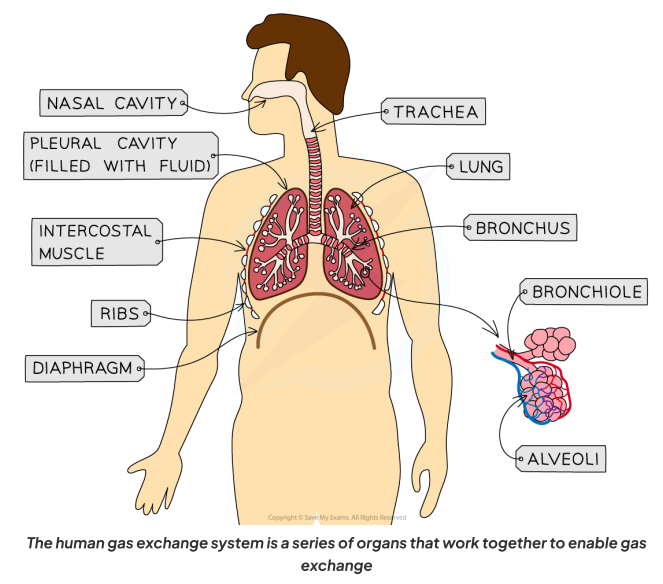
The human gas exchange system contains the following structures:
alveoli (singular alveolus)
bronchioles
bronchi (singular bronchus)
trachea
lungs
Define gas exchange.
The movement of O2 from the alveoli through the epithelial cells into the capillaries through the endothelial cells.
Give a description of the alveoli.
A series of tiny sacs with structural adaptations that maximise gas exchange. The site of gas exchange in the lungs.
Give a description of the bronchioles.
Narrow tubes that connect the alveoli to the bronchi.
Give a description of the bronchi.
A pair of tubes that connect the bronchioles in each lung to the trachea.
Give a description of the trachea.
The airway, or windpipe, that connects the bronchi with the mouth and nose.
Give a description of the lungs.
Two lungs in the chest cavity are the organs of gas exchange.
Gas exchange system structure can be examined during __________.
dissection
What equipment does dissection involve?
scalpel
dissecting scissors
tweezers/forceps
dissecting pins
What may a scalpel be useful for in dissection?
A sharp blade used for precise cutting.
What may dissecting scissors be useful for in dissection?
Small, sharp scissors used for lower-precision tasks or separating layers of tissue.
What may tweesers/forceps be useful for in dissection?
Useful for manipulating the specimen during dissection.
What may dissecting pins be useful for in dissection?
May be useful for pinning sections of a specimen in place while working.
How should you ensure your safety in the dissection practical?
a lab coat, gloves, and eye protection should be worn to avoid contamination with biological material
sharp, clean blades should be used for ease and accuracy of cutting
scalpel blades should cut away from the body
fingers should be kept away from the blade edges
How should you ensure responsible use of biological materials in the dissection practical?
Any biological specimen used for dissection should be from a reputable source and should be disposed of in the correct manner.
What are the key structures that can be see from the dissection of mammalian lungs?
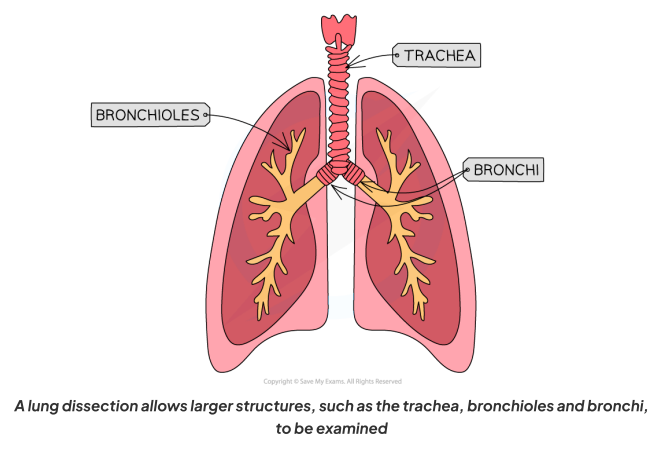
Smaller structures, such as the alveoli, can be hard to distinguish in a dissected lung, though the 'spongy' texture of lung tissue indicates that lungs contain many air-filled sacs.
What are the key structures that can be see from the dissection of fish gills?
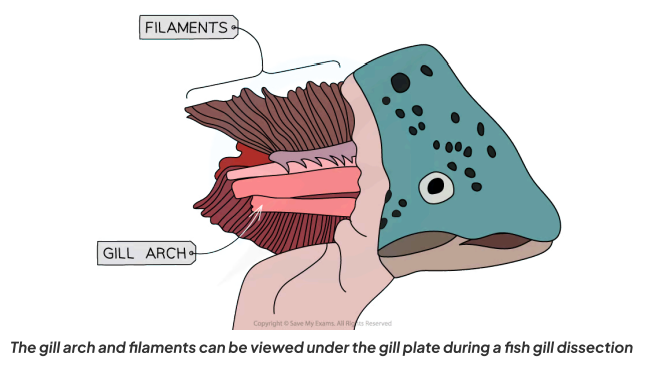
the gill arch; this can be cut to remove the gill from the fish
the gill filaments, which have a feathery appearance
The lamellae are too small to view by eye, but can be examined under a microscope.
Where are the gills of the fish located?
Located on either side of the head, beneath a bony flap known as the operculum.
Is it possible to dissect insects?
Yes, large ones.
How can you dissect an insect tracheal system?
Attach insect to a dissecting board using pins.
Cut the exoskeleton along the length of the abdomen add a saline solution to the abdomen to highlight the location of the tracheae, which will show as silvery tubes.
Tracheae can be removed and viewed under a microscope.
School students may use pre-prepared _________ _____ to view gas exchange tissue under an _______ microscope.
School students may use pre-prepared microscope slides to view gas exchange tissue under an optical microscope.
What features can be viewed from a cross section of mammalian lung tissue?
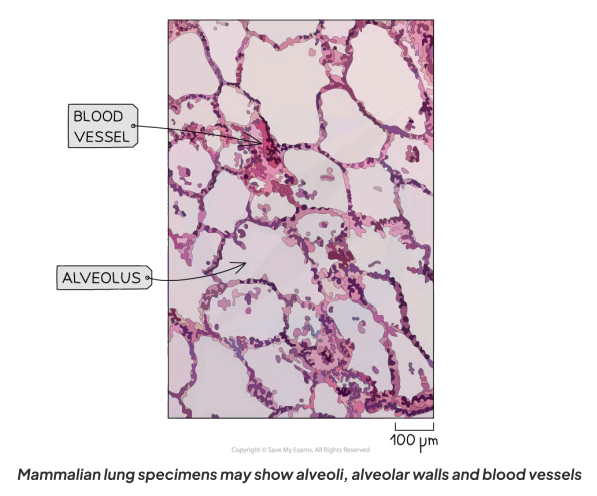
alveoli that differ in size and shape
alveolar walls that are:
one cell thick
made up of flattened cells
nuclei that are shown as dark dots
blood vessels in between the alveoli
What features can be viewed from a cross section of fish gill tissue?
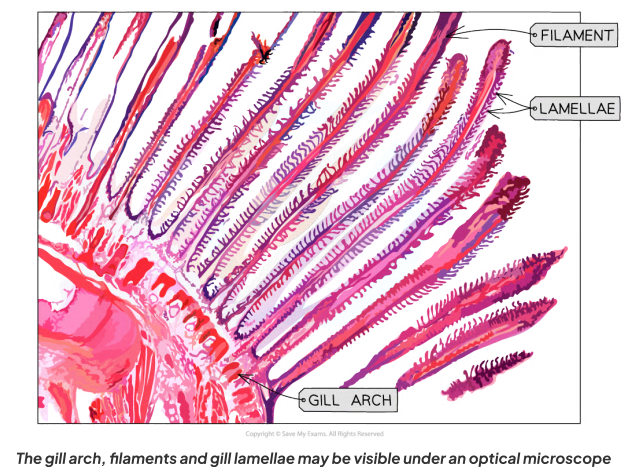
the gill arch which provides a backbone for the gill filaments
many filaments arranged along the gill arch
lamellae visible at higher power
What type of microscope is useful for capturing gas exchange systems?
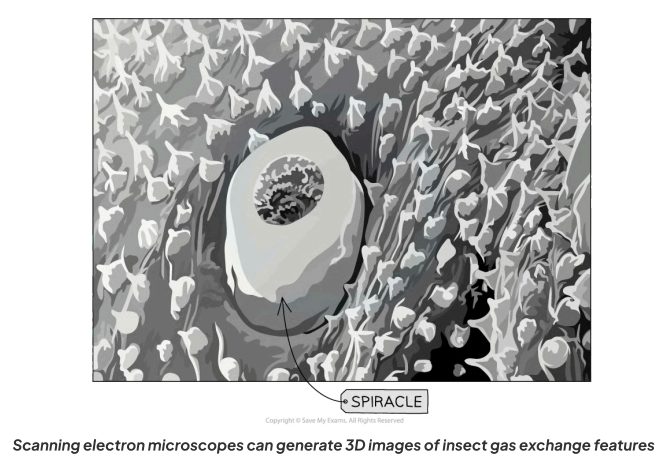
Electron microscopes can take clear images of insect gas exchange structures, e.g.the spiracles.
What features can be viewed from a cross section of stained dicotylenonous leaf tissue?
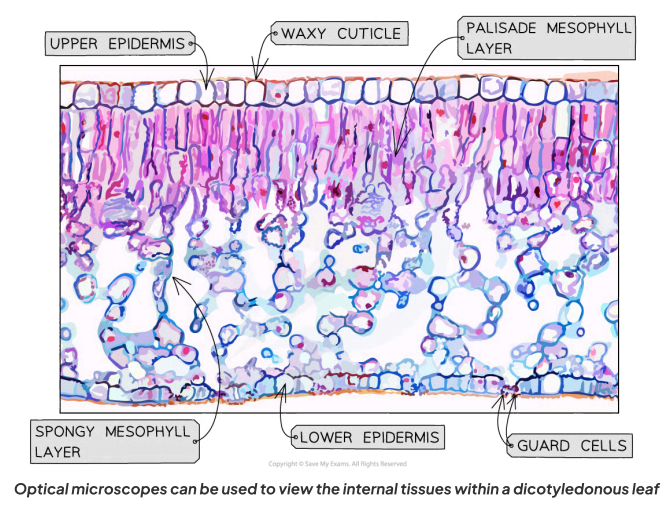
waxy cuticle
epidermal layers
palisade mesophyll layer
spongy mesophyll layer
stomata
guard cells
What is a respirometer?
An experimental set-up that measures oxygen consumption in living organisms.
This is in order to measure the volumes of air involved in gas exchange.
How do respirometers work?
Respirometers measure changes in air pressure inside a container
As oxygen is consumed the air pressure decreases, causing a drop of coloured liquid to move towards the region of lower pressure
The distance moved by the coloured liquid in a given time can be used to calculate the volume of oxygen consumed
What equipment do respirometers often contain that aids their function?
three-way tap
manometer
How do three-way taps work?
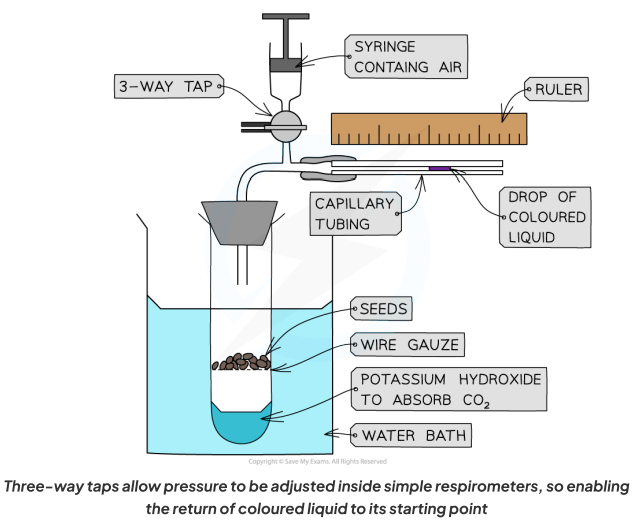
Three-way taps can be opened to allow air into the respirometer, altering the internal pressure. This enables the return of the liquid bead to the starting point to allow easy repeat readings.
How do manometers work?
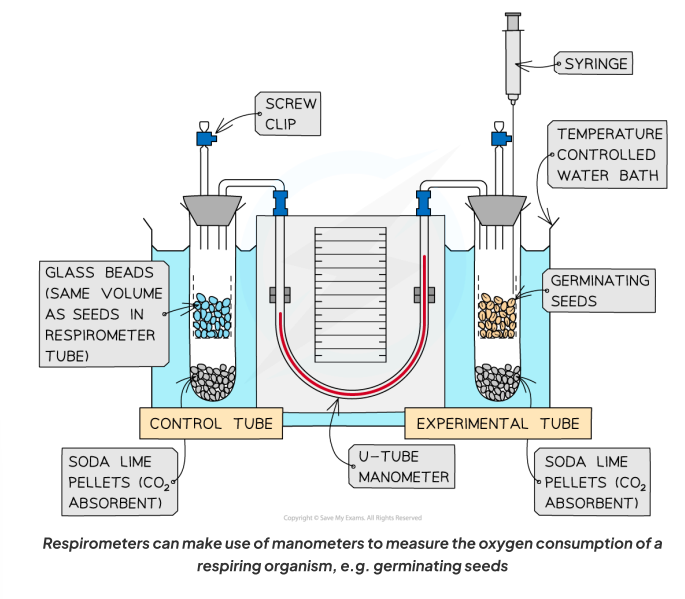
Manometers are narrow tubes that contain liquid, used to determine the difference in air pressure between two sealed containers. The liquid in the tube is drawn towards the container where the pressure is lowest, and the distance moved by the fluid can be used to calculate the volume of gas removed.
The alveolar __________ functions as an ________ surface.
The alveolar epithelium functions as an exchange surface.
Define diffusion.
The net movement of particles (molecules or ions) from an area of higher concentration to an area of lower concentration (down their concentration gradient), a passive process requiring no energy, occurring in liquids/gases and across partially permeable membranes until equilibrium is reached, driven by random particle movement.
What are the functions of the alveolar epethelium that allow it to be a good exchange surface?
large surface area
thin walls
a steep concentration gradient
How do the alveolar epethelium have a large surface area?
The lungs contain many alveoli, increasing the surface area available for oxygen and carbon dioxide to diffuse.
How do the alveolar epethelium have thin walls?
The walls of the alveoli are only one cell thick.
Alveolar epithelium cells are flattened in shape.
Gases have a very short diffusion distance.
How do the alveolar epethelium have a steep concentration gradient?
The constant flow of blood through capillaries that are immediately adjacent to the alveolar epithelium means that oxygenated blood is carried away from the alveoli very quickly.
This maintains the concentration gradient necessary for diffusion of oxygen to occur.
Give a diagram to show how the alveolar epethelium is used as a exchange surface.
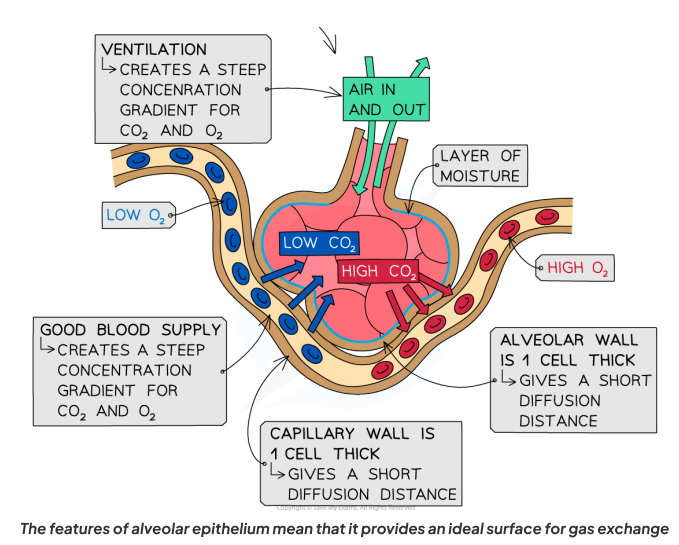
Gas exchange in the lungs occurs when…
oxygen diffuses down its concentration gradient from the air into the blood
carbon dioxide diffuses down its concentration gradient from the blood into the air
The concentration gradients required for effective gas exchange are maintained by…
ventilation in the lungs
the continuous flow of blood in the capillaries
What is ventilation?
The process of moving air in and out of the lungs, involving:
breathing in, or inhalation
breathing out, or exhalation
What mechanism is used to breathe in? (step-by-step)
The diaphragm contracts and flattens and the external intercostal muscles contract.
The ribcage moves upwards and outwards.
Chest volume increases, resulting in a pressure decrease.
Air moves into the lungs down a pressure gradient.
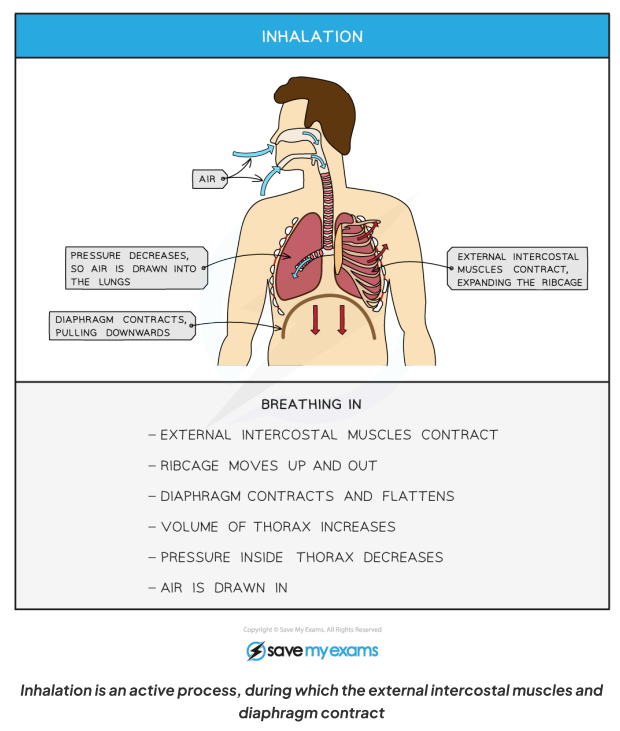
The process of breathing in is passive/active. Why?
The process of breathing in is active.
It requires energy for muscle contraction.
What mechanism is used to breathe out? (step-by-step)
The diaphragm relaxes and curves upwards and the external intercostal muscles relax.
The ribcage moves downwards and inwards.
Chest volume decreases, resulting in a pressure increase.
Air moves out ofthe lungs down a pressure gradient.
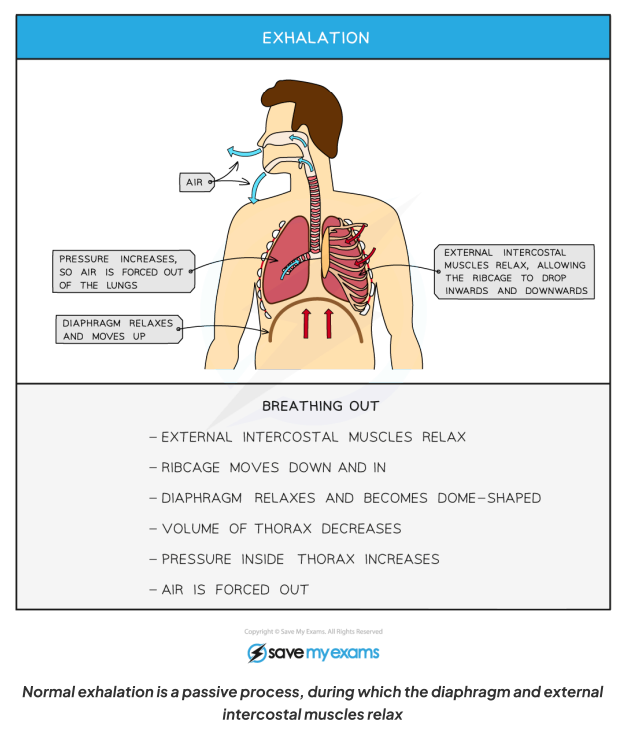
The process of breathing out is passive/active. Why?
When at rest breathing out is a passive process.
It occurs due to the elastic recoil of the lung tissue.
Can inhalation/exhalation be active?
Yes - during forced exhalation.
How oes forced exhalation work?
Internal intercostal muscles contract to pull the ribs down and the abdominal muscles contract to push organs upwards against the diaphragm.
These actions decrease the chest volume further, increasing the pressure and forcing more air out ofthe lungs.
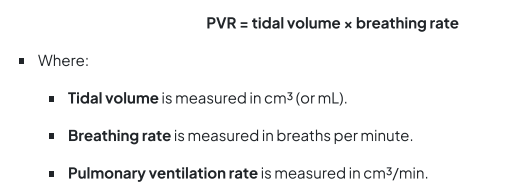
What is pulmonary ventilation rate?
The volume of air an individual breathes per minute.
What is the pulmonary ventilation rate useful for?
It’s an important measure of respiratory function, especially during exercise or illness.
What is tidal volume?
The volume of air inhaled or exhaled in one normal breath.
What is breathing rate?
The number of breaths taken per minute.
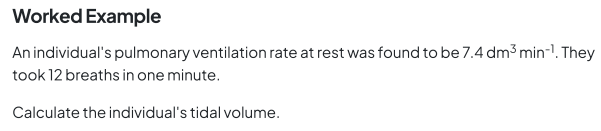
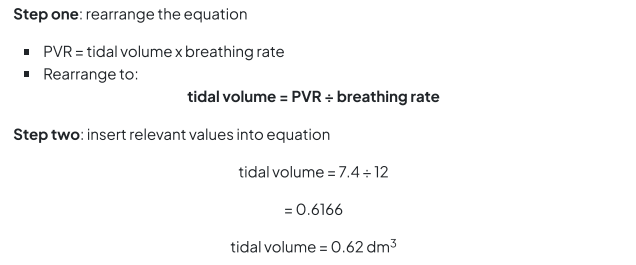
How can you calculate pulmonary ventilation rate?
What are examples of lung diseases?
lung cancer
COPD
How does lung cancer damage the body?
Tumours develop in the lungs due to uncontrolled cell division
The tumour may interfere with the normal working of the lungs, e.g. by squeezing against blood vessels or blocking airways
How does COPD damage the body?
Chronic obstructive pulmonary disease (COPD) includes a range of conditions, such as chronic bronchitis and emphysema
COPD causes damage to the lungs or airways, reducing air flow and/orthe rate of gas exchange
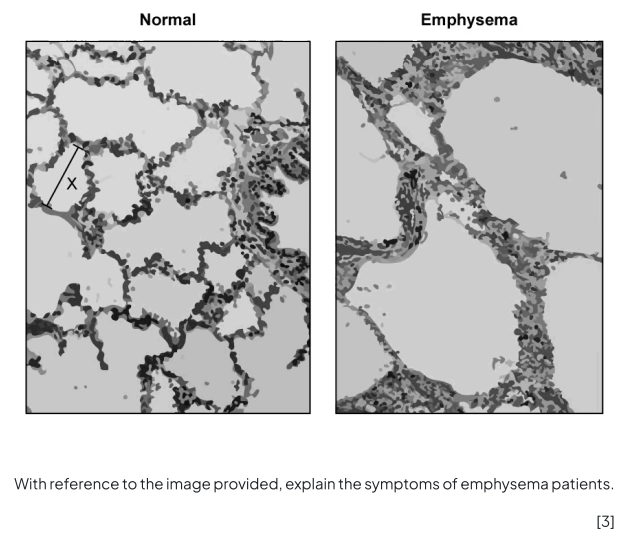

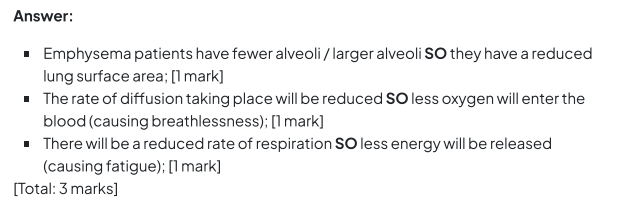
What factors have been linked to lung disease?
Exposure to pollution and cigarette smoke.
How do cigarettes cause lung disease?
they contain:
cancer-causing chemicals
chemicals that affect the ability of the blood to transport oxygen
chemicals that increase mucus production in the airways
What diseases has pollution been linked to?
worsening COPD
asthma
lung cancer
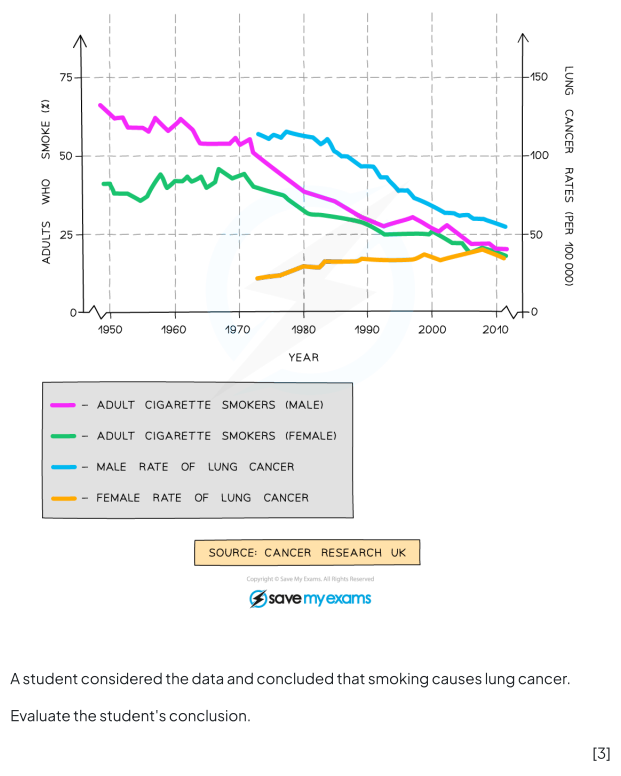
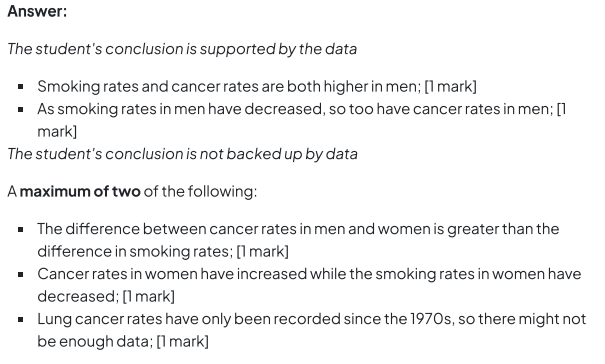
The graph below shows smoking rates in men and women in the UK, as well as rates of lung cancer.

What is a risk factor?
Any factor that is linked to an increased probability of suffering from a particular condition or disease.
What are the risk factors of lung disease?
smoking
air pollution
exposure to certain chemicals at work
genetics
asthma
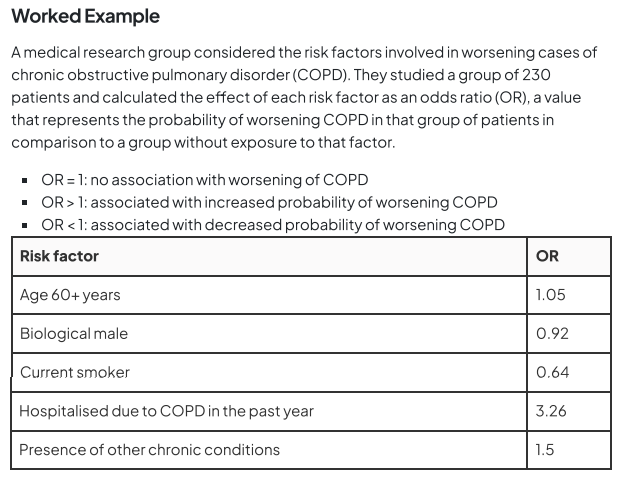
Analyse the data to determine whatthey show aboutthe risk factors studied and worsening of COPD.
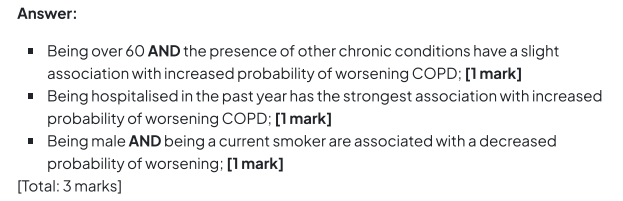
What may cause inaccurate trends/results in data?
a small sample size
a lack of statistical testing
a failure to control other variables, e.g. diet
Why is data from studies on risk factors in disease important?
It is often used to inform government policy, e.g.the introduction of health warnings on cigarettes, and bans on smoking in public places.
This means thatitis importantthat such data are interpreted accurately.
What considerations should be taken into account when analysing data from studies on risk factors?
control variables
sample size
sample demographic
correlation vs causation
statistical tests
Why should control factors be taken into consideration?
It is difficult to eliminate the effects of other variables, e.g. diet, activity levels and genetics, on the outcome of a study on a specific lifestyle factor.
Why should sample size be taken into consideration?
The number of individuals in a study needs to be large enough to represent the population as a whole.
Why should sample demographic be taken into consideration?
The sample needs to contain individuals who represent the target demographic.
E.g. a study that includes women aged 20-40 cannot be used to determine the effect of a risk factor on men, or on women aged 50-60.
Why should correlation vs causation be taken into consideration?
Risk factor data tends to rely on correlation and does not always indicate a causal relationship.
E.g. it would be unethical to conduct a controlled experiment that involves asking one random group of people to smoke 10 cigarettes every day for 10 years, and another to avoid smoking for 10 years, so researchers rely on asking people about their chosen lifestyle factors and looking for patterns in the data.
Why should statistical tests be taken into consideration?
Statistical testing should be used to determine whether any associations between variables are significant or due to chance.
What should you talk about in exam questions about evaluating a data set.
think about the design of the study
who it is meant to represent
whether we can correctly assume causation
whether statistical tests have been carried out
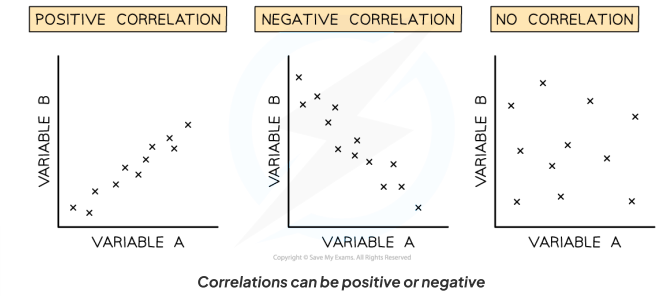
What is correlation?
An association between variables, e.g.:
positive correlation: as variable A increases, variableB increases
negative correlation: as variable A increases, variableBdecreases
What is a correlation coefficient?
A calculation to determine the strength of a calculation.
What is causation?
Causation, or a causal relationship, is present when a change in one variable is caused by a change in the other.
Correlation does NOT equal causation.
Why?
The two variables may be linked by a third factor that has not been taken into account by the research.
What must be done to demonstrate that a correlation?
see the same results repeated across many studies
demonstrate that the causal factor is occurring before the resulting change
demonstrate the causal mechanism
carry out controlled trials (this is not always possible)
What is important to remember when analysing data in terms of extrapolation?