Jovian Moons and Rings
 Studied by 0 people
 Call Kai
 Learn
Learn Practice Test
 Spaced Repetition
 Match
Match Flashcards
 Knowt Play
1/27

There's no tags or description
Looks like no tags are added yet.
Name | Mastery | Learn | Test | Matching | Spaced | Call with Kai |
|---|
No analytics yet
Send a link to your students to track their progress
28 Terms
What are small moons defined by?
Moons smaller than 300 km with no geological activity.
What characterizes medium-sized moons?
Moons between 300-1500 km that had geological activity in the past.
What defines large moons?
Moons larger than 1500 km with ongoing geological activity.
Medium and Large Moons
• Enough self-gravity to be spherical • Have substantial amounts of ice
• Formed in orbit around jovian planets
• Circular orbits in same direction as planet rotation (except Triton)
Small Moons
• These are far more numerous than the medium and large moons.
• They do not have enough gravity to be spherical: Most are"potato-shaped."
• They are captured asteroids or comets, so their orbits do not follow usual patterns.
Why are Jupiter's Galilean moons so geologically active?
due to intense tidal heating, caused by the powerful, rhythmic gravitational tug-of-war between Jupiter and the other moons
Io's Volcanic Activity
• Io is the most volcanically active body in the solar system,
• Volcanic eruptions continue to change Io's surface
Tidal heating
Io is squished and stretched as it orbits Jupiter.
Orbital Resonances
Why are the orbits elliptical?
- Every 7 days, these three moons line up.
- The tugs add up overtime, making all three orbits elliptical.
Europa's Ocean: Waterworld?
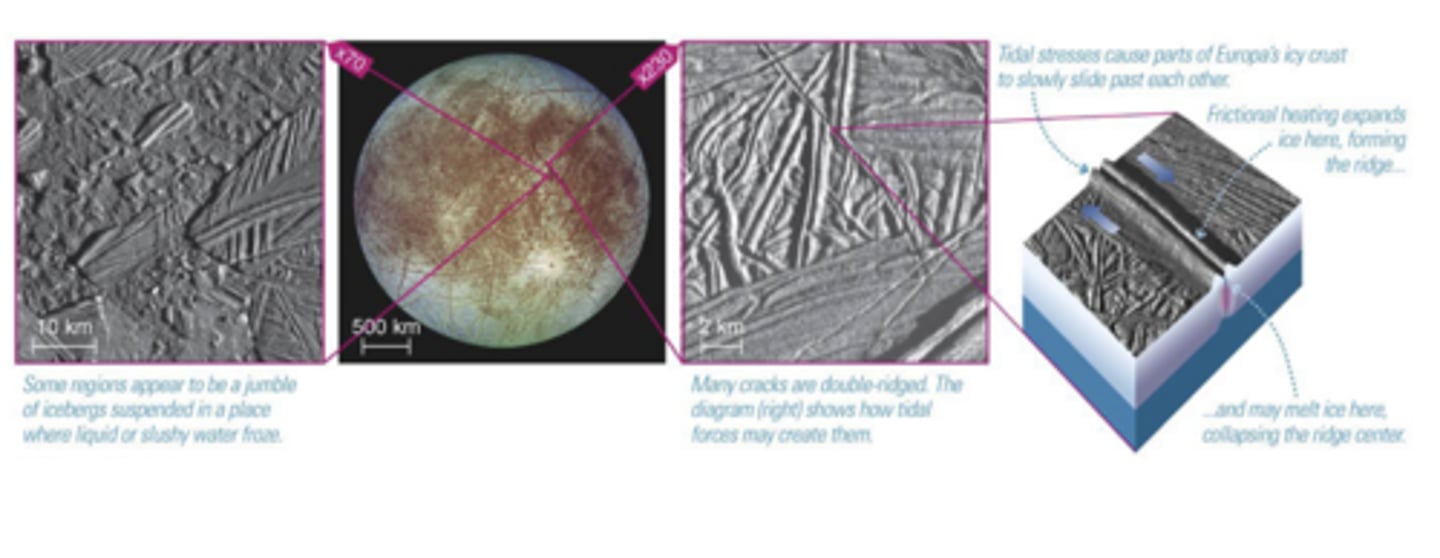
Europa's interior
also warmed by tidal heating
Ganymede
• Largest moon in the solar system
• Clear evidence of geological activity
• Tidal heating plus heat from radio-active decay?
Callisto
• "Classic" cratered iceball
• No tidal heating, no orbital resonances
• But it has a magnetic field!?
What is remarkable about Titan and other major moons of the outer solar system?
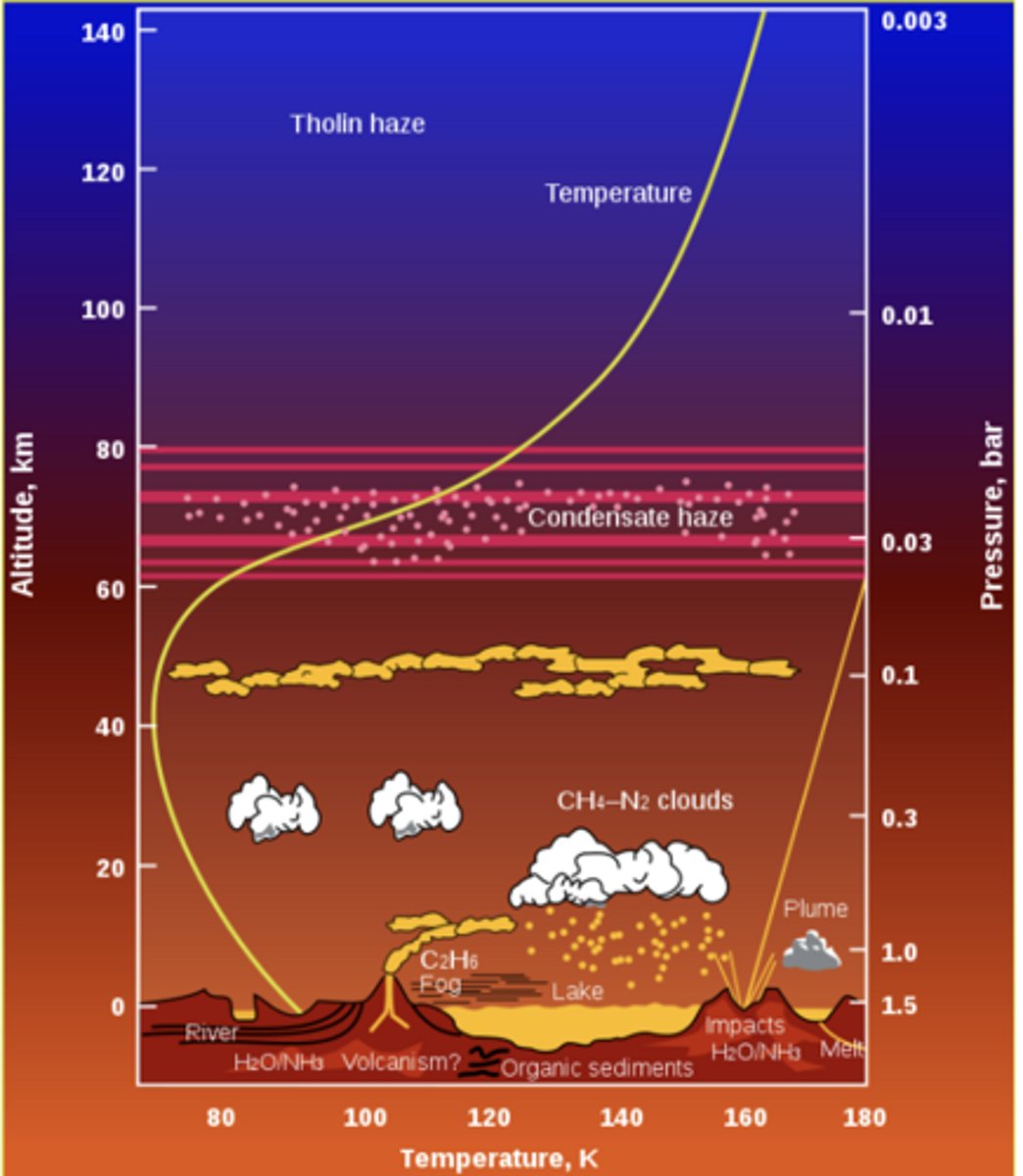
• Titan is the only moon in the solar system to have a thick atmosphere.
• It consists mostly of nitrogen with some argon, methane, and ethane.
Titan's Surface
• Huygens probe provided first look at Titan's surface in early 2005.
• It found liquid methane and "rocks" made of ice.
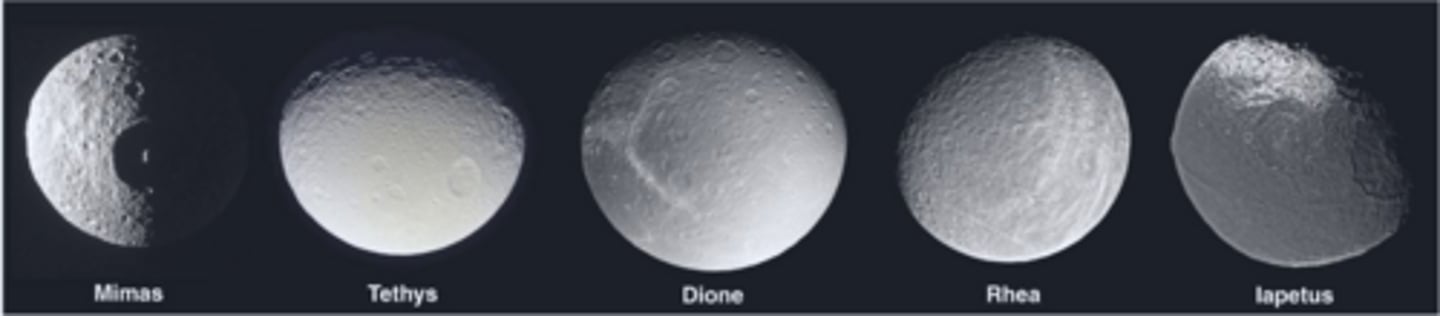
Medium Size Moons of Saturn
• Almost all of them show evidence of past volcanism and/or tectonics.
• Ice fountains of Enceladus suggest it may have a subsurface ocean.
Ice moon convection

Medium Size Moons of Uranus
• They have varying amounts of geological activity.
• Miranda has large tectonic features and few craters (possibly indicating an episode of tidal heating in past).
Neptune's Moon Triton
• Similar to Pluto, but larger
• Evidence of past geological activity
What are Saturn's rings like?
• They are made up of numerous, small individual objects.
• They orbit around Saturn's equator.
• They are very thin.
Gap Moons
• Some small moons create gaps within rings.
Resonance Gaps
Orbital resonance with a larger moon can also produce a gap.
Jovian Ring Systems
• All four jovian planets have ring systems.
• Others have smaller, darker ring particles than Saturn
Why do the jovian planets have rings?
• They formed from dust created in impacts on moons orbiting those planets.
• Rings aren't leftover from planet formation because the particles are too small to have survived for so long. • There must be a continuous replacement of tiny particles.
• The most likely source is impacts with jovian moons.
Ring Formation
• Jovian planets all have rings because they possess many small moons close in.
• Impacts on these moons are random.
• Saturn's incredible rings may be an "accident" of our time.
Comet Shoemaker-Levy 9 (SL9) caused a string of violent impacts on Jupiter in 1994, reminding us that catastrophic collisions still happen. Tidal forces tore it apart during a previous encounter with Jupiter.
info to know
This image shows
An impact plume from a fragment of comet SL9 rises high above Jupiter's surface.
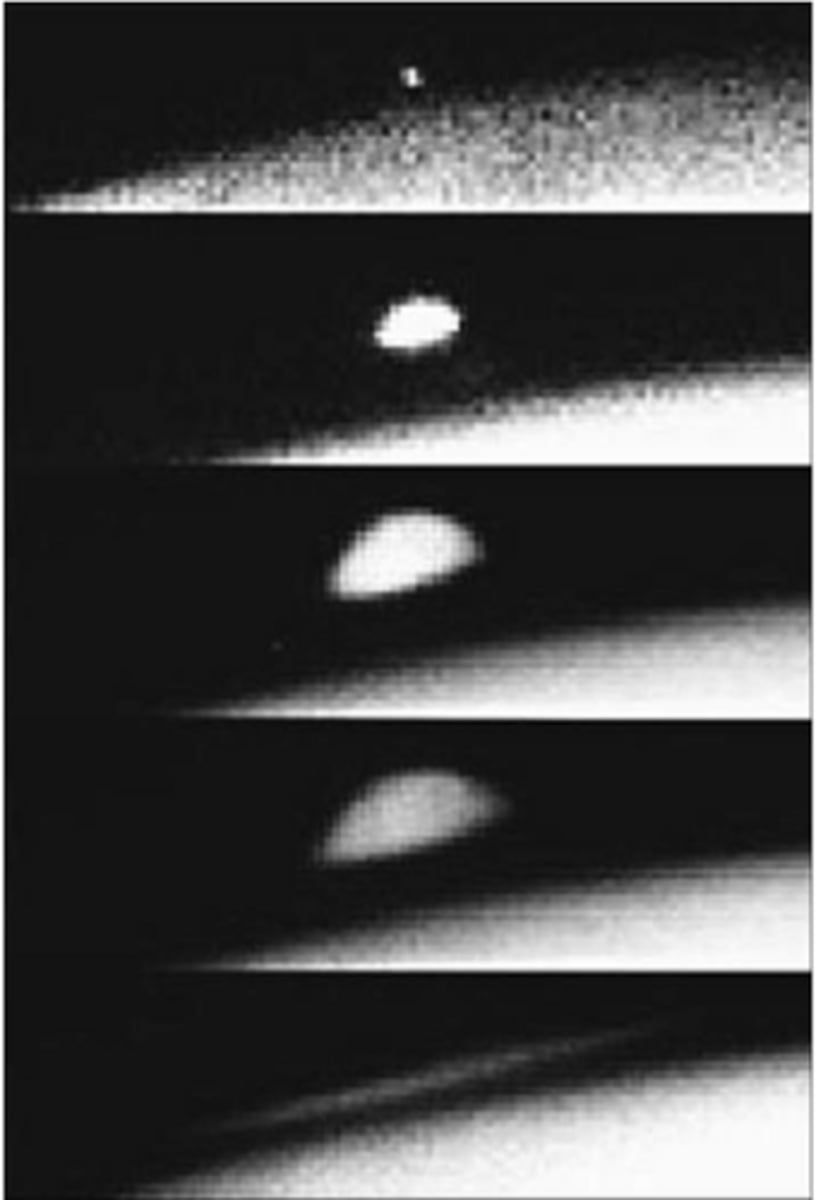
Comet Shoemaker-Levy's Collision with Jupiter
These fragments exploded into huge fireballs and left dark spots at the impact sites that lasted for months.
 Note
Note  Flashcards (21)