Ch. 7 - Communication
 Call Kai
 Learn
Learn Practice Test
 Spaced Repetition
 Match
Match Flashcards
 Knowt Play
1/34

There's no tags or description
Looks like no tags are added yet.
Name | Mastery | Learn | Test | Matching | Spaced | Call with Kai |
|---|
No analytics yet
Send a link to your students to track their progress
35 Terms
Communication
The transfer and understanding of a message between two or more people.
Communicating is more than merely saying something; the meaning of what was said must also be understood.
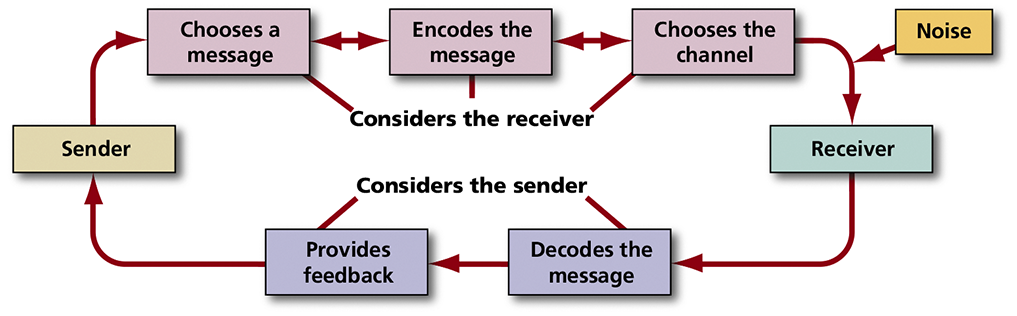
Communication Process
Key Parts
The steps between a source and a receiver that result in the transfer and understanding of meaning and information.
The Receiver: The person the message is directed to.
The Sender: Person that sends the message.
Encoding: Process of turning your thoughts, ideas, or feelings into a message that can be understood by someone else.
Message: The actual physical product of the sender’s encoding. Speech, writing, and gestures.
Channel: How the message travels. Includes formal and informal channels.
Decoding: The message. Includes noise.
Noise: Represents communication barriers that distort the clarity of the message.
Feedback: Check on how successful we have been in transferring our messages as originally intended.
Formal Channels
Communication channels established by an organization to transmit messages related to the professional activities of members.
Examples include: Emails, memorandums, reports, meetings, policies and manuals, chain of command.
Informal Channels
Communication channels that are created spontaneously and that emerge as responses to individual choices.
Examples include grapevine, text messages, social media, causal conversations, friendships at work.
Channel
The medium through which a message travels. Channels differ in their capacity to convey information. Some are rich in that they can:
Handle multiple cues simultaneously.
Facilitate rapid feedback.
Be very personal.
Others are lean in that they score low on these three factors.
Communication Apprehension
Undue tension and anxiety about oral communication, written communication, or both. Due to this someone may choose one specific channel over another.
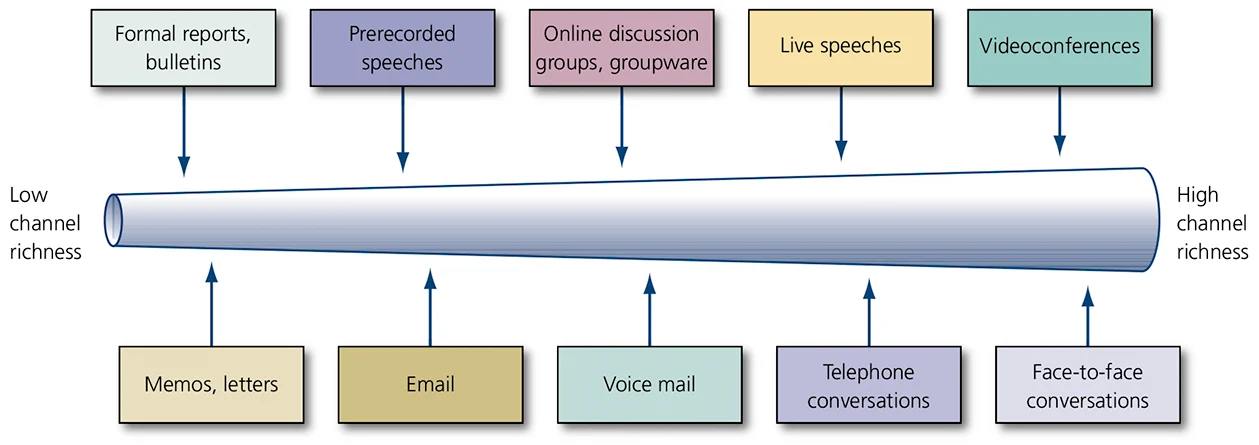
Channel Richness
The amount of information that can be transmitted during a communication episode. Face-to-face conversation scores highest in terms of channel richness because it transmits the most information per communication episode multiple information cues (words, postures, facial expressions, gestures, intonations), immediate feedback (both verbal and nonverbal), and the personal touch of being present.
Rich media is digital media that includes video, audio, and elements that interact with viewers. Impersonal written media such as formal reports and bulletins rate lowest in richness.
Different Channel Richness Types (OWN)
Oral Communication: Whenever you need to gauge the receiver’s receptivity, oral communication is usually the better choice.
Written Communication: Most reliable mode for complex and lengthy communications, and it can be the most efficient method for short messages when, for instance, a two-sentence text can take the place of a 10-minute phone call. Emotional expression is limited though. Important when you want information “on the record.”
Nonverbal: Be alert of nonverbal aspects of communication, cues as well as the literal meaning of a sender’s words.
Filtering
Barrier to Effective Communication
A sender’s manipulation of information so that it will be seen more favourably by the receiver. Managers who tell their boss what they feel their boss wants to hear are filtering information.
The more vertical levels in the organization’s hierarchy, the more opportunities there are for filtering.
Information Overload
Barrier to Effective Communication
A condition in which information inflow exceeds an individual’s processing capacity. When individuals have more information then they can sort, and use they tend to select, ignore, pass over or forget it.
How Personal Emotions can Effect Communication
Barrier to Effective Communication
You may interpret the same message differently when you are angry or distraught than when you are happy.
People in negative moods are more likely to scrutinize messages in greater detail, whereas those in positive moods tend to accept communications at face value.
Extreme emotions such as jubilation or depression are most likely to hinder effective communication.
In such instances, we are most prone to disregard our rational and objective thinking processes and substitute emotional judgments.
Selective Perception in Communication (and Decode)
Barrier to Effective Communication
Because the receivers in the communication process selectively see and hear based on their needs, motivations, experience, background, and other personal characteristics, it is important to understand selective perception.
Receivers also project their interests and expectations into communications as they decode them.
Decode: To interpret or understand a message that someone has sent.
Language in Communication
Barrier to Effective Communication
Even when we are communicating in the same language, words mean different things to different people.
Age and context are two of the biggest factors that influence such differences.
Senders tend to incorrectly assume that the words and terms they use mean the same to the receivers as to themselves.
Silence in Communication
Barrier to Effective Communication
Silence itself can be the message to communicate non-interest or inability to deal with a topic. Can also be a simple outcome of information overload, or a delaying period for considering a response.
Research suggests using silence and withholding communication are common and problematic.
The impact of silence can be organizationally detrimental.
Employee silence can mean managers lack information about ongoing operational problems. Employees remaining silent during meetings can also be a sign that they will only contribute when they perceive that they are truly contributing to the discussion
Lying in Communication
Barrier to Effective Communication
The final barrier to effective communication is outright misrepresentation of information, or lying. People tend to lie multiple times a day, depending on the person, this can be more then a few times a day.
This can lead to a lot of deception within the work place, and is important as it relates to why transparent communication is so vital.
Barriers to Effective Communication
Includes:
Filtering
Selective perception
Information overload
Emotions
Language
Silence
Lying
Slowness: Especially in horizontal communication.
Direction of Communication
Communication can flow vertically and/or laterally in organizations through formal small-group networks or the informal grapevine. This includes:
Downward communication: Communication from managers down to workers.
Upward communication: Communication from workers to managers and higher.
Lateral communication: Communication amongst employees (which can be either good or bad).
Downward Communication
Direction of Communication
Communication that flows from one level of a group or organization to a lower level is downward communication. Group leaders and managers use this approach to assign goals, provide job instructions, inform employees of policies and procedures, identify problems that need attention, and offer feedback.
In downward communication, managers must explain the reasons why a decision was made.
Although this finding may seem like common sense, many managers feel they are too busy to explain things, or that explanations will raise too many questions.
Upward Communication
Direction of Communication
Upward communication flows to a higher level in the group or organization. It’s used to provide feedback to higher-ups, inform them of progress toward goals, and relay current problems.
Upward communication keeps managers aware of how employees feel about their jobs, co-workers, and the organization in general.
Managers also rely on upward communication for ideas on how things can be improved.
Given that most managers’ job responsibilities have expanded, upward communication is increasingly difficult because managers can be overwhelmed and easily distracted.
Lateral Communication
Direction of Communication
When communication occurs among members of the same work group, members at the same level, or among any horizontally equivalent employees, we describe it as lateral (or horizontal) communication. Horizontal communication saves time and eases coordination.
Some lateral relationships are formally sanctioned.
Often, they are informally created to short-circuit the vertical hierarchy and speed up action.
So from management’s perspective, lateral communication can be good or bad.
Because if can lead to efficiency, or breach for going around a manager.
Formal Communication Networks (CWA)
Task-related communications that follow the authority chain. Can be complicated, including hundreds of people and a half-dozen or more hierarchical levels. Includes the chain, wheel and all-channel.
Chain: Rigidly follows the formal chain of command; this network approximates the communication channels you might find in a rigid three-level organization
Wheel: Relies on the leader to act as the central conduit for all group communication; it simulates the communication network you would find on a team with a strong leader.
All-Channel: Network permits group members to actively communicate with one another; it’s most often characterized in practice by self-managed teams, in which group members are free to contribute and no one person takes on a leadership role.
Many organizations today like to consider themselves all-channel, meaning that anyone can communicate with anyone (but sometimes they shouldn’t)
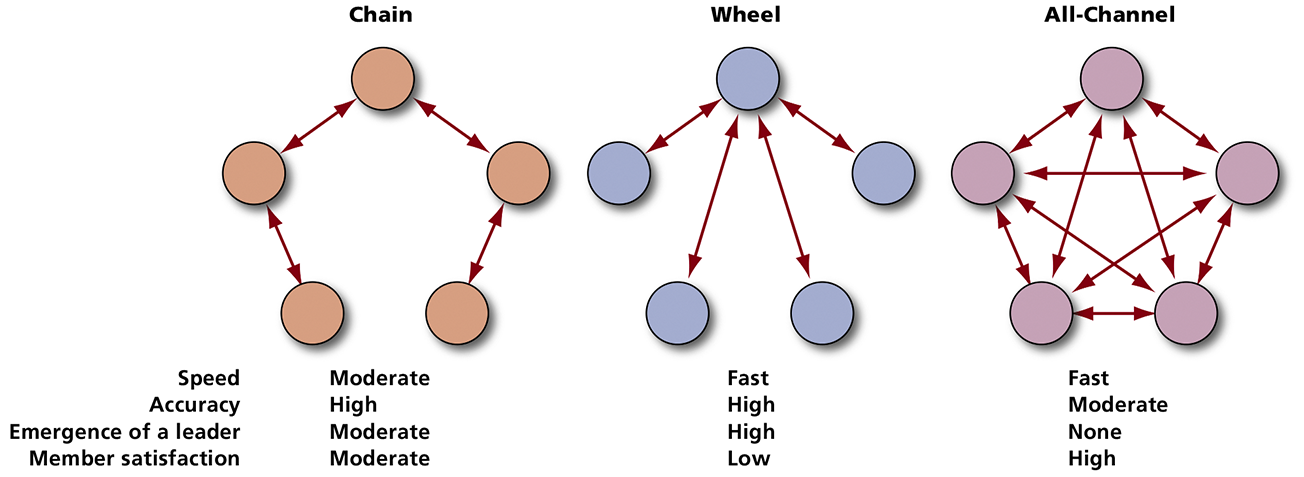
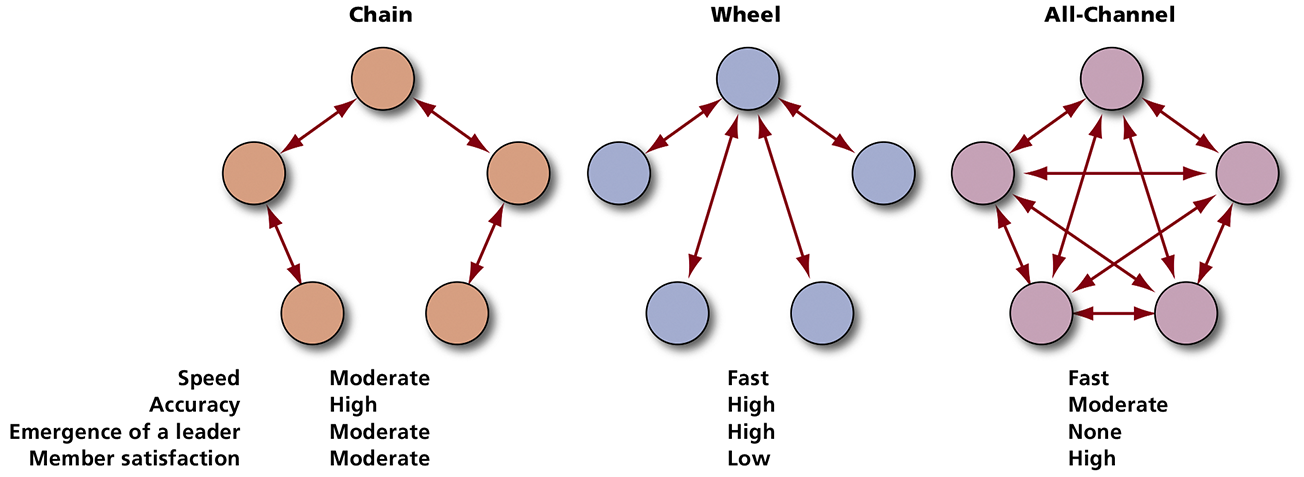
Small-Group Communication
Chain, wheel, or all-channel communication networks that stem from the larger, formal communication network.
Informal Communication Network
Communications that flow along social and relational lines. The most common type is the grapevine. Although rumours and gossip transmitted through the grapevine may be informal, it’s still an important source of information for employees and candidates.
Grapevine or word-of-mouth information from peers about a company has important effects on whether job applicants join an organization.
Oral Communication
Modes of Communication
A primary means of conveying messages is oral communication. Speeches, formal one-on-one and group discussions, and the informal rumour mill or grapevine are popular forms of oral communication.
The advantages of oral communication are speed, feedback, and exchange.
We can convey a verbal message and receive a response in minimal time.
As one professional put it, “Face-to-face communication on a consistent basis is still the best way to get information to and from employees.
Meetings
Modes of Communication
Meetings can be formal or informal, include two or more people, and take place in almost any venue. Some people hate meetings, so it’s important to make them effective.
Good interpersonal communication is key to making meetings effective.
The voice of employees is important to incorporate into meetings.
Videoconferencing and Conference Calling
Modes of Communication
Videoconferencing permits employees and clients to conduct real-time meetings with people at different locations.
Live audio and video images let us see, hear, and talk with each other without being physically in the same location.
Conference calling is generally limited to telephone exchanges where some people may gather around one speaker phone, and others call in through a secure line. There may be some shared files or videos everyone can see on their computers. Both modes are used selectively, according to the application.
Telephone
Modes of Communication
The telephone has been around so long that we can overlook its efficiency as a mode of communication. Communication by telephone is fast, effective, and less ambiguous than email.
However, telephone messages can be easily overlooked, and a lack of functions has made the phone difficult to use without electronic follow-up. Fortunately, a number of software options make phoning more versatile.
Written Communication
Written communication includes letters, email, instant messaging, organizational periodicals, and any other method that conveys written words or symbols.
Usually conducted via letters, PowerPoint, email, instant messaging, text messaging, social media, apps, and blogs.
This is an important method when you want to have written proof, or a paper trail of decisions.
Written Communication Types
PowerPoint Presentations: Often used in conjunction with oral presentations, but its appeal is so intuitive that it can serve as a primary mode of communication. It is not without its detractors, however, who argue that it is too impersonal, disengaging, and frequently hard to follow.
Email: They can be quickly and cheaply written, edited, sent, and stored. Can make employees feel more stressed due to the ability to be accessible, and it can lead to information overload.
Instant Messaging: Effective for the quickness, and availability, however not the best for businesses.
Text Messaging: Business text language should be formal.
Social Media: Has become a tool for prospective employees, hiring managers, employees, and human resource divisions.
Apps: Apps are most popular in regions where mobile phone usage is primary.
Blogs: Experts see blogging as a business necessity for organizations, so it should not be overlooked as a vital form of communication to employees and customers, who can post feedback if they choose.
Others: Flickr, Pinterest, Google+, YouTube, HCL Connections, Workplace from Facebook, Igloo, Simpplr, CA Flowdock, Wikis, Jive, Socialtext, and Social Cast are just a few of the many public and industry-specific platforms, with new ones launching daily
Nonverbal Communication
Messages conveyed through body movements, facial expressions, and the physical distance between the sender and receiver. This can include:
Body language: Usage of bodily motions and facial expressions or the sender’s physical location in relation to the receiver. This can include people perceiving you based off liking / interest and status / power.
Power poses, and the way we position our body can communicate a lot.
Props, artifacts and costumes: Non-verbal communication through the use of various objects. Can include office decor, clothing, and other things someone wears, or has that can communicate information about an individual.
Non-verbal cues: Gestures, facial expressions, eye contact, clothing, personal space, etc.
Proxemics
The study of physical space in interpersonal relationships.
Cross-cultural Communication Barriers
Barriers caused by semantics: Words mean different things to different people. Some words don’t translate between cultures.
Barriers caused by word connotations: Words imply different things in different languages.
Barriers caused by tone differences: In some cultures, language is formal; in others, it’s informal. In some cultures, the tone changes depending on the context.
Differences in tolerance for conflict methods for resolving conflict: People from individualistic cultures tend to be more comfortable with direct conflicts and will make the source of their disagreements overt.
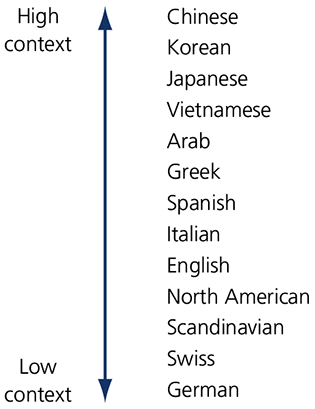
High-context Cultures
Cultures that rely heavily on nonverbal and subtle situational cues in communication. Meaning is implied rather than directly state. People rely on body language, tone of voice, shared experiences, relationships and social cues.
Implies considerably more trust by both parties. What may appear, to an outsider, as a casual and insignificant conversation is important because it reflects the desire to build a relationship and create trust.
Oral agreements imply strong commitments in high-context cultures.
Also, who you are—your age, seniority, rank in the organization—is highly valued and heavily influences your credibility.
Managers can therefore “make suggestions” rather than give orders.
Example: Instead of saying “No,” someone might say “That may be difficult” or stay silent.
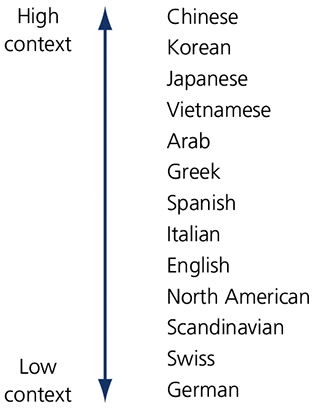
Low-context Cultures
Cultures that rely heavily on words to convey meaning in communication. Communication tends to be specific, straightforward, and less dependent on relationships or context.
Enforceable contracts tend to be in writing, precisely worded, and highly legalistic.
Value directness.
Managers are expected to be explicit and precise in conveying intended meaning.
Example: Someone clearly says “No, I can’t do that.”
Suggestions to Reducing Cultural Barriers (KFSCM)
Know Yourself: Recognizing your own cultural identity and biases is critical to then understanding the unique viewpoint of other people.
Foster a Safe Environment: Clearly establish an environment of equality and mutual concern. This will be your “third culture” context for effective intercultural communication that transcends each person’s cultural norms.
State Facts, Not Interpretation: Interpreting or evaluating what someone has said or done, in contrast to describing, is based more on the observer’s culture and background than on the observed situation. If you state only facts, you will have the opportunity to benefit from the other person’s interpretation. Delay judgment until you have had sufficient time to observe and interpret the situation from the differing perspectives of all the cultures involved.
Consider the Other Person’s Point: Before sending a message, put yourself in the recipient’s shoes. Try to see the people in the group as they really are first, and take a collaborative problem-solving approach whenever potential conflicts arise.
Maintain the Group Identity: Like any culture, the establishment of a common-ground “third culture” for effective intercultural communication takes time and nurturing. Remind members of the group of your common goals, mutual respect, and need to adapt to individual communication preference

