ENGLISH LINGUISTICS II – Contextual Meaning: Deixis / Presupposition / Inference
 Studied by 0 people
 Call Kai
 Learn
Learn Practice Test
 Spaced Repetition
 Match
Match Flashcards
 Knowt Play
1/21

Earn XP
Description and Tags
Vocabulary flashcards covering deixis, time/space reference, discourse features, presupposition, and inference as presented in the lecture notes.
Name | Mastery | Learn | Test | Matching | Spaced | Call with Kai |
|---|
No analytics yet
Send a link to your students to track their progress
22 Terms
Deixis
Certain linguistic expressions (deictics) point to elements of the communicative situation, e.g. time, place, people/objects involved. (e.g. Susie, please, put it on top of that stuff over there in my cupboard tomorrow at the latest.)
Deictic expressions: 5 types
Linguistic items used to point to elements of the communicative situation (time, place, people/things).
①Demonstrative pronouns: these/those, this/that
②Personal pronouns: I, we, you, he/she/it
③Tense markers: fly, flew, will fly, had flown
④Adverbs of space/time: here/there, now/then
⑤Motions verbs: come/go
SYMBOLIC FIELD
auto-‐semantic words with a constant meaning that enable reference independent of situation
автосемантичні слова з постійним значенням, що дозволяють посилання незалежно від ситуації
e.g.
(NENNWÖRTER/SYMBOLFELD)
DEICTIC FIELD
largely syn-‐semantic words whose reference depends on the elements of a given communicative situation (DEIKTIKA/ZEIGFELD)
GESTURAL AND SYMBOLIC USE OF DEIXIS
(1) She’s not the principal; she is. She’s the secretary. (GESTURAL)
(2) This town is famous for its small antique shops. (SYMBOLIC)
(3) Mary wishes that she could visit the land of Lilliput. (NON-‐DEICTIC USE)
(4) If you travel on a train without a valid ticket, you will be liable to pay a penalty fare. (NON-‐DEICTIC USE)
Deictic Centre (Origo)
The reference point (I, here, now) from which deictic interpretation is anchored.
a. Deictic Centre/Origo: I – Here – Now (Speaker Position)
b. Deictic Interpretation: Reference to place, people, time, discourse elements
e.g. (1) This is where I live. (2) That’s where I went to school.
Types of Deixis
A PERSON DEIXIS identifies people
B TIME DEIXIS Identifies temporal points/spans
C SPACE DEIXIS identifies location in space
D DISCOURSE DEIXIS points to parts of text
Person(al) Deixis
Refers to how language identifies the participants in a speech event (speaker, addressee, others). It is mainly realized through pronouns and forms of address. (Huang 2007:136)
Personal Pronouns
Mark person (I/he), number (I/we), gender (he/she).
Many languages (e.g. French tu/vous, German du/Sie) encode social distance or intimacy.
Vocatives (Forms of Address)
Titles or names: Mr. President, Dear Madam, Beloved Joan.
Inclusive vs. Exclusive we
Inclusive "we" → includes both speaker + listener.
Do we have time for that? (to a group, including addressee).
Exclusive "we" → includes speaker + others, but excludes listener.
Do we have time for that? (parent speaking to a child, but meaning “I”).
Social Deixis
Language that encodes the social status of the speaker, addressee, or third person, and their social relationships. (Huang 2007:163)
1. Types
Absolute Social Deixis → Special honorifics/titles for people with recognized status.
Your Majesty, Your Highness, Mr. President, Professor
Relative Social Deixis → Address forms that reflect socially negotiated relationships.
uncle, aunt, Sir/Mr, German Du/Sie
Space/Place Deixis
Words that show location in space relative to the speaker and hearer in a conversation.
(Huang 2007:149)
1. Basic Distinctions
Proximal (near speaker): this, here, come
Medial (near hearer): that (by you)
Distal (far from both): yonder, there, go
2. Ways It’s Expressed
Demonstratives (pronouns): this/that, these/those
Adverbs of place: here, there
Motion verbs: come/go, arrive/depart, pour/fill
3. Other Spatial Expressions
left/right, top/bottom, centre/periphery, foreground/background, above/below, over/under
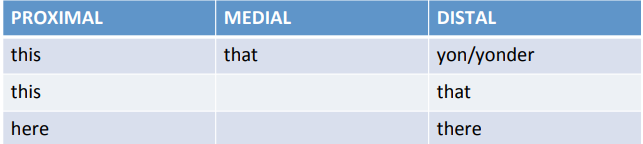
Space/Place Deixis
TYPES OF SPATIAL DEIXIS
①INTRINSIC: e.g. The dog is behind the car. (location determined by inherent features of objects such as sides, front/back etc.
②RELATIVE: e.g. The dog is to the left of the car. (location determined relative to an egocentric perspective, i.e. viewed from the speaker’s point of view; but cf. also e.g. Mary is standing in front of the car. (object/intrinsic vs. speaker-‐ oriented deixis)
③ ABSOLUTE: e.g. The dog is (to the) east of the car. (location determined by reference to an absolute system of coordinates)
④DIRECTIONALS: e.g. hither – here, to this place/thither – there, to that place/ whither – to which place; come, arrive vs. go, depart (indication of the direction of motion)
⑤DEICTIC PROJECTION: e.g. (on an answering machine) I am not here now. (telling a story) and he was like: ‘Oh, she’s never here with me. (the deictic centre shirs to another place etc.)
Time/Temporal Deixis
Words/expressions that locate events in time relative to the moment of speaking.
(Huang 2007:144)
1. Types of Temporal Deixis
Time points → exact moments
eight o’clock, now, then
Time periods → spans with beginning & end
tomorrow evening, next week, in the morning
Calendric time units → fixed natural units
July, Monday, 2025
Non-calendric time units → relative spans
fortnight, weekend, semester
. TYPES OF TIME-DEICTIC MEANS
①DEICTIC ADVERBS OF TIME: proximal/distal time expression (cf. space), e.g. now/then + three-‐part system, e.g. yesterday – today – tomorrow
②TENSE: the grammatical category tense encodes time of actions, events etc. and operates in conjunction with time adverbs; four-‐part system: e.g. had sailed – sailed – is sailing – will sail (deictic projection: will have sailed)
③ASPECT: encodes temporal duration and relations between points in time, e.g. has since been working, is still working
④REPORTED SPEECH: in reported speech deictic expressions shir from the proximal/immediate time to the distal/remote time, cf. 1) Are you planning to be here this evening, 2) I asked here whether she was planning to be there that evening.
⑤HYPOTHETIC CONDITIONALS: actions relating to a fictious world or to a hypothetical real take distal time deixis, e.g. If I was you, I would …; If I had a convertible, I would …
Discourse/Text Deixis
Words or expressions that point to parts of the discourse itself — what has been said before, what is being said now, or what will follow.
(Huang 2007:172)
👉 They create cohesion in a text by linking propositions together.
Forward / Cataphoric (pointing ahead)
Let me make this clear: I did not lie to you.
Here is what I did: …
Backward / Anaphoric (pointing back)
They watched a movie last night. He liked that very much.
Spatial references inside texts
In this section… / see above / in the table opposite
Utterance-initial connectives
However (contrast)
Therefore (consequence)
Besides (addition)
Actually (correction)
Presupposition
background assumption speakers make when saying something.
EXAMPLES Julie’s flat is bright and spacious. >> She has a flat. He so much wished he was rich. >> He is not rich. I wish you wouldn’t always take my bike. >> Someone took my bike before.
CONSTANCY (UNDER NEGATION ETC.)(Properties of Presuppositions)
A presupposition remains true even if the sentence is:
Affirmative (statement)
Negative (denial)
Interrogative (question)
Example
He so much wished he was rich.
He never wished he was rich.
Does he ever wish he was rich?
-he is not rich
DEFEASIBILITY(Properties of Presuppositions)
Presuppositions are usually stable (constant under negation), but in certain contexts they can be cancelled (defeated) if they clash with background knowledge, implicatures, or discourse context.
(1) John died before he finished his Ph.D.
>> John finished his Ph.D. (2) If John’s organizing a party, Mary will be angry. >> John is organizing a party (3) There is no king of France. Therefore the king of France isn’t bald. >> There is a king of France
Types of Presuppositions
1. EXISTENTIAL PRESUPPOSITION e.g. The king of France is bald. PreTy Nina married the rich American. >> X exists (speaker commits himself to existence of entities named)
2. FACTIVE/NON-FACTIVE PRESUPPOSITIONS e.g. I know she’s clever. I’m sad he didn’t like the present. >> stating a true fact (following verbs of cogni9on (epistemic)/emotion (emotive) e.g. I imagined we were there. She pretends to be diligent. >> sth. is not true
3. COUNTERFACTUAL PRESUPPOSITIONS e.g. If I weren’t ill I would … >> info is not true/counter to the truth
4. LEXICAL/STRUCTURAL PRESUPPOSITIONS e.g. He didn’t manage to quit smoking. She let him down him once again. (presupposition generated by lexical item) e.g. When did he call the police? It’s not the food that makes him sick. (presupposition generated by grammatical structure)
Presupposition Triggers
1. ITERATIVES: e.g. She resumed her job at the museum. She had yet another slice of toast. (v./adv./adj. that express repeated ac9on)
2. CHANGE OF STATE PREDICATES: e.g. He turned frugal and thriSy. (v. that express a change of state)
3. IMPLICATIVE PREDICATES: e.g. The university failed to be ranked in the top ten. (v. that imply another ac9on/meaning)
4. TEMPORAL CLAUSES: e.g. ASer she made it a habit to eat regularly, her stomach pains disappeared. (subordinate clauses)
5. CLEFT SENTENCES: e.g. It wasn’t the sports that helped improve her health.
6. COMPARATIVE: e.g. Germany is even more bureaucra;c than Switzerland. Rather than give her flowers he should’ve chosen something fancier as a present.
7. STRESS: e.g. Usually quarrels are his fault. This ;me she insulted HIM.
8. PARTICLES: e.g. The interior is also spectacular.
Inference
All the hidden or implicit information that listeners/readers can derive from text/discourse (beyond what is explicitly said).
Entailment (logical inferences)
Something that must logically be true if the statement is true.
Example: Harry caught three pike.
→ Inference: Harry caught three fish.
Conventional Implicature (relational inferences)
Meaning that comes from particular connecting words (but, therefore, even), regardless of context.
Example: I wanted blue, but I chose gray.
→ Inference: Contrast with expectation (blue ≠ gray).
Connotation (lexical inferences)
Extra associations/meanings that come with certain words.
Example: She arrived in high heels, ballroom dress, and a Land Rover.
→ Inference: Land Rover = rural, rugged lifestyle.
Metaphor / Metonymy (conceptual inferences)
Meaning derived by mapping one concept onto another.
Example: He devoured the book in one go.
→ Inference: He read it quickly and intensely.Example: She savored every page.
→ Inference: She read slowly, enjoying the language.
Entailments
A logical consequence that follows from a sentence; it may not remain true if the sentence is negated.
2. EXAMPLES Pete bought oranges. (= Pete bought fruit.) Unfortunately, he completely forgot about them. After several weeks his cupboard started to smell of spoiled fruit.
NECESSARY/POSSIBLE INFERENCES – FORWARD/BACKWARD INFERENCES
Necessary inferences: Required to understand the discourse; must be true based on the text.
Example (backward): Vase was thrown → Vase is broken.
Example (forward): Neighbors having a party → There will be noise.
Possible inferences: Can be inferred but are not essential for understanding.
Example: Husband threw vase → He had been angry for weeks.
 Note
Note  Flashcards (74)