Trading blocs and the World Trade Organisation
 Call Kai
 Learn
Learn Practice Test
 Spaced Repetition
 Match
Match Flashcards
 Knowt Play
1/5

There's no tags or description
Looks like no tags are added yet.
Name | Mastery | Learn | Test | Matching | Spaced | Call with Kai |
|---|
No analytics yet
Send a link to your students to track their progress
6 Terms
What is a regional trading bloc? And bilateral agreement? Examples?
A regional trading bloc is a group of countries within a geographical region that protect themselves from imports from non-members. They sign an agreement to reduce or eliminate trade barriers, such as tariffs, quotas, etc. (e.g. EU, ASEAN, NAFTA)
A bilateral agreement is a trade agreement between one single country and another single country.
What are the 4 types of trading blocs? Refer to Eurozone
Free trade areas (FTA):
When two or more countries in a region agree to reduce or eliminate trade barriers on all goods.
Custom unions:
Involves the removal of tariff barriers between members and the acceptance of a common external tariff (CET) against non-members.
Common markets:
All members trade all economic resources freely, so barriers to trade in goods, services, capital and labour are removed. Common external tariff imposed on non-members. Also, a significant level of harmonisation of micro-economic polices and policies affecting key industries.
Monetary unions:
Two or more countries with a single currency, with an exchange rate controlled by one/several central bank(s), including the coordination of monetary policies.
Eurozone: The ECB sets interest rates, distributes notes and coins, maintains a stable financial situation, and manages foreign currency reserves.
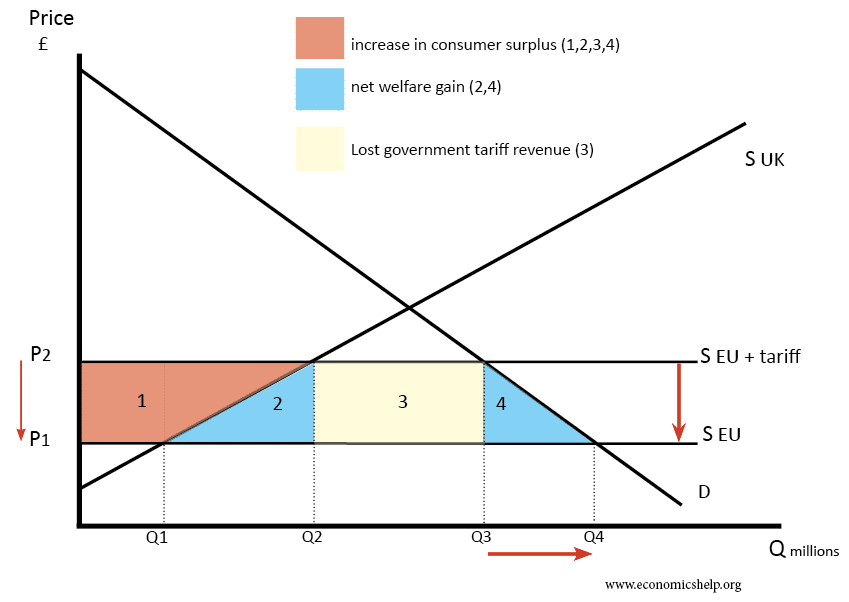
Benefits of regional trade agreements? Include trade creation diagram
Trade creation - when consumption shifts from a higher cost domestic producer to a lower cost producer within the trading bloc
Free trade means increased specialisation through countries with comparative advantages, which increases output
Specialisation also means firms benefit from economies of scale, leading to lower costs and prices (lower transport costs)
Firms can grow much larger by creating a larger customer base, by accessing markets in different countries (e.g. chemicals and cars) - depends on product being sold
Firms inside the bloc are protected from cheaper imports from outside (e.g. EU firms protected from Chinese imports)
More jobs created if more output
Increased choice for consumers
Increased competition as the removal of barriers means domestic industries face greater competition
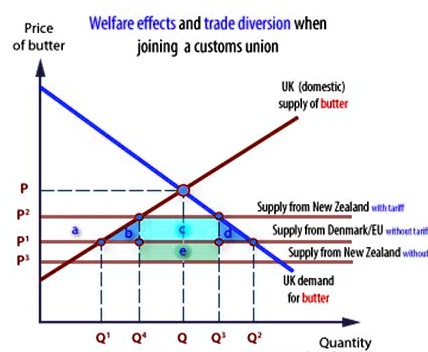
Costs of regional trade agreements? Include trade diversion diagram
Trade diversion - when consumption shifts from a lower cost producer outside the trading bloc to a higher cost, less efficient producer in it (reducing benefits of specialisation and comparative advantage), especially when CET is very high
Reduced competition, as inefficient firms are driven out of the industry, making market oligopolistic
Higher structural unemployment in those industries that cannot compete
Loss of sovereignty for government over its own country (especially in common markets and monetary unions)
Highly complex to govern many different countries and respond to differences (e.g. EU has 27 countries)
Loss of resources, as capital and labour attracted to more successful countries, increasing regional inequalities
Role of the World Trade Organisation (WTO)?
Trade liberalisation and ensuring countries act according to the trade agreements they have signed.
Possible conflicts between regional trade agreements and the WTO?
RTAs contradict WTO’s principles, as a common external tariff (CET) on trade outside trading bloc introduces protectionism, rather than liberalisation
Member countries in a trading bloc can have disagreements and not hold up the trade agreements they have signed (e.g. issues such as farm subsidies and special treatment for developing countries)
Developing and developed countries have different priorities and expectations from the WTO (e.g. developed export-oriented countries push for reduced tariffs to gain market access in developing countries, whereas developing countries want increased tariffs and special treatment to protect its infant industries)

