Role of A Forensic Autopsy Technician
 Studied by 0 people
 Call Kai
 Learn
Learn Practice Test
 Spaced Repetition
 Match
Match Flashcards
 Knowt Play
1/53

Earn XP
Description and Tags
Postmortem Examination
Name | Mastery | Learn | Test | Matching | Spaced | Call with Kai |
|---|
No analytics yet
Send a link to your students to track their progress
54 Terms
What is an Autopsy?
A thorough examination performed by a pathologist to determine the cause and manner of death.
Defined as a clinical (hospital) or forensic autopsy.
Clinical Autopsy
An exam performed in the case of natural deaths, in the hospital by the pathologist based on the consent of the deceased’s next of kin in order to better understand the causes of death.
Forensic Autopsy
An exam performed in the case of suspicious, violent or unknown cause of death in a coroner’s or medical examiners office by a forensic pathologist based on investigator discretion in order to determine cause of death.
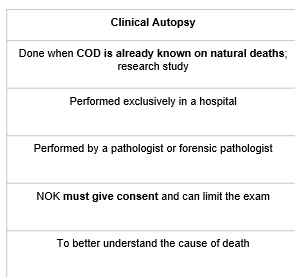
Clinical Autopsies are done when, where, and by whom?
When the COD is already known, in a hospital setting by a pathologist or a forensic pathologist.
In regards to Clinical Autopsies, who needs to give consent and can limit the exam?
The decedent’s next of kin.
Why are Clinical Autopsies done?
To better understand the cause of death.
Forensic Autopsies are done when, where and by whom?
When the COD is unknown, suspicious, or violent. Performed in a Coroner or Medical Examiner's office by a forensic pathologist.
Why are Forensic Autopsies Done?
Done to determine COD and MOD.
In regards to, Forensic Autopsies does the NOK need to give consent or can they limit the exam?
No
The goals of a Forensic Autopsy is to: Derek Decides Codes Potentially Detrimentally Cold
Determine injuries or disease(s) that contribute to and/or cause death
Detection of medical/surgical error
Correlation of signs/symptoms related to disease and untimely death
Positive Identification of the decedent
Determine the time of Death
Collect trace Evidence.
Who can perform a Forensic Autopsy?
Only a Forensic Pathologist, an autopsy technician is present to assist the forensic pathologist.
What is a Forensic Autopsy Technician?
Person responsible for assisting a forensic pathologist before, during, and after an autopsy. Assists the pathologist with body preparation, photography, organ dissection, body restoration, evidence collection and toxicology.
Who gets an Autopsy in the Coroner’s Office?
Anyone who dies a death that is classified other than natural. This includes deaths resulting from accidents, homicides, suicides, or unexplained circumstances.
What is a Homicide?
Death at the hands of another.
What is a Suicide?
Death at the hands of oneself.
What is defined as an accidental death?
Including but not limited to vehicle accidents, pedestrian struck, fall from heights, prescription or illicit drug overdose.
What is defined as an undetermined/suspicious death?
When you are dead and not supposed to be dead. This includes infants, children, teens, and those who are under the age of 55 with a good medical history.
What determines a Natural Death Case?
If a family physician is uncomfortable or unwilling to sign a death certificate, an individual must come in for either an external or internal examination.
What are some reasons why a Family Physician may not sign a death certificate?
Decedent may have been presumed healthy during a recent visit.
A physician may not have seen the decedent for an extended period of time (years).
A physician may have personal/professional reasons for not wanting to sign a death certificate.
What are the Three different types of Postmortem Exams?
External; Internal (post-mortem); Head Only/Partial Exam.
What are the 8 steps for a Forensic Autopsy?
External Examination
Photography
Evidence Collection
Personal Effects Collection
Toxicology Specimen Collection
Internal Examination
Restoration of the Body
Toxicology and Clinical Testing
External Examination of a Forensic Autopsy Consists of:
Confirming that you have the correct body by checking the name on the toe tag
Open the body bag in the presence of two people to ensure the chain of custody.
Photograph the body as it is received. This is done to document the clothing and personal effects.
Undress the decedent.
Photograph the decedent undressed.
Toxicology Collection- Take vitreous humor to check for electrolytes, glucose, and metabolites for drugs. Take urine at the pubic bone. Take blood from the femoral vein in the thigh.
Why does the forensic technician take photos dressed and then undressed during the external examination?
While the decedent is dressed, this is done to document clothing and personal effects.
While the decedent is undressed, these photos will document external injuries, scars, tattoos, and any other physical findings.
When photographing the decedent during the External Examination, how does the technician take the photos?
Toes to the belly and belly to the head. Anterior photos and posterior photos.
As part of the Documentation during the External Exam, how does the Medical Examiner Record their Findings? What specifically is documented?
On paper or dictation.
We look for and document everything, but not limited to, Rigor Mortis, Livor Mortis, Algor Mortis (temp change)
Obvious broken bones, hematoma (bruising), lacerations, abrasions, and all soft tissue injuries. Blood oozing from orifices (ears, nose, mouth, vaginal area, rectum). Identify and measure entrance and exit gunshot wounds, blunt and sharp force injuries, and all findings that are abnormal.
What is Rigor Mortis?
Rigor Mortis is the postmortem stiffening of muscles that occurs several hours after death due to biochemical processes, affecting the body in a specific sequence.
What is Livor Mortis?
The settling of blood in the lowest parts of the body after death, leading to discoloration of the skin. It typically occurs within 30 minutes to two hours postmortem and can help indicate the position of the body at the time of death.
In regards to Evidence Collection, What are the two fingerprints that you ALWAYS collect?
Thumb and index finger
In regard to Evidence Collection, what is the name of the card that is ALWAYS collected for the blood sample?
The FTA card.
In regard to Blood Evidence Collection, what is collected and why?
Blood spots for DNA collection and preservation.
Evidence Collection in Homicide and Suicide Cases- What are other examples of evidence collected?
Fingernails/Fingernail Scrapings,
Pull head hair and pubic hair
Swabs, including but not limited to: hands/fingers; oral, vaginal, and rectal swabs.
Projectiles
Non-Natural artifacts that may penetrate the body (i.e., knives, ligatures).
What is Blanching defined as?
Blanching is a forensic test for livor mortis (blood pooling): applying pressure to purplish skin temporarily turns it white (blanches) if the blood hasn’t yet fixed, indicating recent death (within hours), helping estimate time of death and whether the body was moved.
In regard to Evidence Collection in NON-homicidal Cases how long are drugs or weapons collected, documented, and stored in evidence locker for?
5 years
In regard to Evidence Collection, for Homicide Cases:
Fingers are tested for What?
Gunshot Residue.
Evidence Collection in Homicide Cases
What Other items are collected or retrieved as part of the evidence collection?
Fingernails are clipped and collected, All clothing is collected, All personal effects are collected, and everything is handed over to the police and the chain of custody is started.
During the Internal Exam, What is the most practiced in the United States?
Y-shaped incision, which ensures that any dissection can be concealed with clothing for viewing purposes.
The incision begins at each shoulder, meets at the sternum, and ends at the pubis.
Internal Exam: What is one of the two methods used to remove organs?
Virchow Techniques- Organ by Organ, this method removes each organ one by one.
Internal Exam the Second Technique Used to removal internal Organs is called?
Rokitansky technique- En bloc- all of the internal organs are removed while still connected.
Internal Exam- Once the organs are removed from the body, what is the next step in the exam?
Weights and descriptions are recorded. Organs are then sliced to reveal any underlying pathologies.
What are Stock Jars?
Stock jars are containers used to store tissue samples and fluids collected during an autopsy for further analysis. One piece of each organ is placed in these.
Internal Exam- Regarding Unusual Pathologies that are observed, The Pathologist will send these where?
They send a sample to the histology lab so a slide can be made for the pathologist to review, which allows the pathologist to examine the tissue under a microscope at a cellular level for detailed analysis.
What is the last organ removed from the body during an autopsy?
The brain. Once all of the thoracic and abdominal organs have been removed and dissected, the brain is removed.
What must be stripped away, before the pituitary gland can be removed, while removing the brain from the decedent during the autopsy?
The Dura mater and any surrounding tissues must be stripped away.
Restoration of the Body
Once each organ has been dissected the remaining organs are placed into what?
A biohazard bag is placed into the chest/abdominal cavity, and the body is sewn back together.
Restoration of the Body
After the biohazard bag is placed back and sewn up, what are the next steps of restoration?
The head is sewn back together. The body is washed with soap and water to clear any blood or other bodily fluids. The body is returned to the body bag and placed into the cooler. A funeral home that is chosen by the family will pick the body up for final disposition.
Toxicology
When the COD and MOD cannot be determined what is the COD listed as?
Pending Toxicology.
What is included in the contents sent to the lab for testing in for toxicology?
Contents include Blood, Urine, Vitreous, Bile, and Stomach contents.
Toxicology- When blood is collected what type of tube is it stored in?
Two gray top tubes, with powdered fluoride and potassium oxalate to prevent clotting.
Toxicology- Testing may reveal what at a toxic level and reveal COD?
It may reveal illicit drugs or prescribed medications at a toxic level that will cause death.
Rapid Toxicology is used when?
When an overdose is most likely the COD, a quick-tox test is used. I
If all metabolites turn up negative what type of test is used?
A fentanyl test may be used.
Additional Toxicology
PA State Tox Kit is defined as:
Done for cases of motor vehicle accidents; only the driver is tested.
Two extra gray top tubes filled with peripheral blood
This kit is sent to the PA State Lab, where they test for the presence of alcohol in the blood.
Additional Toxicology
GOL (Gift of Life) Kit Human Gifts Registry for bodies donated to science is:
Done on cases where the decease is an organ donor; Kit has two gray tops, two red tops, and two purple top tubes.
Carbon Monoxide Kit is used when?
Done in cases involving motor vehicle accidents or whenever CO may be present.
Kit has one purple top kit, which is taken to a nearby hospital immediately.
 Note
Note  Flashcards (244)