2.4 - additional theory for geographically discriminatory TP
 Studied by 0 people
 Call Kai
 Learn
Learn Practice Test
 Spaced Repetition
 Match
Match Flashcards
 Knowt Play
1/5

There's no tags or description
Looks like no tags are added yet.
Name | Mastery | Learn | Test | Matching | Spaced | Call with Kai |
|---|
No analytics yet
Send a link to your students to track their progress
6 Terms
Cooper-Massel proposition
Under standard 1st best assumptions, there is always a non-geographically discriminatory TP that is superior welfare-wise (or strictly not inferior) to any form of RTA
Even if RTA net TC
Welfare Comparison of ‘Equivalent’ Discriminatory and Non-Discriminatory Tariff
pp > pw ph = pw (1+t0) - ad-velorem
we choose a new multilateral tariff t < t0 that deilvers same level of dom production, C & TC as with a CU
creating a CU decreases dom production + increases D
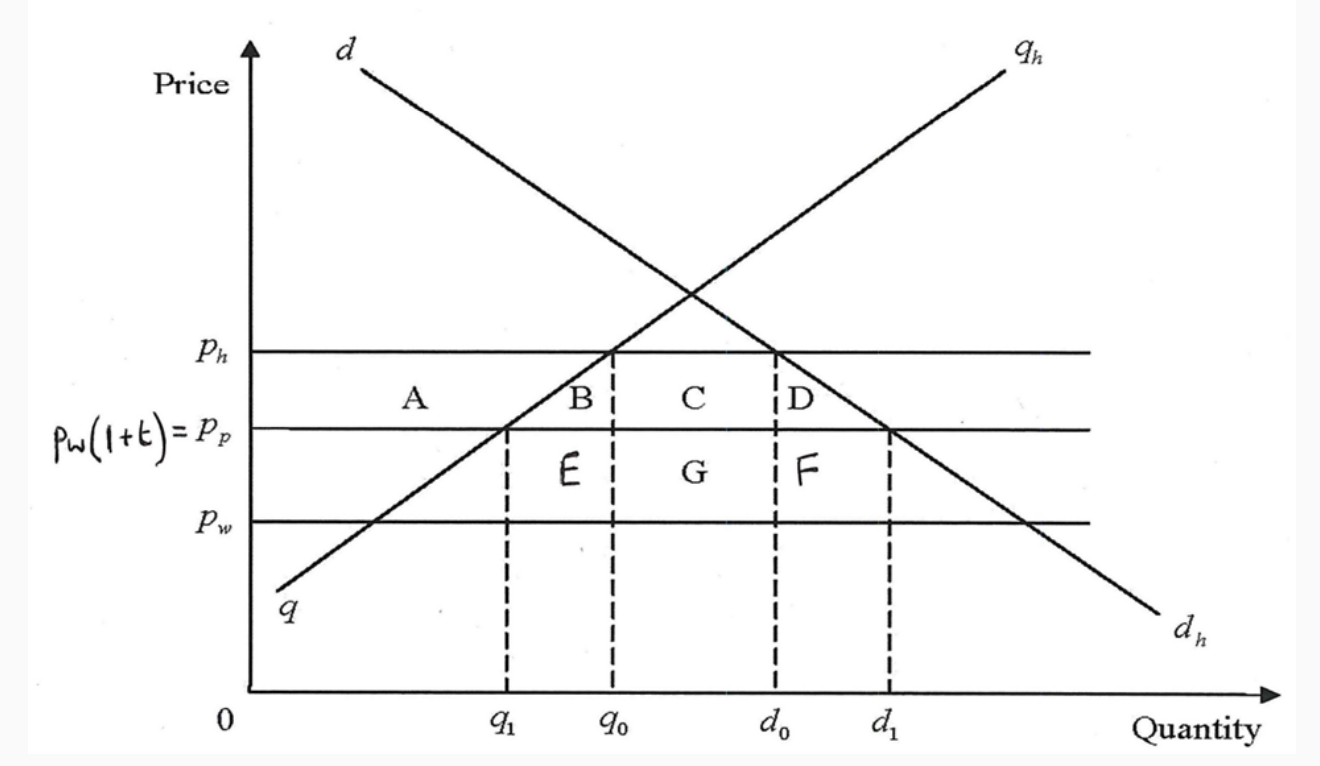
Welfare Comparison of ‘Equivalent’ Discriminatory and Non-Discriminatory Tariff - Net Welfare
Net welfare for CU = B+D-G
No tariff revenue as tariffs eliminated
Net welfare of multilateral reduction = B+E+D+F
B+E - Resource saving from displacement of dom production from M from RoW (q0 - q1)
D+F - Additional benefit relative to cost of M from increasing C of M (d1-d2)
With multilateral tariffs, M come from lowest cost from RoW
Only TC & no TD + tariff revenue from all M
E+F>-G → E+F+G > 0 Higher gains than with CU
X supply and Partner nation
Standard analysis assumes partner X to other CU member at constant cost - X Supply horizontal (Importer small in bloc)
No welfare effects for partner as px = cost for each unit
However if X Supply upward sloping, X increase = p increase to cover MC
generates PS gain for Exporter (not available from non-discrim TP)
Provides incentive for Exporting firms in Partner to join a CU
Rent transfers from H → F provides some rationale for compensation sent back to H / Importer
Welfare in CU with X Supply upwards sloping - graph
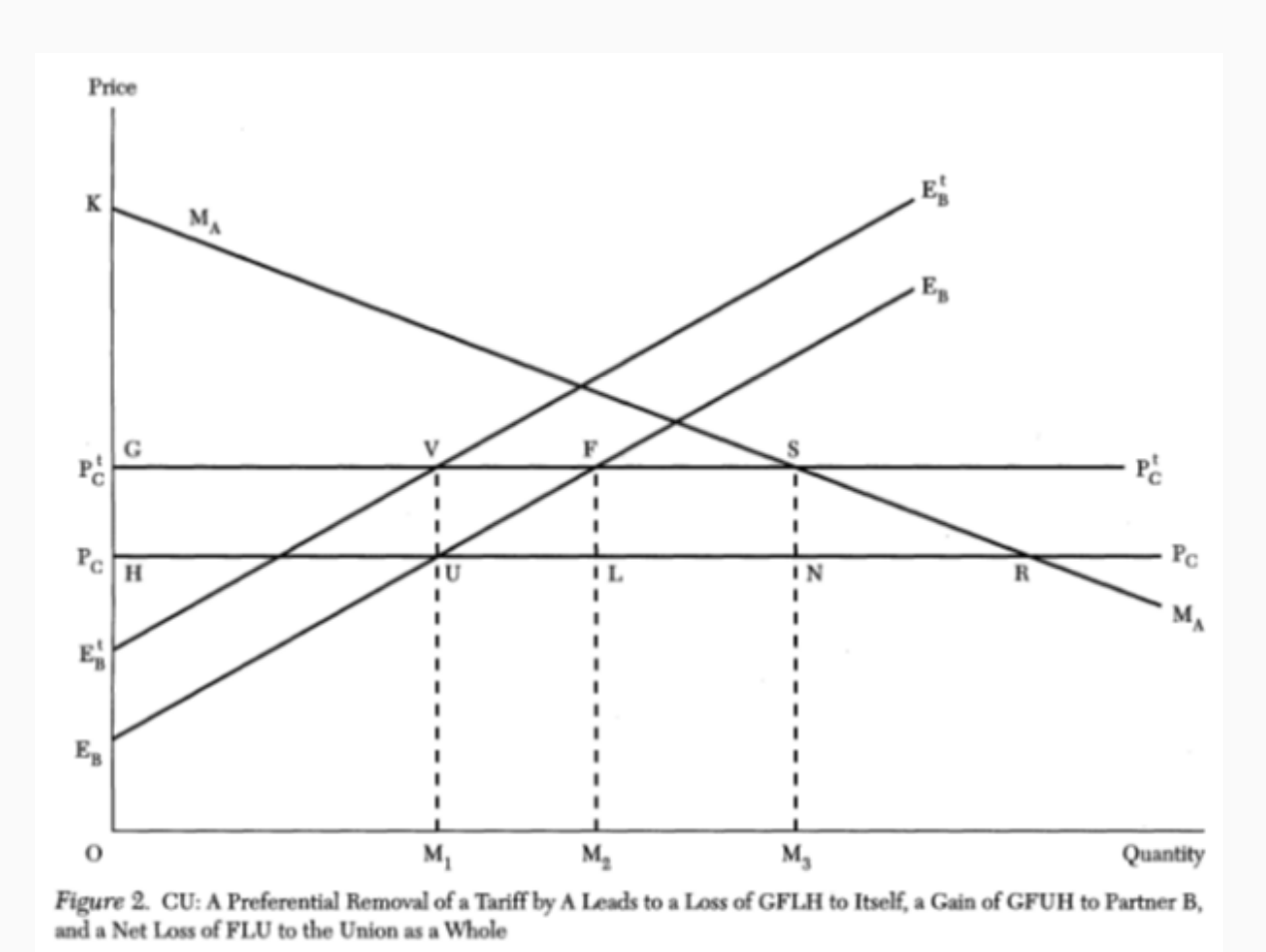
Welfare in CU with X Supply upwards sloping - analysis
Initially A imposes MFN tariff (t) on M from B & C
Shifts X Supply upwards
Equilibrium at price ptc M = M3 - M1
Compared to autarky welfare gain for A = KGS (CS) + 0 (PS) + GSNH (Tariff)
Forming a CU between A & B removes tariff from B X Supply
Bs X increases (M1→M2) & Cs fall (M3-M1 → M3-M2)
Pure TD so CU is welfare worsening
Tariff revenue lost → GFUH captured by B producers (Bs TOT gains in CU)
FUL = deadweight loss
 Note
Note  Flashcards (83)