BIOLOGICAL Model Chp.2 (Exam 1; PSYC168)
 Studied by 0 people
 Call Kai
 Learn
Learn Practice Test
 Spaced Repetition
 Match
Match Flashcards
 Knowt Play
1/54

There's no tags or description
Looks like no tags are added yet.
Name | Mastery | Learn | Test | Matching | Spaced | Call with Kai |
|---|
No analytics yet
Send a link to your students to track their progress
55 Terms
What is the basic approach of the biological model? How does it view psychopathology?
Sees physical processes in the body as key to human behavior.
Two contributing factors...
1. Genetics
2. Evolution
Psychopathology is viewed as
What are the three leading kinds of biological treatments for psychopathology?
1. Drug therapy (by far the most common)
2. Brain stimulation
3. Psychosurgery
What are the pros of the biological model? (hint:2)
1. Biological research provides valuable information.
2. Biological treatments often bring great relief when other approaches have failed.
What are the cons of the biological model? (hint:2)
1. Not everything is biological; our mental life is an interplay of biological and nonbiological factors. Focusing on only biological variables can limit our understanding of psychopathology.
2. Biological treatments can also produce undesirable effects. Ex. Antipsychotic drugs can cause severe shaking.
What is Diathesis-stress model? What does the term Diathesis mean?
Diathesis = Preexisting vulnerability for disorder. Ex. Biological or genetic, thinking style (ex. Believing you don't have control over what happens to you), sociocultural (ex. poverty)
Diathesis does not lead to disorder alone!!... has to combine with stress!!
Stress = Proximal stressors
What is a model or paradigm?
Describes a set of assumptions and concepts that help scientists explain and interpret observations. Terms are interchangeable. Helps us organize and interpret what we know about psychological functioning.
"The model or paradigm is our attempt to explain something that we _____ ______."
It's our attempt to explain something we cannot directly observe.
What are the 3 things that each model helps us do?
1. Spell out basic assumptions.
2. Give order to the field under study.
3. Set guidelines for its investigation.
What does the model or paradigm influence?
1. What the investigators observe.
2. The questions they ask
3. The information they seek
4. How they interpret this information
What is epigenetics and what does it mean for psychological disorders?
The environment influences gene expression. It means all psychological disorders have some sort of environmental contribution; NO psychological disorder is 100% heritable!
What are neurons and what do they do?
A nerve cell in the brain; the primary functional unit of the nervous system. They communicate information throughout the brain in the form of electrical impulses that travel from one or more neurons.
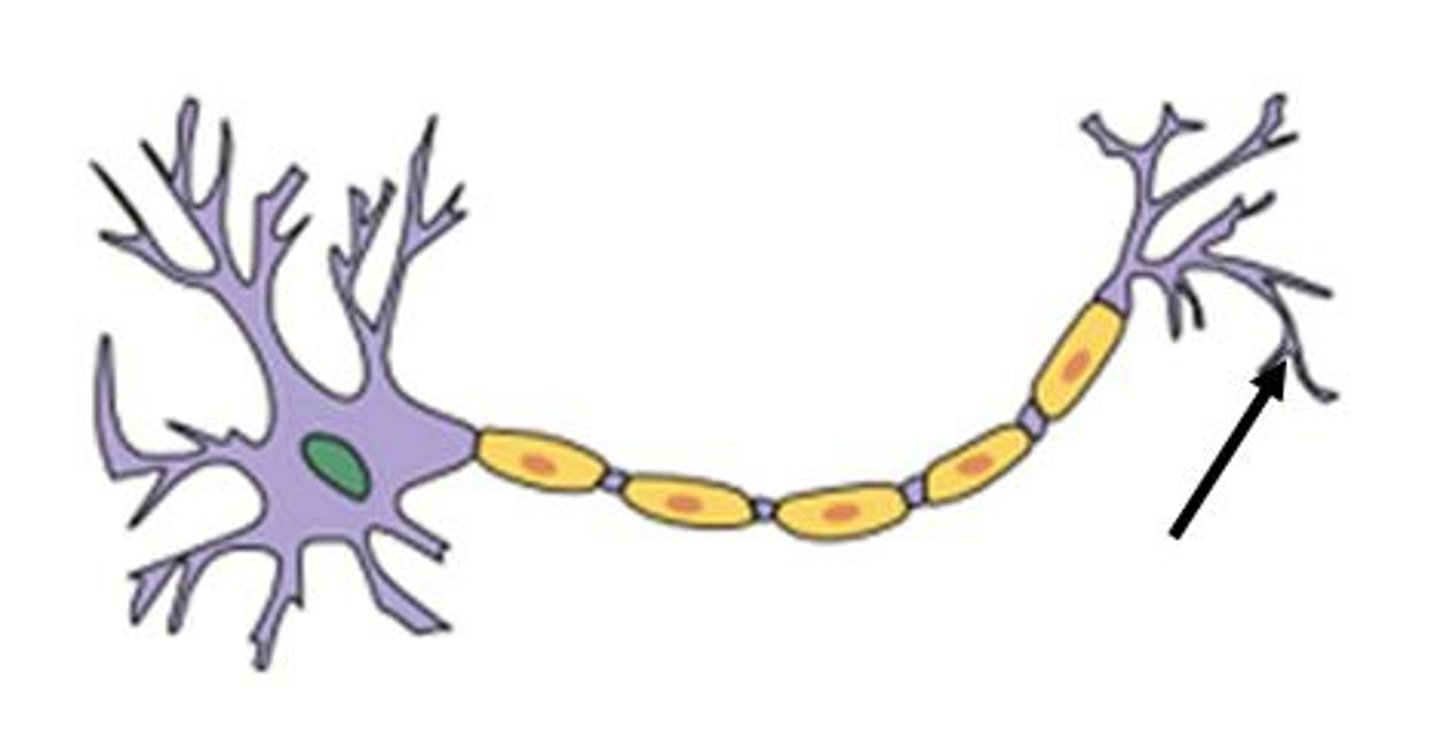
Name the 5 major parts of the neuron.
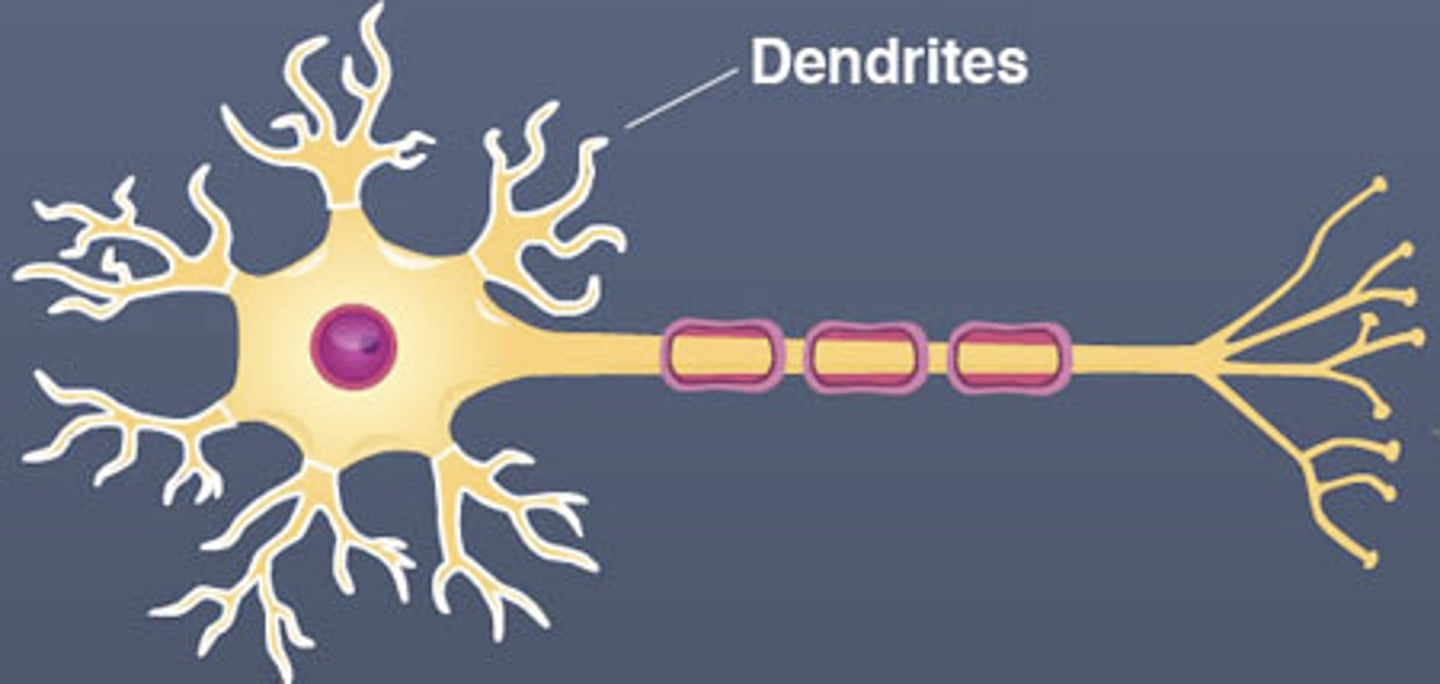
1. Dendrites
2. Soma
3. Axon-hillock
4. Axon
5. Axon Terminals/ Synaptic Buttons
What are (1) dendrites? What do they do?
Antenna-like extensions located at one end of the neuron; there are multiple dendrites.
Receives the impulse; it's where neurons receive most of their information. They have receptors that pick up chemical signals (neurotransmitters) from other neurons.
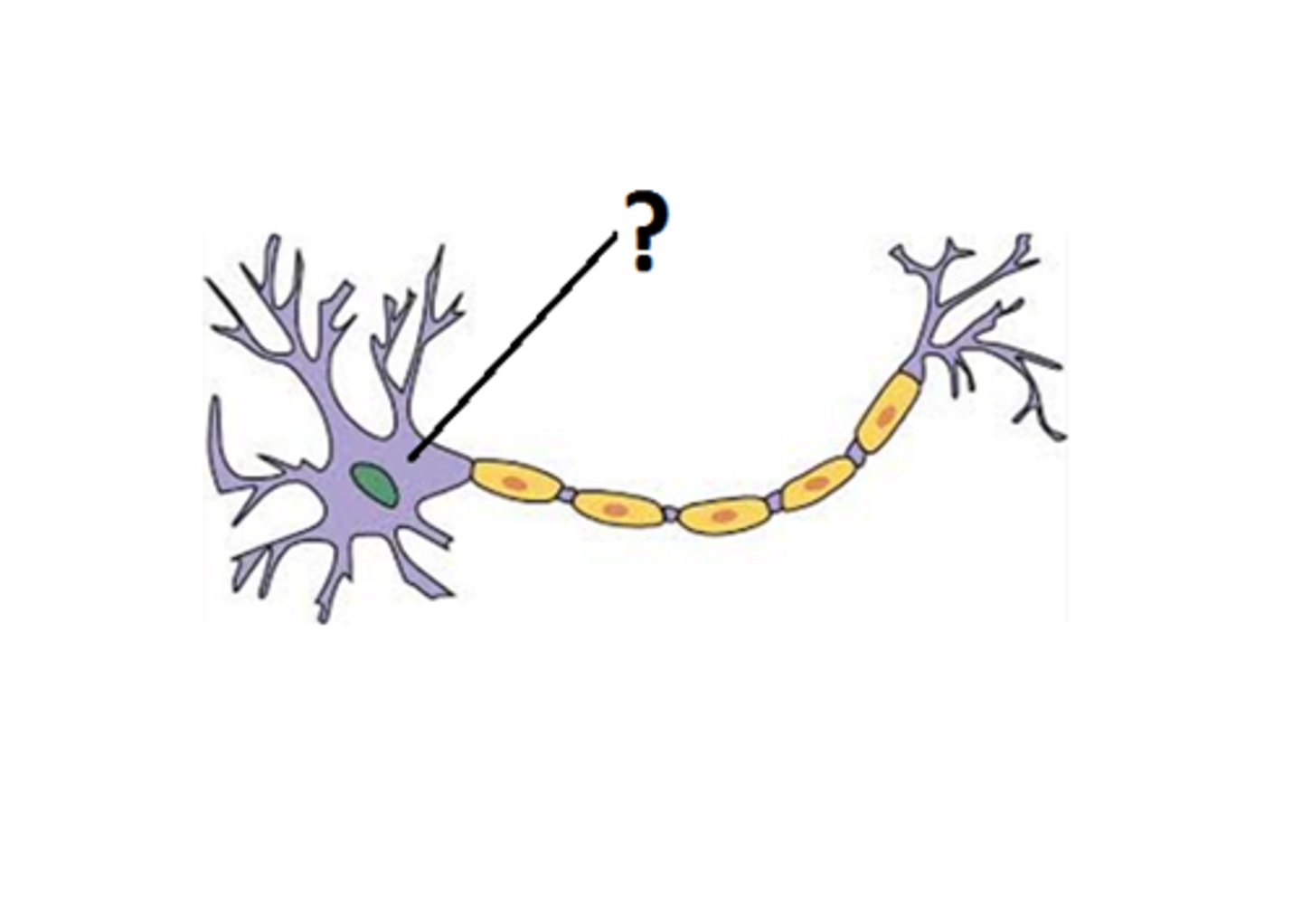
What is the (2) soma? What does it do?
The cell body; it contains the nucleus (DNA).
Interprets the chemical signal; it takes the info from the dendrites and brings it to the axonhillock.
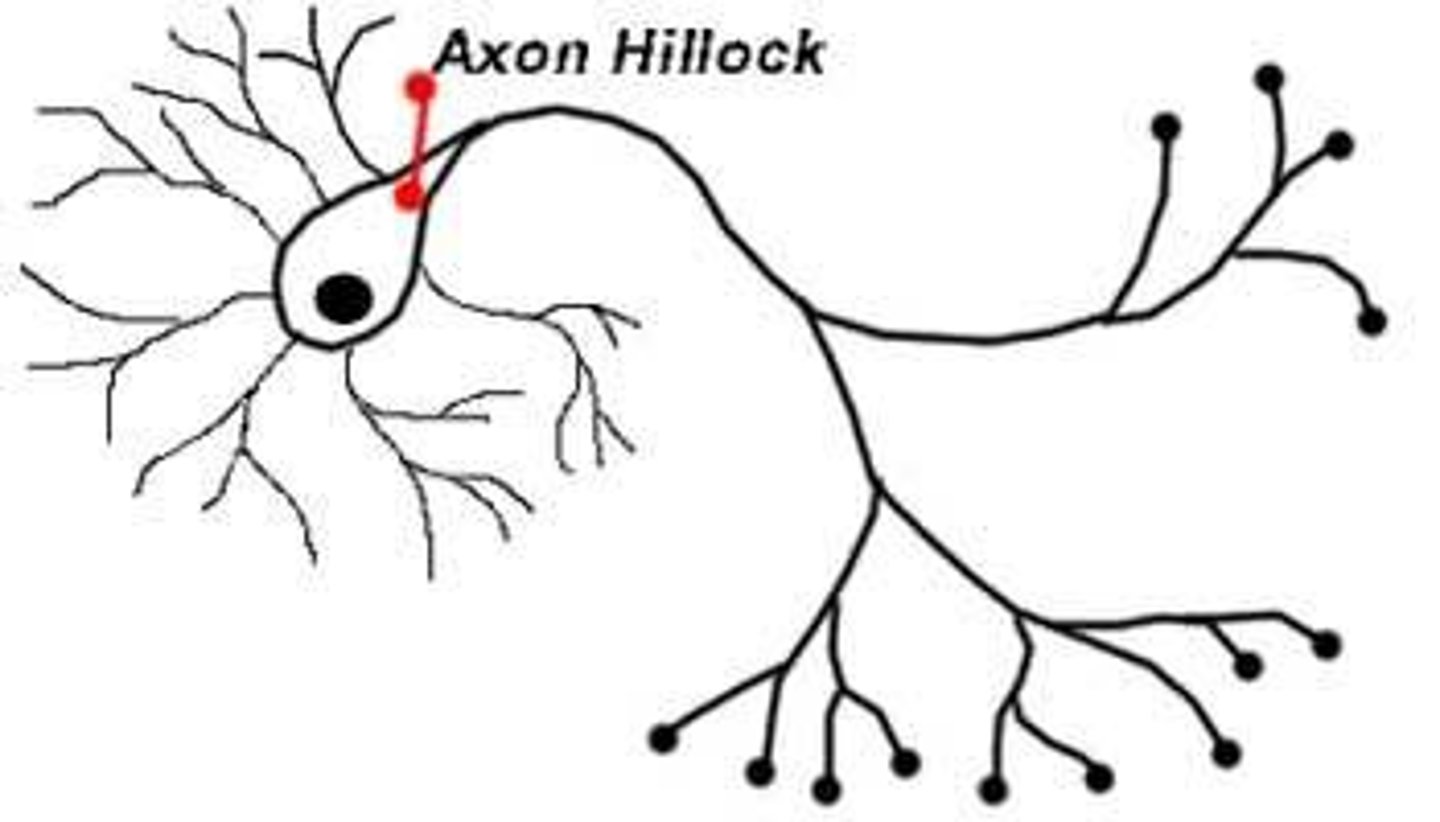
What is the (3) axon-hillock? What does it do?
The part between the axon and the Soma; the start of the axon.
If the signal is strong enough, it takes it from the soma and sends it to the axon.
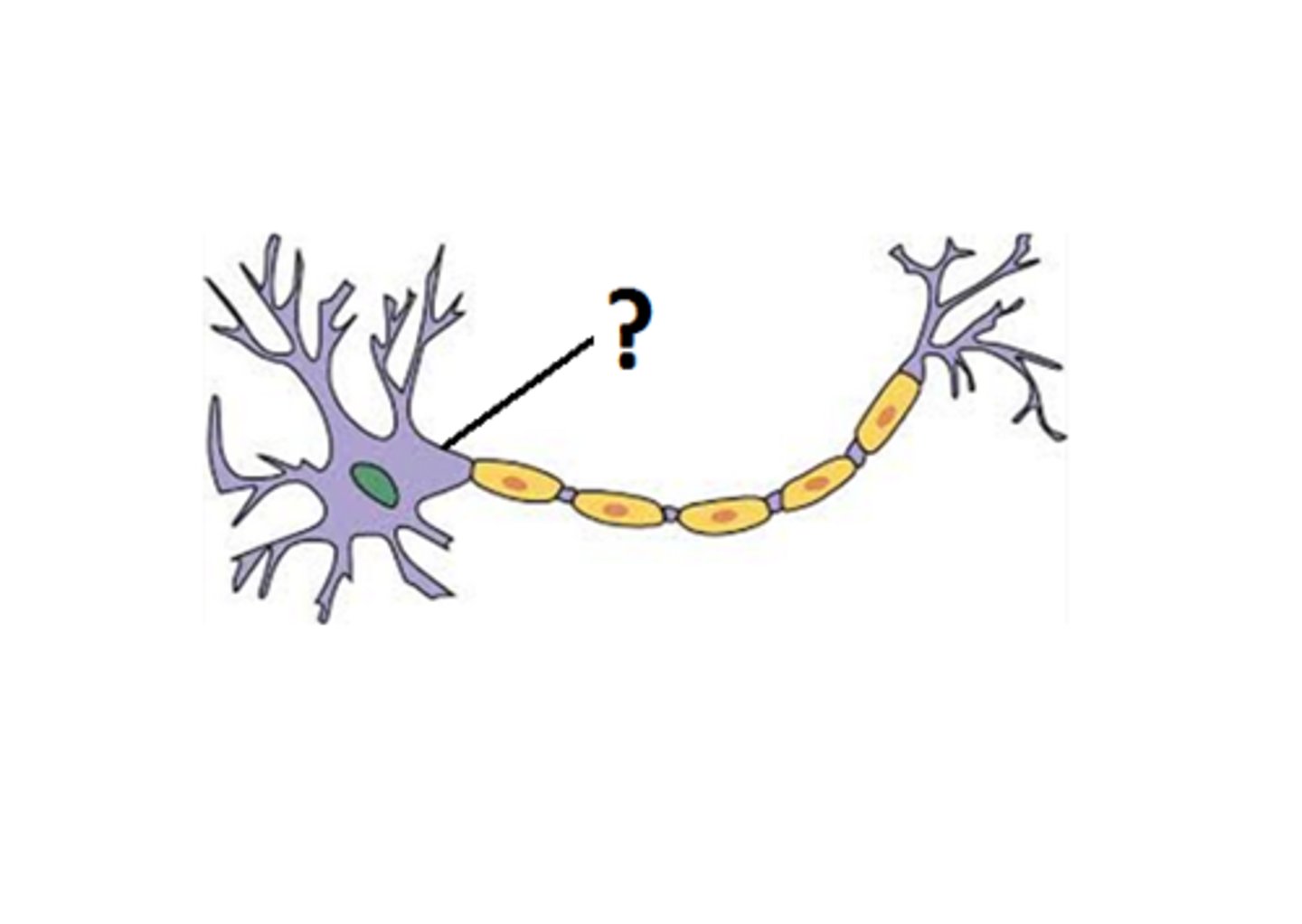
What is the (4) Axon? What does it do?
A long fiber extending from the neuron's body that is covered in myelin. There is only one axon per neuron, but can be very long.
Takes the impulse, now called an "action potential" to the nerve ending.
What is the (5) Axon terminal? What does it do?
The end of the axon.
Transmits to the dendrites of other neurons; when the signal reaches the terminal, it causes the release of neurotransmitters that are received by the dendrites of another neuron and the process starts over again.
What is an action potential? What does it do?
The term refers to the signal/impulse in a neuron when it has reached the axon. It is an electrical, not chemical, signal.
What is a myelin sheath? What does it do?
Covers the axon. It protects the signal from degrading when it is traveling down the axon.
What are neurotransmitters?
Chemical messengers. A chemical that, released by one neuron, crosses the synaptic space to be received at the receptors on the dendrites of neighboring neurons. There are dozens of neurotransmitters in the brain.
What is the synapse?
They are where two neurons (nerve ending of one neuron and the dendrite of another) are close enough to pass on the chemical signals from one to the other. Neurons do not touch each other. It is a specialized structure where most communication between neurons happens.
What is the synaptic cleft?
The tiny space between the nerve ending of one neuron and the dendrite of another (the synapse). Neurons do not touch each other.
What are receptors?
A site on the postsynaptic neuron that receives a neurotransmitter.
What is the Presynaptic neuron?
The neuron when the signal is initiated. Pre= Before "the giver" - Chappel Roan
What is the Postsynaptic neuron?
The neuron that receives the signal. Post= After "take it like a taker" - Chappel Roan
What are vesicles?
Small sacks that package neurotransmitters. Each contains thousands of neurotransmitters.
What do vesicles do?
They fuse to the synaptic membrane and release neurotransmitters into the synaptic cleft.
What is the process of synaptic transmission? (Hint: 6 steps)
1. The presynaptic neuron is excited by an electrical signal, the action potential.
2. This causes vesicles to fuse with the presynaptic membrane; the vesicles release their contents, neurotransmitters, into the synaptic cleft (the gap).
3. In the cleft, neurotransmitters interact with receptors on the postsynaptic membrane.
4. Neurotransmitters bind with these receptors, causing an effect in the postsynaptic neuron.
5. The post synaptic neuron...
- Excitatory: Increases the likelihood of an action potential.
Or...
- Inhibitory: Decreases the likelihood of an action potential.
6. The neurotransmitter molecules are cleared from the synaptic cleft via (1) diffusion, (2) reuptake, or (3) broken down by enzymes and reused.
What is meant when a neurotransmitter has an excitatory effect?
Increases the likelihood of firing. The neurotransmitter binding to the receptors of the postsynaptic neuron increases the likelihood of an action potential.
What is meant when a neurotransmitter has an inhibitory effect?
Decreases the likelihood of firing. The neurotransmitter binding to the receptors of the postsynaptic neuron decreases the likelihood of an action potential.
What are the three ways neurotransmitter molecules may be cleared from the synaptic cleft?
1. Diffusion
2. Reuptake
3. Broken down by enzymes and reused.
What is diffusion?
The process where neurotransmitters in the synaptic cleft drift away. One of the processes that clears molecules from the synaptic cleft.
What is reuptake?
The process where neurotransmitters in the synaptic cleft are taken back into the presynaptic neuron. One of the processes that clears molecules from the synaptic cleft.
What are SSRIs and how do they work? How does this relate to synaptic transmission?
Goal= Treat depression by increasing serotonin level; based on the assumption that depression is linked to low serotonin.
How they work...
Inhibiting the reuptake of serotonin; it stops transporters from taking excess serotonin out of the synaptic cleft. This leaves more serotonin in the synaptic cleft; which gets stronger with time. Research also suggests SSRI's work in other ways; largely the placebo effect.
How do cells communicate with each other?
With neurotransmitters; chemical messengers.
How do cells communicate within themselves?
Action potentials!; electrical signals!
Which neurotransmitters are most closely tied to psychological disorders? (Hint:4)
1. Serotonin: Mood disorders
2. Dopamine: Schizophrenia
3. Norepinephrine: Panic Disorder & Mood Disorders
4. Gamma Aminobutyric Acid (GABA): Anxiety
TB: Depression is linked to low or irregular activity of the neurotransmitters serotonin, norepinephrine, and glutamate.
What are the 5 proposed ways an imbalance of neurotransmitters (NT) occurs?
1. Excessive/too little production of a NT.
2. Excessive/ too little release of a NT.
3. Excess/deficiency of enzymes that break down NT.
4. Too fast/slow reabsorption by presynaptic neuron.
5. Post-synaptic neuron receptors abnormally sensitive/insensitive.
What is the major function of the Prefrontal cortex?
Important for executive functioning; it's the part of our brain associated with managing attention, behavior, and emotions. It helps us modulate our behavior to reach short term and long term goals.
What is the major function of the Amygdala?
Involved in recall of emotional memories. Amygdala=emotion Also involved in threat response; real-world stimuli and threatening thoughts.
What is the major function of the Hippocampus?
Involved in memory.
What is the major function of the Hypothalamus?
Involved in regulating bodily states. Drives such as hunger, thirst, and sex. Bodily conditions such as temperate, circadian rhythm, and sleep-wake cycles.
What is the endocrine system?
A series of endocrine glands, located throughout the body, that release chemicals called hormones into the bloodstream that propel body organs into action. Endocrine glands work along with neurons to control such vital activities as growth, reproduction, heart rate, body temperature, and stress.
How does the endocrine system work?
What are the endocrine system messengers called?
Hormones; they are the chemicals released by endocrine glands into the bloodstream to propel body organs into action.
What is a brain circuit?
A network of particular brain structures that work together, triggering each other into action to produce a distinct kind of behavioral, cognitive, or emotional reaction. Research shows it may be more informative to look at the interconnectivity of the entire circuit, rather than individual brain structures, to fully understand human functioning.
What are psychotropic medications?
Drugs that mainly affect the brain and reduce many symptoms of mental dysfunction. One of the three leading kinds of biological treatment, and by far the most common form.
What are the 4 types of psychotropic medications?
1. Antianxiety Drugs or Anxiolytics = Help reduce tension and anxiety.
2. Antidepressant Drugs = Help improve functioning of people with depression and certain other disorders.
3. Antibipolar Drugs or Mood Stabilizers = Help steady the moods of those with bipolar disorder, a condition marked by mood swings from mania to depression.
4. Antipsychotic Drugs = Help reduce the confusion, hallucinations, and delusions that accompany psychosis, the loss of contact with reality found in schizophrenia and other disorders.
What is brain stimulation?
Interventions that directly or indirectly stimulate certain areas of the brain in order to bring about psychological improvement.
What are the 4 types of brain stimulation?
1. Electroconvulsive therapy (ECT)
2. Transcranial Magnetic Stimulation (TMS)
3. Vagus Nerve Stimulation (VNS)
4. Deep Brain Stimulation (DBS)
Briefly explain Electroconvulsive therapy (ECT).
A biological treatment in which a brain seizure is triggered when an electric current passes through electrodes attached to the patient's forehead. Primarily used for severe depression. The oldest (and most controversial) form of brain stimulation.
Briefly explain Transcranial Magnetic Stimulation (TMS).
Electromagnetic coil is placed on or above a person's head, sending a current into certain areas of the brain.
Briefly explain Vagus Nerve Stimulation (VNS).
A pulse generator is implanted in a person's neck, helping to stimulate their vagus nerve, a long nerve that extends from the brain down through the neck and on to the abdomen. The stimulated vagus nerve then delivers electrical signals to the brain.
Briefly explain Deep Brain Stimulation (DBS).
Electrodes are surgically implanted in specific areas of a person's brain and connected to a battery ("pacemaker") in the chest. The pacemaker proceeds to power the electrodes, sending a steady stream of low-voltage electricity to the targeted brain areas. Used to treat severe depression.
What is psychosurgery?
Brain surgery for mental disorders. In modern times, they are typically used only after certain severe disorders have continued for years without responding to any other treatment.

