Week 10 - non-parametric tests
 Studied by 0 people
 Call Kai
 Learn
Learn Practice Test
 Spaced Repetition
 Match
Match Flashcards
 Knowt Play
1/23

There's no tags or description
Looks like no tags are added yet.
Name | Mastery | Learn | Test | Matching | Spaced | Call with Kai |
|---|
No analytics yet
Send a link to your students to track their progress
24 Terms
what are parametric statistics?
make assumptions about the population from which the sample has been drawn
a common assumption being that the distribution of scores in the population is normal
what are non-parametric statistics?
do not make assumptions about the underlying population distributions → distribution free statistics
non-parametric tests have less power than their parametric equivalents (higher risk of type II error)
what’s the non-parametric equivalent of an independent t-test (between ps)
Mann-Whitney U test
what’s the non-parametric equivalent of a paired t-test (within)
Wilcoxon T test
what’s the non-parametric equivalent of a 1-way Independent ANOVA (between)
Kruskal Wallis Test
what’s the non-parametric equivalent of 1-way repeated measures ANOVA (within)
Friedman Test
what’s the non-parametric equivalent of factorial designs
there is no non-parametric equivalents
how can normality be tested in t-tests and ANOVAs?
shapiro-wilk test shows if its normal or not
when do you use a non-parametric test?
if either variable is measured on an ordinal scale
if data is not normally distributed according to Shapiro-wilk
when do you use asymptotic p-value vs exact p-value?
asymptotic → ok for large samples
exact → more conservative (better when sample size is small, sample size differs across IV levels, or where distributions aren’t normal)
what measure of central tendency do you use for non-parametric measures?
median & min and max range
what is the format of a Mann Whitney U writeup?
U= , p= .__ , r = .__
how do you write up a wilcoxon T test
z = , p = .__ r= ._
what would you report after a significant Kruskal-wallis result
post-hoc (Mann-whitney U)
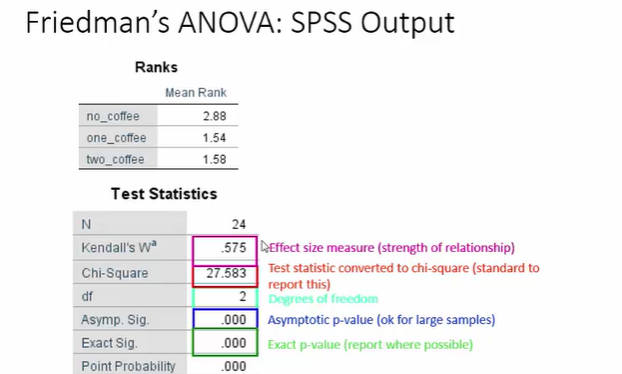
what would you report after a significant Freidman’s ANOVA
Wilcoxon T tests, corrected for multiple comparisons
How do you report Freidman’s ANOVA?
X² (2, N=24) =27.58, p <.001, with a Kendall’s coefficient of concordance (W = .575) reflecting a strong effect
what are the non-parametric tests of relationships?
Spearman’s rho
Kendall’s tau
When do you use Spearman’s rho/Kendall’s tau
use Spearman’s rho when N>20, Kendall’s Tau when N<20
How do you report Spearman’s Rho?
rs(23) = .580, p = .003
how do you report Kendall’s Tau?
rt(23) = .580, p = .003
what are non-parametric tests for categorical data?
one variable chi-square
chi-square test of independence
the ‘data’ are frequency counts rather than scores
How would you write up chi - square?
X² (1, N=35) = 1.61, p = .240 and then a table reporting observed frequency and expected frequency
What does the Chi-square test for independence measure>
measures the association between 2 variables:
each variable measured on a categorical scale, 2×2, r*c (row, colomn)
What is Cramer’s V?
Chi-squared equivalent of a r value → percentage of shared variance = V²
 Note
Note  Flashcards (20)