11.6 The Directional Derivative and the Gradient Vector
 Call Kai
 Learn
Learn Practice Test
 Spaced Repetition
 Match
Match Flashcards
 Knowt Play
1/4

There's no tags or description
Looks like no tags are added yet.
Name | Mastery | Learn | Test | Matching | Spaced | Call with Kai |
|---|
No analytics yet
Send a link to your students to track their progress
5 Terms
The Directional Derivative
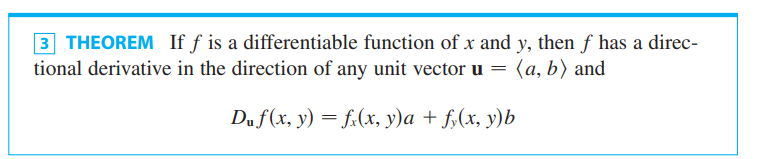
The directional derivative is the rate at which a multi-variable function changes with respect to a particular direction; for the directional derivative, the direction vector MUST be a unit vector.
Once the direction vector has been defined as a unit vector, then the directional derivative is simply:
The Directional Derivative with Angular Measures
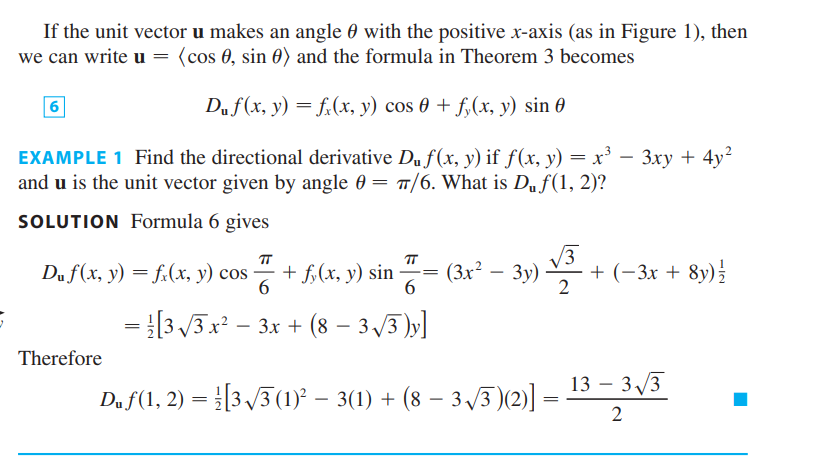
If the direction vector is provided based on the angle which is made between the plane and the surface, then the directional derivative formula becomes:
The reason why u = <cos(theta), sin(theta)> is because we assume that the hypotenuse (the magnitude of the vector) is 1 (hence why we use a unit vector), so then the x and y components become nothing more than cos(theta)/1 = cos(theta) and sin(theta)/1 = sin(theta).
The Gradient Vector
The Gradient Vector is the vector that contains all of the first-order partial derivatives of a multi-variable function:
Relation Between the Directional Derivative and the Gradient Vector
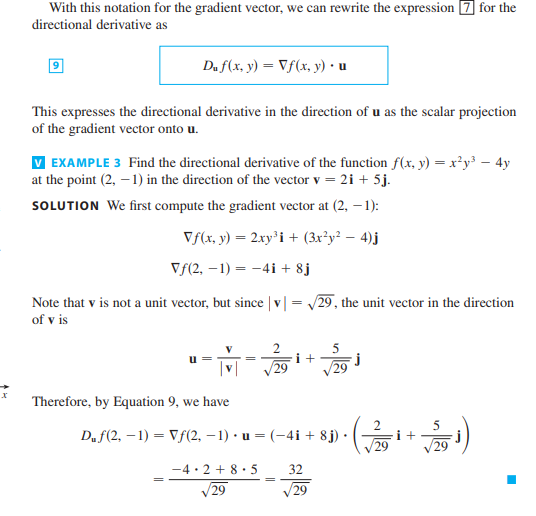
The directional derivative can be written as the dot product between the gradient vector and the unit direction vector.
Direction of Maximum Change
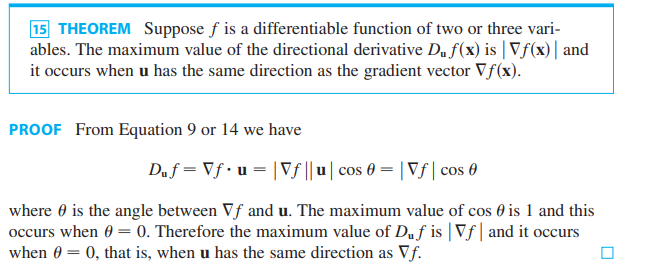
The maximum value of the directional derivative (i.e. the direction in which the maximum change occurs) is in the direction of the gradient vector.
If the unit direction vector is the same as the gradient vector, then that is the direction of maximum ascent of a multi-variable function at a point (a,b).
Furthermore, the AMOUNT of change that is maximum is simply the magnitude of the gradient vector (makes sense since we want to find the length of this vector → magnitude).