PE 34 chapter 5
 Call Kai
 Learn
Learn Practice Test
 Spaced Repetition
 Match
Match Flashcards
 Knowt Play
1/14

There's no tags or description
Looks like no tags are added yet.
Name | Mastery | Learn | Test | Matching | Spaced | Call with Kai |
|---|
No analytics yet
Send a link to your students to track their progress
15 Terms
acute respiratory responses
increased respiratory rate
increased tidal volume
increased ventilation
increased gaseous exchange
respiratory rate
How many breaths per minute.
12-15 breaths per minute during rest, but rate will increase as a direct response to the oxygen demand. A warmup leads to a gradual increase, can rise to 50-60 breaths per minute.
Direct linear relationship between exercise intensity and respiratory rate and oxygen uptake
Tidal volume
The amount of air taken per breath.
At rest tends to be 0.5L, in exercise can rise to 4-5L. Males have higher TV due to larger lungs.
TV has a finite capacity, reached at submax intensities. Max TV at 75% HR.
Ventilation
Air breathed in and out from lungs per min.
Ventilation (L/Min) = respiratory rate (breaths/min) x tidal volume (L/breath)
increased gaseous exchange
Takes place at lungs and muscle. Gas moves from high to low concentration. As we breath in, more o2 enters the lungs and more difusion in alveoli due to surrounding capillaries.
Carbon dioxide concentration is higher in capillaries then alveoli, o2 goes into capillary and carbon moves out = gas exchange.
Difusion from the lungs will reach the muscles, once blood is used carbon produced. Breathing out gets carbon out of body, gases are exchanged.
Allows so oxygen can go through working muscles while difusing with carbon dioxide, from high to low pressure.
Acute cardiovascular responses
increased heart rate
increased stroke volume
increased blood pressure
redistribution of blood
increased cardiac output
oxygen uptake
refers to the amount of oxygen transported to, taken up by and used by the body for energy production.
oxygen uptake at rest
approximately 0.25/0.3 litres per minute
The body stores minimal amounts of oxygen. This means that the amount of oxygen entering your bloodstream is directly proportional to the amount used by your tissues for oxidative metabolism.
demand for oxygen
low HR
low RR
low muscle activity
o2 supply= o2 demand
maximum oxygen uptake (vo2 max)
the maximum amount of oxygen per minute that can be taken in, transported and utilised by the body for energy production
no further increase in oxygen uptake can be achieved
oxygen deficit
the state in which there is a discrepancy (shortfall) between oxygen supply and the oxygen needed to meet the energy requirements of the activity. The anaerobic pathways must supplement the energy demands of the activity.
start of exercise
O2 demand is greater than the supplied O2
during O2 deficit muscles obtain energy from anaerobic energy systems
increase exercise intensity= increase oxygen deficit= longer for body to meet o2 demand
graph of o2 deficit, steady state and EPOC
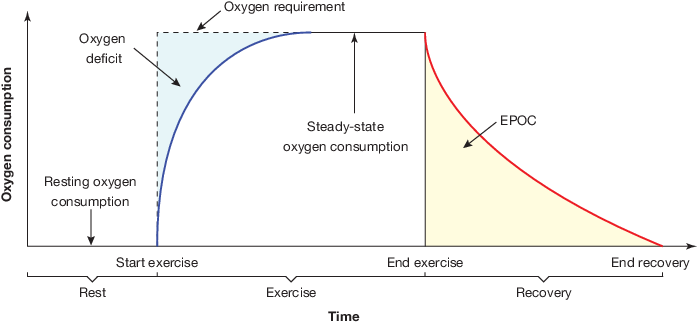
EPOC
excess post-exercise oxygen consumption
elevated oxygen consumption after the completion of exercise
after the completion of exercise o2 uptake or consumption does not immeadiately return to resting levels
increase exercise intensity= larger EPOC
larger deficit= larger EPOC
active recivery increases EPOC
2 parts of EPOC
fast part- restores ATP at muscles, restores o2 to myoglobin, re-synthesise CP
slow part- core temp returns, HR and RR return, lactic converts to glycogen, glucose and protein, fatty acid cycling increases, accumulated h+ oxidisr into H2O and CO2
factors associated with the amount and duration of EPOC
elevated muscle temp
increased use of mitochondria
increased ATP production
restoring CP stores
Lactate production during exercise
Explore top notes

