Theory of the Firm
 Call Kai
 Learn
Learn Practice Test
 Spaced Repetition
 Match
Match Flashcards
 Knowt Play
1/3

There's no tags or description
Looks like no tags are added yet.
Name | Mastery | Learn | Test | Matching | Spaced | Call with Kai |
|---|
No analytics yet
Send a link to your students to track their progress
4 Terms
Economies of Scale
1: Specialisation of labour
Each worker specialises in performing certain tasks, increasing productive efficiency andallowing output to be produced at a lower AC
2: Specialisation of management
Managers can specialise in a certain area, increasing productive efficiency and allowingoutput to be produced at a lower AC
3: Bulk buying of inputs (factors of production)
As quantities of inputs purchased increase, the price per unit drops
4: Financing
Larger firms may have lower interest rates, thus reducing costs per unit of output
5: Spreading of certain costs, such as marketing, over large volumes
Thus resulting in lower AC
Diseconomies of scale
1: Coordination and monitoring difficulties
Managers struggle to monitor a larger workforce, resulting in growing inefficiencies andincreasing AC as the firm expands.
2: Communication difficulties
Various components of the firm may less easily communicate as the firm grows increasinginefficiency and increasing AC.
3: Poor worker motivations
Workers may feel less connected to the firm and management in a large firm, they becomeless productive, increasing AC
Perfect Competition
Many small firms
Homogeneous products (perfect substitutes)
No market power (firms are price takers)
No barriers to entry or exit
Perfect information
Perfect factor mobility
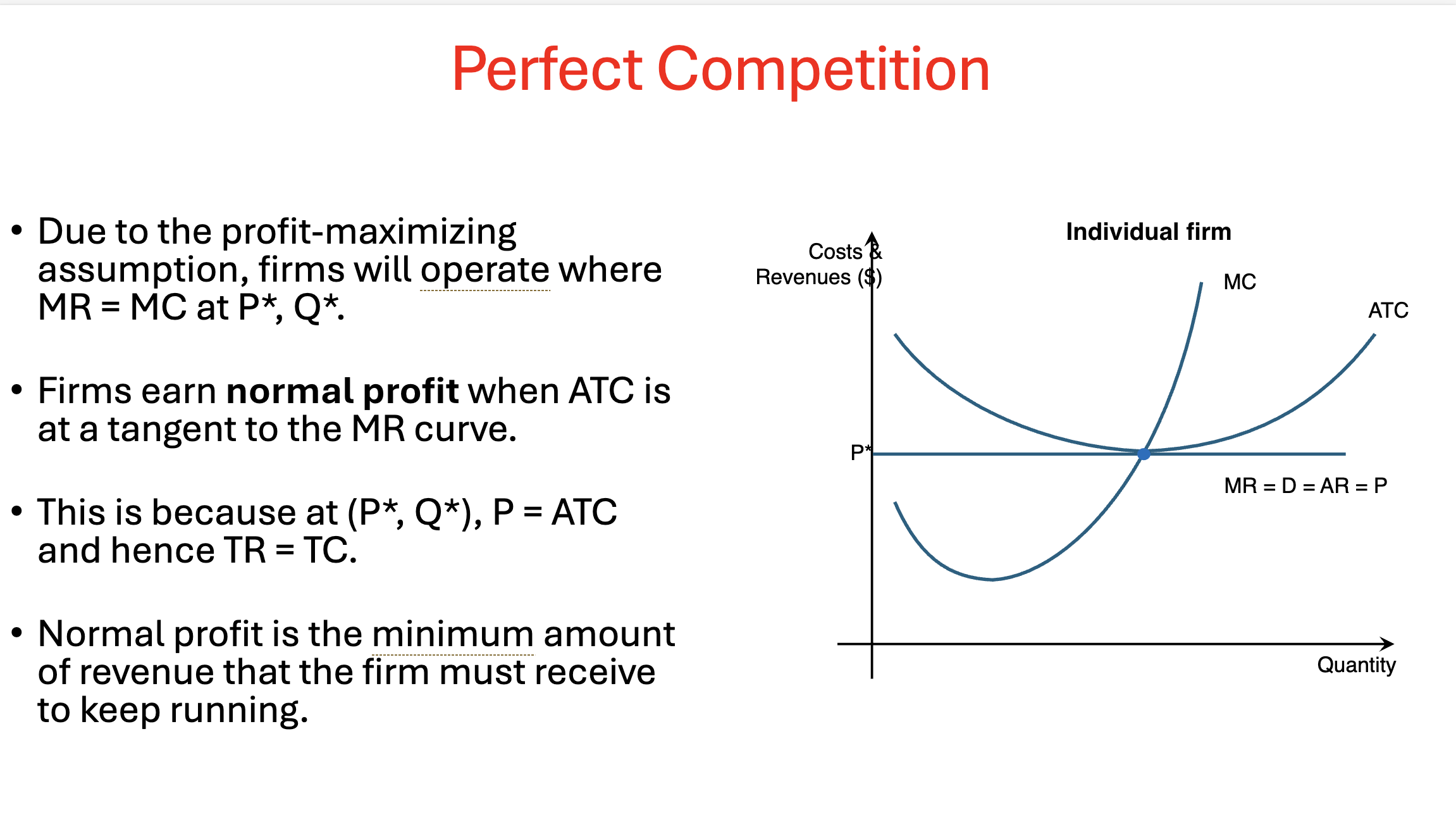
Perfect Competition Diagram
Explore top notes

Explore top flashcards
