Legal Studies - Part II of Core - Human Rights - Syllabus Notes
 Studied by 0 people
 Call Kai
 Learn
Learn Practice Test
 Spaced Repetition
 Match
Match Flashcards
 Knowt Play
1/68

There's no tags or description
Looks like no tags are added yet.
Name | Mastery | Learn | Test | Matching | Spaced | Call with Kai |
|---|
No analytics yet
Send a link to your students to track their progress
69 Terms
1.0 The nature and development of human rights
1.1 The definition of human rights
Define Human rights
These are the rights and freedoms that are believed to belong to all human beings. Human rights do not discriminate based on race, age, gender, nationality, language, sexuality, physical ability, appearance, negligence, or religion.
1.0 The nature and development of human rights
1.1 The definition of human rights
What are the 4 qualities of Human rights?
They are universal, indivisible, inalienable, and inherent.
1.0 The nature and development of human rights
1.1 The definition of human rights
Define Universal
Universal: applicable to all.
1.0 The nature and development of human rights
1.1 The definition of human rights
Define indivisible
Indivisible: all rights are equally important.
1.0 The nature and development of human rights
1.1 The definition of human rights
Define inalienable
Inalienable: cannot be taken away.
1.0 The nature and development of human rights
1.1 The definition of human rights
Define inherent
Inherent: they are permanent; you are born with them, and they stay with you.
1.0 The nature and development of human rights
1.1 The definition of human rights
What obligations do nation-states have regarding human rights?
Nation-states (countries) have an obligation, both legal and moral, to uphold these rights.
1.0 The nature and development of human rights
1.2 Developing recognition of human rights
1.2.1 The abolition of slavery
What is Slavery?
Slavery is forced labour in which a person is considered to be the legal property of another, and pre-dates recorded history.
1.0 The nature and development of human rights
1.2 Developing recognition of human rights
1.2.1 The abolition of slavery
When was the first move to abolish slavery?
Moves to abolish slavery came early; Iceland was the first nation to abolish slavery in 1117. Widespread abolition largely began in the 18th century when rationalist people viewed slavery as violating the rights of man. Evangelical Christians began to criticise it as 'unchristian.'
1.0 The nature and development of human rights
1.2 Developing recognition of human rights
1.2.1 The abolition of slavery
When was slavery ruled to be illegal?
Slavery was ruled illegal in the common law of England in a 1722 judgement by the Court of King's Bench in the case of Somersett (R V Knowles; ex parte Somersett (1722) 20 State Tr 1. This did not mean that slavery was legal in colonies, just in England. British politician William Wilberforce pressured the government to end the slave trade in overseas colonies - see: Slave Trade Act 1807 (UK). However, it was not until the Slavery Abolition Act of 1833 (UK) that slavery itself was abolished. Slaves were freed the next year.
1.0 The nature and development of human rights
1.2 Developing recognition of human rights
1.2.1 The abolition of slavery
When did the US follow this ruling?
The United States flowed 1808. The Northern States of America abolished trade with the Southern States, which continued slavery because of their high agricultural trade. This was one of the main causes of the American Civil War (1861-1865). All US slaves were freed by the end of the war in 1865, and slavery ended by the Thirteenth Amendment to the US Constitution, though the intergenerational legacy of slavery and oppression lives on.
1.0 The nature and development of human rights
1.2 Developing recognition of human rights
1.2.1 The abolition of slavery
When was Slavery prohibited in the UDHR?
At the end of WWII, under Article 4 of the UDHR, slavery was prohibited. The last state to officially abolish slavery was Mauritania in 1981. However, today an estimated 50 million people is living in modern slavery worldwide according to the Global Slavery Index 2023.
1.0 The nature and development of human rights
1.2 Developing recognition of human rights
1.2.2 Trade unionism and labour rights
Explain employment law and fair working conditions in Australia
Employment law and fair working conditions are relatively new legal developments. In contemporary Australia, we may take safe working conditions, the right to paid holidays, and minimum wage for granted, but these were hard-fought victories of labour movements.
1.0 The nature and development of human rights
1.2 Developing recognition of human rights
1.2.2 Trade unionism and labour rights
Why were trade unions introduced?
Calls for trade unions (or early examples of such) were triggered by a lack of workplace safety, low wages, and long hours doing laborious work.
1.0 The nature and development of human rights
1.2 Developing recognition of human rights
1.2.2 Trade unionism and labour rights
What are the areas covered by trade unions?
The areas typically protected by trade unions are:
Minimum wages
Working conditions
Equal pay
Long service leave
Paid public holidays
Maternity leave and paternity leave.
Annual leave
Occupational health and safety laws
Worker's compensation
1.0 The nature and development of human rights
1.2 Developing recognition of human rights
1.2.3 Universal suffrage
Define Suffrage
Suffrage refers to the legal right to vote in a democratic election. Previously, a person's gender, status, race, age, beliefs, and nationality limited suffrage.
1.0 The nature and development of human rights
1.2 Developing recognition of human rights
1.2.3 Universal suffrage
Who were the suffragettes?
Women who campaigned for the right to vote were known as suffragettes. The contribution to the war effort by women in WWI in the UK was instrumental in the suffragettes' campaigns, which set the foundation for voting rights for women.
1.0 The nature and development of human rights
1.2 Developing recognition of human rights
1.2.4 Universal education
What is universal education, and where is it included under the UDHR?
All human beings have a right to an education. This was included under Article 26 of the UDHR and is now considered a basic human right and essential component of autonomy and opportunity, as education rates are strongly correlated with a high quality of life and longer life expectancy.
1.0 The nature and development of human rights
1.2 Developing recognition of human rights
1.2.4 Universal education
How has universal education been implemented in NSW?
In NSW, the Public Instruction Act 1880 (NSW) led to the government taking control of all the church-run schools, except those run by the Catholic Church, and making education free, secular, and compulsory. The school leaving age in NSW was raised to 17 years as of 2010.
1.0 The nature and development of human rights
1.2 Developing recognition of human rights
1.2.4 Universal education
What is the Australian Populations literacy rate?
The Australian population now has a 99% literacy rate. However, approximately 14% of adults only have a very low literacy level, meaning they may still struggle with everyday life or in the workplace. These rates also tend to be higher in First Nations populations or in rural and remote areas. Furthermore, Australia's position in the PISA results (which compare the English, Maths, and Science performance of 15-year-olds globally) has been trending downward for the past two decades, so more must be done to increase education across the board.
1.0 The nature and development of human rights
1.2 Developing recognition of human rights
1.2.5 Self-determination
Define Self-determination
This is the collective right of a group of people to determine their own political status and how they want to be governed.
1.0 The nature and development of human rights
1.2 Developing recognition of human rights
1.2.6 Environmental rights
What do environmental rights refer to?
These are seen as essential to securing and promoting other human rights. This right relates to both current generations and future generations.
1.0 The nature and development of human rights
1.2 Developing recognition of human rights
1.2.6 Environmental rights
What is the main failure of environmental rights?
The main failure regarding environmental rights is the difficulty of getting global cooperation. Countries that have an economy that relies on industrial pollution or environmentally damaging practices may be reluctant to accept treaties to promote a healthy environment.
1.0 The nature and development of human rights
1.2 Developing recognition of human rights
1.2.6 Environmental rights
What are two examples of legal action in support of environmental rights?
In 2015, 196 nations signed on to the Paris Agreement, a legally binding international treaty on climate action.
Each year, the UN hosts a Climate Change Conference of the Parties (COP) in which representatives from 198 parties (197 nations plus the European Union) meet to discuss solutions to tackle climate change.
1.0 The nature and development of human rights
1.2 Developing recognition of human rights
1.2.7 Peace rights
How were Peace rights developed?
The history of peace rights can be traced back to the United Nations Charter in 1945, which set out the organisation's goal to maintain global peace. The precursor to the UN was the League of Nations, created during the Paris Conference in Versailles after World War I, though it ultimately proved to be ineffective in preventing another World War.
1.0 The nature and development of human rights
1.2 Developing recognition of human rights
1.2.7 Peace rights
How has the UN promoted peace rights?
In 1984, the UN adopted the Declaration on the Rights of Peoples to Peace, a non-binding agreement that prioritises peace for all people, defining its aims to:
Eliminate the threat of war, particularly nuclear war
Denounce the use of force in international relations
Settle international disputes by peaceful means, as directed by the UN Charter
Various articles within the UN Charter seek to balance the rights of countries to defend themselves or grant self-determination to their people with the global desire for peace. For instance, Article 51 declares that states have the inherent right to individual or collective self-defence if an armed attack against them occurs. Under Article 39, the UN Security Council can authorise actions to maintain or restore peace.
1.0 The nature and development of human rights
1.3 Formal statements of human rights
1.3.1 Universal Declaration of Human Rights
What are the 4 freedoms the UDHR protects?
In 1941, President Franklin Roosevelt called for the protection of Four Freedoms:
Freedom of speech
Freedom of worship
Freedom from want
Freedom from fear
1.0 The nature and development of human rights
1.3 Formal statements of human rights
1.3.1 Universal Declaration of Human Rights
Why was the UN charter created?
The UN Charter was created to "reaffirm faith in fundamental human rights, in the dignity and worth of the human person." This is the second purpose of the charter. However, the UN Charter did not define what the rights were. So, the UDHR stepped in.
1.0 The nature and development of human rights
1.3 Formal statements of human rights
1.3.1 Universal Declaration of Human Rights
What type of law is the UDHR?
This is considered soft law, meaning that it does not create legal obligations upon states. The reason for this is that the UN Charter needed a sub-document to define the rights and freedoms that it referred to. However, this does not mean that the UDHR is less influential than a 'hard law' document; the UDHR has been the catalyst for more than 200 international treaties, conventions, declarations and bills of rights. It is a part of international customary law, which is concepts or actions that have developed in a way that has endured time to the extent that they are widely accepted globally.
1.0 The nature and development of human rights
1.3 Formal statements of human rights
1.3.2 International Covenant on Civil and Political Rights
What is the ICCPR?
The ICCPR is a multilateral treaty that binds nations that ratify or accede to it. This was drafted and approved in 1966 and came into force in 1976. The aim of the ICCPR is to protect people from arbitrary use of power by a government and uphold the rule of law. It also acts to protect an individual from an oppressive government.
1.0 The nature and development of human rights
1.3 Formal statements of human rights
1.3.2 International Covenant on Civil and Political Rights
What are the key components of the ICCPR?
Key components of the ICCPR include:
Articles 2 and 3 pertain to equality between men and women.
Article 6 pertains to the right to life.
Articles 9 and 14 pertain to the right to freedom of movement, the right to a fair trial and the right to be presumed innocent until proven guilty.
Freedom of thought, conscience, speech, religion and assembly are upheld.
Children have a right to special protection under the law.
People have the right to marry whoever they wish and have a family.
People have a right to vote.
Ethnic minorities have the right to enjoy their cultures.
1.0 The nature and development of human rights
1.3 Formal statements of human rights
1.3.2 International Covenant on Civil and Political Rights
How is compliance with the ICCPR monitored?
The states that sign the treaty are monitored by the Human Rights Committee, which reports on states and investigates reported violations.They publish a report on each country every 5 years, and the committee have the power to hear complaints brought by one country against another, and hear complaints brought by individuals against their own government.
1.0 The nature and development of human rights
1.3 Formal statements of human rights
1.3.3 International Covenant on Economic, Social and Cultural Rights
What is the role of the ICESCR?
The ICESCR mostly deals with labour rights, including things like safe working conditions, fair wages, and trade unions.
1.0 The nature and development of human rights
1.3 Formal statements of human rights
1.3.3 International Covenant on Economic, Social and Cultural Rights
Does the ICESCR monitor compliance of countries?
The Committee on Economic, Social and Cultural Rights hears and monitors compliance of countries, but it does not hear individual petitions.
1.0 The nature and development of human rights
1.3 Formal statements of human rights
1.3.4 International Bill of Rights (not in official syllabus)
What caused additional documents to be created within the IBR?
The Cold War is what essentially meant that two documents, rather than one, were added to the International Bill of Rights. The ICCPR, ICESCR and the UDHR make up the International Bill of Rights
2.0 Promoting and enforcing human rights
In the international community:
2.1 State sovereignty
What is a state?
A state is a defined territory with an effective government. It has the capacity to enter into international relations, and has a permanent population. For our purposes, a state is the legal term for country - it is not to be confused with domestic states like NSW or Victoria.
2.0 Promoting and enforcing human rights
In the international community:
2.1 State sovereignty
What is state sovereignty?
This is the authority of a state to make decisions on behalf of itself in relation to domestic and international issues. Article 2(1) of the UN Charter states that "the UN is based on the principle of the sovereign equality of all of its states." State sovereignty is not absolute, but it is very powerful. If it were absolute, anarchy could result. As it is still limited, states have an obligation to adhere to international documents that have been ratified.
2.0 Promoting and enforcing human rights
In the international community:
2.1 State sovereignty
Why is state sovereignty an important part of international law?
State sovereignty is an important feature of international law as it gives nation-states autonomy with the responsibility to make decisions in the best interests of the state's people.
2.0 Promoting and enforcing human rights
In the international community:
2.1 State sovereignty
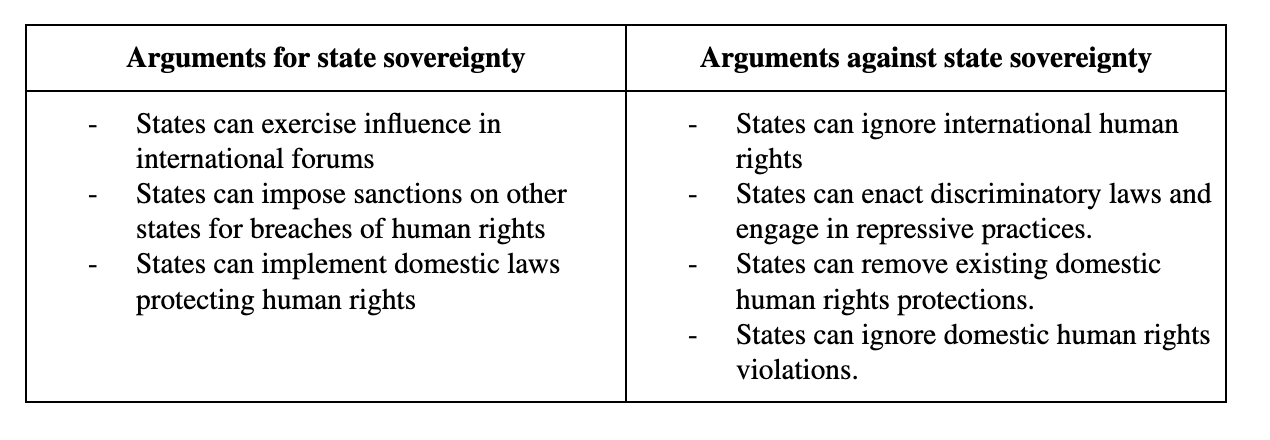
What are the arguments for and against state sovereignty?
2.0 Promoting and enforcing human rights
2.2 The roles of :
2.2.1 The United Nations
When was the UN established, and how many states are members?
The UN was formed after World War II and after the failed organisation that was the League of Nations. The UN has substantial influence over the world order.
The UN has 193 states at the time of publication, as well as two special 'observer state' memberships for the Vatican and the State of Palestine.
2.0 Promoting and enforcing human rights
2.2 The roles of :
2.2.1 The United Nations
What are the organs of the UN?
UN General Assembly (UNGA)
UN Security Council (UNSC)
Economic and Social Council (ECOSOC)
UN Secretariat
International Court of Justice (ICJ)
Office of the UN High Commissioner for Human Rights (OHCHR)
UN Human Rights Council (UNHRC)
2.0 Promoting and enforcing human rights
2.2 The roles of :
2.2.1 The United Nations
What is the role of the UN General Assembly (UN)?
Has representatives from all member states, and theoretically, each state has equal voting power.
Main forum for international discussions, many relating to human rights.
UN Human Rights Council reports directly to UNGA.
2.0 Promoting and enforcing human rights
2.2 The roles of :
2.2.1 The United Nations
What is the role of the UN Security Council (UNSC)?
Has responsibility for the maintenance of peace and security.
Exercises power through legally binding resolutions.
Can authorise peace-keeping, military action, or sanctions.
5 permanent members (P5) - France, US, Russia, China, UK - each with veto power.
UNSC has 10 non-permanent members with a 2-year term.
2.0 Promoting and enforcing human rights
2.2 The roles of :
2.2.1 The United Nations
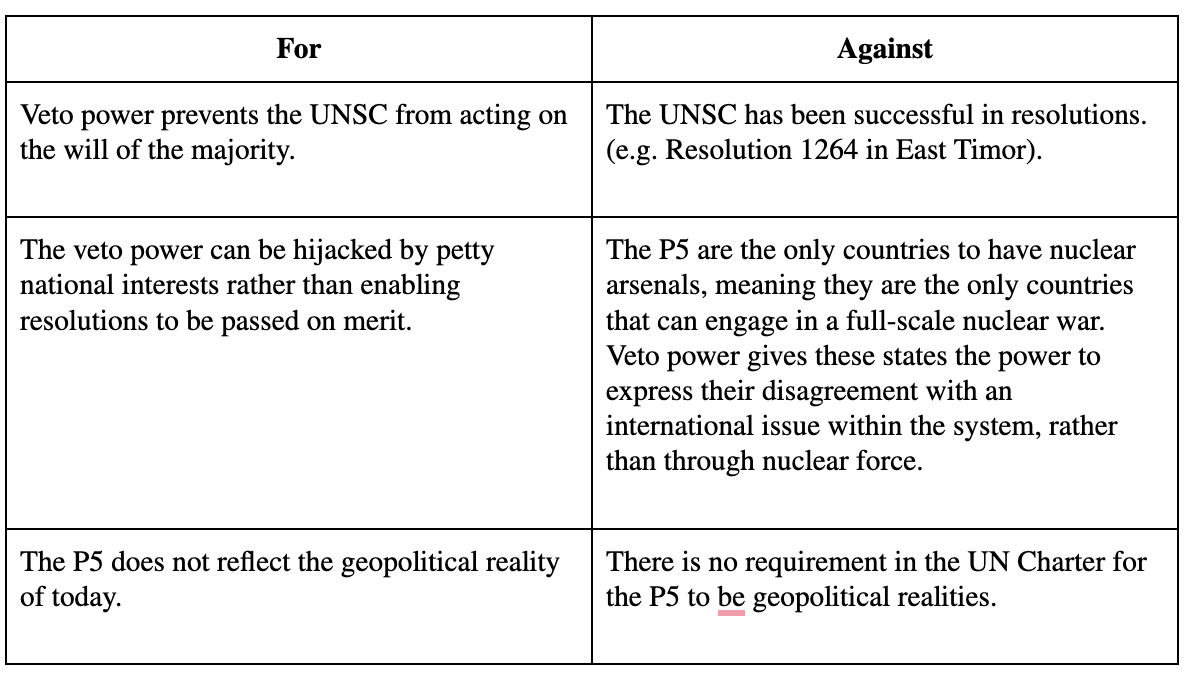
What are the main arguments for and against veto powers?
The debate over whether or not the veto power should be abolished.
2.0 Promoting and enforcing human rights
2.2 The roles of :
2.2.1 The United Nations
What is the role of the Economic and Social Council (ECOSOC)?
54 rotating members who meet annually.
Includes committees that discuss economic, social, environmental, and humanitarian issues.
It used to house the Commission on Human Rights, but in 2006, this was given to the UNGA.
2.0 Promoting and enforcing human rights
2.2 The roles of :
2.2.1 The United Nations
What is the role of the UN Secretariat?
This is the main administrative body, consisting of 40,000+ staff working worldwide.
António Guterres of Portugal is the Secretary-General as of 2024. This role was formally held by Ban Ki-moon of South Korea, who was the most prominent figure in the United Nations.
2.0 Promoting and enforcing human rights
2.2 The roles of :
2.2.1 The United Nations
What is the role of the International Court of Justice (ICJ)?
The ICJ is advisory only but has jurisdiction to settle disputes submitted by member states.
Produces opinions on international law, though these cases rarely relate to human rights.
2.0 Promoting and enforcing human rights
2.2 The roles of :
2.2.1 The United Nations
What is the role of the Office of the UN High Commissioner for Human Rights (OHCHR)?
This is the administrative agency in the UN Secretariat that works to promote and protect human rights. It was established in 1993. It aims to advance universal ratification and implementation of UDHR and human rights standards, and promote universal enjoyment of human rights. It also provides support to other UN human rights bodies (e.g. the Australian Human Rights Commission).
2.0 Promoting and enforcing human rights
2.2 The roles of :
2.2.1 The United Nations
What is the role of the UN Human Rights Council (UNHRC)?
This is an intergovernmental body established in 2006. There are 47 member states rotated on 3-year terms. The Council makes recommendations regarding human rights. It also has a complaints procedure that allows individuals, rather than states, to bring issues to the attention of the Council.
The UNHRC periodically reviews the standards of human rights in different states. Former President Obama added the US to the Council in 2009, thus strengthening its ability and effectiveness because of the influential nature of the US in the world order.
2.0 Promoting and enforcing human rights
2.2 The roles of :
2.2.2 Intergovernmental organisations
What are IGOs created by?
These are created by agreements between states. Each has an international treaty to establish the IGO and its aims.
2.0 Promoting and enforcing human rights
2.2 The roles of :
2.2.2 Intergovernmental organisations
What are some examples of IGOs?
The World Trade Organisation (164 member states)
The Commonwealth of Nations (56 member states)
The African Union (55 member states)
The European Union (27 member states)
The Arab League (22 member states)
2.0 Promoting and enforcing human rights
2.2 The roles of :
2.2.4 Non-government organisations
What are NGOs?
These are organisations independent of the government, often taking the form of aid groups or charities. Examples of NGOs include The Red Cross, Amnesty International, and Human Rights Watch.
2.0 Promoting and enforcing human rights
2.2 The roles of :
2.2.4 Non-government organisations
What is the role of an NGO?
NGOs play a role in informing the global community of human rights violations and progress. They research, document and investigate human rights cases. NGOs are effective because they are independent of governments and political bias. They work to inform the general public of what governments may not want them to know.
2.0 Promoting and enforcing human rights
2.2 The roles of :
2.2.5 The media
What is the role of the media?
The media often work closely with NGOs as they can have a significant influence on the general public. However, this is only the case in countries with freedom of the press.
Restriction of internet access or television means that the media is not as effective in some countries.
According to Article 19 of the UDHR, "everyone has the right to... seek, receive and impart information and ideas through any media regardless of frontiers."
2.0 Promoting and enforcing human rights
In Australia:
2.3 The incorporation of human rights into domestic law
What system of law does Australia use?
Australia has a dualist system, which means that our legal system requires us to legislate the treaties we ratify in order to make them domestically binding. If we had a monist system, like France, any treaty we ratily would automatically become an Act of Parliament. Australia passes legislation in order to incorporate international human rights documents into our domestic law.
2.0 Promoting and enforcing human rights
2.4 The roles of:
2.4.2 The Constitution, including division of powers and separation of powers
What is the role of the Constitution?
Express rights are explicitly written human rights protected by the Constitution.
Implied rights are rights that aren't explicitly written, but are implied.
The express rights are freedom of religion, the right to vote in a Commonwealth election, the right to trial by jury in federal indictable, and the right to just terms where the Commonwealth compulsorily acquires property.
The High Court ruled in Lange V ABC 1997 that the Constitutions contains an implied right to freedom of political communication: a type of free speech.
The ability of the Constitution to protect human rights is very limited.
2.0 Promoting and enforcing human rights
2.4 The roles of:
2.4.2 The Constitution, including division of powers and separation of powers
What is the separation of powers?
The separation of powers is protected in the Constitution.
Separation of powers involves separating the legislative, executive, and judiciary arms of the state. This way, too much power cannot lie in one arm (think back to Year 11 Legal Studies).
This protects against the abuse of power, which could lead to human rights abuses. It also allows for the judiciary arm to quash any legislation that it deems to be an obstruction of human rights.
2.0 Promoting and enforcing human rights
2.4 The roles of:
2.4.2 The Constitution, including division of powers and separation of powers
What is the division of powers?
This is the basis of Australian federation: the division at state and federal level.
Heads of power are the powers listed in the Constitution as areas that the Commonwealth can legislate on (e.g. marriage and currency).
Residual powers are powers which belong to the states and are not written in the Constitution.
An extremely important head of power given to the Commonwealth regarding human rights is the external affairs power. This gives the Commonwealth the authority to include international treaties in legislation. Human rights treaties can be binding on states if the necessary legislation is in place.
2.0 Promoting and enforcing human rights
2.4 The roles of:
2.4.3 Statute law
What is Statute law?
These are parliament-made laws.
Many of these human rights statutes were created in response to international documents.
The rights laid out in statute law are also not fixed - they can be removed by a later Act of Parliament.
2.0 Promoting and enforcing human rights
2.4 The roles of:
2.4.3 Statute law
What are some examples of Statute law?
Racial Discrimination Act 1975 (Cth)
Sex Discrimination Act 1984 (Cth)
Australian Human Rights Commission Act 1986 (Cth)
Disability Discrimination Act 1992 (Cth)
Age Discrimination Act 2004 (Cth)
Anti-Discrimination Act 1977 (NSW)
2.0 Promoting and enforcing human rights
2.4 The roles of:
2.4.4 Common law
What is the role of common law?
This is the body of law that is composed by the judgments of the courts.
Common law is evolving. It was passed down to Australia from the UK and evolves independently from the government - protecting many human rights.
The presumption of innocence and the right to a fair trial (different to the fair trial by jury for an indictable offence, as in the Constitution) are protected in common law.
Common law rights are not fixed - they can be removed by Acts of Parliament.
Judgements develop rights on a case-by-case basis.
Justice Brennen remarked that international law was "a legitimate and important influence on the common law, especially when international law declared the existence of universal human rights."
2.0 Promoting and enforcing human rights
2.4 The roles of:
2.4.5 Courts and tribunals
What is the role of the Australian Human Rights Commission (AHRC)?
Previously known as the Australian Human Rights and Equal Opportunity Commission, this Commission was established under the Human Rights Commission Act 1986 (Cth) to deal with the alleged violations of the Anti-Discrimination Act 1977 (NSW). The Commission receives and investigates complaints into discrimination and breaches of human rights. The AHRC also promotes public awareness about numan rights, providing legal advice, conducting public inquiries, and producing recommendations. It also gives advice and makes submissions to parliament and governments on the development of laws, policies and programs. The AHRC investigates various complaints and will take the matter to the Federal Court if they cannot resolve it.
2.0 Promoting and enforcing human rights
2.4 The roles of:
2.4.5 Courts and tribunals
What is the role of the High Court of Australia?
The High Court has the power to set precedents that are binding on other courts. They can also overturn legislation that conflicts with the Constitution.The High Court of Australia is critical in protecting human rights because the judges can take into consideration international standards. Consequently, they can apply these standards in the absence of legislation that properly enforces international standards of human rights.
2.0 Promoting and enforcing human rights
2.4 The roles of:
2.4.6 Non-government organisations
What is the role of NGOs?
These investigate and report on human rights issues. NGOs (alongside the media) are largely responsible for 'naming and shaming' human rights violations, shaping public opinion, and pressuring the government to make changes.
2.0 Promoting and enforcing human rights
2.4 The roles of:
2.4.7 The media
What is the role of the media?
Although it can be independent of NGOs, the media often publishes the findings of NGOs. There is no explicit right to freedom of speech in Australia - in fact there are limitations to it (such as racial vilification).However, the right to freedom of political communication is an implicit right in the Constitution.
2.0 Promoting and enforcing human rights
2.4 The roles of:
2.4.8 A Charter of Rights (arguments for and against)
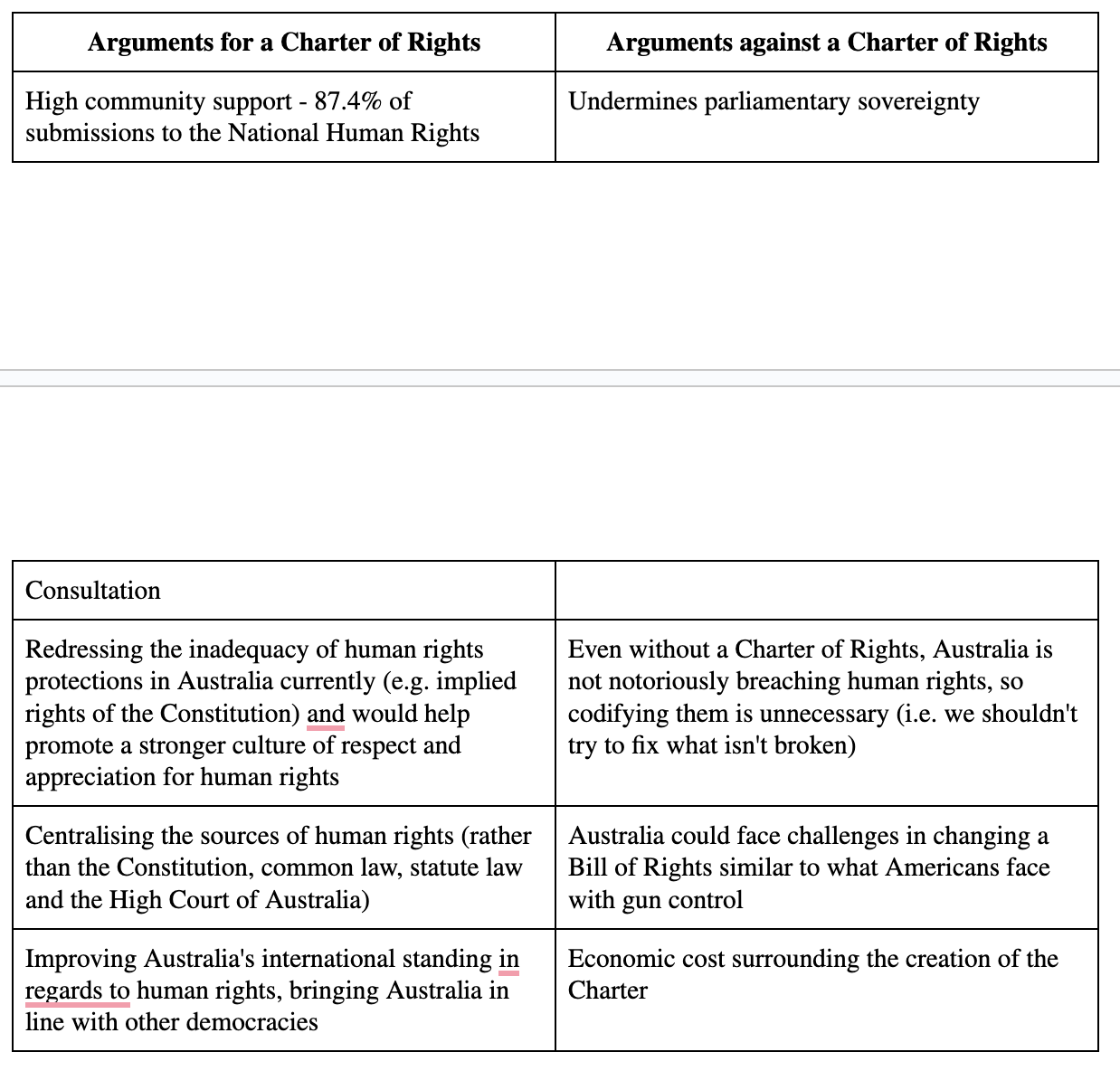
What are the main arguments for and against having a Charter of Rights in Australia?
2.0 Promoting and enforcing human rights
2.4 The roles of:
2.4.8 A Charter of Rights (arguments for and against)
What is a Legislative Charter of Rights?
A Charter of Rights could be legislated, meaning it becomes part of statute law or part of our Constitution. If it is a legislated Charter of Rights it is created by parliament. The effect this has on the protection of human rights is at the will of Parliament, meaning that human rights can be changed at any time. A legislative Charter of Rights provides a uniform and codified method of protection.
2.0 Promoting and enforcing human rights
2.4 The roles of:
2.4.8 A Charter of Rights (arguments for and against)
What is a Constitutional Charter of Rights?
The effect of protection on human rights would be different under a Constitutional Charter of Rights. This type of charter, to some extent offers a better level of protection than a legislative Charter of Rights. To change this type of charter, a nation state needs to implement a referendum. A referendum is time consuming, costly and not always successful, so they are generally avoided unless necessary.
 Note
Note  Flashcards (355)