Calorimetry
 Studied by 0 people
 Call with Kai
 Learn
Learn Practice Test
 Spaced Repetition
 Match
Match Flashcards
 Knowt Play
1/6

There's no tags or description
Looks like no tags are added yet.
Name | Mastery | Learn | Test | Matching | Spaced | Call with Kai |
|---|
No study sessions yet.
7 Terms
Calorimetry
Calorimeter: A device used to measure the heat released or absorbed during a chemical or physical process occurring within it
Therefore, calorimetry is the study of energy changes during a physical and chemical process, while using a calorimeter
Using a Simple Calorimeter
A simple calorimeter is made up of two stacked vessels covered by a lid with holes for the thermometer and stirrer
The inside vessel is filled with a known mass of water
The vessels are both strong insulators to help prevent thermal energy from escaping
However, some still does due to the holes in the cup for the stirrer and thermometer
Since some gas can escape, this calorimeter measures the energy changes at a constant pressure
Assumptions about Calorimeter
A simple calorimeter measures the temperature change of the water in which a process such as a chemical reaction is occurring
What assumptions must be considered about a calorimeter:
When measuring this, some assumptions need to be considered;
1) The system is isolated (thermal energy exchanged with outside surroundings is ignored)
2) Thermal energy exchanged between the objects within the calorimeter is ignored
3) If something dissolves in the water, the solution will retain the same properties (density and heat capacity will be the same)
4) The process is under constant pressure
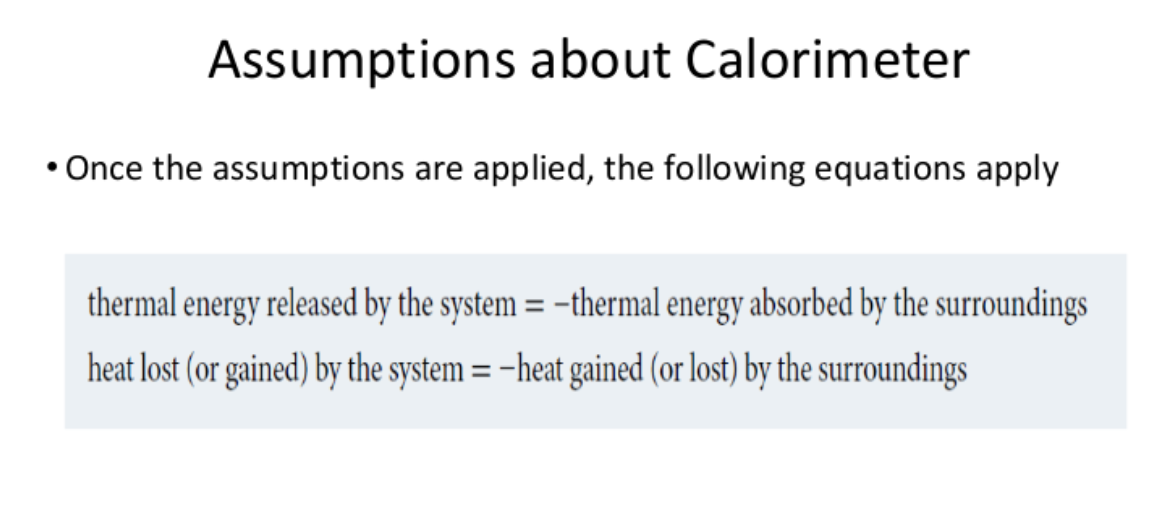
Once the assumptions are applied, the following equations apply
How to use a simple calorimeter
Ensure that all water inside is equilibrated. Measure initial temperature
Add reactants to the calorimeter
Allow the reaction to proceed. Stir to maintain an even temperature throughout. Record any changing temperatureFor an exothermic reaction, the final temp is the maximum temperature
For an endothermic reaction, the final temperature is the minimum
Using Calorimetry Data
The water in the calorimeter absorbs or releases the energy in the experiment
As a result, you can use Q = mc∆T
If the solution is dilute, you can assume that the specific heat capacity is the same as water
If not dilute, then the specific heat capacity decreases
 Note
Note  Flashcards (45)