Psychology Test 3

0.0(0)
Studied by 0 people
call kaiCall Kai
learnLearn
examPractice Test
spaced repetitionSpaced Repetition
heart puzzleMatch
flashcardsFlashcards
GameKnowt Play
Card Sorting

1/103

encourage image

There's no tags or description

Looks like no tags are added yet.

Last updated 1:33 AM on 4/7/26
Name
Mastery
Learn
Test
Matching
Spaced
Call with Kai

No analytics yet

Send a link to your students to track their progress

104 Terms
1
New cards
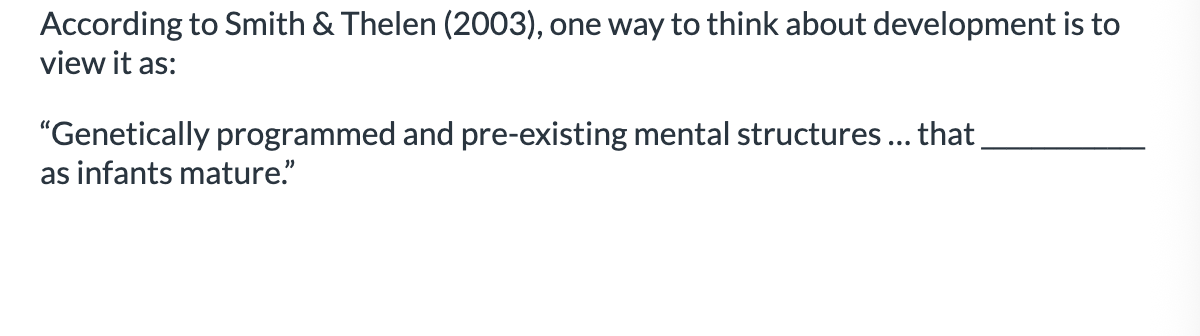
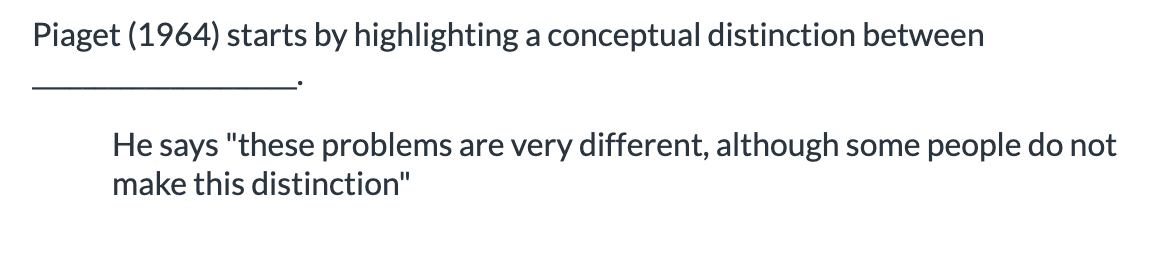
<ul><li><p>intuitive concept and intuitive theories </p></li><li><p>development and learning </p></li></ul><p></p>
  • intuitive concept and intuitive theories

  • development and learning

development and learning

<p>development and learning </p>
2
New cards
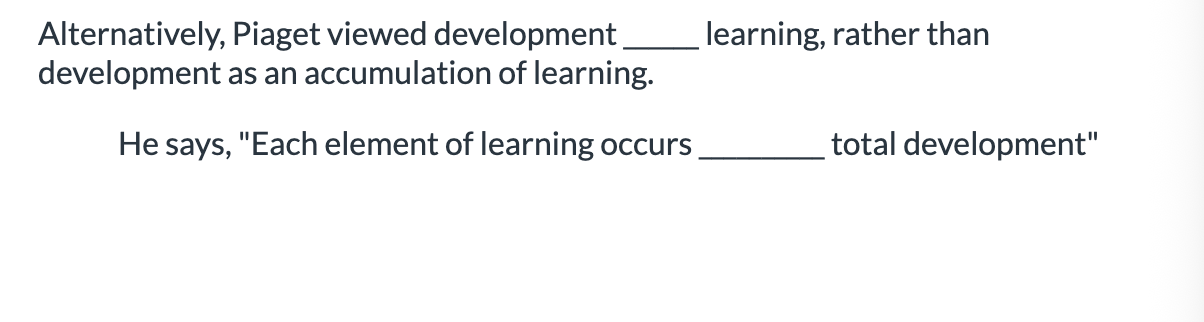
<p>development 1: Spontaneous process, tied to the whole process of embryogenesis</p><p>learning 1: provoked by situations… as opposed to spontaneous </p><p>development 2: A total.. process that needs to be situated in its general biological and psychological context</p><p>learning 2: limited to a single problem or to a single structure </p><p></p><p>development 1: provoked by situations… as opposed to spontaneous  </p><p>learning 1: Spontaneous process, tied to the whole process of embryogenesis</p><p>development 2: A total.. process that needs to be situated in its general biological and psychological context</p><p>learning 2: limited to a single problem or to a single structure </p>

development 1: Spontaneous process, tied to the whole process of embryogenesis

learning 1: provoked by situations… as opposed to spontaneous

development 2: A total.. process that needs to be situated in its general biological and psychological context

learning 2: limited to a single problem or to a single structure
development 1: provoked by situations… as opposed to spontaneous

learning 1: Spontaneous process, tied to the whole process of embryogenesis

development 2: A total.. process that needs to be situated in its general biological and psychological context

learning 2: limited to a single problem or to a single structure

development 1: Spontaneous process, tied to the whole process of embryogenesis

learning 1: provoked by situations… as opposed to spontaneous

development 2: A total.. process that needs to be situated in its general biological and psychological context

learning 2: limited to a single problem or to a single structure

3
New cards
<ol><li><p><span>is reduced to a series of specific learned items</span></p></li><li><p><span>is a construction of cognitive structure</span></p></li></ol><p></p>
  1. is reduced to a series of specific learned items

  2. is a construction of cognitive structure

  1. is reduced to a series of specific learned items

4
New cards
<ol><li><p>an atomistic view </p></li><li><p>a relational view</p></li></ol><p></p>
  1. an atomistic view

  2. a relational view

  1. an atomistic view

5
New cards
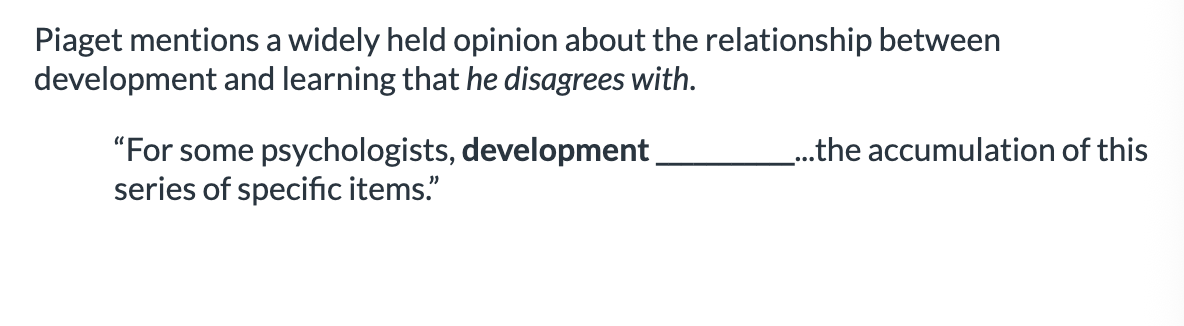
<ol><li><p>is derived from, prior to </p></li><li><p>explains, as a function of </p></li></ol><p></p>
  1. is derived from, prior to

  2. explains, as a function of

  1. explains, as a function of

6
New cards
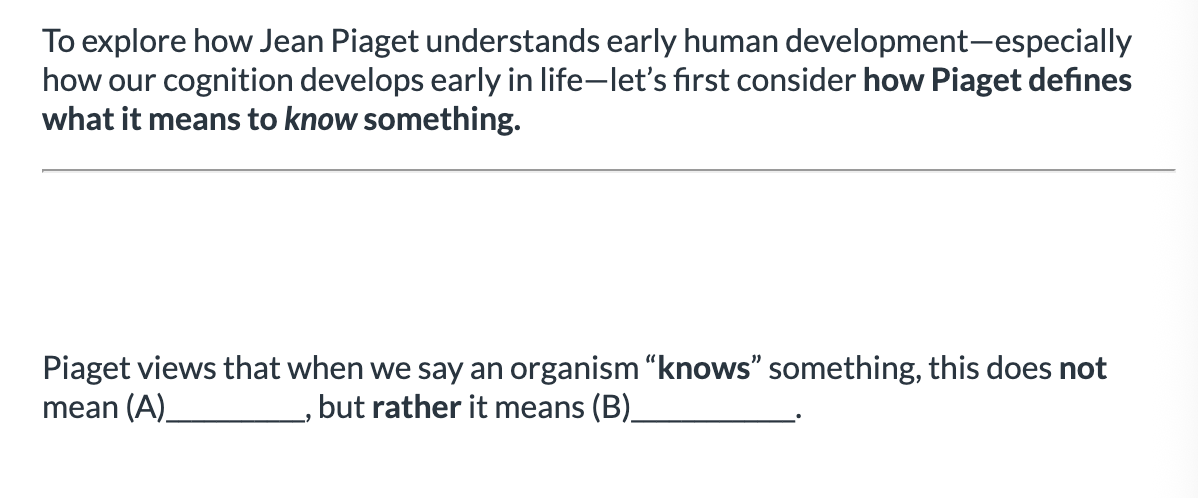
<ol><li><p>A: <span>"simply to look at it and making a mental copy or image of it." B:"to act on it...to modify, to transform the object...and as a consequence to understand the way the object is constructed"</span></p></li><li><p><span>A: "to act on it...to modify, to transform the object...and as a consequence to understand the way the object is constructed".  B: "simply to look at it and making a mental copy or image of it."</span></p></li></ol><p></p>
  1. A: "simply to look at it and making a mental copy or image of it." B:"to act on it...to modify, to transform the object...and as a consequence to understand the way the object is constructed"

  2. A: "to act on it...to modify, to transform the object...and as a consequence to understand the way the object is constructed". B: "simply to look at it and making a mental copy or image of it."

  1. A: "simply to look at it and making a mental copy or image of it." B:"to act on it...to modify, to transform the object...and as a consequence to understand the way the object is constructed"

7
New cards
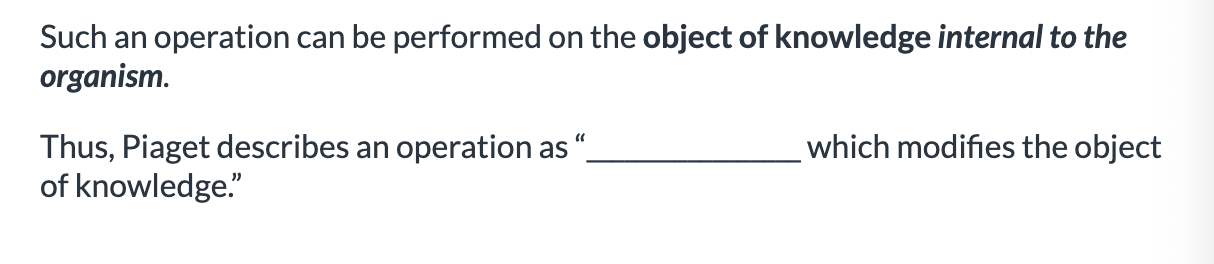
<ol><li><p>maintaining the symmetry </p></li><li><p>operation</p></li></ol><p></p>
  1. maintaining the symmetry

  2. operation

  1. operation

8
New cards
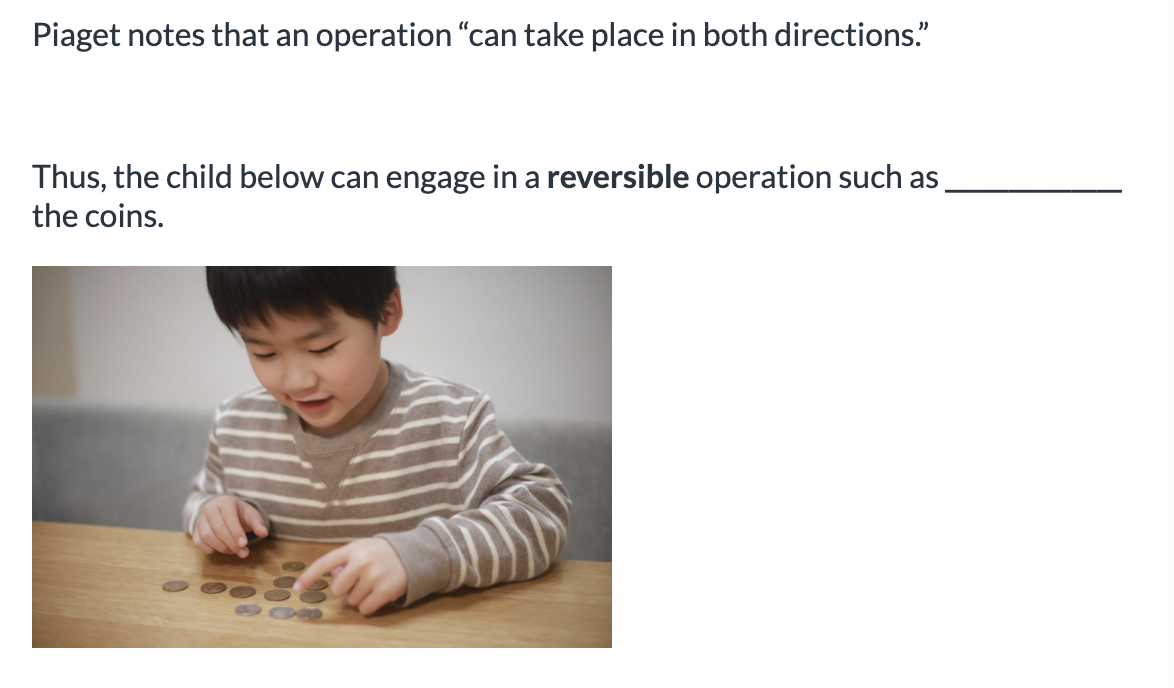
<ol><li><p>adding and subtracting </p></li><li><p>joining and separating </p></li><li><p>counting forward and counting backward </p></li><li><p>ALL of THEM</p></li></ol><p></p>
  1. adding and subtracting

  2. joining and separating

  3. counting forward and counting backward

  4. ALL of THEM

  1. ALL OF THEM

9
New cards
<ol><li><p>externalized action</p></li><li><p>interiorized action</p></li></ol><p></p>
  1. externalized action

  2. interiorized action

  1. interiorized action

10
New cards
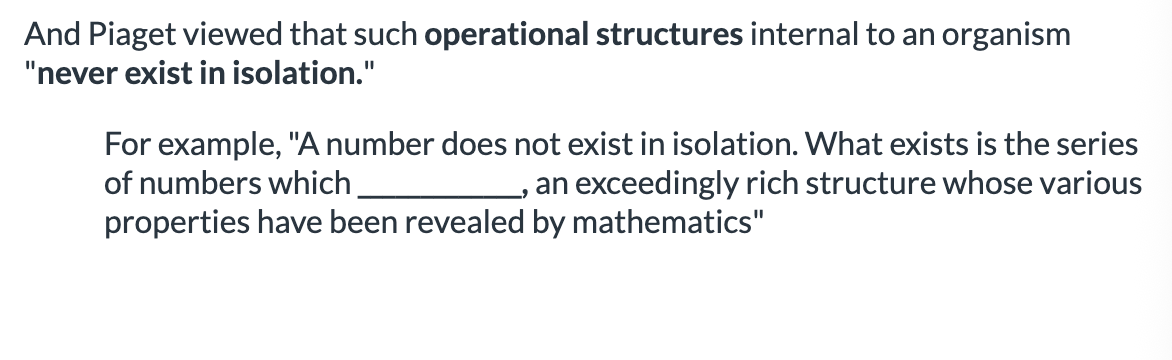
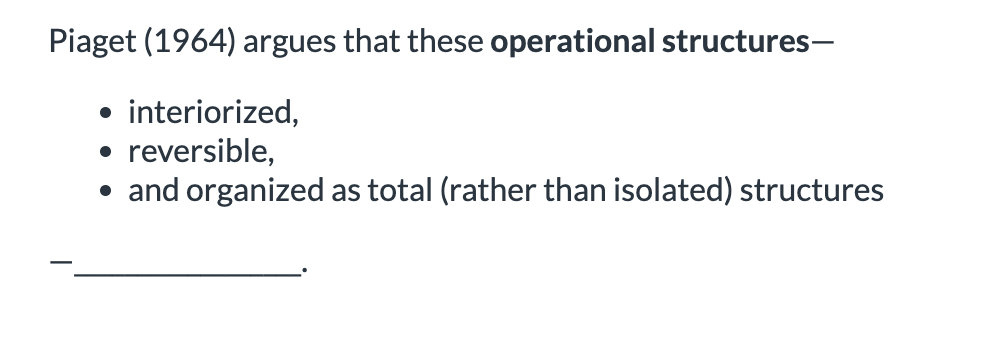
<ol><li><p>exist in isolated manner </p></li><li><p>constitute a structure</p></li></ol><p></p>
  1. exist in isolated manner

  2. constitute a structure

  1. constitute a structure

11
New cards
<ol><li><p>emerge around young adulthood </p></li><li><p>constitute the basis of knowledge, the natural psychological reality </p></li></ol><p></p>
  1. emerge around young adulthood

  2. constitute the basis of knowledge, the natural psychological reality

  1. constitute the basis of knowledge, the natural psychological reality

12
New cards
<ol><li><p>development </p></li><li><p>learning</p></li></ol><p></p>
  1. development

  2. learning

  1. development

13
New cards
<ol><li><p>A: <span>indispensable for, B: not immediately translated into operations</span></p></li><li><p><span>A: not immediately translated into operations, A: i</span>ndispensable for, </p></li></ol><p></p>
  1. A: indispensable for, B: not immediately translated into operations

  2. A: not immediately translated into operations, A: indispensable for,

  1. A: indispensable for, B: not immediately translated into operations

14
New cards
<ol><li><p><span>the schema of the variable object forms&nbsp;</span></p></li><li><p><span>the schema of the permanent object</span></p></li></ol><p></p>
  1. the schema of the variable object forms 

  2. the schema of the permanent object

  1. the schema of the permanent object

15
New cards
<ol><li><p>when they are in view </p></li><li><p>even when they are hidden from view </p></li></ol><p></p>
  1. when they are in view

  2. even when they are hidden from view

  1. even when they are hidden from view

16
New cards
<ol><li><p>no operation </p></li><li><p>full operation </p></li></ol><p></p>
  1. no operation

  2. full operation

  1. no operation

17
New cards
<ol><li><p>A: operational reversibility B: conservation of quantity</p></li><li><p>B: conservation of quantity A: operational reversibility </p></li></ol><p></p>
  1. A: operational reversibility B: conservation of quantity

  2. B: conservation of quantity A: operational reversibility

  1. A: operational reversibility B: conservation of quantity

18
New cards
<ol><li><p><span>(A) externalized operations, (B) does not change</span></p></li><li><p><span>(A) operational reversibility, (B) changes</span></p></li></ol><p></p>
  1. (A) externalized operations, (B) does not change

  2. (A) operational reversibility, (B) changes
  1. (A) operational reversibility, (B) changes

19
New cards
<ol><li><p>A: <span>operation on concrete objects or events 2. B: mentally reverse operations</span></p></li><li><p><span>A: mentally reverse operations, B: </span>operation on concrete objects or events</p></li></ol><p></p>
  1. A: operation on concrete objects or events 2. B: mentally reverse operations
  2. A: mentally reverse operations, B: operation on concrete objects or events

  1. A: operation on concrete objects or events 2. B: mentally reverse operations

20
New cards
<ol><li><p><span>(A) hypotheses and abstract propositions, (B) concrete objects</span></p></li><li><p><span>(A) concrete objects (B) hypotheses and abstract propositions</span></p></li></ol><p></p>
  1. (A) hypotheses and abstract propositions, (B) concrete objects
  2. (A) concrete objects (B) hypotheses and abstract propositions

  1. (A) hypotheses and abstract propositions, (B) concrete objects

21
New cards
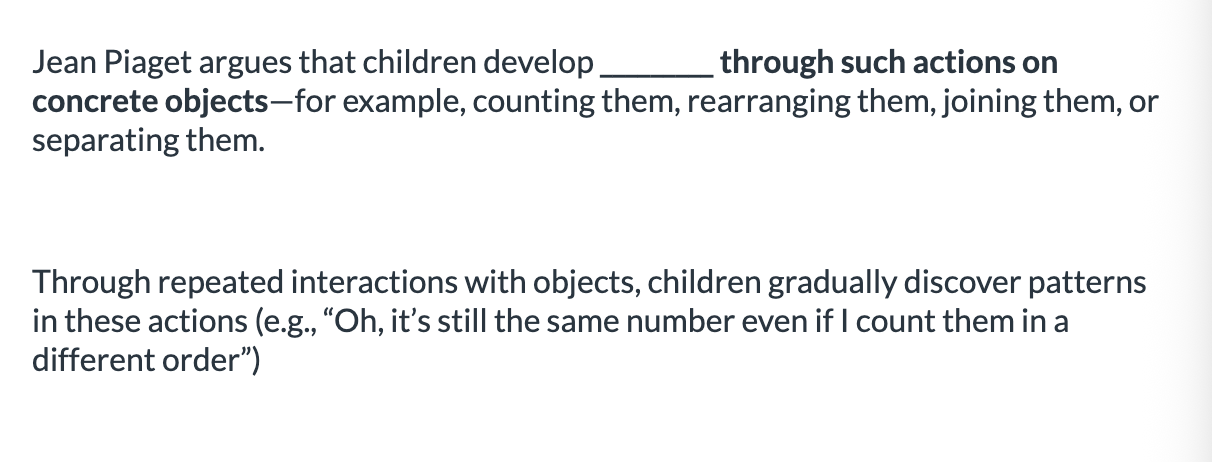
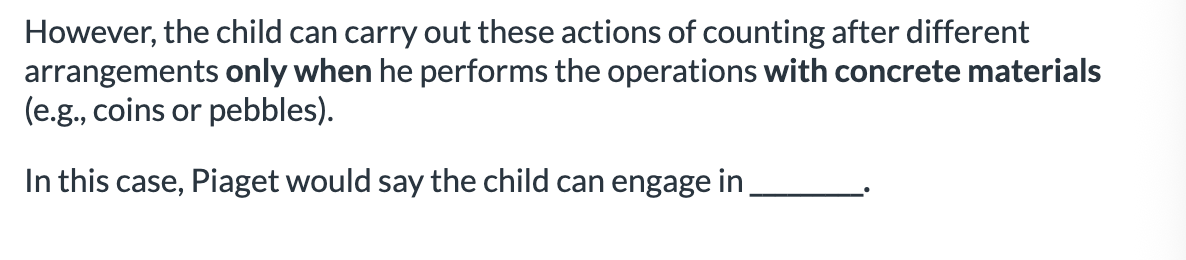
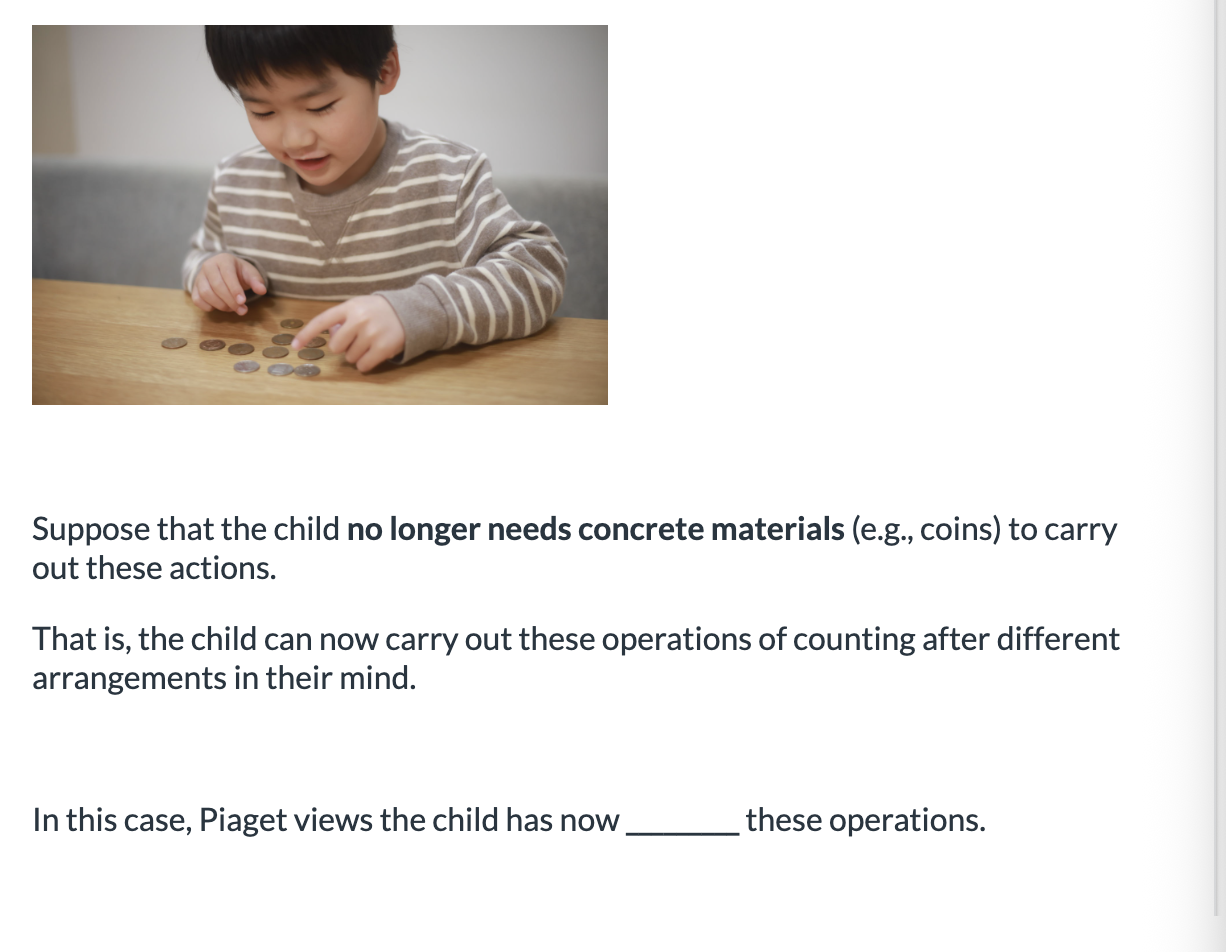
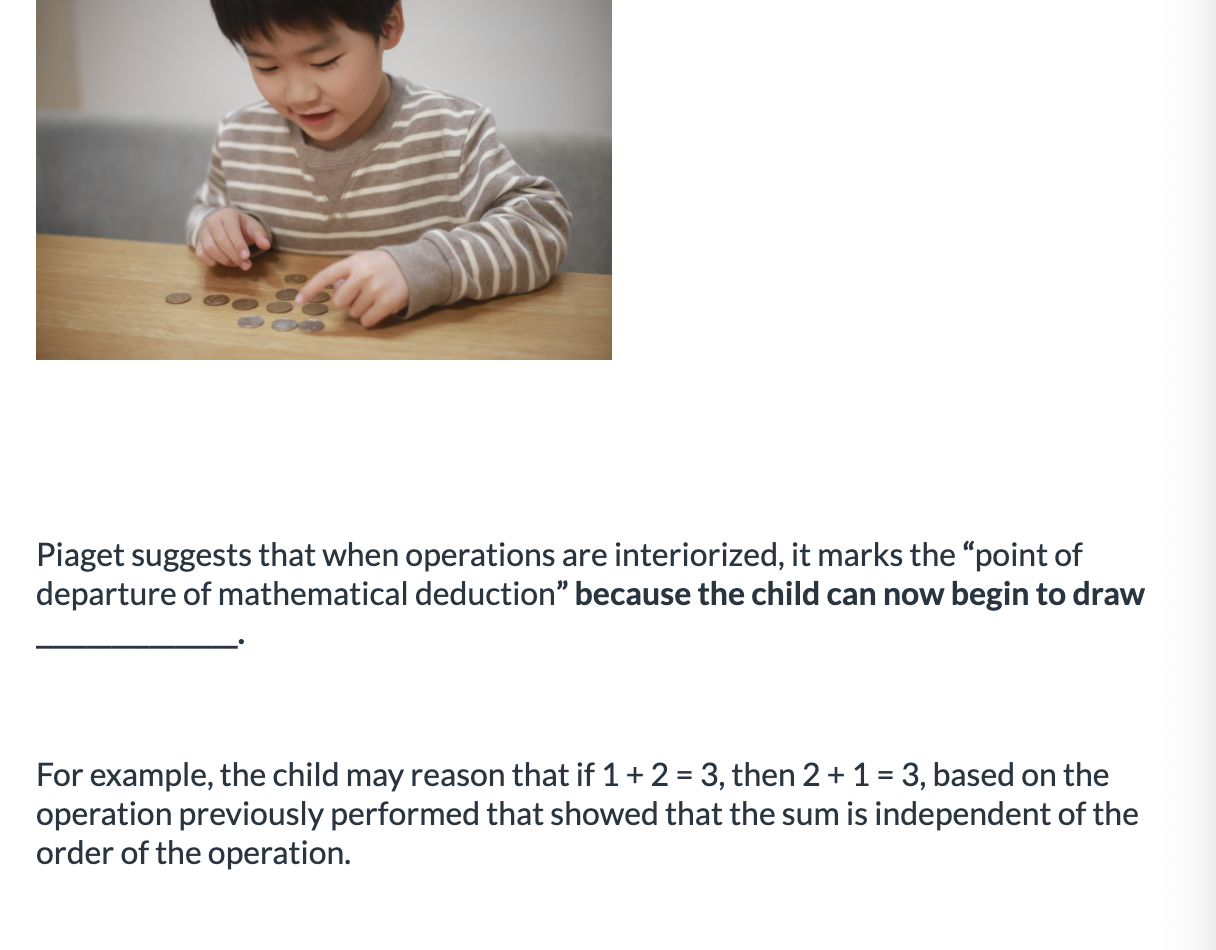
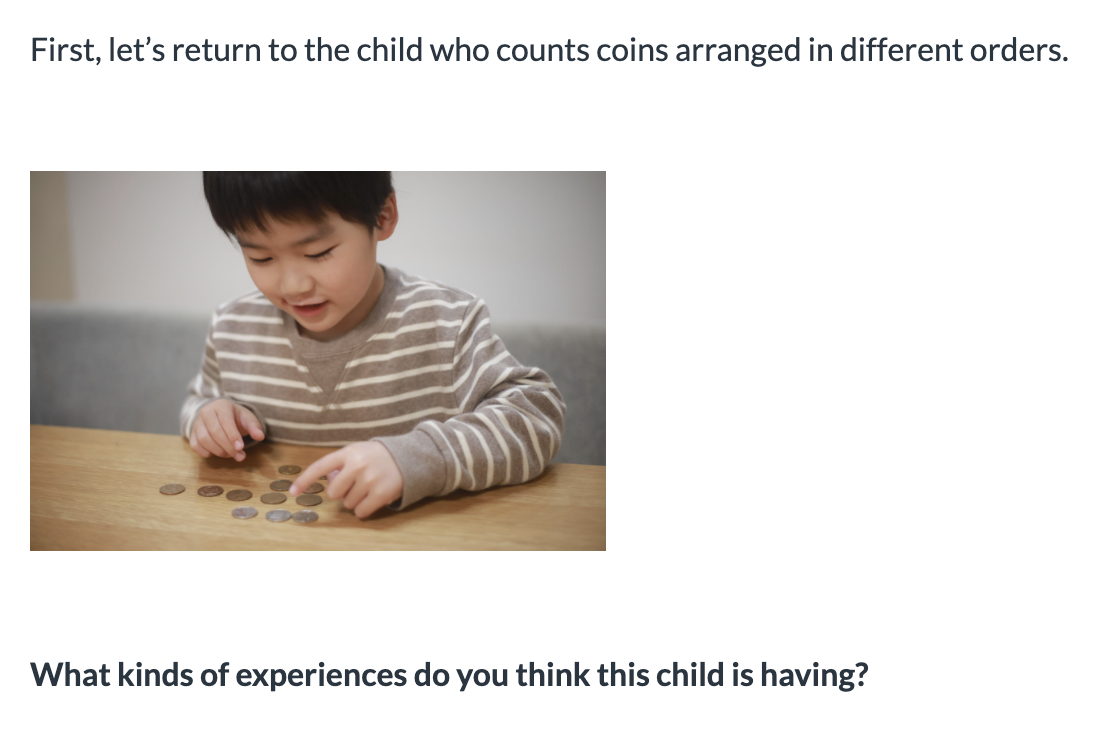
<ol><li><p><span>an experience of the child's own actions (e.g., a property of the act of ordering or counting)</span></p></li><li><p><span>an experience of objects themselves (e.g., a property of coins)</span></p></li></ol><p></p>
  1. an experience of the child's own actions (e.g., a property of the act of ordering or counting)
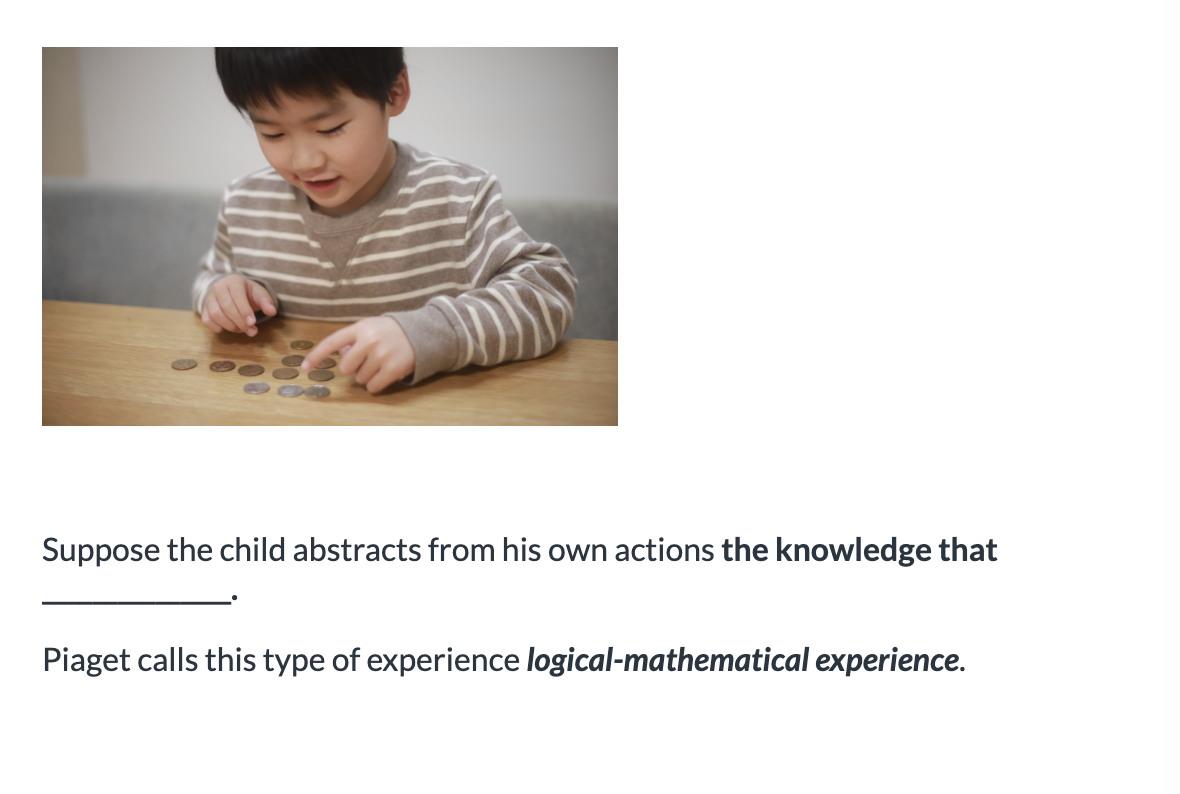
  2. an experience of objects themselves (e.g., a property of coins)

  1. an experience of the child's own actions (e.g., a property of the act of ordering or counting)

22
New cards
<ol><li><p>the sum is independent of order </p></li><li><p>the coins have round shapes</p></li></ol><p></p>
  1. the sum is independent of order

  2. the coins have round shapes

  1. the sum is independent of order

23
New cards
<ol><li><p><span>logical-mathematical knowledge</span></p></li><li><p><span>linguistic knowledge</span></p></li></ol><p></p>
  1. logical-mathematical knowledge

  2. linguistic knowledge

  1. logical-mathematical knowledge

24
New cards
<ol><li><p>concrete operations </p></li><li><p>hypothetical operations</p></li></ol><p></p>
  1. concrete operations

  2. hypothetical operations

  1. concrete operations

25
New cards
<ol><li><p><span>interiorized</span></p></li><li><p><span>externalized</span></p></li></ol><p></p>
  1. interiorized

  2. externalized

  1. interiorized

26
New cards
<ol><li><p><span>logical conclusions from operations themselves</span></p></li><li><p><span>logical conclusions from memorization&nbsp;</span></p></li></ol><p></p>
  1. logical conclusions from operations themselves
  2. logical conclusions from memorization 

  1. logical conclusions from operations themselves

27
New cards
<ol><li><p>maturation </p></li><li><p>experience </p></li><li><p>social transmission </p></li><li><p>equilibration or self-regulation </p></li></ol><p></p>
  1. maturation

  2. experience

  3. social transmission

  4. equilibration or self-regulation

1 through 3

28
New cards
<ol><li><p>maturation </p></li><li><p>experience </p></li><li><p>social transmission </p></li><li><p><span>equilibration or self-regulation</span></p></li></ol><p></p>
  1. maturation

  2. experience

  3. social transmission

  4. equilibration or self-regulation

  1. equilibration or self-regulation

29
New cards
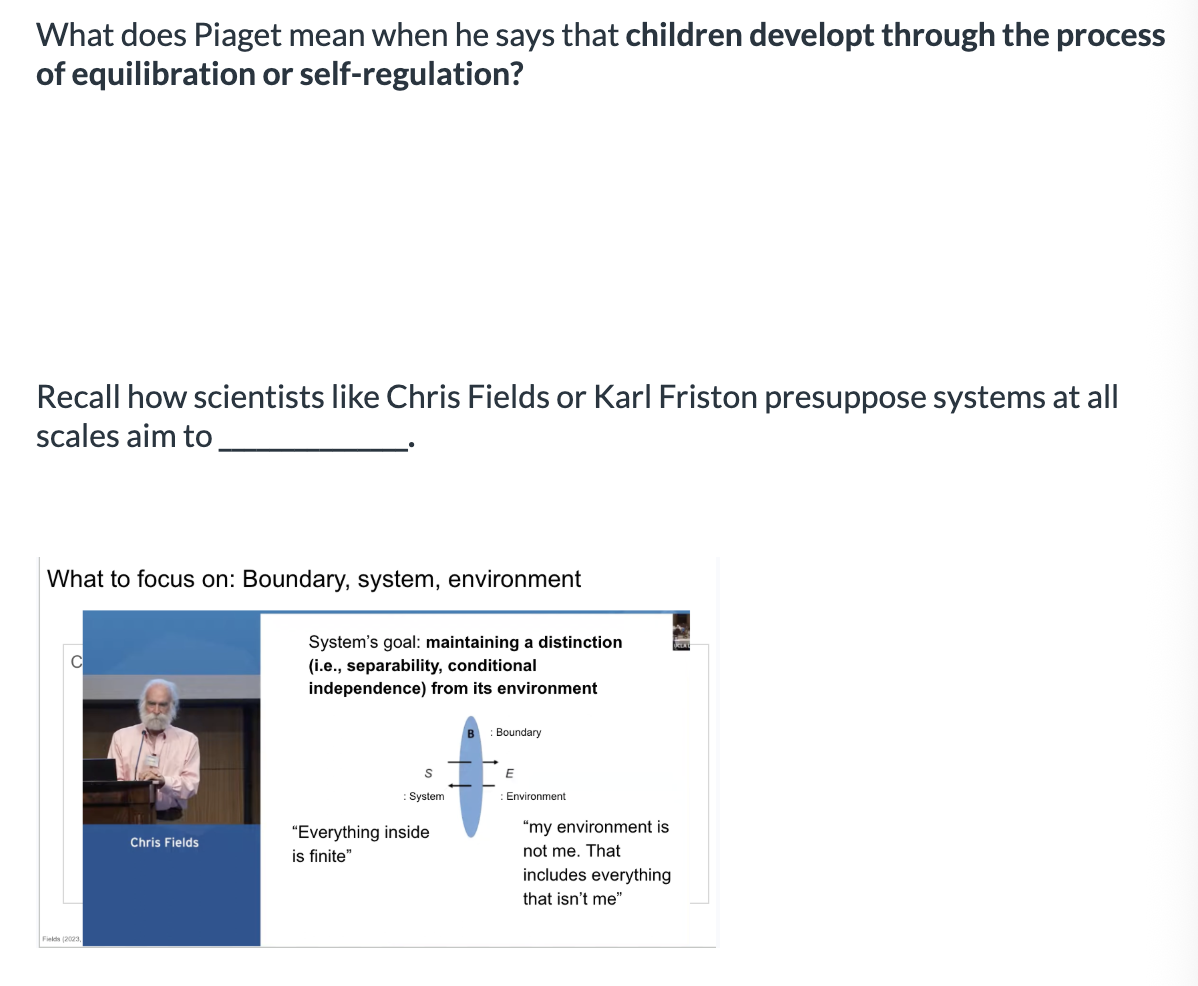
<ol><li><p><span>aim to dissolve boundaries between system and environment</span></p></li><li><p><span>maintain conditional independence from their environment.</span></p></li></ol><p></p>
  1. aim to dissolve boundaries between system and environment

  2. maintain conditional independence from their environment.
  1. maintain conditional independence from their environment.

30
New cards
<ol><li><p><span>disequilibrium</span></p></li><li><p><span>equilibrium</span></p></li></ol><p></p>
  1. disequilibrium

  2. equilibrium

  1. equilibrium

31
New cards
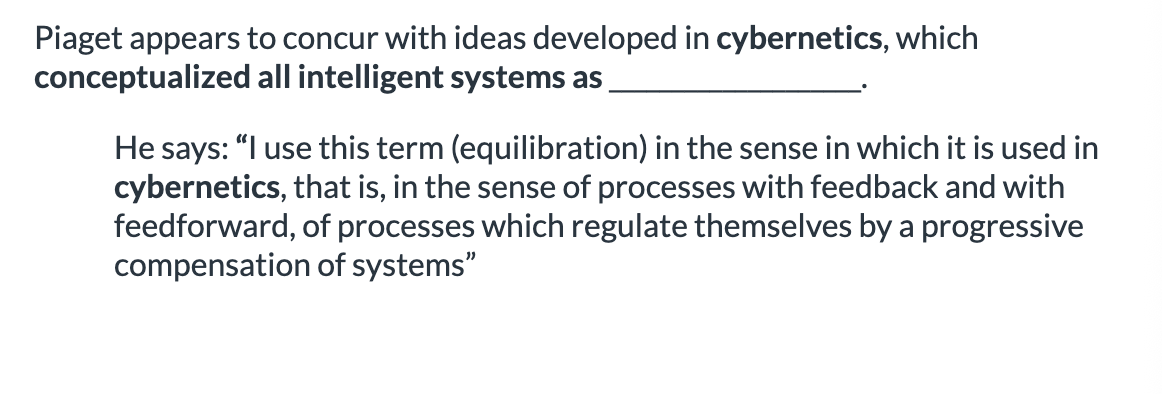
<ol><li><p><span>goal-directed systems capable of self-regulation or self-correction.</span></p></li><li><p><span>stimulus-responding systems</span></p></li></ol><p></p>
  1. goal-directed systems capable of self-regulation or self-correction.
  2. stimulus-responding systems

  1. goal-directed systems capable of self-regulation or self-correction.

32
New cards
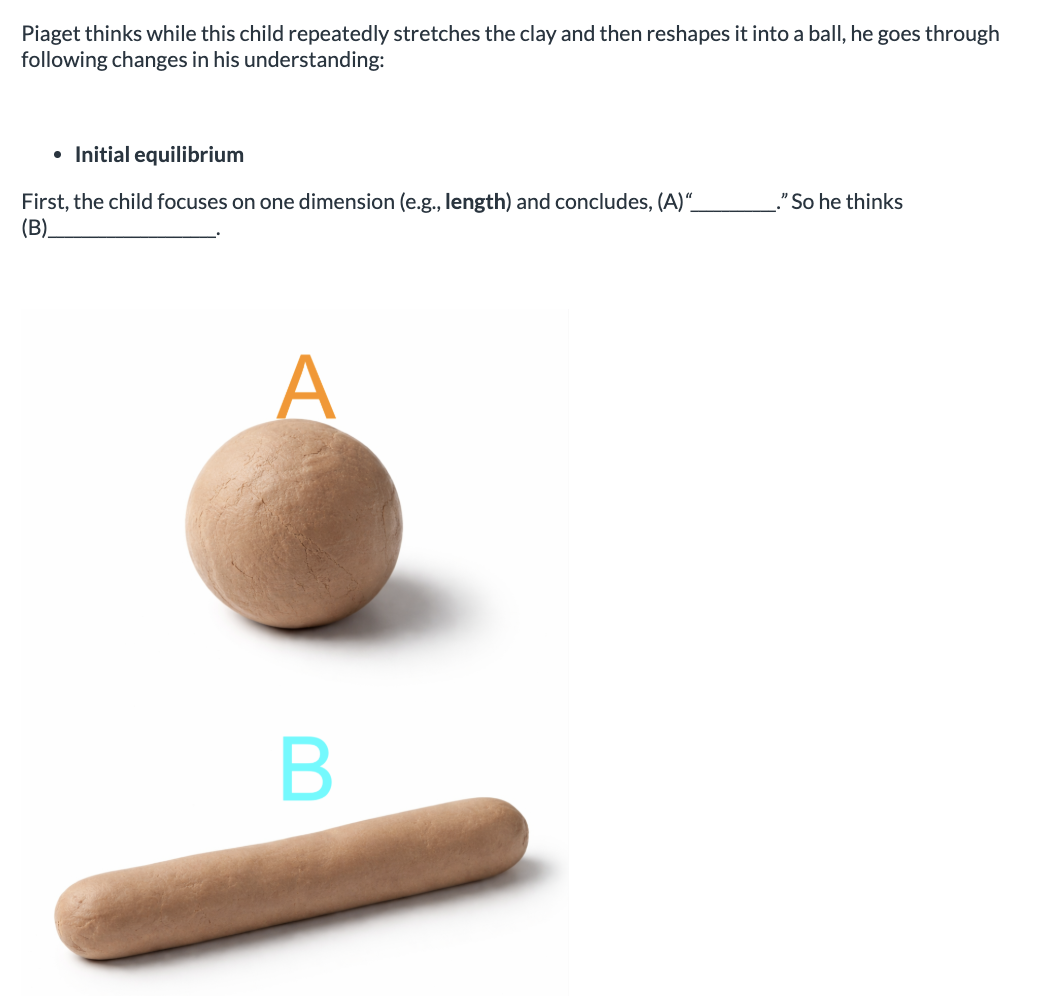
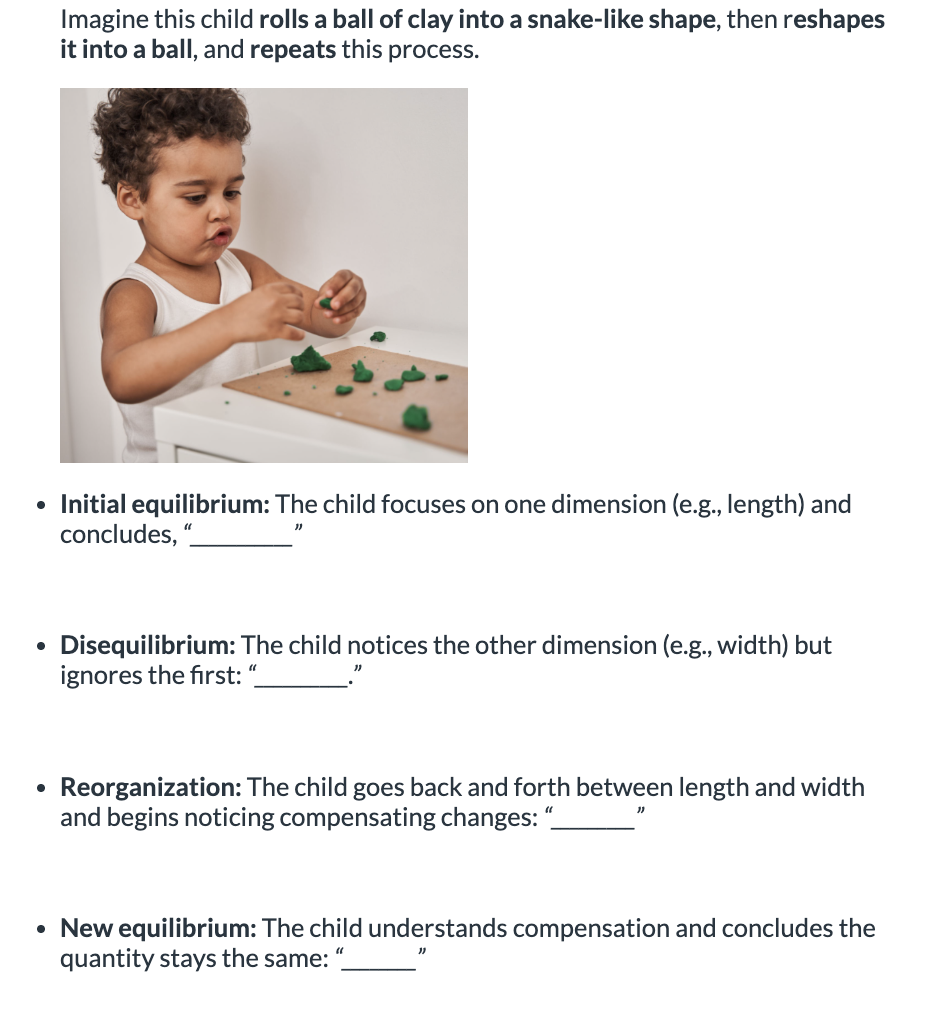
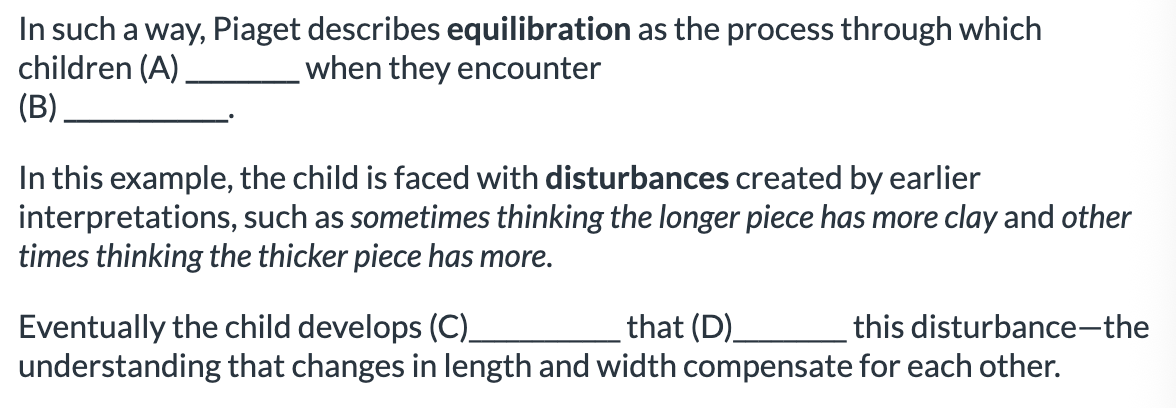
<p>Initial <span>equilibrium: Longer means more </span></p><p><span>Disequilibrium: Thinner means less</span></p><p><span>Reorganization: Oh, it gets longer but also thinner. And if it gets shorter, it gets thicker.</span></p><p><span>New equilibrium: It got longer but thinner, so nothing really changed.</span></p><p></p><p>Initial equilibrium: Thinner means less</p><p>Disequilibrium: Longer means more </p><p>Reorganization: Oh, it gets longer but also thinner. And if it gets shorter, it gets thicker.</p><p>New equilibrium: It got longer but thinner, so nothing really changed.</p><p></p><p></p>

Initial equilibrium: Longer means more

Disequilibrium: Thinner means less

Reorganization: Oh, it gets longer but also thinner. And if it gets shorter, it gets thicker.

New equilibrium: It got longer but thinner, so nothing really changed.
Initial equilibrium: Thinner means less

Disequilibrium: Longer means more

Reorganization: Oh, it gets longer but also thinner. And if it gets shorter, it gets thicker.

New equilibrium: It got longer but thinner, so nothing really changed.

Initial equilibrium: Longer means more

Disequilibrium: Thinner means less

Reorganization: Oh, it gets longer but also thinner. And if it gets shorter, it gets thicker.

New equilibrium: It got longer but thinner, so nothing really changed.

33
New cards
<ol><li><p>A: reorganize their cognitive structure, B: <span>disturbances in their understanding, C:a new cognitive structure</span></p></li><li><p>A: disturbances in their understanding, B: reorganize their cognitive structure,  C:a new cognitive structure</p></li></ol><p></p>
  1. A: reorganize their cognitive structure, B: disturbances in their understanding, C:a new cognitive structure
  2. A: disturbances in their understanding, B: reorganize their cognitive structure, C:a new cognitive structure

  1. A: reorganize their cognitive structure, B: disturbances in their understanding, C:a new cognitive structure

34
New cards
<ol><li><p>external reinforcement </p></li><li><p>equilibration </p></li><li><p>stimulus-response associations </p></li></ol><p></p>
  1. external reinforcement

  2. equilibration

  3. stimulus-response associations

  1. external reinforcement

  1. stimulus-response associations

35
New cards
<ol><li><p>get constructed through infants’ actions </p></li><li><p>awaits revelation </p></li></ol><p></p>
  1. get constructed through infants’ actions

  2. awaits revelation

  1. awaits revelation

36
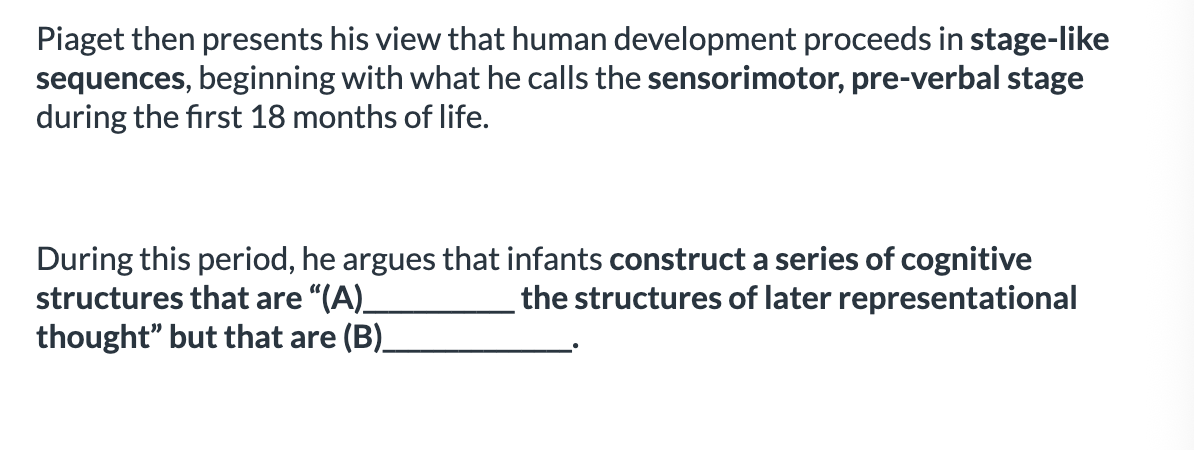
New cards
<ol><li><p>A: emergent, B: real</p></li><li><p>A: real, B: emergent </p></li></ol><p></p>
  1. A: emergent, B: real

  2. A: real, B: emergent

  1. A: emergent, B: real

37
New cards
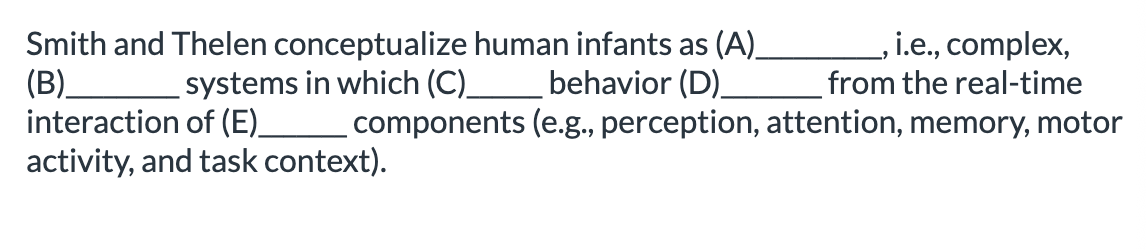
<ol><li><p>A: self-organizing B: dynamical systems , C: novel, D: emerges, E: multiple </p></li><li><p>A: dynamical systems, B: self-organizing, C: novel, D: emerges, E: multiple </p></li></ol><p></p>
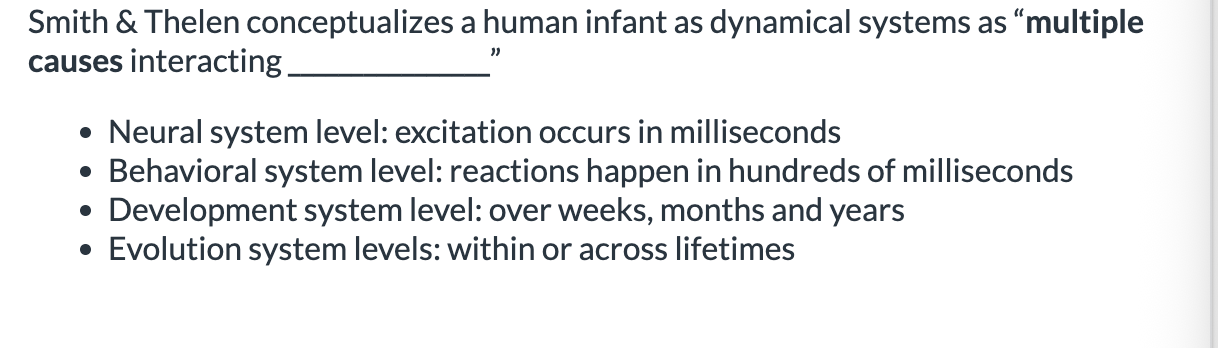
  1. A: self-organizing B: dynamical systems , C: novel, D: emerges, E: multiple

  2. A: dynamical systems, B: self-organizing, C: novel, D: emerges, E: multiple

  1. A: dynamical systems, B: self-organizing, C: novel, D: emerges, E: multiple

38
New cards
<ol><li><p><span>incapable of cross-scale communication</span></p></li><li><p><span>over nested timescales&nbsp;</span></p></li></ol><p></p>
  1. incapable of cross-scale communication

  2. over nested timescales 

  1. over nested timescales 

39
New cards
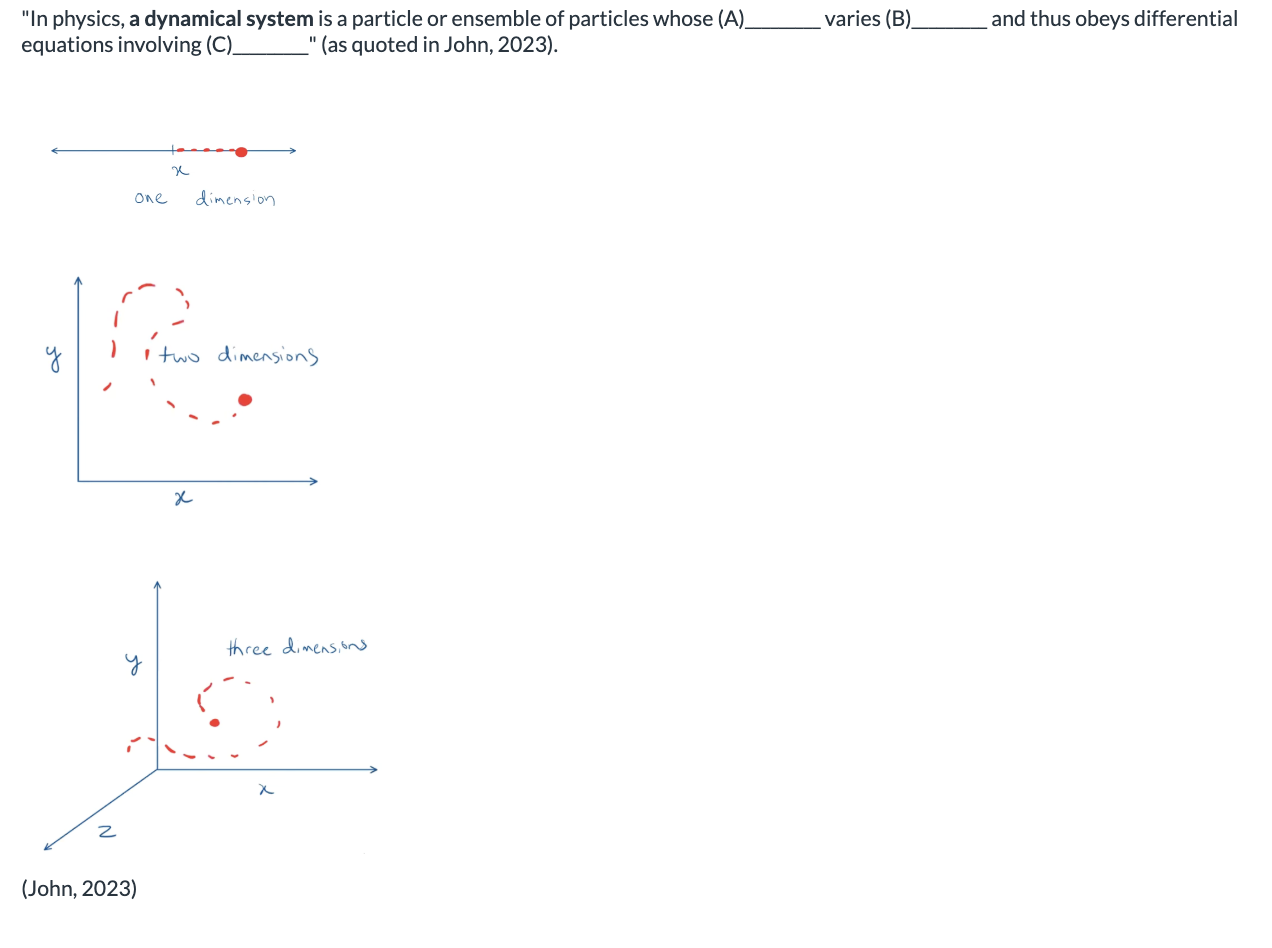
<ol><li><p>A: States, B: over time, C: time derivatives</p></li><li><p>A: time derivatives B: over time, C: States</p></li></ol><p></p>
  1. A: States, B: over time, C: time derivatives

  2. A: time derivatives B: over time, C: States

  1. A: States, B: over time, C: time derivatives

40
New cards
<ol><li><p>quantum</p></li><li><p>Newtonian</p></li></ol><p></p>
  1. quantum

  2. Newtonian

  1. Newtonian

41
New cards
<ol><li><p>A: <span>novelty, B: their own activities</span></p></li><li><p><span>A: their own activities, A: novelty </span></p></li></ol><p></p>
  1. A: novelty, B: their own activities

  2. A: their own activities, A: novelty

  1. A: novelty, B: their own activities

42
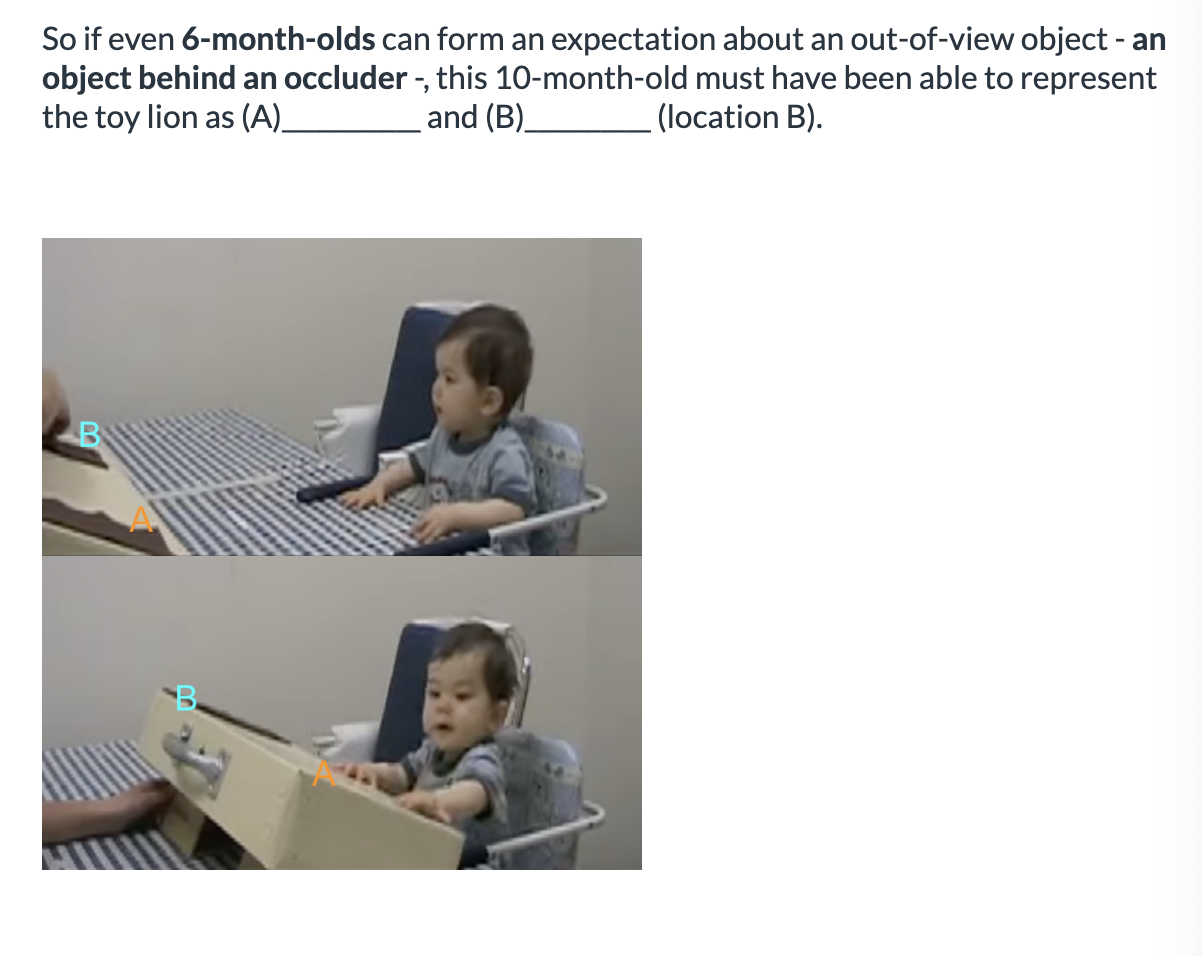
New cards
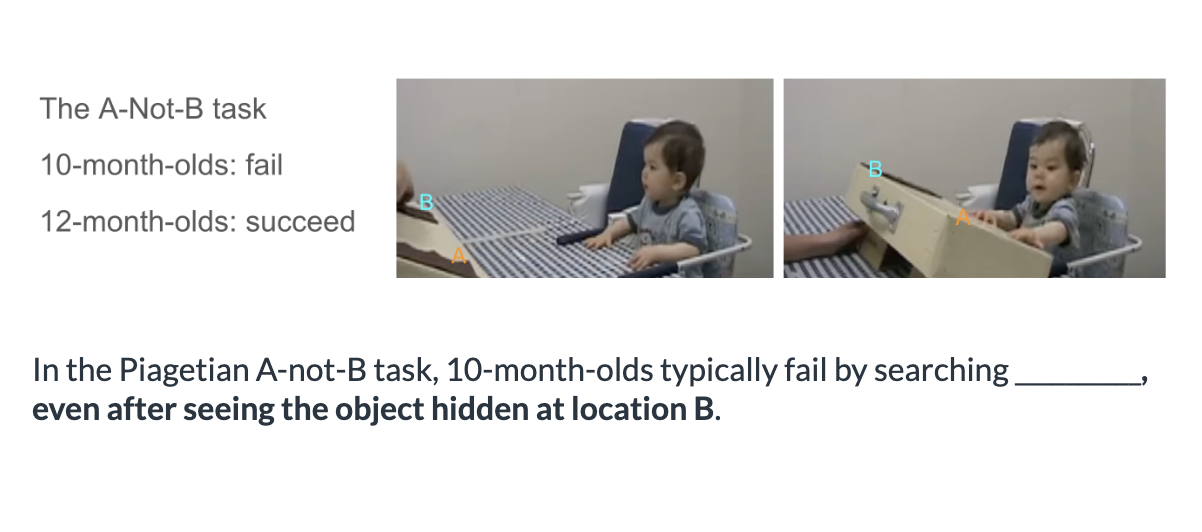
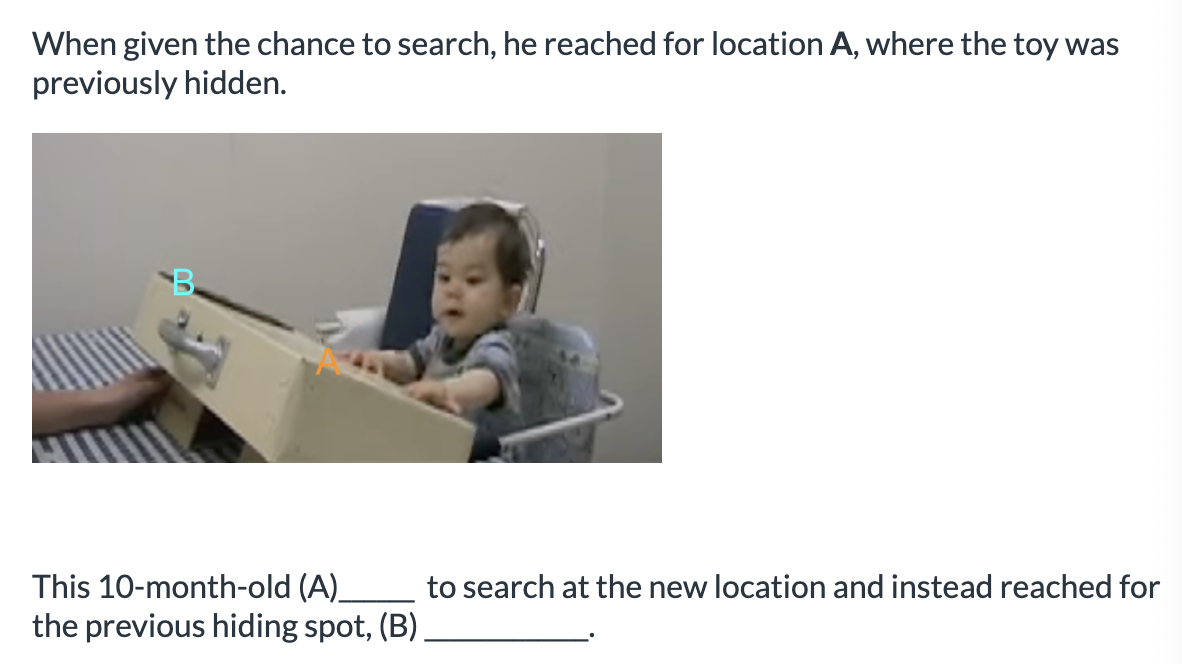
<ol><li><p><span>at location B (the new hiding place)</span></p></li><li><p><span>at location A (the original hiding place)</span></p></li></ol><p></p>
  1. at location B (the new hiding place)

  2. at location A (the original hiding place)
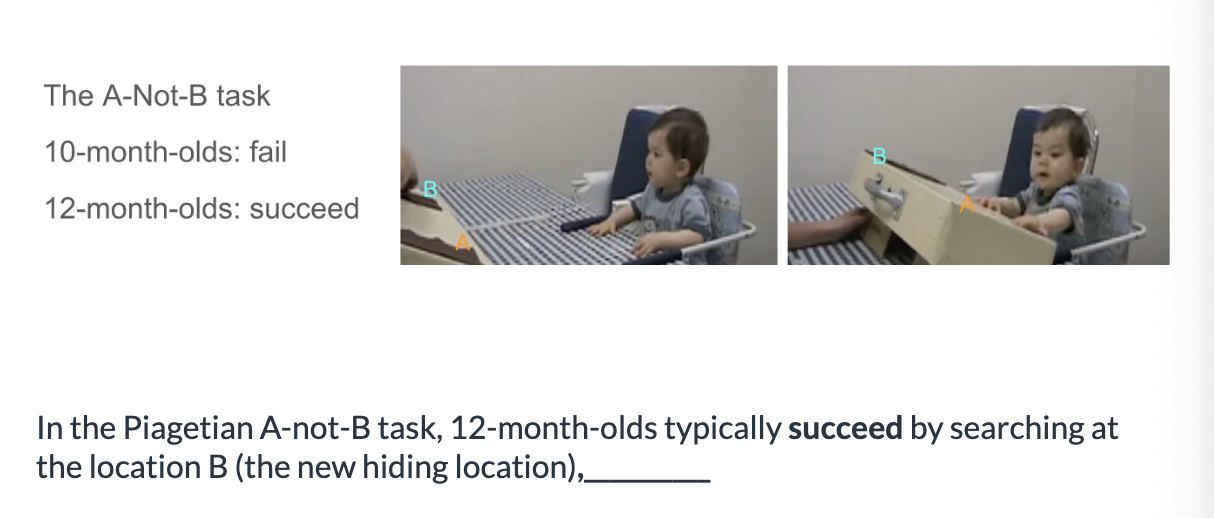
  1. at location A (the original hiding place)

43
New cards
<ol><li><p><span>only when they have never seen the object hidden at location </span></p></li><li><p><span>even after seeing the object hidden at location A&nbsp;in the previous trials</span></p></li></ol><p></p>
  1. only when they have never seen the object hidden at location

  2. even after seeing the object hidden at location A in the previous trials
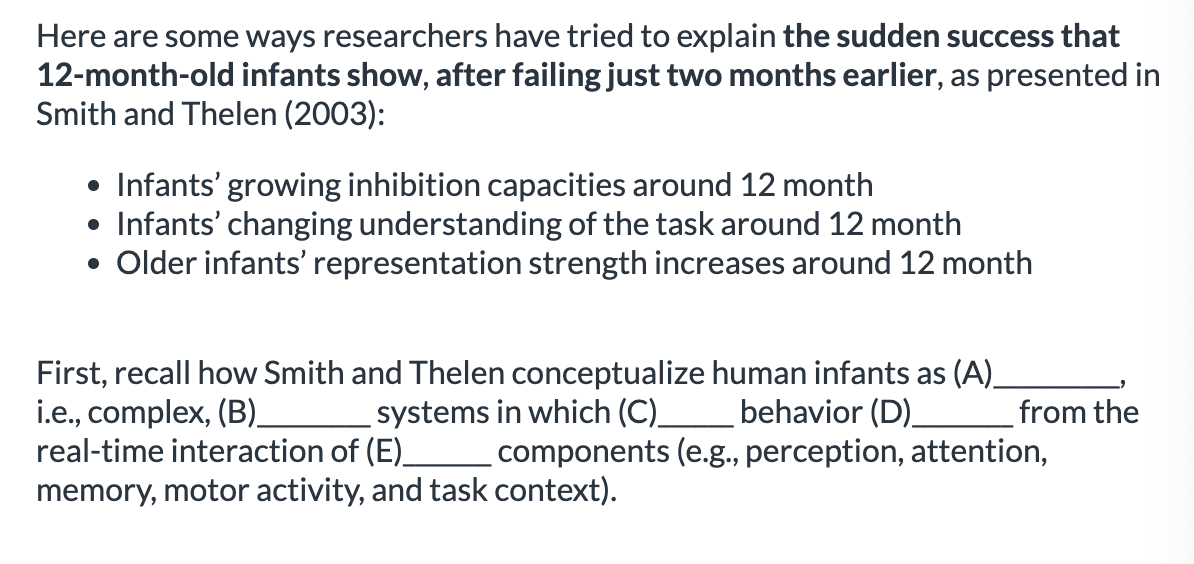
  1. even after seeing the object hidden at location A in the previous trials

44
New cards
<ol><li><p>A: <span>dynamical systems, B: self-organizing, C: novel, D: emerges, E: multiple </span></p></li><li><p><span>A: multiple, B: dynamical systems, C: self-organizing, D: novel, E: emerges </span></p></li></ol><p></p>
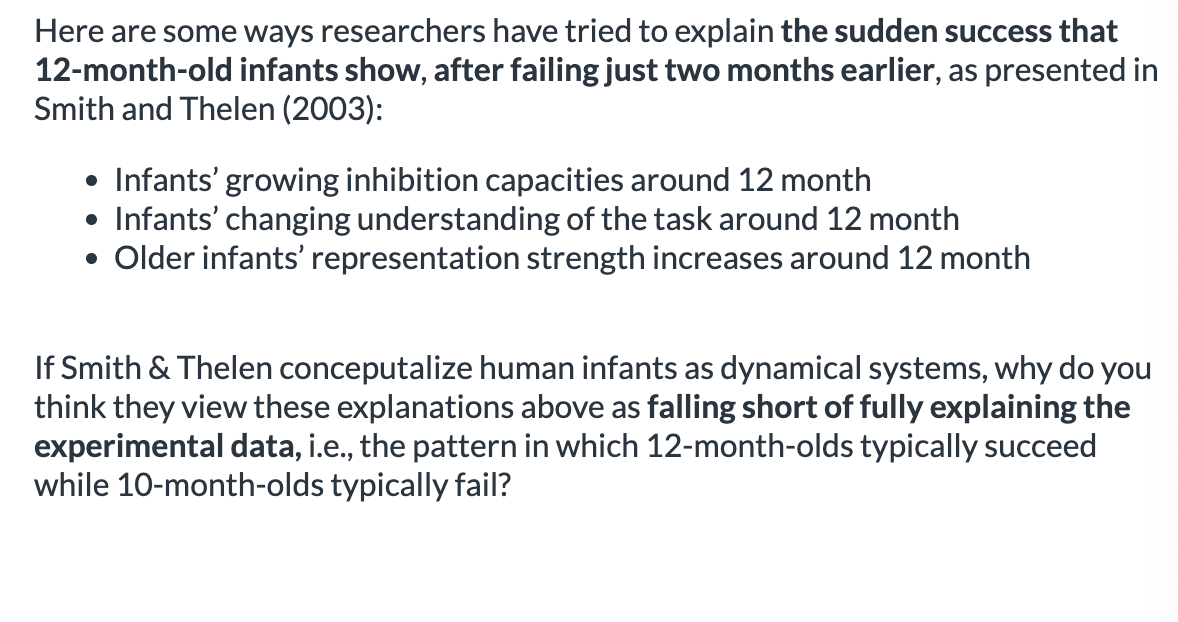
  1. A: dynamical systems, B: self-organizing, C: novel, D: emerges, E: multiple

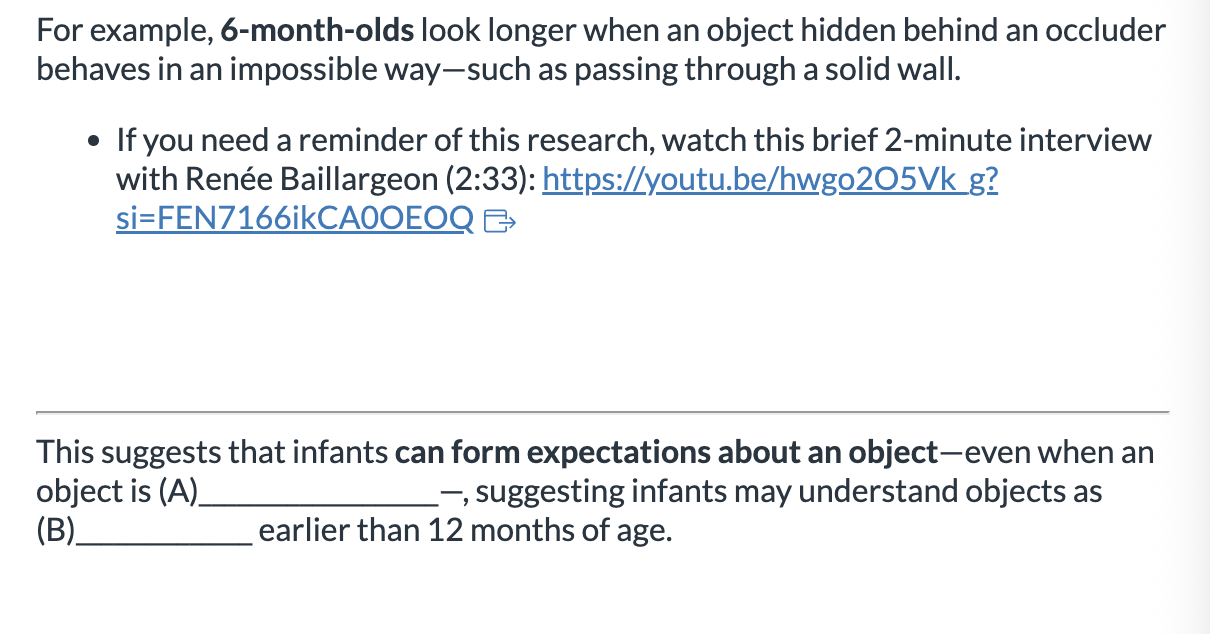
  2. A: multiple, B: dynamical systems, C: self-organizing, D: novel, E: emerges

  1. A: dynamical systems, B: self-organizing, C: novel, D: emerges, E: multiple

45
New cards
<ol><li><p><span>“Because these accounts seek an explanation solely in terms of infants' cognitive capacities neglecting development in other sensory-motor areas"</span></p></li></ol><ol start="2"><li><p><span>“Because these accounts seek an explanation in terms of too codependent and confounding variables”&nbsp;</span></p></li><li><p><span>“Because these accounts seek an explanation in terms of a single cause <strong>when there is no single cause</strong>”&nbsp;</span></p></li></ol><p></p>
  1. “Because these accounts seek an explanation solely in terms of infants' cognitive capacities neglecting development in other sensory-motor areas"

  1. “Because these accounts seek an explanation in terms of too codependent and confounding variables” 

  2. “Because these accounts seek an explanation in terms of a single cause when there is no single cause” 
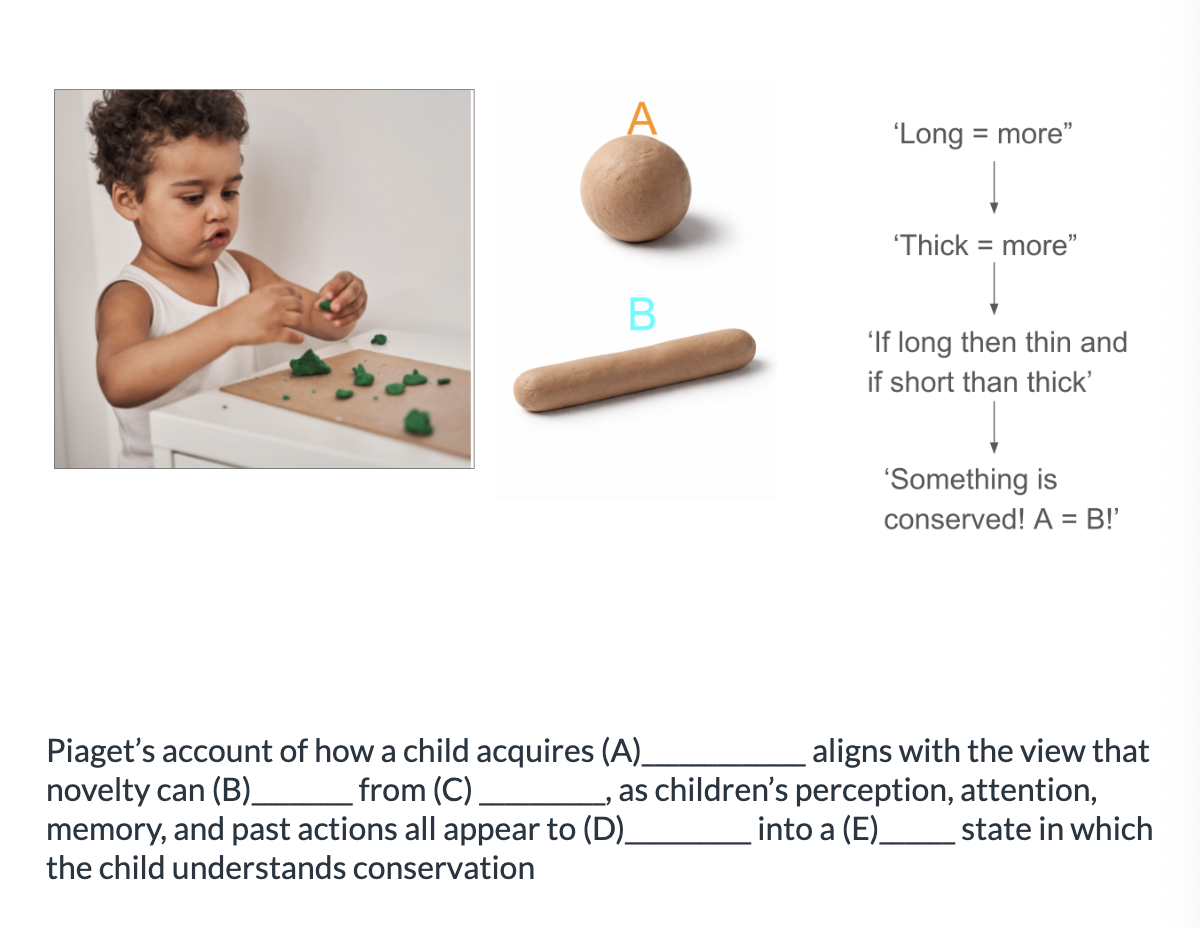
  1. “Because these accounts seek an explanation in terms of a single cause when there is no single cause” 

46
New cards
<ol><li><p>A: <span>a new knowledge of conservation, B: new, C: multiple casual factors, D: integrate, E: emerge</span></p></li><li><p>A: a new knowledge of conservation, B: emerge, C: multiple casual factors, D: integrate, E: new</p></li></ol><p></p>
  1. A: a new knowledge of conservation, B: new, C: multiple casual factors, D: integrate, E: emerge

  2. A: a new knowledge of conservation, B: emerge, C: multiple casual factors, D: integrate, E: new
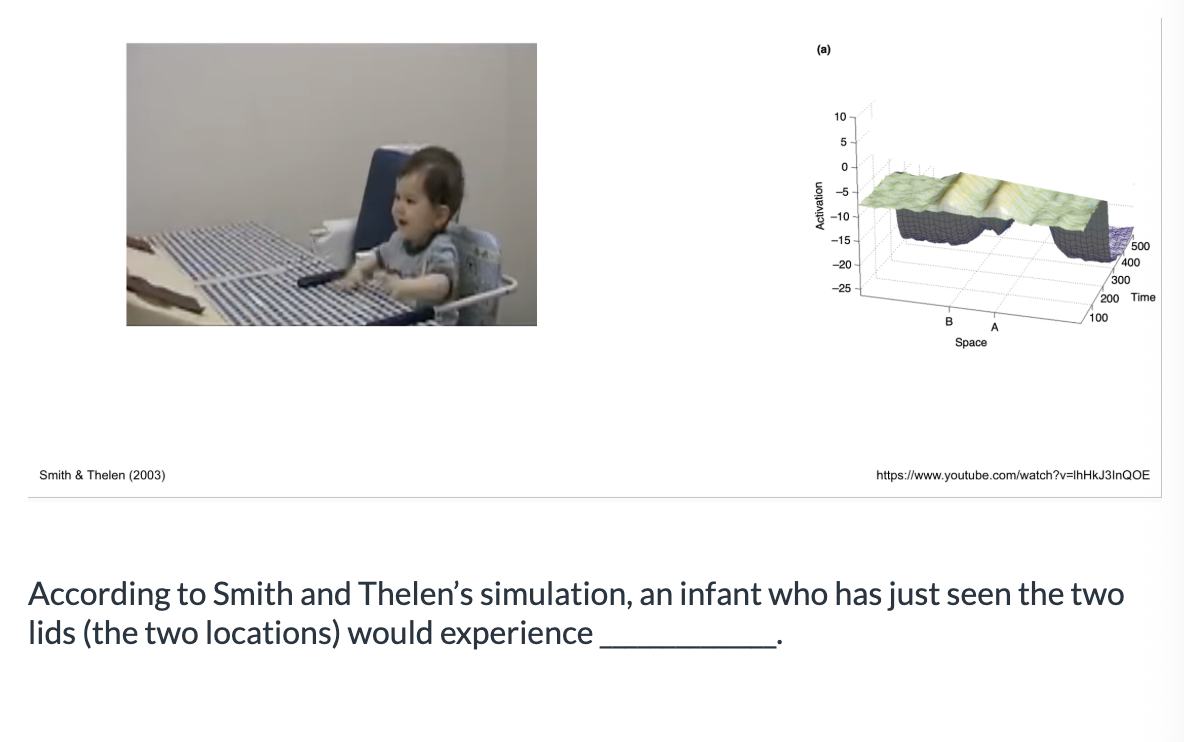
  1. A: a new knowledge of conservation, B: emerge, C: multiple casual factors, D: integrate, E: new

47
New cards
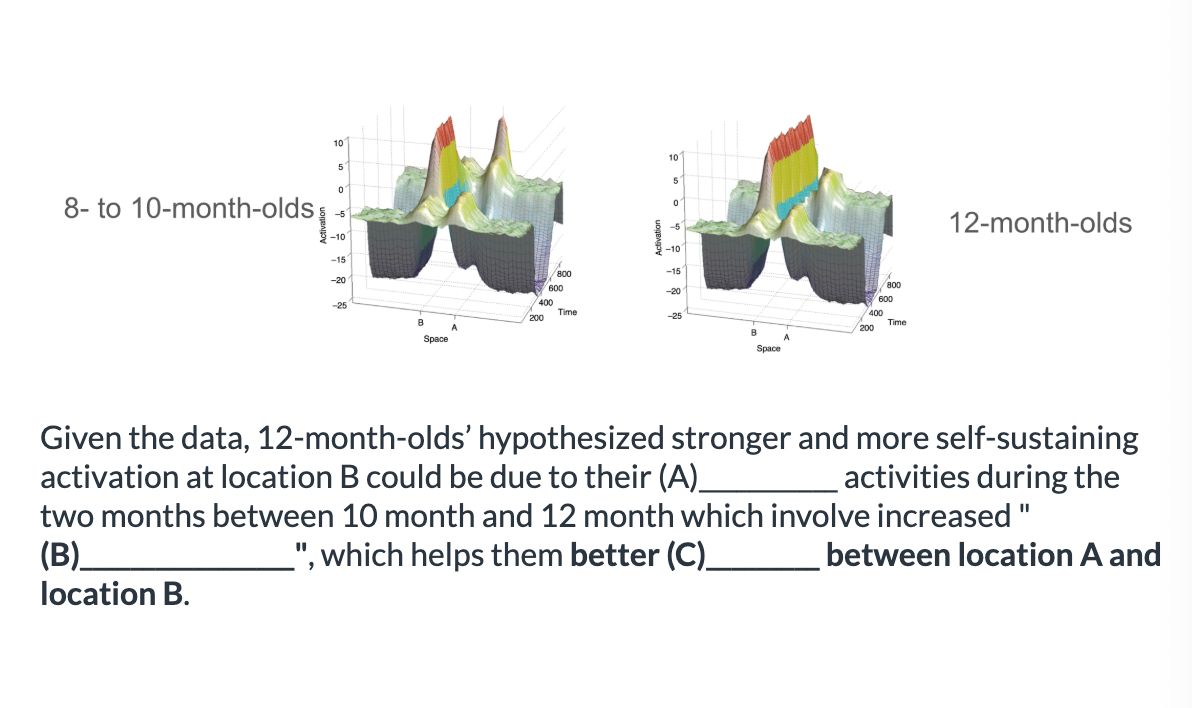
<ol><li><p><span>higher levels of activation at location B&nbsp;</span></p></li><li><p><span>similar levels of activation at both locations</span></p></li><li><p><span>higher levels of activation at location A&nbsp;</span></p></li></ol><p></p>
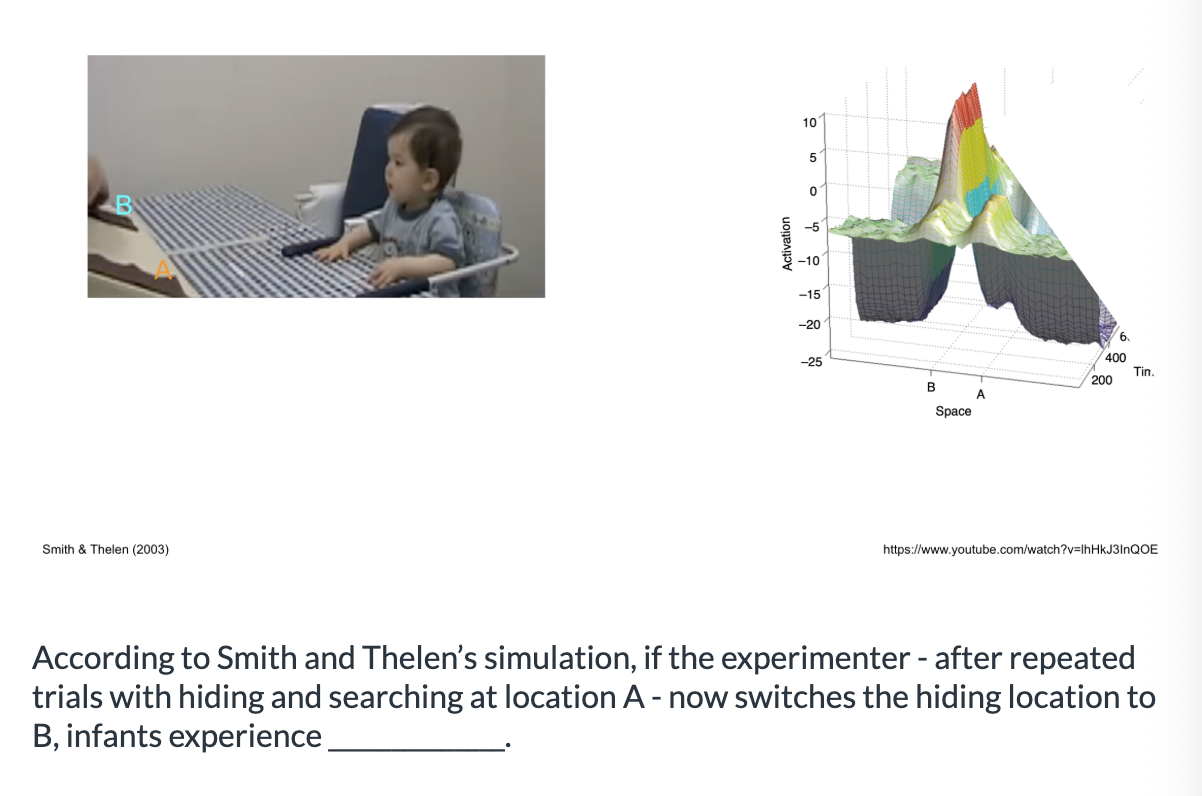
  1. higher levels of activation at location B 

  2. similar levels of activation at both locations
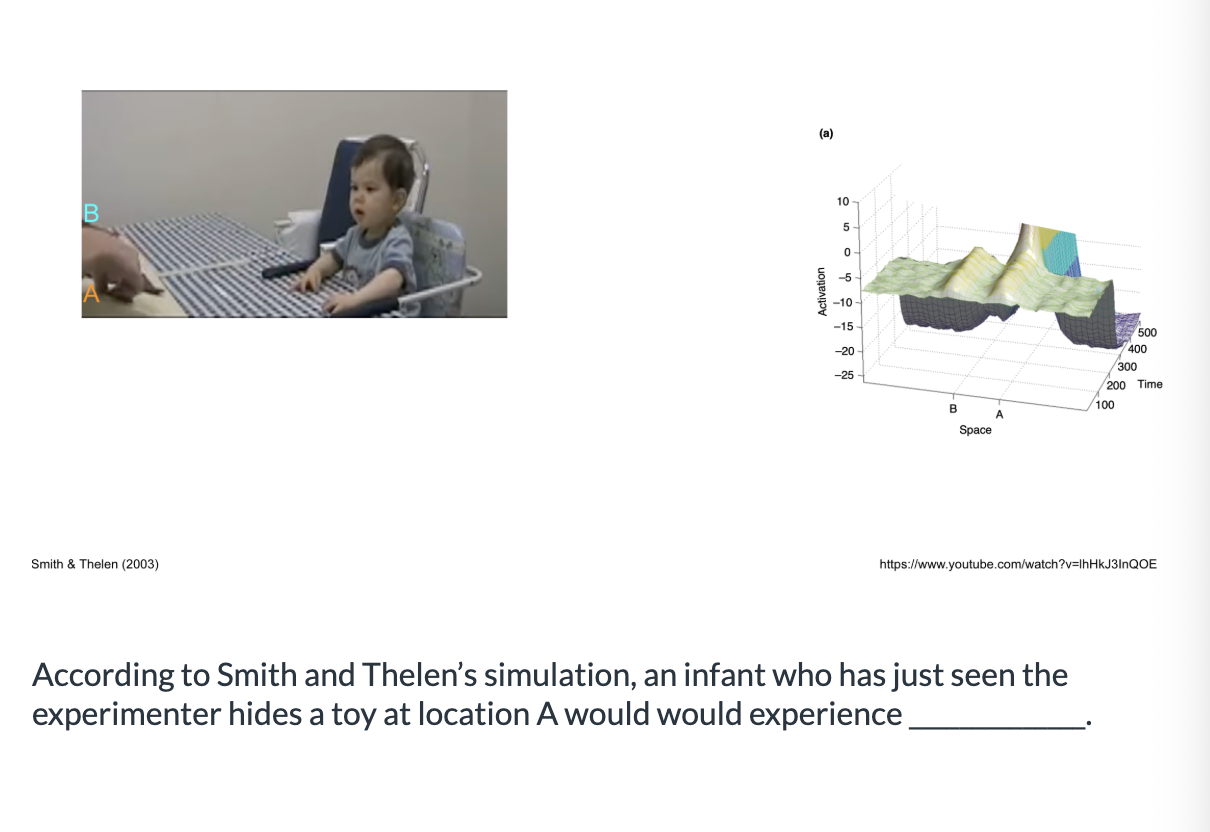
  3. higher levels of activation at location A 
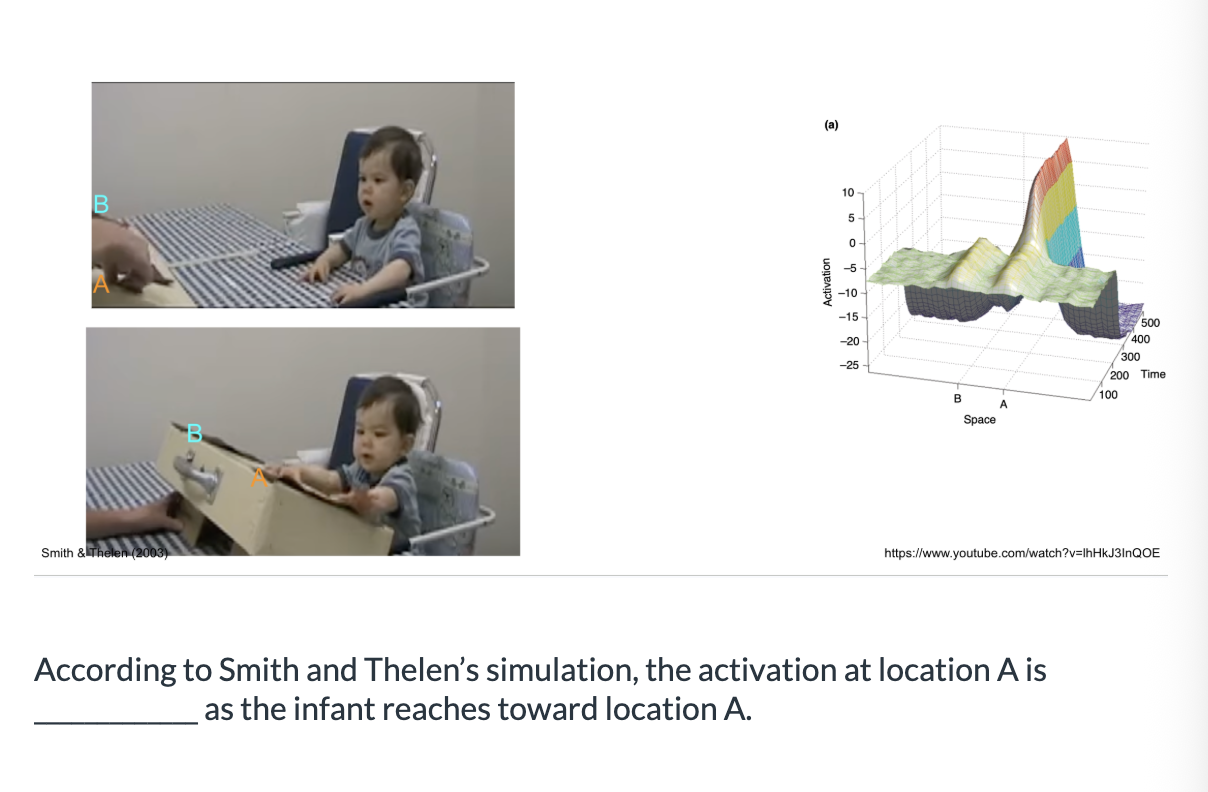
  1. similar levels of activation at both locations

48
New cards
<ol><li><p>higher levels of activation at location B </p></li><li><p>similar levels of activation at both locations</p></li><li><p>higher levels of activation at location A</p></li></ol><p></p>
  1. higher levels of activation at location B

  2. similar levels of activation at both locations

  3. higher levels of activation at location A

  1. higher levels of activation at location A

49
New cards
<ol><li><p>self-sustaining for long </p></li><li><p>transient </p></li><li><p>quickly decaying</p></li></ol><p></p>
  1. self-sustaining for long

  2. transient

  3. quickly decaying

  1. self-sustaining for long

50
New cards
<ol><li><p><span>similar levels of activation at both locations&nbsp;</span></p></li><li><p><span>higher activation at location A&nbsp;</span></p></li><li><p><span>higher activation at location B&nbsp;</span></p></li></ol><p></p>
  1. similar levels of activation at both locations 

  2. higher activation at location A 

  3. higher activation at location B 

  1. higher activation at location B 

51
New cards
<ol><li><p>A: higher activation at location, B: lingering memory, C: dominate </p></li><li><p>A: lingering memory, B: dominate, C: higher activation at location</p></li></ol><p></p>
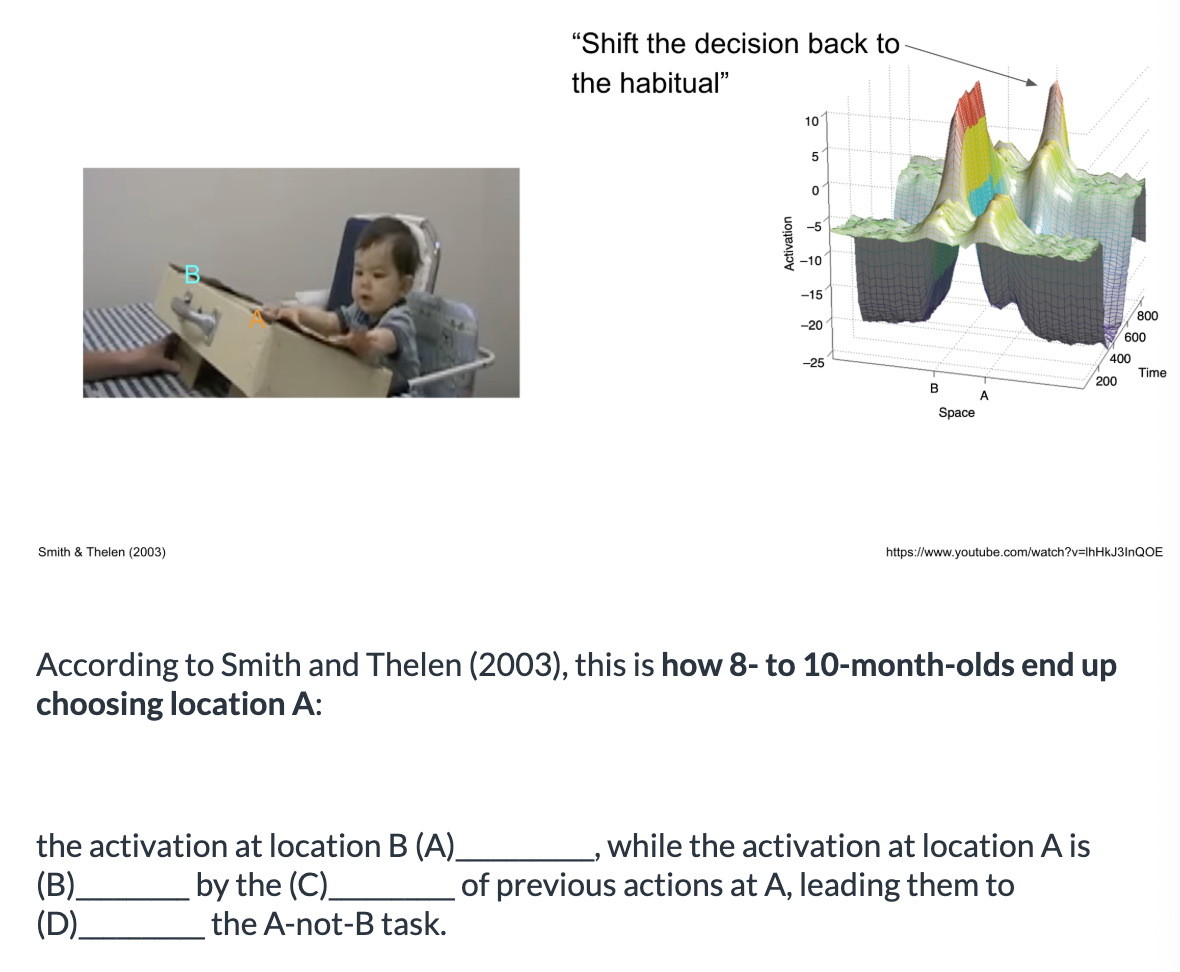
  1. A: higher activation at location, B: lingering memory, C: dominate

  2. A: lingering memory, B: dominate, C: higher activation at location

  1. A: higher activation at location, B: lingering memory, C: dominate

52
New cards
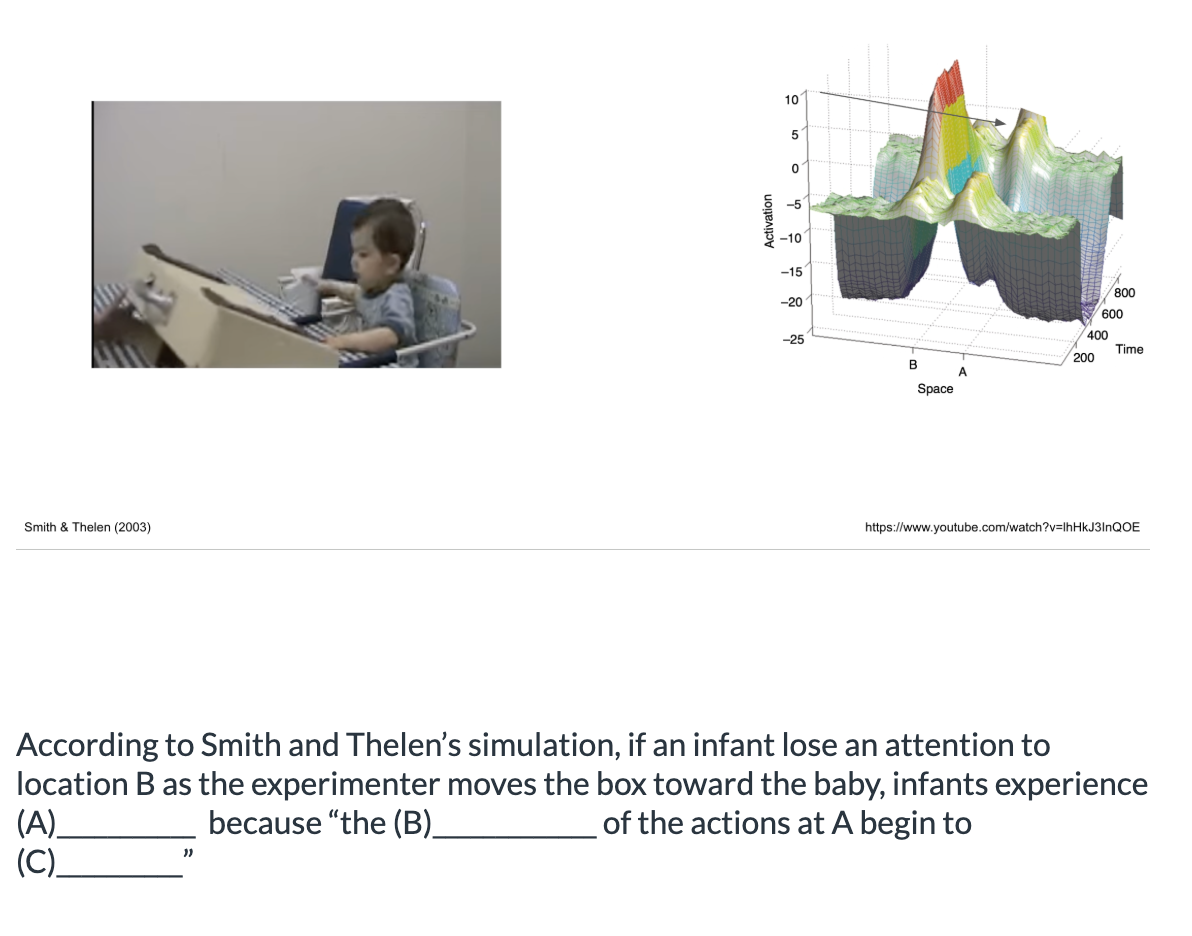
<ol><li><p>A: quickly delays B: revives, C: lingering memory, D: fail </p></li><li><p>A: revives, B: quickly delays, C: lingering memory D: fail </p></li></ol><p></p>
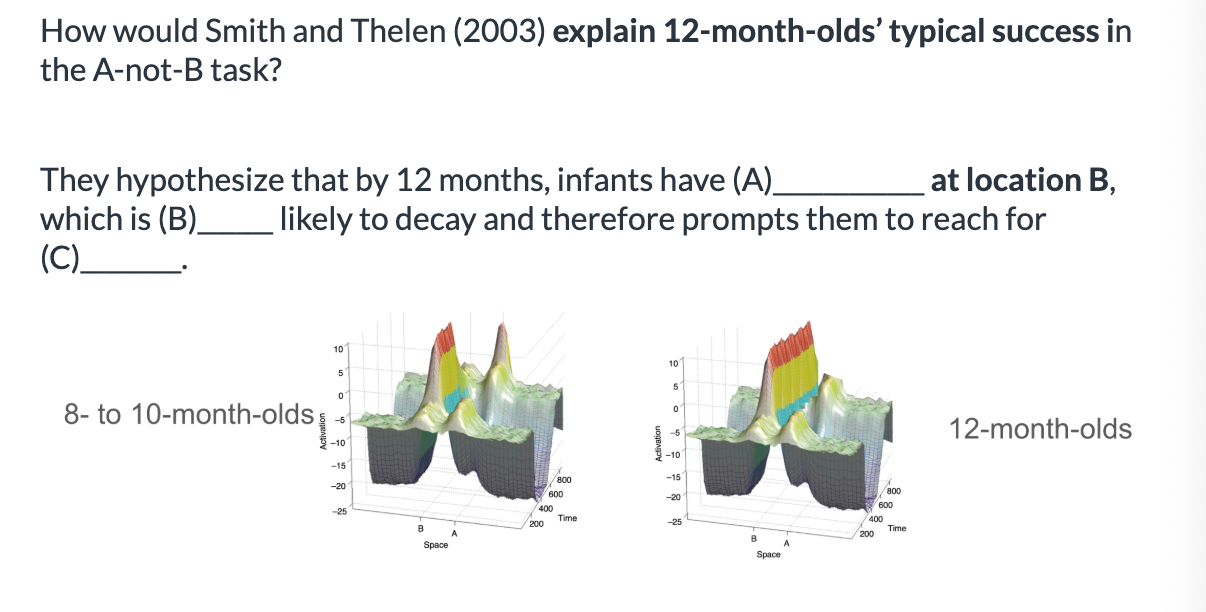
  1. A: quickly delays B: revives, C: lingering memory, D: fail

  2. A: revives, B: quickly delays, C: lingering memory D: fail

  1. A: quickly delays B: revives, C: lingering memory, D: fail

53
New cards
<ol><li><p>A: less, B: location B, C: stronger and more persistent activation</p></li><li><p>A: location B: stronger and more persistent activation </p></li><li><p>A: stronger and more persistent activation, B: less, C: location B </p></li></ol><p></p>
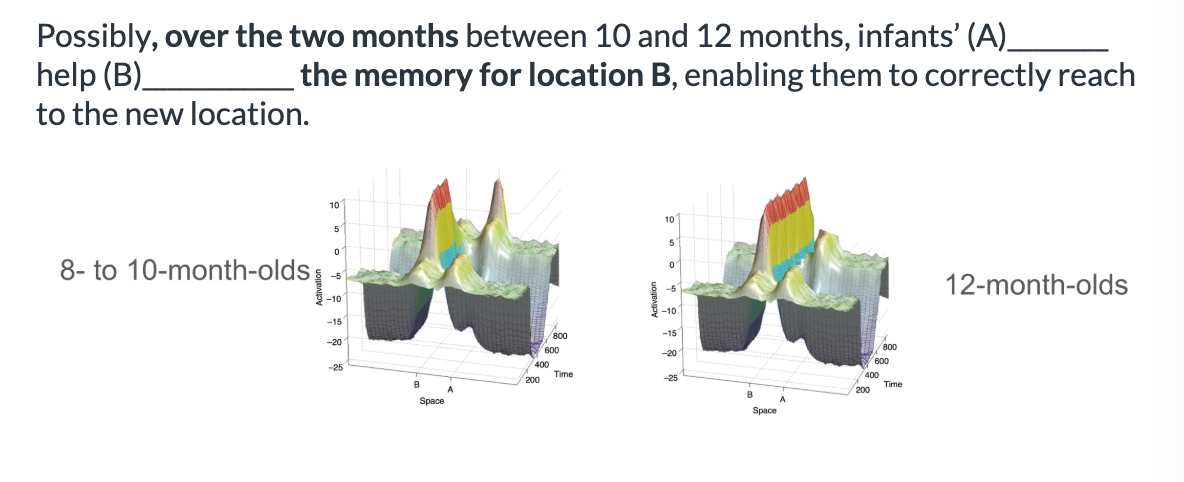
  1. A: less, B: location B, C: stronger and more persistent activation

  2. A: location B: stronger and more persistent activation

  3. A: stronger and more persistent activation, B: less, C: location B

  1. A: stronger and more persistent activation, B: less, C: location B

54
New cards
<ol><li><p>A: real-time activities B: strengthen and sustain </p></li><li><p>A: strengthen and sustain, A: real-time activities   </p></li></ol><p></p>

  1. A: real-time activities B: strengthen and sustain

  2. A: strengthen and sustain, A: real-time activities

  1. A: real-time activities B: strengthen and sustain

55
New cards
<ol><li><p>pre-determined developmental plans </p></li><li><p>real-time activities </p></li></ol><p></p>
  1. pre-determined developmental plans

  2. real-time activities

  1. real-time activities

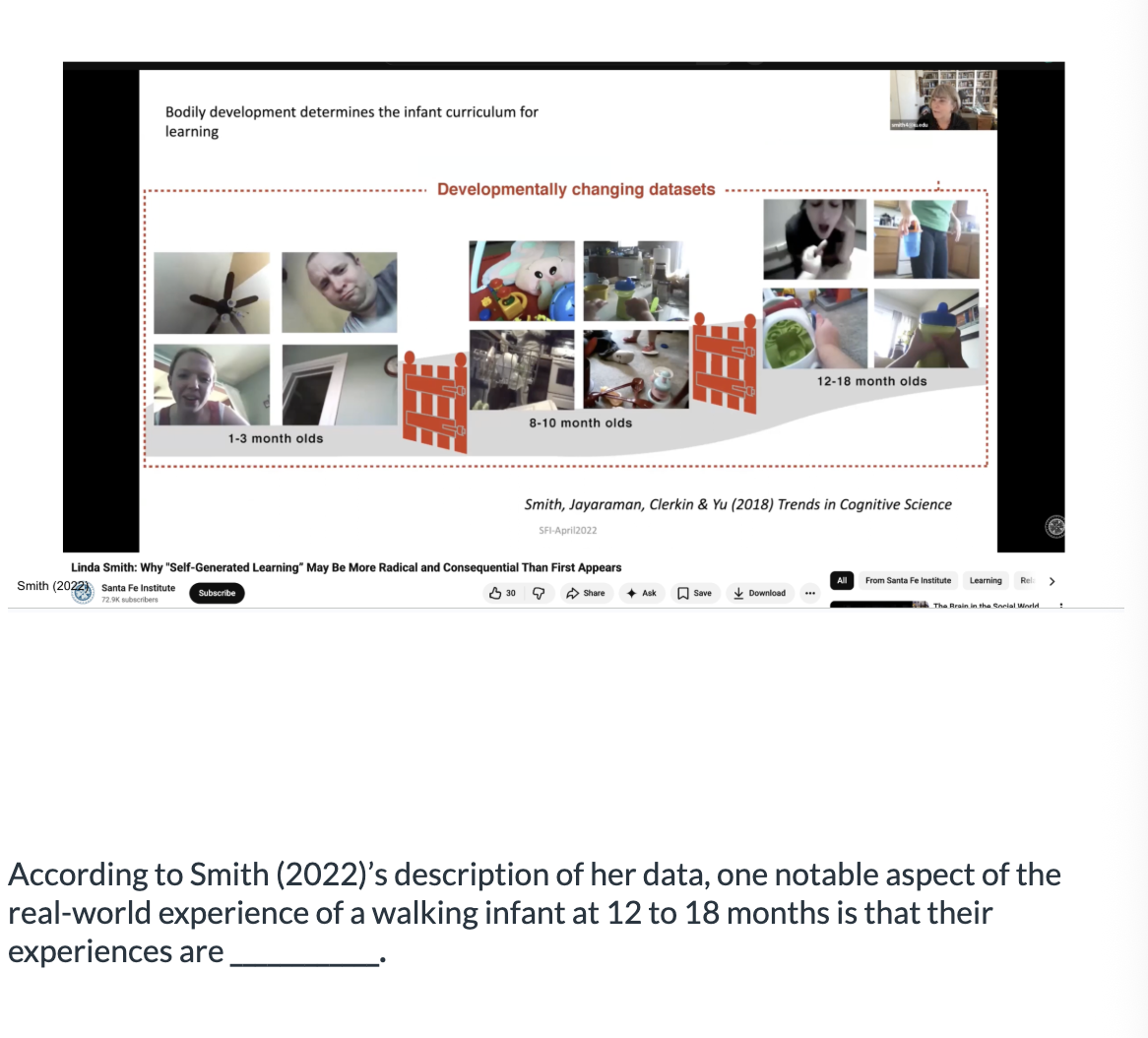
56
New cards
<ol><li><p>A: bodily development, B: pre-crawling, C: crawling, D: walking </p></li><li><p>A: pre-crawling, B: crawling, C: bodily development, D: </p></li></ol><p></p>
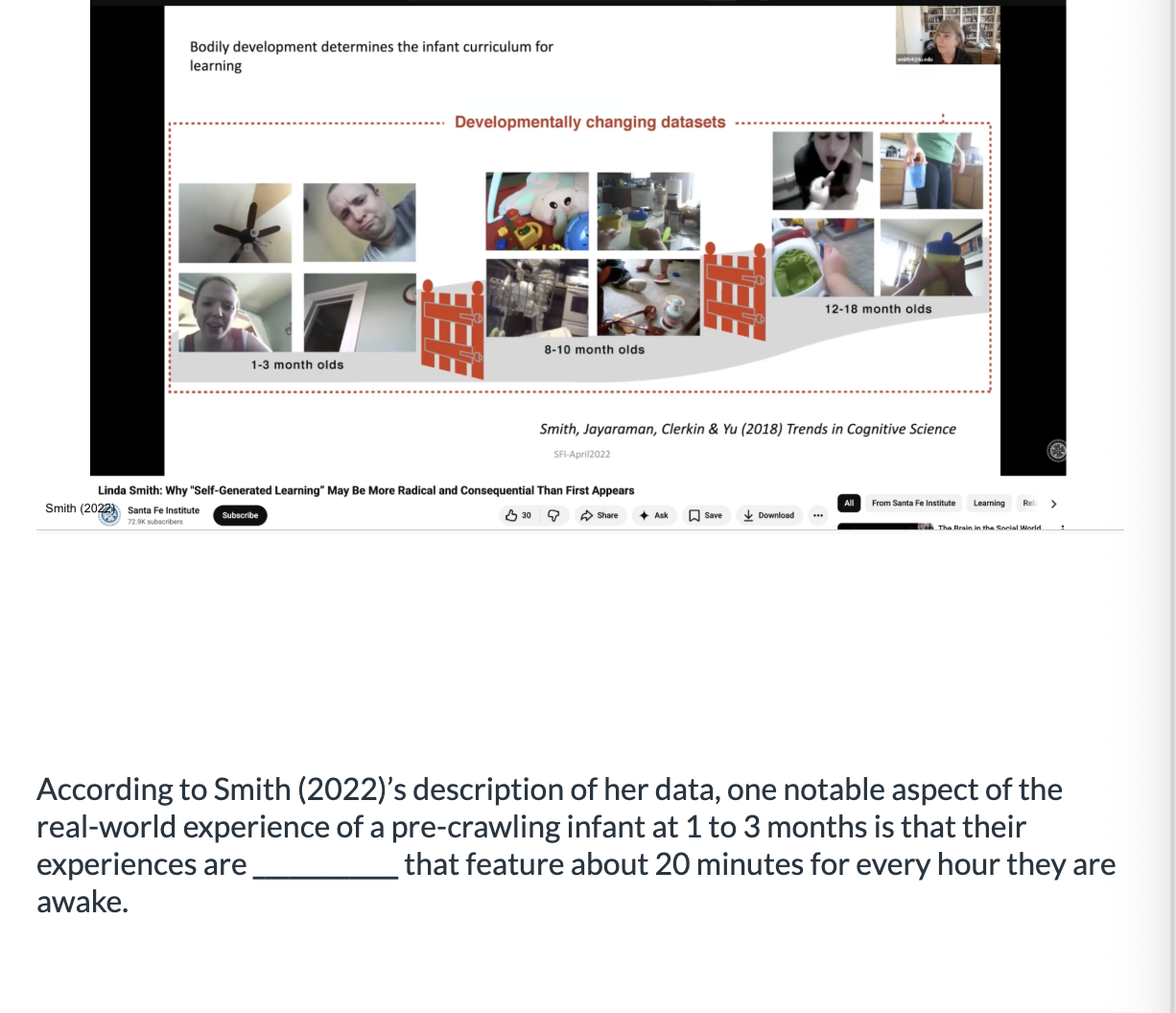
  1. A: bodily development, B: pre-crawling, C: crawling, D: walking

  2. A: pre-crawling, B: crawling, C: bodily development, D:

  1. A: bodily development, B: pre-crawling, C: crawling, D: walking

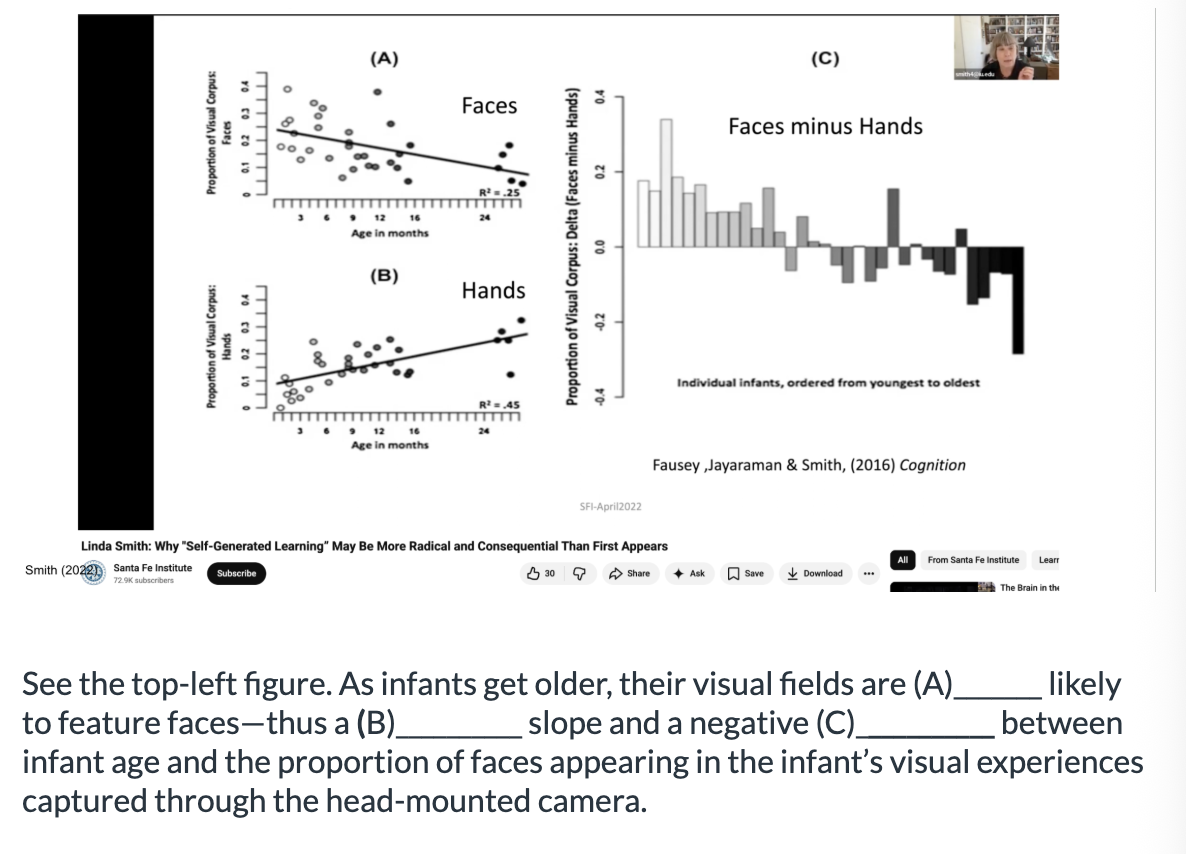
57
New cards
<ol><li><p>dense with hands </p></li><li><p>dense with faces </p></li><li><p>BOTH</p></li></ol><p></p>
  1. dense with hands

  2. dense with faces

  3. BOTH

  1. dense with faces

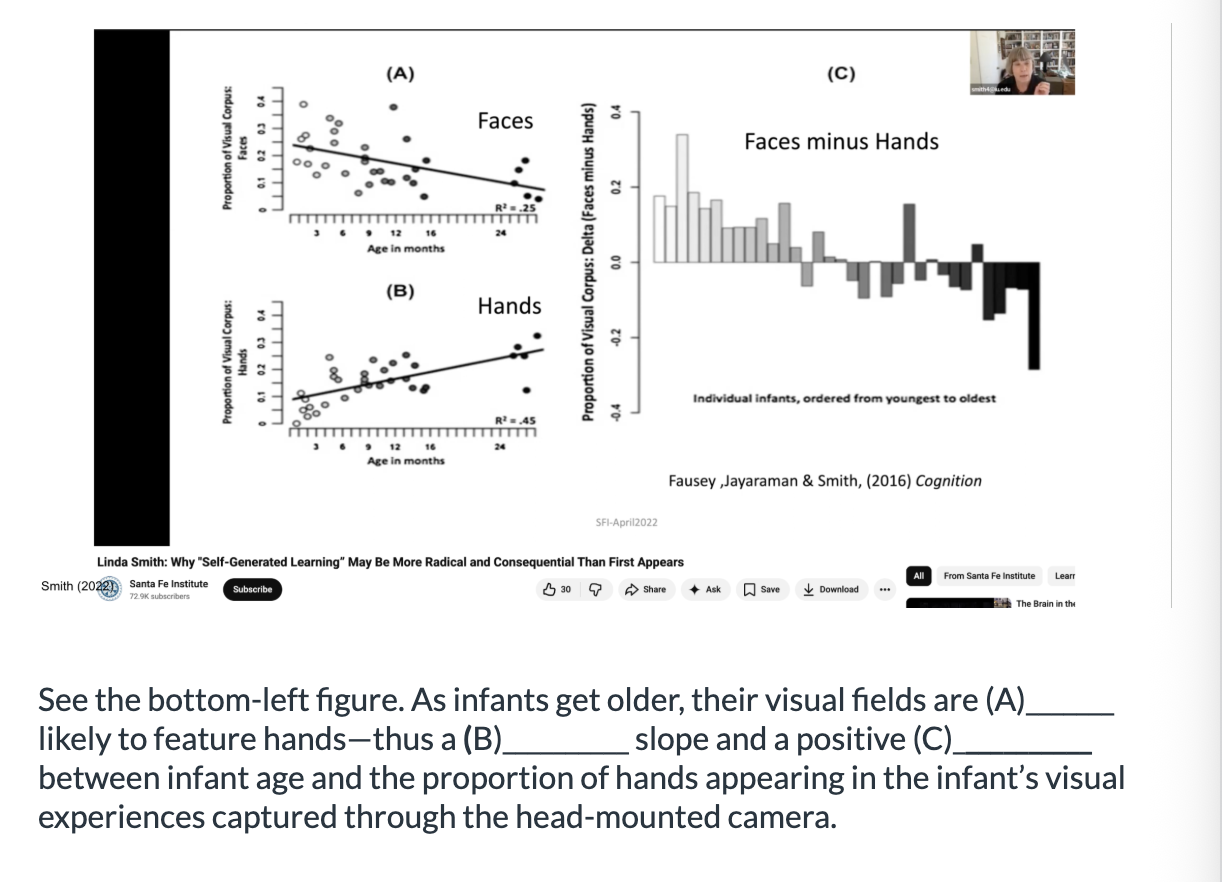
58
New cards
<ol><li><p>dense with hands </p></li><li><p>dense with faces </p></li><li><p>BOTH</p></li></ol><p></p>
  1. dense with hands

  2. dense with faces

  3. BOTH

  1. dense with hands

59
New cards
<ol><li><p>A: less, B: correlation, C: negative </p></li><li><p>A: less, B: negative, C: correlation </p></li><li><p>A: less, B: positive, C: correlation</p></li></ol><p></p>
  1. A: less, B: correlation, C: negative

  2. A: less, B: negative, C: correlation

  3. A: less, B: positive, C: correlation

  1. A: less, B: negative, C: correlation

60
New cards
<ol><li><p>A: more, B: positive, C: correlation </p></li><li><p>A: positive, B: less, C: correlation </p></li><li><p>A: negative, B: less, C: correlation</p></li></ol><p></p>
  1. A: more, B: positive, C: correlation

  2. A: positive, B: less, C: correlation

  3. A: negative, B: less, C: correlation

  1. A: more, B: positive, C: correlation

61
New cards
<ol><li><p>A: experience perceiving, B: real-time </p></li><li><p>A: real-time, B: experience perceiving </p></li></ol><p></p>
  1. A: experience perceiving, B: real-time

  2. A: real-time, B: experience perceiving
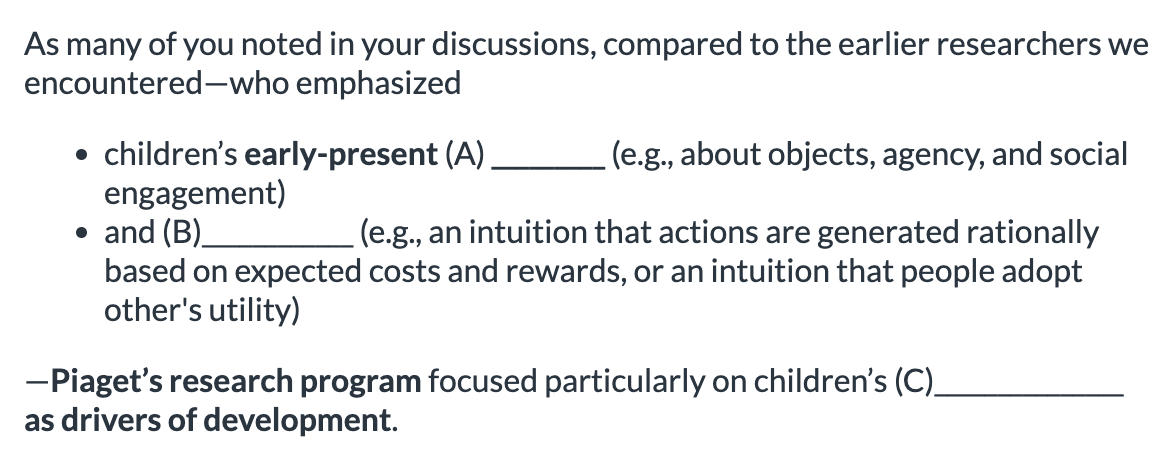
  1. A: real-time, B: experience perceiving

62
New cards
<ol><li><p>A: <span>intuitive theories, B: intuitive concepts, C: own actions and everyday experiences</span></p></li><li><p><span>A: </span>intuitive concepts, B: intuitive theories, C: own actions and everyday experiences</p></li><li><p>A: own actions and everyday experiences, B: intuitive concepts, C: intuitive theories </p></li></ol><p></p>
  1. A: intuitive theories, B: intuitive concepts, C: own actions and everyday experiences
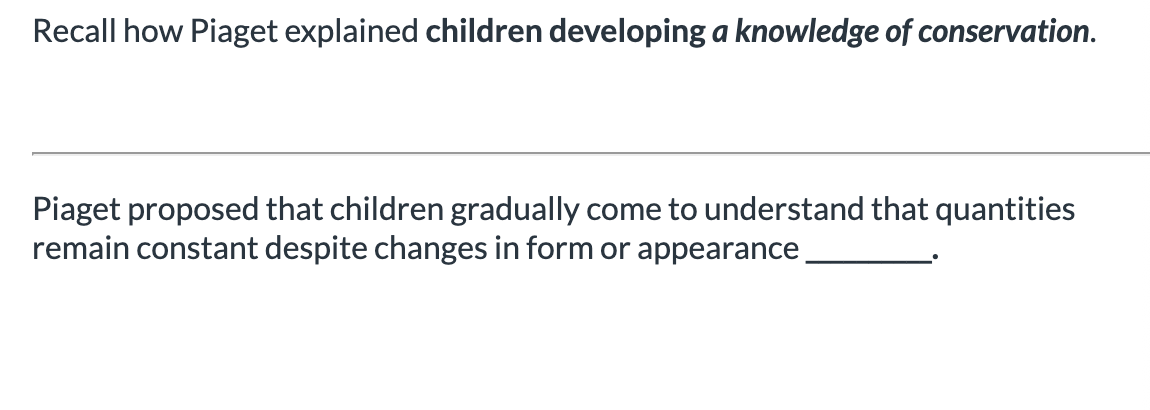
  2. A: intuitive concepts, B: intuitive theories, C: own actions and everyday experiences

  3. A: own actions and everyday experiences, B: intuitive concepts, C: intuitive theories

  1. A: intuitive concepts, B: intuitive theories, C: own actions and everyday experiences

63
New cards
<p><span>1, with the aid of intuitive concepts about conservation&nbsp;</span></p><ol start="2"><li><p><span>through their actions and experiences</span></p></li><li><p><span>with the aid of intuitive theories about conservation&nbsp;</span></p></li></ol><p></p>

1, with the aid of intuitive concepts about conservation 

  1. through their actions and experiences

  2. with the aid of intuitive theories about conservation 

  1. through their actions and experiences

64
New cards
<ol><li><p>A: <span>Longer means more, B: B has more than A</span></p></li><li><p><span>A: B has more than A, B: </span>Longer means more</p></li></ol><p></p>
  1. A: Longer means more, B: B has more than A
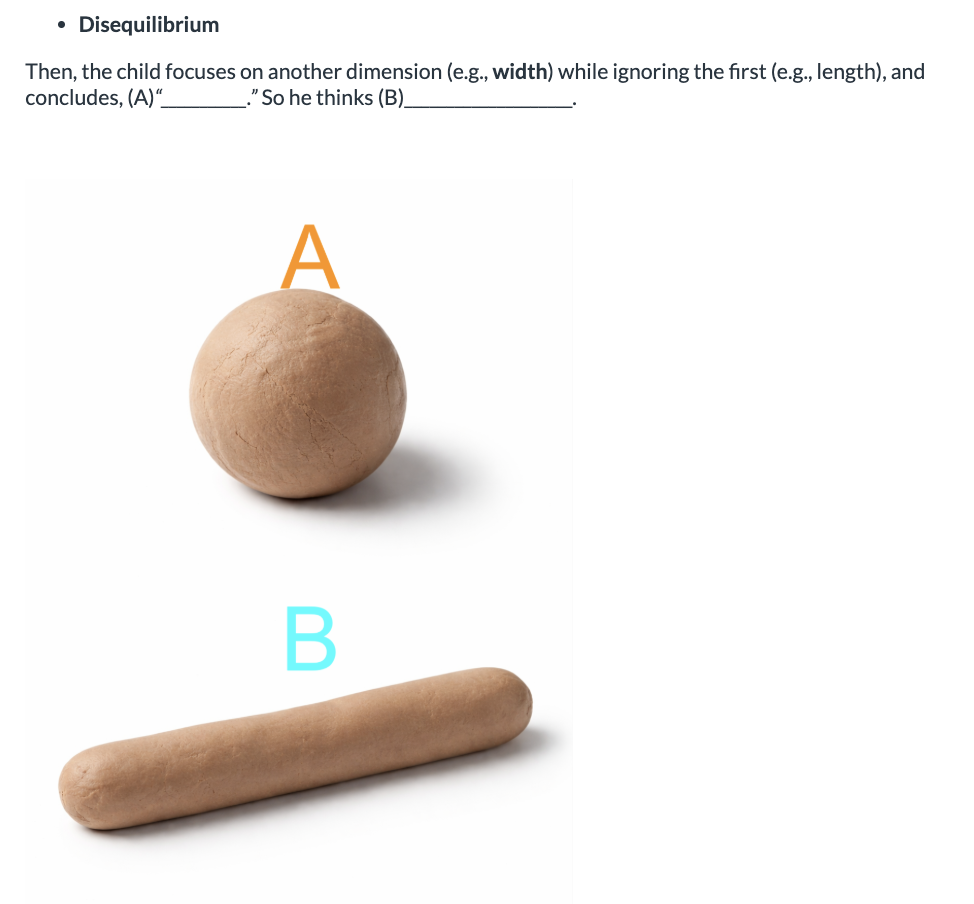
  2. A: B has more than A, B: Longer means more

  1. A: Longer means more, B: B has more than A

65
New cards
<ol><li><p>A: thicker means more, B: A has more than B </p></li><li><p>A: A has more than B, B: A thicker means more </p></li></ol><p></p>
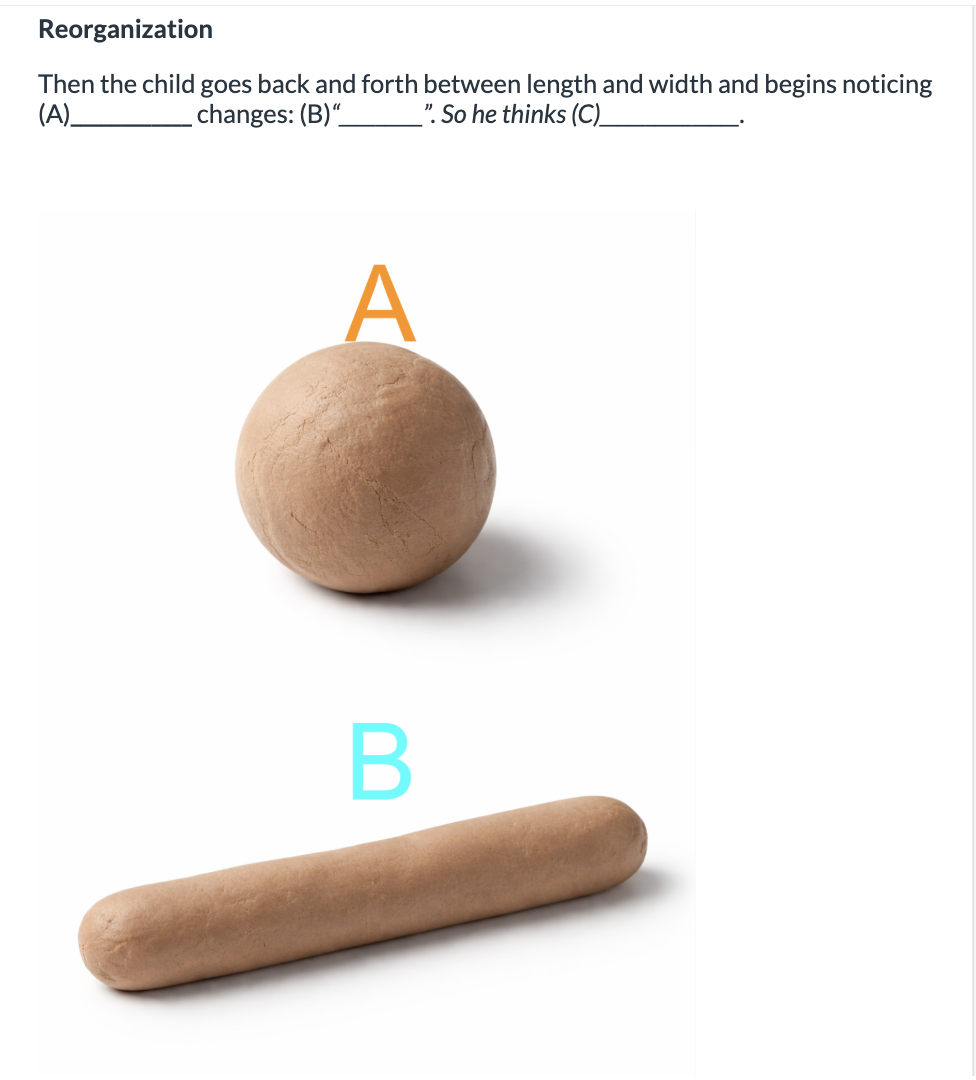
  1. A: thicker means more, B: A has more than B

  2. A: A has more than B, B: A thicker means more

  1. A: thicker means more, B: A has more than B

66
New cards
<ol><li><p>A: compensating, B: Oh, its get longer but also thinner. And if it gets shorter, it gets thicker C: A and B has the same</p></li><li><p>A: Oh, its get longer but also, B: And if it gets shorter, it get thicker, C: compensating</p></li></ol><p></p>
  1. A: compensating, B: Oh, its get longer but also thinner. And if it gets shorter, it gets thicker C: A and B has the same
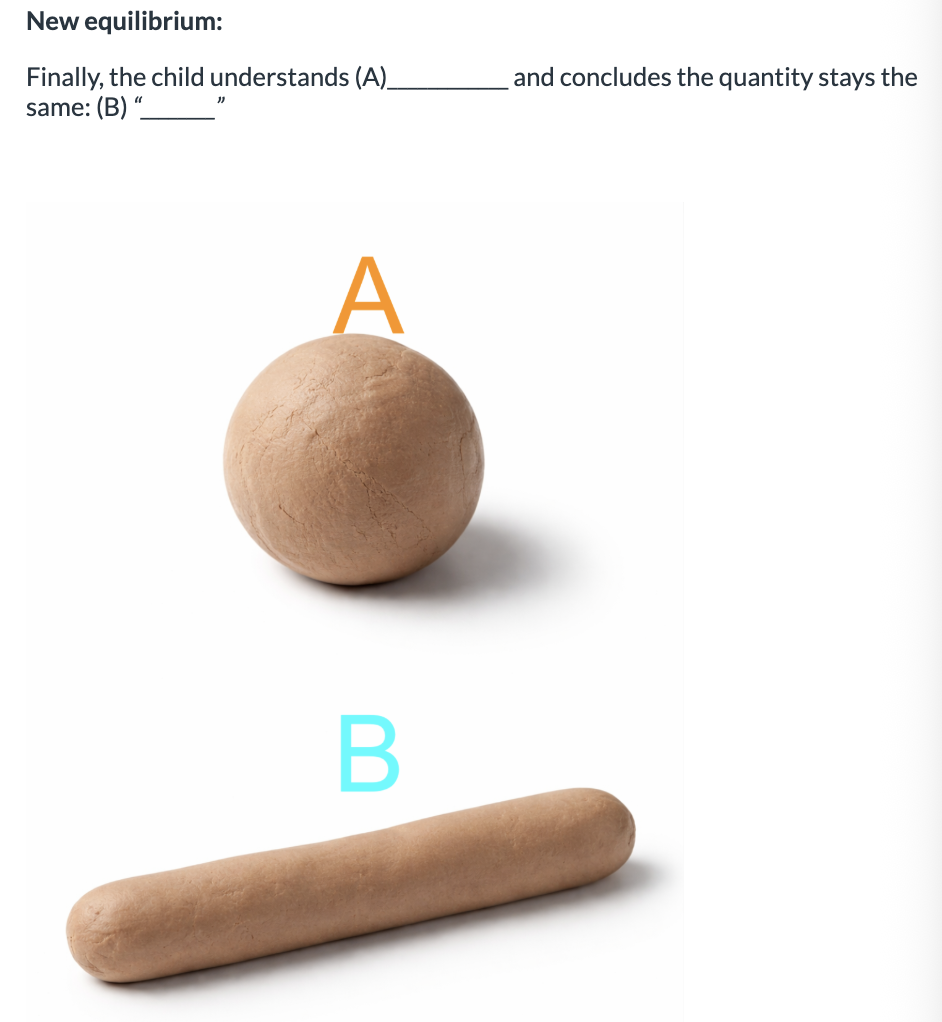
  2. A: Oh, its get longer but also, B: And if it gets shorter, it get thicker, C: compensating

  1. A: compensating, B: Oh, its get longer but also thinner. And if it gets shorter, it gets thicker C: A and B has the same

67
New cards
<ol><li><p>A: conservation, B: it got longer but thinner, so nothing really changed </p></li><li><p>A: it got longer but thinner, so nothing really changed , B: conservation</p></li></ol><p></p>
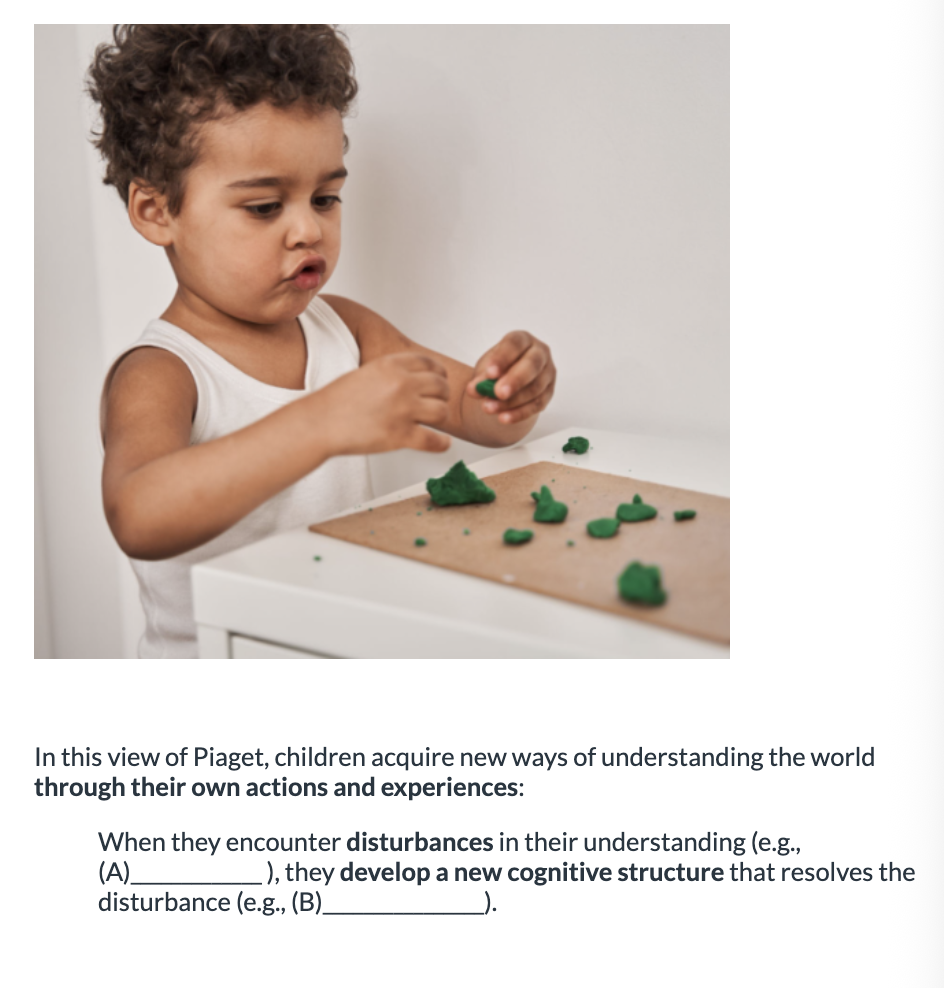
  1. A: conservation, B: it got longer but thinner, so nothing really changed

  2. A: it got longer but thinner, so nothing really changed , B: conservation

  1. A: conservation, B: it got longer but thinner, so nothing really changed

68
New cards
<ol><li><p>A: <span>sometimes longer means more, while other times thicker means more, B: the length and width of clay are compensated, so the same quantity despite appearance differences</span></p></li><li><p><span>A: the length and width of clay are compensated, so the same quantity despite appearance differences, B: sometimes longer means more, while other times thicker means more</span></p></li></ol><p></p>
  1. A: sometimes longer means more, while other times thicker means more, B: the length and width of clay are compensated, so the same quantity despite appearance differences

  2. A: the length and width of clay are compensated, so the same quantity despite appearance differences, B: sometimes longer means more, while other times thicker means more

  1. A: sometimes longer means more, while other times thicker means more, B: the length and width of clay are compensated, so the same quantity despite appearance differences

69
New cards
<ol><li><p>intuitive concepts </p></li><li><p>daily, real-time experiences </p></li><li><p>intuitive theories </p></li><li><p>ALL THREE </p></li></ol><p></p>
  1. intuitive concepts

  2. daily, real-time experiences

  3. intuitive theories

  4. ALL THREE

  1. daily, real-time experiences

70
New cards
<ol><li><p>rejects </p></li><li><p>approves </p></li></ol><p></p>
  1. rejects

  2. approves

  1. rejects

71
New cards
<ol><li><p><span>(A) succeeded (B) before observing the toy being hidden in the new location.</span></p></li><li><p><span>(A) failed (B) even after observing the toy being hidden in the new location.</span></p></li></ol><p></p>
  1. (A) succeeded (B) before observing the toy being hidden in the new location.

  2. (A) failed (B) even after observing the toy being hidden in the new location.

  1. (A) failed (B) even after observing the toy being hidden in the new location.

72
New cards
<ol><li><p>continue to fail at </p></li><li><p>typically succeed in </p></li></ol><p></p>
  1. continue to fail at

  2. typically succeed in

  1. typically succeed in

73
New cards
<ol><li><p>represent object as bounded </p></li><li><p>represent objects as permanent </p></li></ol><p></p>
  1. represent object as bounded

  2. represent objects as permanent

  1. represent objects as permanent

74
New cards
<ol><li><p>affirmed </p></li><li><p>rejected </p></li></ol><p></p>
  1. affirmed

  2. rejected

  1. rejected

75
New cards
<ol><li><p>A: permanent B: out of sight </p></li><li><p>A: out of sight, B: permanent </p></li></ol><p></p>
  1. A: permanent B: out of sight

  2. A: out of sight, B: permanent

  1. A: out of sight, B: permanent

76
New cards
<ol><li><p>A: permanent B: out of sight </p></li><li><p>A: out of sight, B: permanent </p></li></ol><p></p>
  1. A: permanent B: out of sight

  2. A: out of sight, B: permanent

  1. A: out of sight, B: permanent

77
New cards
<ol><li><p><span>(A) transient (B) recall the memory of its previous location&nbsp;</span></p></li><li><p><span>(A) permanent (B) track its movement to the new location</span></p></li><li><p><span>BOTH</span></p></li></ol><p></p>
  1. (A) transient (B) recall the memory of its previous location 

  2. (A) permanent (B) track its movement to the new location

  3. BOTH

(A) permanent (B) track its movement to the new location

78
New cards
79
New cards
80
New cards
81
New cards
82
New cards
83
New cards
84
New cards
85
New cards
86
New cards
87
New cards
88
New cards
89
New cards
90
New cards
91
New cards
92
New cards
93
New cards
94
New cards
95
New cards
96
New cards
97
New cards
98
New cards
99
New cards
100
New cards

Explore top notes

note
PATHOLOGY
Updated 1126d ago
0.0(0)
note
Invisible Man Chapter 20
Updated 1194d ago
0.0(0)
note
Of Tests and Testing
Updated 1226d ago
0.0(0)
note
World: Political Systems
Updated 1229d ago
0.0(0)
note
PATHOLOGY
Updated 1126d ago
0.0(0)
note
Invisible Man Chapter 20
Updated 1194d ago
0.0(0)
note
Of Tests and Testing
Updated 1226d ago
0.0(0)
note
World: Political Systems
Updated 1229d ago
0.0(0)

Explore top flashcards

flashcards
3.4: donner une instruction
36
Updated 707d ago
0.0(0)
flashcards
topic 1.1
32
Updated 1206d ago
0.0(0)
flashcards
Belangrijksten Heiligen A-Z
50
Updated 119d ago
0.0(0)
flashcards
Neurons PNS and CNS
36
Updated 902d ago
0.0(0)
flashcards
Conrad JROTC ACP SY 25-26
100
Updated 115d ago
0.0(0)
flashcards
3.4: donner une instruction
36
Updated 707d ago
0.0(0)
flashcards
topic 1.1
32
Updated 1206d ago
0.0(0)
flashcards
Belangrijksten Heiligen A-Z
50
Updated 119d ago
0.0(0)
flashcards
Neurons PNS and CNS
36
Updated 902d ago
0.0(0)
flashcards
Conrad JROTC ACP SY 25-26
100
Updated 115d ago
0.0(0)