20th Century Art 2
 Call Kai
 Learn
Learn Practice Test
 Spaced Repetition
 Match
Match Flashcards
 Knowt Play
1/46

There's no tags or description
Looks like no tags are added yet.
Name | Mastery | Learn | Test | Matching | Spaced | Call with Kai |
|---|
No analytics yet
Send a link to your students to track their progress
47 Terms
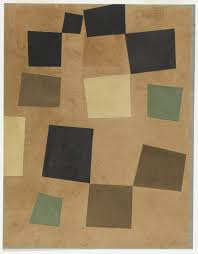
Arrangement According to the Laws of Chance, Jean Arp, 1915, Dada
Subject: small composition, one of founders of Dadaism, important notion of this movement: chance!, created by randomly tearing paper into squares and haphazardly placing them onto the piece
Form: geometric focused, papier collage, yellow, green, black, and brown, lack of control, can’t create perfect shapes, all different sizes and angles, removes artist’s intent, distancing artist from the creation of art, more in tune with nature rather than the reason of his own mind/control he might impose on it,
Function: nonsensical, meant to confuse and shock people, focus on creating reactions with abstract and shocking innovation, rejection of classical art and acceptance of primitive/spontaneous art
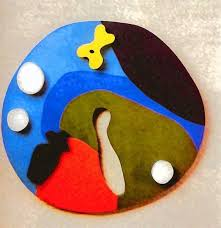
Relief Clock, Jean Arp, 1915, Dada
Subject: constructed painting, thin sheets layered on top of one another with paint, means of creating from the unconscious mind
Form: reds, blues, greens, yellows, blacks, and whites, lot of geometric forms, used psychic automatism (automatic drawing), curvilinear lines resulting in organic shapes, oval shapes, irregular abstraction, saw plants/amoebas, and exotic vegetables in his work, transformation, taken from the inner part of his mind, carpenter cut the forms out of wood, consciously arranged and painted them on the composition to guide the ideas, various layers of the thin wood building up outward, nature with green/blue/white, suggestion of a clock/sun dial, yellow form: female body, white ovals: eggs
Function: nonsensical, meant to confuse and shock people, focus on creating reactions with abstract and shocking innovation, rejection of classical art and acceptance of primitive/spontaneous art
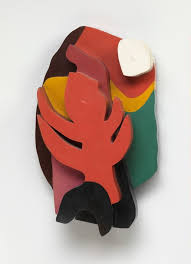
Forest, Jean Arp, 1915, Dada
Subject: title comes after the artist has generated the forms and arranged the composition
Form: organic forms, abstract colors, central form looks like a tree/plant, dense forest is suggested with colors, patches of green, white, purple, pink, blue/black, placement of forms above others, dimension with relief, irregular nature of backdrop, not traditional in any sense
Function: nonsensical, meant to confuse and shock people, focus on creating reactions with abstract and shocking innovation, rejection of classical art and acceptance of primitive/spontaneous art
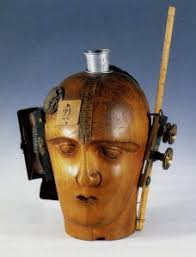
The Spirit of Our Time, Raoul Hausmann, 1920, Dada
Subject: unflattering portrait of the average German after WW1, 3D assemblage
Form: ruler, nails, pocket watch, numbers, old camera parts, typewriter, purse, cup, head is made of wood, head: eyes with no pupils (eyes that refuse to see reality), bowed, closed mouth (won’t speak up), cup: do you think for yourself or do others pour info into your head, numbers on the head: humans have become robots/dehumanized (broken mechanical watch), type-set cartridge (typewriter) is on the ear (dependency on the media for what is being said)
Function: based in chance, brain is empty, German wants order, his king, Sunday sermon, and easy chair - saying they are dumb, lazy, and complacent, meant to confuse and shock people, focus on creating reactions with abstract and shocking innovation, rejection of classical art and acceptance of primitive/spontaneous art
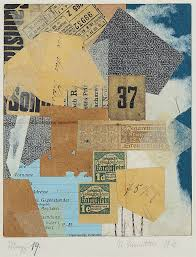
Merz 19, Kurt Schwitters, 1920, Dada
Subject: Merz: word that is made, not found, fragment of German word found my chance as he was working on a collage, freedom from all fetters, for the sake of artistic creation, product of strict artistic discipline, consists of things he picked up from the streets of Germany
Form: everything has broken down and new things had to be made out of the fragments, scraps of paper, trash, bus tickets, wrappers, newspaper, torn up and fragmented, but still have original meaning within them, all objects have connection to Germany industry, elements stand out and have a presence, color is beige, warm color is based next to blue cold color, viewer is seeking to complete the fragments, reasonable explanation for their arrangement, numbers, legal documents, price tag
Function: meant to confuse and shock people, focus on creating reactions with abstract and shocking innovation, rejection of classical art and acceptance of primitive/spontaneous art
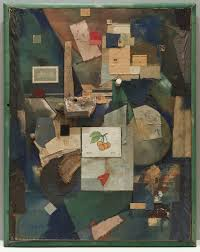
Cherry Picture, Kurt Schwitters, 1920, Dada
Subject: collage on cardboard, colored paper and fabrics, printed labels, metal, wood, cork, oil paint, pencil, and ink
Form: painted image, found objects he collected from the streets, the dirt and grime of Germany, waste from the industrial world that have become a part of the capitalist society, chaos of the streets, lot of greens and yellows, strong associations with disorder of defeated Germany, animals, pipes, newspaper, papers that have been discarded, fragments with things painted over it, not inviting or appealing - direct comment on the state of Germany, ugly, harsh, candy wrappers, on the cherry: nonsensical phrase
Function: meant to confuse and shock people, focus on creating reactions with abstract and shocking innovation, rejection of classical art and acceptance of primitive/spontaneous art, everything has broken down and new things had to be made out of the fragments
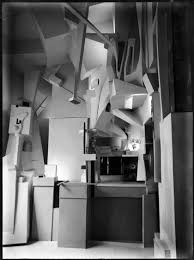
Cathedral of Erotic Misery, Kurt Schwitters, 1920, Dada
Subject: charged words, hard to separate ourselves from drawing associations with the words, mertz bau - build with mertz, 3D form that is recognized as the first true artistic installation, Germany
Form: add art to his environment, addition to the daily life, adding abstract geometric forms to his studio, walls and niches are covered with forms, modeling and depth to previous flat areas, growth, angular forms, plainer elements that enliven the space/energize it, little areas, place things within the spaces that are personal to him, wood, plaster, found objects, wanted to make his house into an art project, own “chapel” where he found solace and peace - shrine, focus on using white for pure/calming, pops of primaries, abstract nature
Function: meant to confuse and shock people, focus on creating reactions with abstract and shocking innovation, rejection of classical art and acceptance of primitive/spontaneous art, everything has broken down and new things had to be made out of the fragments
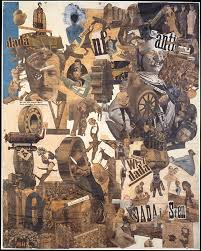
Cut With the Kitchen Knife Dada through the Last Weimar Beer Belly Cultural Epoch of Germany, Hannah Hoch, 1920, Dada
Subject: photomontage, papier collage but specifically made from photographs and pictures that we would find in magazines and newspapers, member of Dada, worked for a publishing house for women’s magazines, females will bring the change they need if given the chance, look at German government and its connection to Dada
Form: mass produced sources for public consumption, papers cut out from the world of culture, appears nonsensical, texts with the pictures, ordered organization split into quarters, explosive chaotic nature, upper left: dada propaganda, large photo of Einstein, invest your money in dada, blues; bottom left: machinery wheel bearings, industry connected to top left, yellowy newspapers, large crowds of people, dada persuasion, communist party in Germany represented; upper right: anti dada, corrupt Weimar Government, buildings, faces of military, guns, Kaiser Wilhelm, emasculates the men by imposing their heads on fragile female forms, Paul Hindenburg - war and destruction by these leaders; lower right: Dadaists, other revolutionaries, capable of bringing change to Germany, Kovitz, Hausmann, Lenin, Marx, map of Europe that indicates in black where women have been given the right to vote, kitchen knife: cutting out images to create collage and stereotypical roles of women, desire to slice open Germany and examine the overfed patriarchs - cut through beer belly
Function: meant to confuse and shock people, focus on creating reactions with abstract and shocking innovation, rejection of classical art and acceptance of primitive/spontaneous art, everything has broken down and new things had to be made out of the fragments, critical of the new German republic
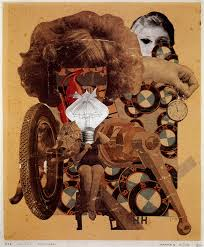
Pretty Maiden, Hannah Hoch, 1920, Dada
Subject: photomontage, papier collage but specifically made from photographs and pictures that we would find in magazines and newspapers, member of Dada, worked for a publishing house for women’s magazines, females will bring the change they need if given the chance, new woman able to have an independent life
Form: critical of culture in Germany, response to birth of industrial advertising and ideals of beauty, BMW - airplane engines, first to do a mass producing of them, but then went making airbrakes for train cars, kickstand/mechanical lever thing, wheel on the side, aspects of industry covering up the female body/headless, hairdo without a head, head without an eye, someone holding a timepiece, advertisement using women to sell products, objectifying women, woman in a bathing suit, replacing head with a lightbulb
Function: meant to confuse and shock people, focus on creating reactions with abstract and shocking innovation, rejection of classical art and acceptance of primitive/spontaneous art, everything has broken down and new things had to be made out of the fragments, critical of the new German republic
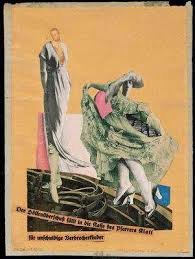
Dada Dance, Hannah Hoch, 1920, Dada
Subject: photomontage, papier collage but specifically made from photographs and pictures that we would find in magazines and newspapers, member of Dada, worked for a publishing house for women’s magazines, females will bring the change they need if given the chance
Form: targeting fashion and how it establishes standards of beauty, mass promoted and show expectation of what women are meant to look like, big full dress, fanciful material, head is small, feet are small and stuffed in high heels, elegant pose, big hat obscures the unhappy face of the woman, walking over a runway made up of industrial springs, expectation that women should maintain poise and be able to overcome obstacles, other figure is tall and slender, stretched figures, long legs and arms, tiny head stuck on top - not about the mind or person, but instead about image of people, how the dress fits and extenuates, African head grimacing - natural, free, true, pure, commentating of foolishness of modern progressive society, text at bottom: not logical, “excess of hell falls into the coffers of exter clot, of innocent children of criminals", bright colors
Function: meant to confuse and shock people, focus on creating reactions with abstract and shocking innovation, rejection of classical art and acceptance of primitive/spontaneous art, everything has broken down and new things had to be made out of the fragments, critical of the new German republic
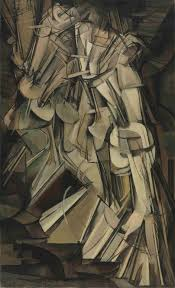
Nude Descending a Staircase, Marcel Duchamp, 1915, Dada
Subject: most important Dada artist, heavily criticized artist who brought Dada to USA, mixture of cubism and futurism, a figure is moving down a staircase
Form: fracturing, nude female moving downward, flattening of space, angular plane, beige white, with brown background, lot of line work, very abstract, took apart a nude and put it back together, step by step moving downward, meant to be more cerebral than visual, shows how the body moves every step it takes
Function: meant to confuse and shock people, focus on creating reactions with abstract and shocking innovation, rejection of classical art and acceptance of primitive/spontaneous art, everything has broken down and new things had to be made out of the fragments

Bicycle Wheel, Marcel Duchamp, 1915, Dada
Subject: artist is not making the art but declaring it art, takes a bike wheel and puts it on a stool, elevate art works with pedestal, criticizing tradition
Form: assisted readymade, from the industrial world, mass produced, utilitarian usage, based in choice, look at these objects in a new point of view, idea is more important than manipulating materials by hand, has the potential to move, kinetic movement
Function: meant to confuse and shock people, focus on creating reactions with abstract and shocking innovation, rejection of classical art and acceptance of primitive/spontaneous art, step out of tradition, idea is more important than the object itself, forces us to contemplate aesthetic questions
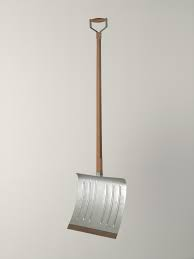
In Advance of a Broken Arm, Marcel Duchamp, 1915, Dada
Subject: artist is not making the art but declaring it art, a shovel put in a museum context
Form: readymade, from the industrial world, mass produced, utilitarian usage, look at these objects in a new point of view, on the wall, bright light, white wall - encourages us to look beyond its everyday use, suspended in air, creates shadow, puts emphasis on the image, name is kind of funny - humorous element, idea is more important than manipulating materials by hand
Function: meant to confuse and shock people, focus on creating reactions with abstract and shocking innovation, rejection of classical art and acceptance of primitive/spontaneous art, step out of tradition, idea is more important than the object itself, forces us to contemplate aesthetic questions
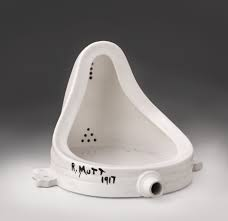
Fountain, Marcel Duchamp, 1915, Dada
Subject: artist is not making the art but declaring it art, 3D object, industrial public urinal, chosen by artist and given the title Fountain, puts a signature and a date on it - pride and saying someone created it
Form: readymade, from the industrial world, mass produced, utilitarian usage, look at these objects in a new point of view, look at these objects in a new point of view, R. Mutt is a humorous name, J.L.Mott Ironworks, not accepted to the 1917 exhibition in New York - committee refused to incorporate it, useful but has no place in an art exhibition - not art, porcelain, used in show windows technically, fountain traditionally is artwork but it doesn’t feel like it here, idea is more important than manipulating materials by hand
Function: meant to confuse and shock people, focus on creating reactions with abstract and shocking innovation, rejection of classical art and acceptance of primitive/spontaneous art, step out of tradition, idea is more important than the object itself, forces us to contemplate aesthetic questions
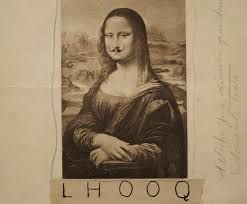
L.H.O.O.Q., Marcel Duchamp, 1915, Dada
Subject: artist is not making the art but declaring it art, the Mona Lisa with a mustache and goatee
Form: assisted readymade, in 2D, Mona Lisa is considered a masterpiece, have just accepted that it is a masterpiece without knowing why, defaced her image, postcard, mass produced piece of paper with this image, LHOOQ is a French pun, objectifies her, “she has a hot ass,” attacks a sacred piece and wants to take people away from accepting art just because everyone else does and someone said it was significant
Function: meant to confuse and shock people, focus on creating reactions with abstract and shocking innovation, rejection of classical art and acceptance of primitive/spontaneous art, step out of tradition, idea is more important than the object itself, forces us to contemplate aesthetic questions
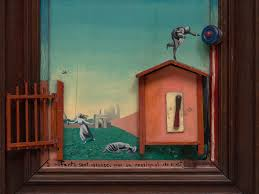
Two Children Are Threatened by a Nightingale, Max Ernst, 1925, Surrealism
Subject: German self-taught artist, naturalistic realist, two figures are scared by a tiny bird - absurdity, man on top of the building is fleeing while holding a child
Form: title is written at the bottom of the frame, atmospheric perspective, visual similarities to Dali’s work, bright technicolor sky, oranges and blues contrasting with each other, traditional linear perspective, show of depth, shows classical elements of representing figures and architecture, exists outside of the frame, an assemblage (3D collage), not sure if the nightingale is the problem - woman is holding a large knife, a gate is open to show the events, doorknob suggests another realm, disturbing and upsetting world, retreat deeper into the subconscious, grass is detailed, knife like form, not a sharp blade, figures are all black and white/gray scale - important distinction, maybe a look into the past, title preceded the image - came from reading a poem and thinking about it
Function: connected to the inner mind and looking into the subconscious, see the world in new and unique ways, the more you look the more you see
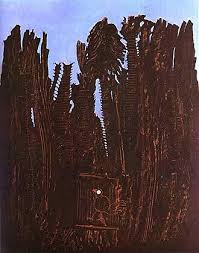
Forest and Dove, Max Ernst, 1925, Surrealism
Subject: German self-taught artist, naturalistic realist, oil on canvas, very dark image, blue sky with a forest and a small bird in the center
Form: forest is a recollection of his childhood, enchantment and terror, foreboding, powerful and threatening form, creepy texture, spiny and prickly, not an inviting forest, reaching up high, simple shape of trees going upward, most don’t have a top, lot of horizontal lines, coarse and rough nature of the bark, bird is trapped in the heart of the forest and within a square cage - dove symbolized himself, possibly how he felt as a child being trapped in the dark and scary forest, bright white eye of the dove - scared and pure state, peaceful creature, bird who has the ability to be free with wings is trapped in the cage and the forest, technique: grattage, scraping wet oil paint off a canvas laid over textured surfaces like wood, mesh, or leaves; frottage, automatic technique where you put paper over a texture and rub it to create a scene from there, used a fishbone to create the texture
Function: connected to the inner mind and looking into the subconscious, see the world in new and unique ways, the more you look the more you see
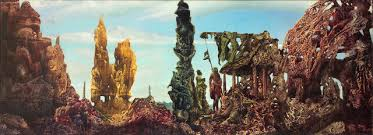
Europe After the Rain, Max Ernst, 1940, Surrealism
Subject: oil on canvas, German self-taught artist, naturalistic realist, traditional medium but using new techniques, right during WW2, impactful on American art, creepy image, apocalyptic scene, a few figures in the picture under remnants of a structure
Form: bright use of color, pleasant sky and calm clouds spread across, more you look it gets creepier, growth and gnarled, suggestive of a landscape, verticals and horizontals reaching across the picture plane, colors suggestive of autumn, decalcomania: placed his canvas/paper/glass on a wet painted surface and would then pull it away, chance textural effects, forms are organic and twisted, but seem cancerous and abnormal, rotted, living thing that looks turned inside out, figures are looking out into the composition to an area we can’t see, so much detail in the forms, overgrown and distorted, figure has classical figure type - contrapposto but has a bird head, lot of reds, purples, greens, and yellows, female figure has her back turned to the figure, remnants of the cow at the front, a woman’s body is on display, shows how war effects humans as well as nature and animals, remnants of civilization but through war, has been stripped of its ordered appearance and all that exists is chaotic masses of transforming nightmarish images
Function: connected to the inner mind and looking into the subconscious, see the world in new and unique ways, the more you look the more you see, commentary on world war 2
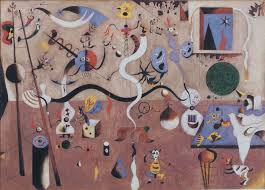
The Harlequin’s Carnival, Joan Miro, 1925, Surrealism
Subject: Spanish artist, biomorphic surrealist, title suggests joy and a carnival like setting, harlequin: traditional mask and diamond patterned tights - comic character, all other things seem to be floating and flying around
Form: drawing without thought, organic living forms, consciously reworks into a creation, feels primitive and fantastic amoeba like forms, unusual forms, suggestive but transformed into unrealistic images, weird little creatures spread out across the whole frame, harlequin does not seem happy - very sad, being upheld by other creatures, spike going through his head, music staffs - sense of celebration, things are odd and unusual, lot of eyes - watching you and a window into the soul (moving deeper within), lot of creatures flying - birds and butterflies, wings, creatures attached to each other
Function: connected to the inner mind and looking into the subconscious, see the world in new and unique ways, the more you look the more you see, expresses the horrors of being in Europe at the time, psychic automatism
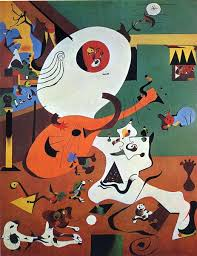
Dutch Interior I, Joan Miro, 1925, Surrealism
Subject: Spanish artist, biomorphic surrealist, some forms are suggestive of a house (animals like dogs and cats as well as a person), scene of everyday life
Form: drawing without thought, organic living forms, consciously reworks into a creation, feels primitive and fantastic amoeba like forms, unusual forms, suggestive but transformed into unrealistic images, taking an established image and transforming it into dream-like fantastic worlds, lot of bright primary colors, inspired by Jan Steen, outside scene expressed in the background with water and buildings, lot of geometric forms, major elements of original are still there (dog, lute player - very large and sinister though), window, paintings, cat), woman is no longer a traditional part of the scene - replaced by the table almost and melted apart, positivity of colors
Function: connected to the inner mind and looking into the subconscious, see the world in new and unique ways, the more you look the more you see, expresses the horrors of being in Europe at the time, psychic automatism
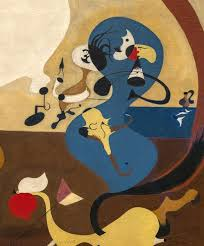
Dutch Interior II, Joan Miro, 1925, Surrealism
Subject: Spanish artist, biomorphic surrealist, abstract scene showing children making a cat dance - reminiscent, dog is in yellow, left orange figure has no childlike quality - looks upset, cat is being tormented funnily, girl making music, and boy dancing
Form: drawing without thought, organic living forms, consciously reworks into a creation, feels primitive and fantastic amoeba like forms, unusual forms, suggestive but transformed into unrealistic images, taking an established image and transforming it into dream-like fantastic worlds, lot of bright primary colors, inspired by Jan Steen, pokes fun at human fallibility, instrument up top, swirl of organic forms, bug like form wrapping around, circles are very present
Function: connected to the inner mind and looking into the subconscious, see the world in new and unique ways, the more you look the more you see, expresses the horrors of being in Europe at the time, psychic automatism
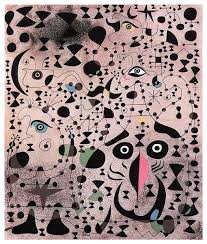
Beautiful Bird Revealing the Unknown to a Pair of Lovers, Joan Miro, 1940, Surrealism
Subject: Spanish artist, biomorphic surrealist, try to take the title and make sense of it, small composition, part of a series, had to escape Spain to go to France but then is invaded by Germany
Form: lot of black geometric figures, drawing without thought, organic living forms, consciously reworks into a creation, feels primitive and fantastic amoeba like forms, unusual forms, suggestive but transformed into unrealistic images, circles, eyes everywhere, lot of triangle/hour glass shapes, watercolor painting with charcoal added, lot of lines, stars, all connected everywhere, lot of symbolism - reality and sadness of the moment, creepy figures - being watched and nervous about how to escape, bird like shapes - shows freedom, hourglass figures are butterflies - a ton of them!, has a connection to transformation and rebirth - renewal, galaxy view: we move through time and change
Function: connected to the inner mind and looking into the subconscious, see the world in new and unique ways, the more you look the more you see, expresses the horrors of being in Europe at the time, psychic automatism
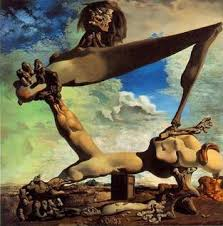
Soft Construction with Boiled Beans, Salvador Dali, 1935, Surrealism
Subject: monstrosity dominates the scene, title is confusing too, trying to make sense of the image in relation to dreams, political painting - Spanish Civil War (1936) becomes a police state, decomposing figure tearing itself apart (savage description), the figure is a vast human body breaking out into monstrous abnormal growths of limbs tearing at one another in a delirium of strangulation
Form: landscape has low horizon line, atmospheric perspective with a beautiful clouded sky, lot of blues, whites, and greys in the clouds, people are engaging in the civil war/everyone is against each other, horrific monster, forms are complete yet don’t make sense, agony on the face of the figure, parts of twisting and tearing, gnarled feet and hands, breast is being grabbed, anatomically muscular arm, organic lines, suggestive of a human but lost, objects are loosing their solidity, tongue is hanging loose, figure is placed on a small nightstand - suggests an object being placed on a sacrificial alter, beans are connected to sacrifice - ancient practice of this region of Spain where beans were offered up to appease the gods, man is staring at the body from the back, head is inspired by Goya (Saturn Devouring his Children), crazed look of self preservation, drawers is connected to idea of secrets being tucked away
Function: academically trained - reflected in his forms and traditional techniques, connected to the inner mind and looking into the subconscious, paranoiac critical method - spontaneous method of irrational understanding based on the interpretive critical association of phenomenon (disoriented state of mind), see the world in new and unique ways,
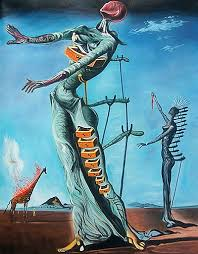
Flaming Giraffe, Salvador Dali, 1935, Surrealism
Subject: addresses Spanish Civil War, directly correlates to his feelings about the war, massive female figures in front and flaming giraffe, speaks to lose of humanity and identity to war
Form: classical training is evident - distorted but classically inspired with clothing and figure type, flesh is peeled off, drawers are open all throughout the body, face is revealed - identity is no longer visible, classic pose of stumbling in the dark, other female holds up long piece of flesh - speaks to notions of death and destruction, human race’s ability to devour and destroy, weird extensions in backs of figures - propped up, speaks to the weak and flawed nature of humanity - may directly speak to men, flaming giraffe - appears in several Dali works, represents the masculine cosmic apocalyptic monster - premonition of war
Function: academically trained - reflected in his forms and traditional techniques, connected to the inner mind and looking into the subconscious, paranoiac critical method - spontaneous method of irrational understanding based on the interpretive critical association of phenomenon (disoriented state of mind), see the world in new and unique ways
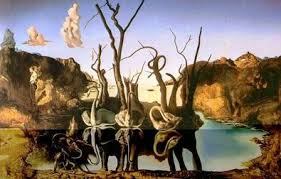
Swans Reflecting Elephants, Salvador Dali, 1935, Surrealism
Subject: small scale, intense and discordant colors, very bright, attention played to particulars/details, scene with swans, elephants, and a man in a confusing landscape, like a dream where we try to decode elements, naturalistic surrealism
Form: very complex scene, image that introduces double images in the same scene, lot of accuracy in form and realistic, but there are also elements that are at odds with reality, “hand painted dream photographs,” light hits off of several areas in a real way, many objects that don’t make sense, hard to define and identify, objects that don’t act the way they should, wants to discredit appearances (claim they are deceiving), forms are mostly complete, relying on the reflection of the lake to create the double image (swans turning into elephants, gnarled and dead trees add to the form of the swans to create elephants, atmospheric perspective, landscape is Spanish, swirling forms in the cliffs, self-portrait of Dali looking at the rocks, forms in the sky seem like clouds but aren’t traditional, harbor with ships in background, create in front is very intertwined
Function: academically trained - reflected in his forms and traditional techniques, connected to the inner mind and looking into the subconscious, paranoiac critical method - spontaneous method of irrational understanding based on the interpretive critical association of phenomenon (disoriented state of mind), see the world in new and unique ways
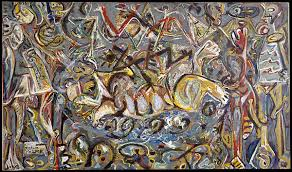
Pasiphae, Jackson Pollock, 1945, Abstract Expressionism
Subject: American abstract artist,
Form:
Function:
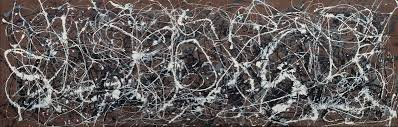
Arabesque, Jackson Pollock, 1945, Abstract Expressionism
Subject: American abstract artist,
Form:
Function:
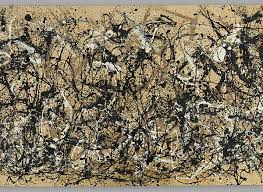
Autumn Rhythm, Jackson Pollock, 1945, Abstract Expressionism
Subject: American abstract artist,
Form:
Function:
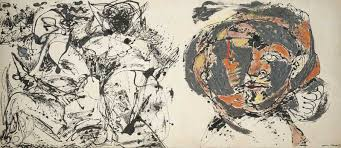
Portrait and a Dream, Jackson Pollock, 1945, Abstract Expressionism
Subject: American abstract artist,
Form:
Function:
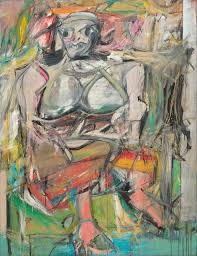
Woman I, Willem de Kooning, 1950, Abstract Expressionism
Subject:
Form:
Function:
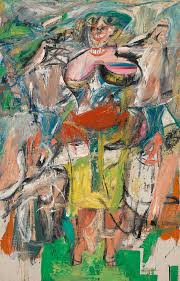
Woman and Bicycle, Willem de Kooning, 1950, Abstract Expressionism
Subject:
Form:
Function:
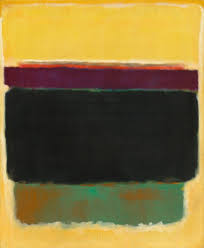
Untitled, Mark Rothko, 1950, Abstract Expressionism
Subject:
Form:
Function:
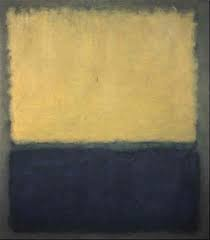
Light, Earth, and Blue, Mark Rothko, 1950, Abstract Expressionism
Subject:
Form:
Function:
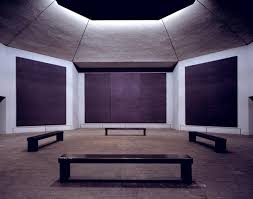
Rothko Chapel, Mark Rothko, 1960, Abstract Expressionism
Subject:
Form:
Function:
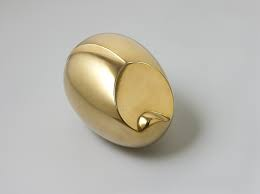
Newborn, Constantijn Brancusi, 1915, Pre- and Post-War Abstract Sculpture
Subject:
Form:
Function:
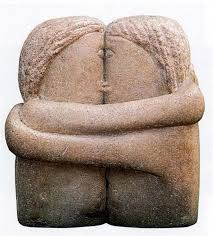
The Kiss, Constantijn Brancusi, 1915, Pre- and Post-War Abstract Sculpture
Subject:
Form:
Function:
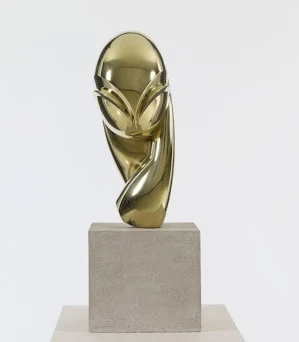
Mademoiselle Pogany, Constantijn Brancusi, 1915, Pre- and Post-War Abstract Sculpture
Subject:
Form:
Function:
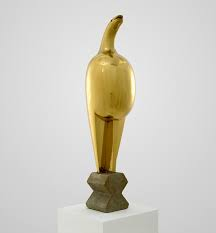
Maistra, Constantijn Brancusi, 1915, Pre- and Post-War Abstract Sculpture
Subject:
Form:
Function:
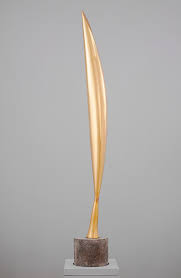
Bird in Space, Constantijn Brancusi, 1930, Pre- and Post-War Abstract Sculpture
Subject:
Form:
Function:
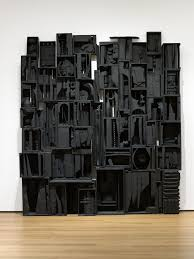
Sky Cathedral, Louise Nevelson, 1960, Pre- and Post-War Abstract Structure
Subject:
Form:
Function:
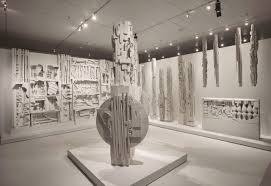
Dawn’s Wedding Feast, Louise Nevelson, 1960, Pre- and Post-War Abstract Structure
Subject:
Form:
Function:
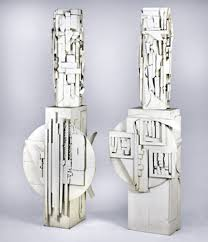
Bride and Disk and Groom and Disk, Louise Nevelson, 1960, Pre- and Post-War Abstract Structure
Subject:
Form:
Function:
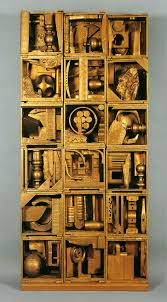
Royal Tide I, Louise Nevelson, 1960, Pre- and Post-War Abstract Structure
Subject:
Form:
Function:
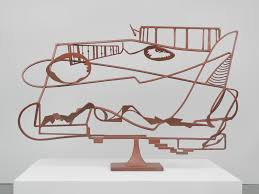
Hudson River Landscape, David Smith, 1950, Pre- and Post-War Abstract Sculpture
Subject:
Form:
Function:
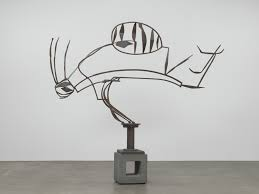
Australia, David Smith, 1950, Pre- and Post-War Abstract Sculpture
Subject:
Form:
Function:
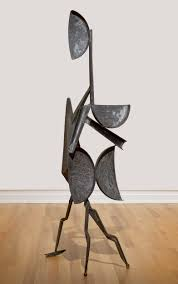
Tank Totem IV, David Smith, 1960, Pre- and Post-War Abstract Sculpture
Subject:
Form:
Function:
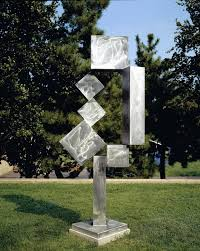
CUBI XII, David Smith, 1960, Pre- and Post-War Abstract Sculpture
Subject:
Form:
Function:

