Lecture 16. Cell junctions, cell adhesion and extracellular matrix
 Call Kai
 Learn
Learn Practice Test
 Spaced Repetition
 Match
Match Flashcards
 Knowt Play
1/49

There's no tags or description
Looks like no tags are added yet.
Name | Mastery | Learn | Test | Matching | Spaced | Call with Kai |
|---|
No analytics yet
Send a link to your students to track their progress
50 Terms
Cell junctions
tight junctions
adherens junctions
desmosomes
What can’t pass through tight junctions?
water molecules
What do tight junctions do?
They seal the gaps between epithelial cells
What do adherens junctions connect?
connect actin filament bundles in one cell with those in the next cell
connect the cytoskeleton of cells to each other or to the extracellular matrix
What do desmosomes connect?
They connect intermediate filaments in one cell to those in the next cell
What do gap junctions allow?
Allow the passage of small water-soluble molecules from cell to cell
act like channels
What do tight junctions form?
Barriers between the apical and basolateral domains
How are tight junctions sealed?
By claudins and occludins
transmembrane proteins
What are examples of cell-cell anchoring junctions?
adherens junctions
desmosomes
What do adherens junctions form?
They form adhesion belts between epithelial cells
What do cadherins protein mediate?
They mediatet cell adhesion to the adherens junction
What are cadherins proteins?
Are calcium dependent homotypic cell adhesion proteins
without calcium binding is weak
Where do cadherins bind?
They bind to the actin cytoskeleton through anchor proteins called catenins
What is special about cadherins?
They tend to self-aggregate and have affinity for eachother (E vs. N)
What’s an important example of cadherins?
They play an important role in neural tube development
invagination
What is an E-cadherin?
Epithelial cadherin
What is N-cadherin?
Neural cadherin
What happens during development in cells?
They segregate from one another depending on the cadherins they express
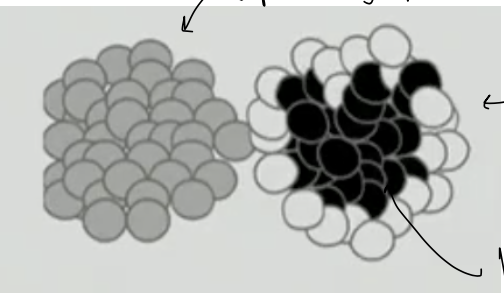
Pop Quiz
Cells expressing either N-cad (A), high levels of E-cad (B), or low levels of
E-cad (C) have sorted themselves out on a substratum as shown below.
A, C, B
N is a seperate group (grey)
C is low E so it’s “hiding”
and high E is on the outside, still interacting with low E
What do desmosomes serve as?
Serve as anchoring sites for intermediate filaments
are connected internally to intermediate filament in cytoskeleton
What serve as the transmembrane recepetors in Desmosomes?
Desmoglein and desmocollin
form a heterodimer
are cadherin-family members
What serve as the intracellular anchoring proteins in desmosomes?
Plakoglobin and desmoplakin
What would result if there was a mutation in the anchoring proteins (plakoglobin & desmoplakin)
Prevents binding of desmosomes to intermediate filaments
What diseases result from desmosomes?
Skin diseases where antibodies are made against their own desmosomal proteins, result in severe blistering
What are Cell-ECM anchoring junctions?
Focal adhesions and hemi-desmosomes
What is a focal adhesion?
actin-linked cell-matrix adhesion anchors actin filaments in cell to ECM
What are hemidesmosomes?
Hemidesmosomes anchor intermediate filaments in a cell to the ECM
What makes up the focal adhesion structure?
Integrins and Vinculin
What are integrins?
they’re the receptors that cluster at focal adhesions. Bind to many ECM components including collagens and laminins
binds to many things to ensure it’s tightly bound to basal lamina
What is Vinculin?
Vinculin marks focal adherins where bundles of actin filaments terminate at the plasma membrane, connecting receptors that bind the ECM
adaptor proteins bind to actin
are inside the cell
Why are integrins important
They’re the major receptor for the ECMW
What makes up a transmembrane heterodimer?
alpha and beta subunits that are held together by noncovalent bonds
9 types of beta subunits
24 types of alpha subunits
How are hemi desmosomes different or similar to focal adhesions?
Similar: Integrins act as the transmembrane receptor and the anchor is to the ECM
difference: the intracellular attachment is to intermediate filaments (similar to desmosomes)
What is selectin?
a protein that’s highly expressed in endothelial cells (cell wall)
What do selectins do?
They mediate transient cell-cell adhesion in the bloodstream
mediate heterotypic binding
they bind to carbohydrates (sugars/lectins) that are attached to the surface of cells
How do selectins and integrins work together?
They let white blood cells leave the bloodstream and enter tissues
When there is weak adhesion and rolling what is present?
Selectin
When there is strong adhesion and emigration what is present?
Integrin
Extracellular matrix (ECM)
How is connective tissue important?
connective tissue under the epithelium contains a variety of ECM components, many of which are made by fibroblasts
What are Glycosaminoglycans (GAGs)?
an ECM component
polysaccharide
unbranched polysaccharide chains composed of a repeating disaccharide unit
are highly negatively charged, attract Na+ ions
occupy a huge amount of space and form hydrated gel
What are proteoglycans?
An ECM component
GAGs that are linked to a protein backbone
an ex. is aggrecan found in cartilage
What is collagen?
An ECM component
synthesized by fibroblasts
What is the structure of collagen?
an alpha chain
3 alpha chains wrap around each other to form a triple-stranded helical rod
Where can the different types of collagen be found?
Bone, cartilage, skin, and blood vessels
What can happen if there’s a collagen gene mutation?
Weak bones, easier to fracture, joint or bone deformaties
What is basal lamina?
An ECM component
underlies all epithelial sheets
What does basal lamina contain?
laminin, perlecan, nidogen, and type 4 collagen
Case study - role of beta 4 integrin
What is beta 4 required for ?
Hemidesmosome formation
skin issues/blisters

