PLT THINKERS
 Call Kai
 Learn
Learn Practice Test
 Spaced Repetition
 Match
Match Flashcards
 Knowt Play
1/31

There's no tags or description
Looks like no tags are added yet.
Name | Mastery | Learn | Test | Matching | Spaced | Call with Kai |
|---|
No analytics yet
Send a link to your students to track their progress
32 Terms
Who was Jerome Bruner?
He was an educational thinker who created constructivism & discovery Learning Theory
What are the core tenants of constructivism and discovery learning theory?
Three stages to levels of learning
• Enactive (action/involved)
• Iconic (images and models)
• Symbolic (abstract ability)
Spiral Curriculum/Education: building up from previous knowledge to construct ideas.
Who was John Dewey?
Believed in student-centered experience learning.
What are the core tenants of John Dewey’s Theory?
Students should be actively engaged in their own learning
• Teachers/students thrive in academic autonomy
• Context: past experiences, how the event takes place, & levels of engagement
• Pragmatic theory of truth: discovery
Who was Erik Erikson?
Created the 8 stages of Human Development
What are the core tenants of the 8 stages of Human Development?
• Infancy (Trust vs. mistrust) 0-2
• Toddler (Autonomy vs. Doubt) 2-4
• Early Childhood (Initiative vs. Guilt) 4-6
• Elementary (Industry vs. Inferiority) 6-12
• Adolescence (Identity vs. Role Confusion) 12-18
• Young Adult (Intimacy vs. Isolation) 19-40
• Middle Adult (Generativity vs. Stagnation) 40-65
• Late Adult ( Ego Integrity vs. Despair) 65+
Who was Lawrence Kohlberg?
Developed the moral development theory
What are the core tenants of the Moral Development theory?
Pre-conventional (directed consequences)
• Punishment/avoidance: based on avoiding punishment & earning reward
• Exchange of favors: others have needs but mine is greater (self-interests)
• Conventional (wanting to please)
• Good boy/girl: maintain image, please another
• Law/order: unchangeable rules to make order
• Post-conventional (sense of justice)
• Social Contract: rules are contracts/social agreements and can change (just laws)
• Universal Ethical Principle: maintains a few principles that surpasses the rules to regulate self
Who was Abraham Maslow?
Created the heirarchy of needs
What are the core tenants of the Hierarchy of Needs?
Physiological: breath, eat, drink,
sleep,
• Safety: earn $ and shelter
• Love: love & belonging
• Esteem: SPECIAL self confidence,
respect from others
(perform/compete)
• Self-actualization: generosity
with leisure
Who was Maria Montessori?
Developed an individual student learning model
What are the core tenants of the individual student learning model?
Learning Process
• Learn concept
• Process concept through exploration
and practice
• Knowledgeable on concept (teach)
• Emphasizes
• individuality/independence
(children’s individual pace)
• Engage all senses in prepared environment (special needs)
Who was Jean Piaget?
Created the stages of cognitive development
What are the core tenants of the stages of cognitive development?
Learning: new experiences are assimilated into pre-schema, schema is accommodated to fit new experience
•Schema: concept of how something works
•Assimilation: new experience & adding to pre
•Accommodation: changing schema to fit
Sensorimotor (0-2) Reflexes reflexes (sucking motion in new born);
Primary circular reactions (1-4 mon.) no goal;
Secondary circular reactions (4-8 mon.) goal;
Coordination of secondary circular reactions (8-12 mon.) desired goal reached by series of actions;
Tertiary circular reaction (12-18 mon.) reverse series of action; Object Permanence: objects exist without being seen
•Pre-operational (2-7) Imaginary Play Egocentrism: my perspective is everyone’s perspective (3 mountain problem ) Why? Animism (object has emotions) Artificialism (object given ability to act) Transductive Reasoning (Object responded to external action) Trouble distinguishing mounts/quantities
•Concrete operational (2-11) Seriation: organize objects on multiple levels; Hierarchical Organization: animals, mammals, canine, dogs; Reversibility: return objects to original state; Decentration: compare aspects
of item; Transitivity: put things in order; Struggle with deductive reasoning
Formal Operational (11-15) Deductive reasoning: information to draw conclusion; Test hypothesis to discover future; Abstract thinking by imagine what would happen; Meta-cognition: change thinking patterns
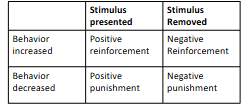
Who was BF skinner?
Developed the operant conditioning model (pr, pp, nr, np)
What are the core tenants of the operant conditioning model?
Who was Lev Vygotsky?
developed sociocultural theory
What are the core tenants of sociocultural theory?
Learning: Social interactions (parents, peers, siblings, & teachers) Cultural Values (beliefs & traditions) Individual (language & Communication skills)
• Intrapersonal: individual
• Interpersonal: social/compared
• Zone of Proximately Development: Learning that takes place at or just above independent learning from current to potential knowledge
• Scaffolding: helping students learn
Who was Howard Gardner?
developed the multiple intelligences theory
What are the core tenants of the multiple intelligences theory
Verbal
Mathematical/logical
Visual/spatial
Kinesthetic
Musical
Intrapersonal
Interpersonal
Natural
Existential
Who was Nitza Hidalgo?
Developed the levels of culture theory
What are the core tenants of the levels of culture theory?
Concrete (surface i.e. clothing, food,
celebrations)
• Behavioral (unspoken rules i.e. social roles &
nonverbal communication)
• Symbolic (unconscious rules i.e. values &
beliefs)
• Culture Systems of belief, values,
assumptions to guide behavior/share
(learned)
• Generational transmitted
• Based on symbols
• Ethnocentric own culture lenses to view
other cultures
Who was Luis Mull
developed the funds of Knowledge theory
What are the core tenants of the funds of knowledge theory?
Unknown resources of knowledge
that a teacher/school may not
understand
• Fund of knowledge: historically
accumulated/culturally bodies of
knowledge/skills essential for
function/well-being
• Incorporate into daily life; What
students know/do in known world
(i.e. homevisits); Literacy & Numeracy
assessment to identify specific are;
Provide experiences and relate
content to specific areas of concern
Who was albert bandura
developed the social learning theory
What are the core tenants of the social learning theory?
Children learn by observing others (modeling/viewing experiences) not always directly reward
• Reciprocal Causation Model (not always equilateral triangle) person, environment, behavior
• Transmit: cues, strengthen/weaken existing, new pattern of behavior
• Model POWER: Live (mother/father) Symbolic Models (socially appropriate & aware of others like super hero/computer game)
• Vicarious reinforcement: arouse emotional reaction in other by model as reinforcement for behavior and positive emotion in observer
• Punishment: Administered (info about behavior, restraint on imitating, devalued) Absence (acceptance of behavior) Lack of punishment & violence as a solution
• Direct Reinforcement: imitate the model
• Self-reinforcement: established standards & evaluate behavior
• Self-Efficacy: ability to produce results with own actions (social
Modeling, Mastery, Social Persuasion, Physical and emotional state
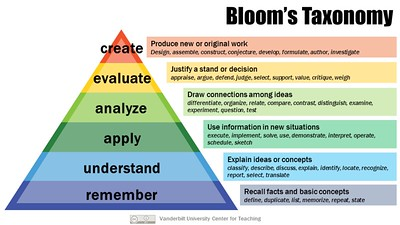
Who was Benjamin Bloom?
Created the original blooms taxonomy
What are the core tenants of blooms taxonomy?
Who was Edward Thorndike?
developed the theory of Connectionism and Law of effect
What are the core tenants of connectionism and law of effect?
Stated that behaviors followed by positive outcomes are strengthened, while those followed by negative ones are weakened.
Who was John B Watson?
Developed behaviorism
What are the core tenants of behaviorism?
posits that all behaviors are learned from the environment through conditioning. He emphasized that observable, measurable behavior—not internal mental processes—is the focus of education.

