Chapter 13: Mendel's Experiments and Heredity
 Call Kai
 Learn
Learn Practice Test
 Spaced Repetition
 Match
Match Flashcards
 Knowt Play
1/30

There's no tags or description
Looks like no tags are added yet.
Name | Mastery | Learn | Test | Matching | Spaced | Call with Kai |
|---|
No analytics yet
Send a link to your students to track their progress
31 Terms
Genetics
The scientific study of heredity.
Heredity
The process of passing traits from parents to offspring through genes.
Pangenesis
Early theory that "gemmules" (seeds) are released from all cells and collect in gametes.
Preformationism
The debunked belief that organisms grow directly from gametes (uniparental inheritance).
Blending Hypothesis
Darwin's idea that offspring are simply a mathematical average of both parents.
Gregor Mendel
The "Father of Genetics"; an Austrian monk who studied inheritance using pea plants.
True-breeding
Plants that, when self-fertilized, always produce offspring with the same phenotype as the parent.
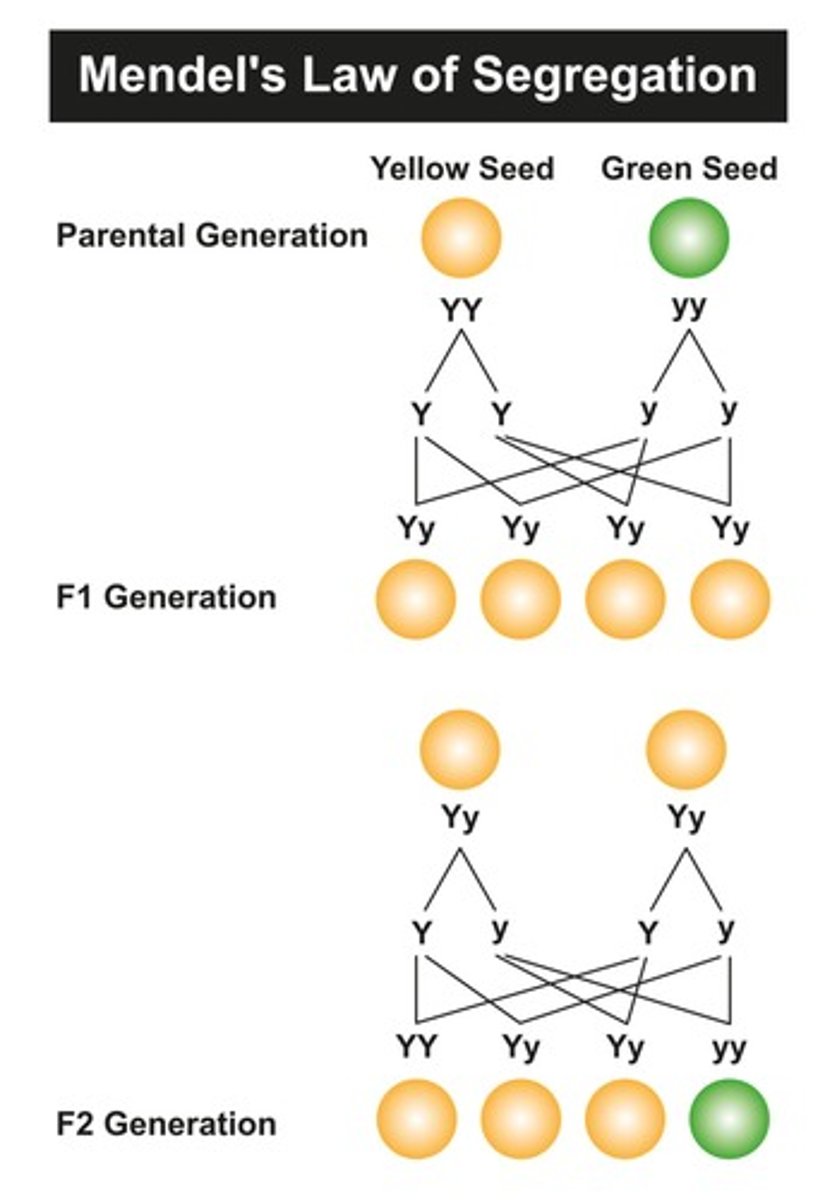
F1 Generation
The first generation of offspring from a cross of true-breeding parents; usually shows only the dominant trait.
F2 Generation
The offspring resulting from the self-fertilization of the F1 generation; shows a 3:1 ratio of traits.
Alleles
Alternative versions of the same gene (e.g., Purple vs. White flowers).
Dominant Allele
The allele that is always displayed in a heterozygote, masking the other version.
Recessive Allele
The allele that is masked in a heterozygote; only expressed when two copies are present.
Law of Segregation
Principle stating that two alleles for a trait separate during meiosis so each gamete carries only one.
Homozygous
Having two identical alleles for a gene (can be dominant or recessive).
Heterozygous
Having two different alleles for a gene (one dominant, one recessive).
Genotype
The specific genetic makeup or combination of alleles in an individual.
Phenotype
The observable physical traits or characteristics of an individual.
Punnett Square
A grid used to predict the potential genotypes and phenotypes of offspring from a cross.
Monohybrid Cross
A cross between individuals that involves one specific characteristic (e.g., flower color).
Dihybrid Cross
An experiment evaluating two different characters at once to see if they are inherited together or separately.
Law of Independent Assortment
Genes for different traits assort independently of one another (only if they are on different chromosomes).
Incomplete Dominance
When heterozygotes display an intermediate, "blended" phenotype (e.g., Red x White = Pink snapdragons).
Codominance
When both alleles contribute equally and distinctly to the phenotype (e.g., AB blood type).
Epistasis
When one gene masks or interferes with the expression of a second gene (e.g., coat color in Labs).
Polygenic Inheritance
When multiple genes combine to influence a single phenotype (e.g., human skin color).
Environmental Influence
The concept that phenotype is a result of both genotype and environmental factors.
Pedigree Chart
A family tree diagram used to track the inheritance patterns of specific genetic traits.
Dominant Pattern
Inheritance where affected offspring must have at least one affected parent.
Recessive Pattern
Inheritance where affected offspring can come from two unaffected (carrier) parents.
Carrier
An unaffected heterozygote who "carries" a recessive allele and can pass it to offspring.
Overdominance
When a heterozygote has a survival advantage over both homozygotes (e.g., Sickle Cell carriers resisting Malaria).

