Bio1110 Food Processing
 Call Kai
 Learn
Learn Practice Test
 Spaced Repetition
 Match
Match Flashcards
 Knowt Play
1/29

There's no tags or description
Looks like no tags are added yet.
Name | Mastery | Learn | Test | Matching | Spaced | Call with Kai |
|---|
No analytics yet
Send a link to your students to track their progress
30 Terms
Why do we need to take in food?
For energy, essential nutrients and organic molecules (things animals cannot make like some amino acids that we can make from simple organic molecules that we get from food)
What is a catabolic process?
Breaking down materials
What is a anabolic process?
Using foundation level materials to build molecules
What molecules can we extract energy from?
Carbohydrates (sugars), Fats (glycerol fatty acids), and Proteins (amino acids)
How is energy extracted from molecules?
Through cellular respiration where the sugars/fatty acids/amino acids are broken down and used to make ATP
What are the building blocks for Carbohydrates?
Monosaccharides (glucose, fructose, and galactose, We eat starches and sugars → digestive enzymes break them down into monosaccharides → absorbed into the bloodstream
What are the building blocks of Proteins?
Amino acids, we can make some of them ourselves, others we get from breaking down food since we can’t make them on our own
What are the building blocks of Lipids?
Glycerol and fatty acids, We eat fats and oils → bile emulsifies them → enzymes break them into glycerol + fatty acids → absorbed and reassembled into triglycerides
What are the building blocks of Nucleic acids?
Nucleotides, We eat plants and animals → their cells contain DNA/RNA → digestion breaks nucleic acids into nucleotides → we reuse them to build our own DNA/RNA
What is ingestion?
taking food into the body for it to be digested
What are the four modes of ingestion that we see in animals?
Suspension feeders, Fluid feeders, Substrate feeders, and Bulk feeders
What is suspension feeding?
filtering food particles out of water, some whales do this and so do sponges
What is Fluid feeding?
ingesting the liquid (different from suspension because suspension doesn’t consume the water), ex. blood so a lot of blood sucking insects
What is substrate feeding?
living on and making your food source your home, caterpillars do this
What is bulk feeding?
bringing large chunks of food into the body, we do this
What are the three main diets that animals have?
Herbivores, Omnivores, and Carnivores
What do herbivores eat?
plants or algae, deer do this
What do Omnivores eat?
plants and other animals, bears and we do this
What do Carnivores eat?
other animals, lions do this
What is another type diet outside the main three?
Detritivores - eat partially decaying plant material, worms do this
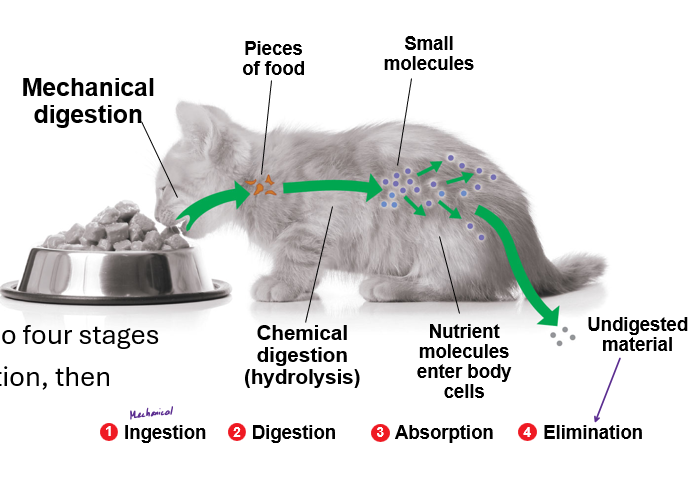
What are the four stages of food processing
Ingestion, Digestion, Absorption, and Elimination
What is digestion?
breaking food molecules down to the monomers so that they can be used to make things our bodies need that we can’t make on our own
Mechanical Digestion is …
breaks food up into smaller pieces, it increases the surface area of the food, this way there is more SA so more enzymes can attach to the food and break it down
Chemical digestion is …
hydrolysis → polymers to monomers, enzymes, acids, and bile to break chemical bounds, breaks macromolecules down so they can be absorbed
Food molecules cannot be used …
directly, they are too big and not a perfect match with the macromolecules needed by the animal
Chemical digestion occurs in specialized …
compartments, they must be restricted so that the enzymes don’t start breaking down our bodily systems
Sponges digest all their food how?
lysosomes (they use low pH and enzymes), they use this simple method because they don’t need to digest more complex food
Incomplete digestive tracts use …
Extracellular digestion (inside gastrovascular cavity, food particles are absorbed by cells and released in GVC and digestive enzymes go in and break them down)
Canal =
tube
Food processing for complete digestive systems is …
a one-way flow, division of labor, extracellular digestion, then absorption, has a beginning and end