Heart sound 1

0.0(0)
studied byStudied by 0 people
0.0(0)
call kaiCall Kai
learnLearn
examPractice Test
spaced repetitionSpaced Repetition
heart puzzleMatch
flashcardsFlashcards
GameKnowt Play
Card Sorting

1/139

encourage image

There's no tags or description

Looks like no tags are added yet.

Last updated 3:29 AM on 2/3/26
Name
Mastery
Learn
Test
Matching
Spaced
Call with Kai

No analytics yet

Send a link to your students to track their progress

140 Terms

1
New cards
Heart sounds
Sounds produced due to closure or opening of heart valves
2
New cards
Cardiac cycle
Sequence of events occurring during one heartbeat
3
New cards

Atrial systole

Phase where atria contract and fill ventricles
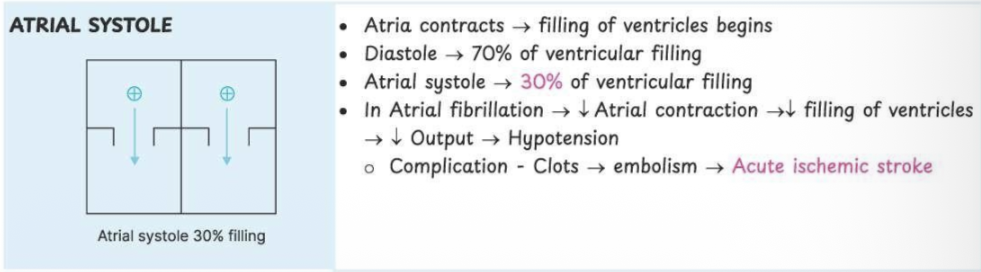
<p>Phase where atria contract and fill ventricles</p>
4
New cards
Percentage of ventricular filling by atrial systole
30% of ventricular filling
5
New cards
Percentage of ventricular filling during diastole
70% of ventricular filling
6
New cards
Effect of atrial fibrillation on ventricular filling
Absent atrial contraction → decreased ventricular filling → decreased cardiac output → hypotension
7
New cards
Major complication of atrial fibrillation
Clot formation → embolism → acute ischemic stroke
8
New cards

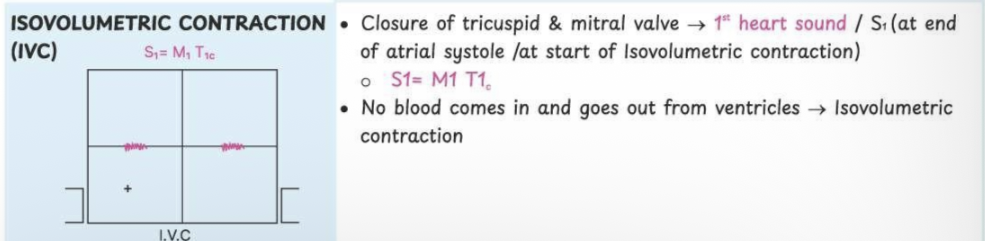
Isometric contraction

knowt flashcard image
9
New cards
Cause of first heart sound (S1)
Closure of mitral and tricuspid valves
10
New cards

Timing of S1

at End of atrial systole /at start of isovolumetric contraction

11
New cards

Mnemonic for S1

M1T1

12
New cards
Isovolumetric contraction
Phase where ventricles contract but no blood enters or leaves
13
New cards
Valve status during isovolumetric contraction
All valves closed
14
New cards
Ventricular pressure during isovolumetric contraction
Pressure starts building up
15
New cards

Valve bulge after isovolumetric contraction

Slight bulge in mitral and tricuspid valves

16
New cards

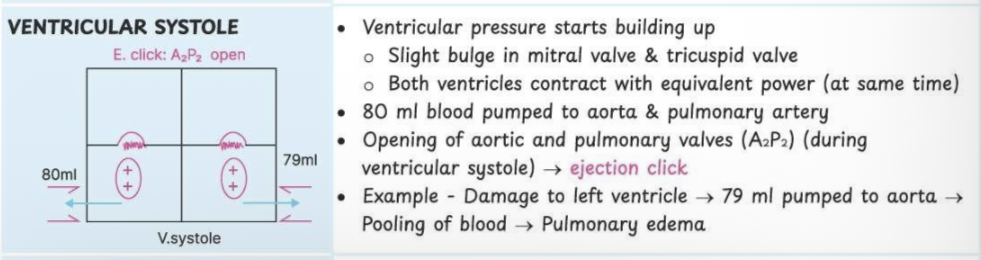
Ventricular systole

knowt flashcard image
17
New cards

Ventricular contraction pattern in ventricular systole

Both ventricles contract simultaneously with equal force

18
New cards
Stroke volume during ventricular systole
Approximately 80 ml
19
New cards
Valves opening during ventricular systole
Aortic and pulmonary valves
20
New cards
Ejection click
Produced due to opening of aortic and pulmonary valves
21
New cards

Ejection click is seen in

  • Normal

  • Aortic stenosis

22
New cards
Cause of pulmonary edema in LV dysfunction
Reduced blood ejection → pooling → pulmonary edema
23
New cards

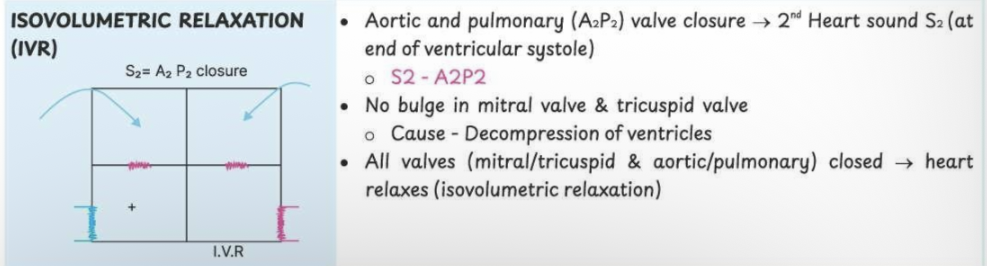
Isovolumetric relaxation

knowt flashcard image
24
New cards
Cause of second heart sound (S2)
Closure of aortic and pulmonary valves
25
New cards
Timing of S2
End of ventricular systole
26
New cards
Components of S2
A2 and P2
27
New cards
Valve bulge during S2
Absent bulge of mitral and tricuspid valves
28
New cards
Cause of valve behavior in S2
Decompression of ventricles
29
New cards
Isovolumetric relaxation
Phase where heart relaxes with all valves closed
30
New cards
Valve status during isovolumetric relaxation
Mitral, tricuspid, aortic and pulmonary valves closed
31
New cards

Rapid ventricular filling phase

Initial phase of diastole where blood flows rapidly into ventricles
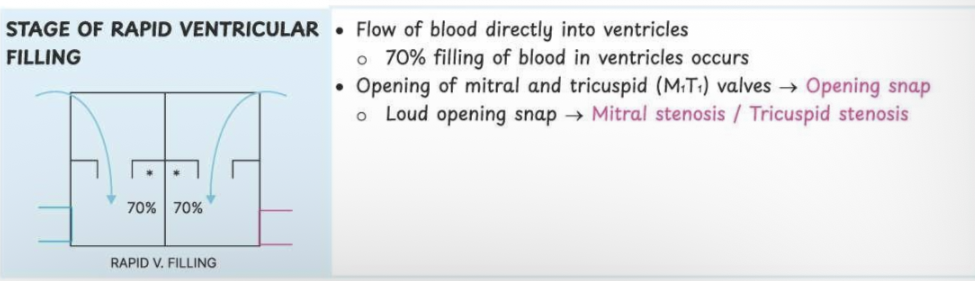
<p>Initial phase of diastole where blood flows rapidly into ventricles</p>
32
New cards

Maximum filling occur in which phase of cardiac cycle

rapid ventricular filling

33
New cards
Percentage of filling during rapid ventricular filling
70% of ventricular filling
34
New cards
Valves opening during rapid ventricular filling
Mitral and tricuspid valves
35
New cards
Opening snap
Sound produced due to opening of stenosed AV valves
36
New cards
Cause of loud opening snap
Mitral stenosis or tricuspid stenosis
37
New cards

Gap between second heart sound

splitting of 2nd heart sound

38
New cards

Time lag between A2P2 splitting

30 msec

39
New cards

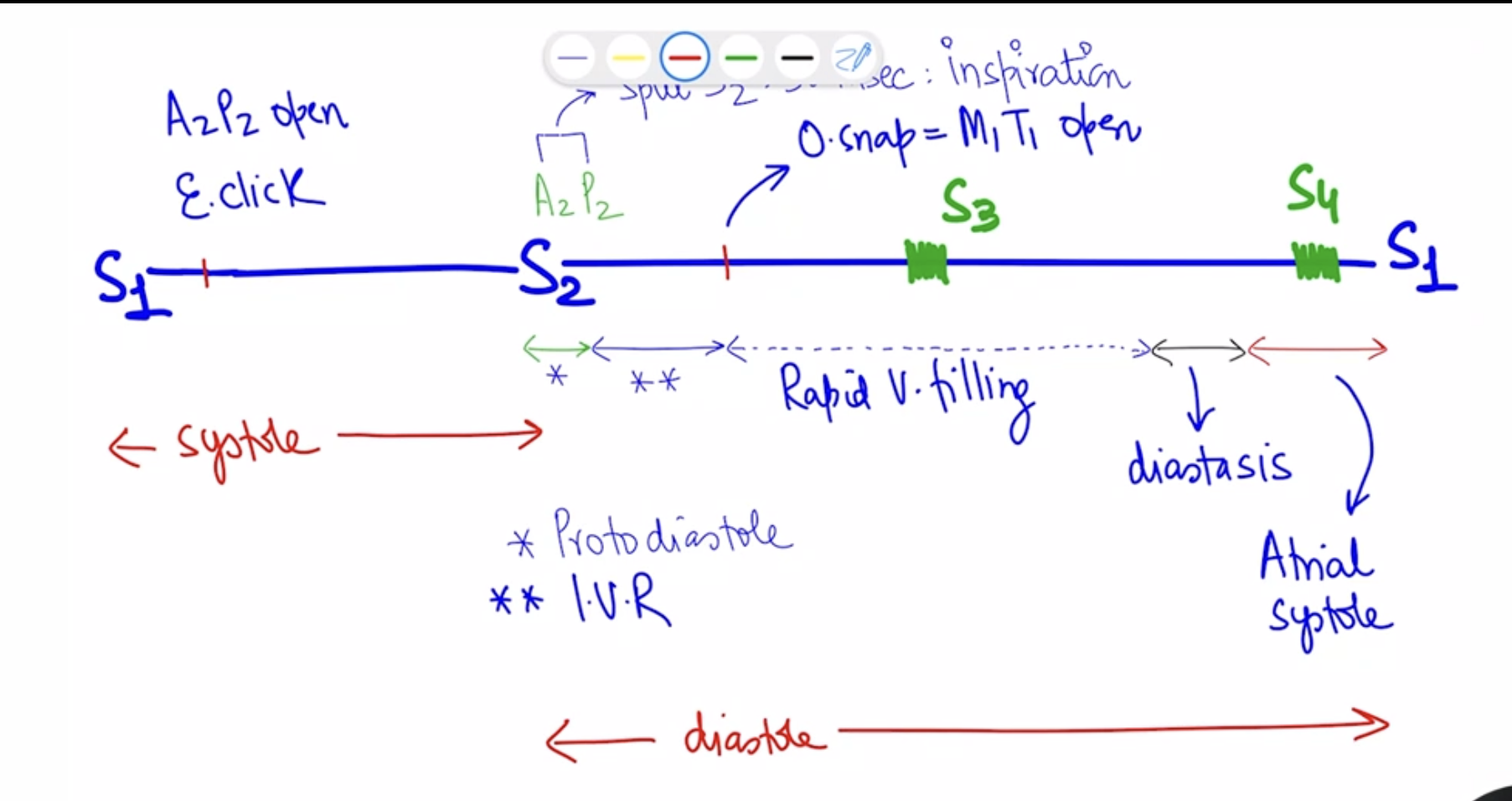
Full linear diagram of sound, systole, diastole
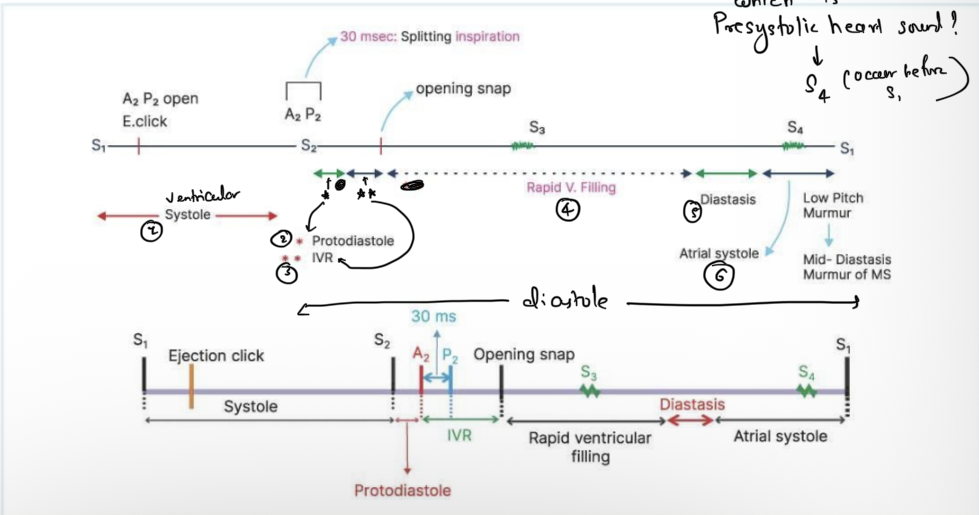
knowt flashcard image
40
New cards

Between s1 and s2

ventricular systole

41
New cards

What is protodiastole?

period between end of systole to closure of A2P2 ( valve need some time to close )

42
New cards

Phase just after s2

protodiastole

43
New cards

Period between s2/protodiastole till opening snap

IVR (isovolumetric relaxation)

44
New cards

Phase after IVR

rapid ventricular filling

45
New cards

Sound in rapidventricular filling

S3

46
New cards

Other name of 3rd heartsound

ventricular gallop rhythm

47
New cards

Diastasis

Phase of minimal ventricular filling

48
New cards

Least movement of heart present in

diastasis

49
New cards
Meaning of diastasis
Heart appears to stand still
50
New cards
Systole duration
S1 to S2
51
New cards

Systole phase present between

S1 to S2

52
New cards
Diastole duration
S2 to S1
53
New cards

Phases in diastole

  1. Protodiastole

  2. IVR

  3. Rapid ventricular filling

  4. Diastasis

  5. Atrial systole

54
New cards

All events chart in video

knowt flashcard image
55
New cards
Protodiastole
Early diastolic phase immediately after S2
56
New cards

Splitting of S2 more prominent in

inspiration

57
New cards
Third heart sound (S3)
Occurs during rapid ventricular filling
58
New cards
Cause of S3
Blood hitting ventricular wall
59
New cards
Age significance of S3
Physiological in
60
New cards
Fourth heart sound (S4)
Occurs during atrial systole
61
New cards

Other name of 4th heart sound

atrial gallop rhytm

62
New cards

Which heart sound present before S1

s4

63
New cards
Cause of S4
Pathological stiff ventricle
64
New cards
Gallop rhythm
Combination of abnormal heart sounds (S3 or S4)
65
New cards
Time gap between A2 and P2
Approximately 30 milliseconds
66
New cards
Physiological splitting of S2
More prominent during inspiration
67
New cards
Cause of S2 splitting
Increased venous return delays P2
68
New cards
Pitch of S1, S2 and opening snap
High pitched
69
New cards

High piched heart sound

(Heard by diaphragm)

  • S1

  • S2

  • Opening snap

70
New cards
Stethoscope part for high pitched sounds
Diaphragm
71
New cards
Pitch of S3, S4 and murmurs
Low pitched
72
New cards

Low pitched heart sound include

Heard through bell

  • S3

  • S4

  • Tumor plop sound (in cardiac tumor e.g atrial myxoma)

73
New cards
Stethoscope part for low pitched sounds
Bell
74
New cards
Tumor plop sound
Low pitched sound seen in atrial myxoma
75
New cards
Cause of tumor plop
Swinging tumor hitting mitral valve leaflet
76
New cards
Tumor causing plop sound
Atrial myxoma
77
New cards

Low pitch murmer

mid diastolic murmer

78
New cards

Is murmer heart sound?

no, it is due to turbulence of blood

79
New cards
Mid diastolic murmur heard with bell
Mitral stenosis
80
New cards

Cardiac auscultation areas

Five standard areas
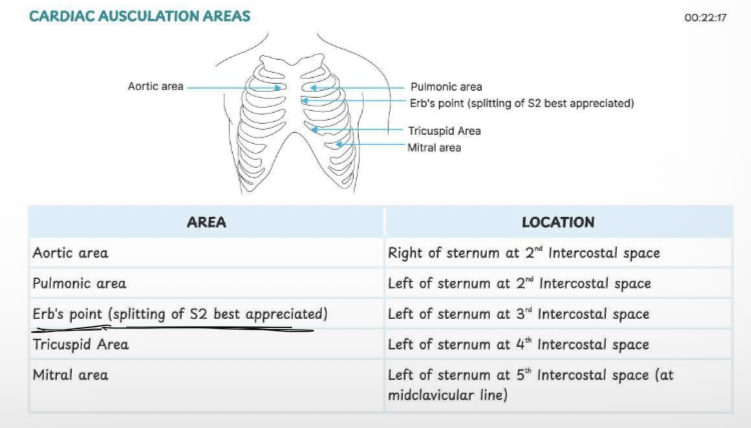
<p>Five standard areas</p>
81
New cards
Aortic area location
Right of sternum at 2nd intercostal space
82
New cards
Pulmonic area location
Left of sternum at 2nd intercostal space
83
New cards
Erb’s point location
Left of sternum at 3rd intercostal space
84
New cards
Best area to hear S2 splitting
Erb’s point
85
New cards
Tricuspid area location
Left of sternum at 4th intercostal space
86
New cards
Mitral area location
Left 5th intercostal space at midclavicular line
87
New cards
Nature of atrial myxoma
Pedunculated benign tumor
88
New cards

Site of atrial myxoma

Left atrium ( attached by stalk to wall)

89
New cards
Behavior of atrial myxoma
Swings like pendulum in atrial cavity
90
New cards
Effect of atrial myxoma on blood flow
Acts as obstacle to mitral inflow
91
New cards
Clinical feature of large atrial myxoma
Mid diastolic murmur mimicking mitral stenosis
92
New cards
Effort intolerance in atrial myxoma
Due to reduced LV filling
93
New cards

Sound mechanism in atrial myxoma

tumor obstacle →blood hit tumor →swinging of tumor →hit mitral valve leaflet → produce sound

94
New cards

Big sized atrial myxoma cause

mitral stenosis

95
New cards
Platypnea
Breathlessness on sitting relieved on lying down
96
New cards

Cause of platypnea in atrial myxoma

Tumor obstructs valve in upright position (gravity)

97
New cards

Clinical features of atrial myxoma

  • young female

  • Dyspnea on exertion

  • Platypnea ( breathlessness while sitting → resolve on lying)

  • Transient ischemic attacks ( embolism of platelet plug, embolism of tumor cell)

98
New cards
Cause of TIA in atrial myxoma
Tumor emboli or platelet emboli
99
New cards

Examination finding in atrial myxoma

  • Pallor

  • Tumor plop

  • Mid-diastolic murmer

  • Mitral regurgiattion ( damage to mitral leaflets )

100
New cards
Long term effect of atrial myxoma
Mitral regurgitation due to leaflet damage