L12: Ruminant Digestion and Metabolism of Proteins
 Studied by 0 people
 Call with Kai
 Learn
Learn Practice Test
 Spaced Repetition
 Match
Match Flashcards
 Knowt Play
1/40

Earn XP
Description and Tags
Unit 3 Nutrition
Name | Mastery | Learn | Test | Matching | Spaced | Call with Kai |
|---|
No study sessions yet.
41 Terms
(T or F) Ruminants can subsist on a very low (sometimes almost zero) protein diet
True
How can ruminant survive on little protein?
Ruminants get the protein they need from the microbes in their rumen. The microbes have a high biological value and an amino acid profile that closely resembles what the host needs. The amino acid composition of microbial proteins is very similar to that of muscle and milk proteins.
(T or F) There are no proteases in ruminant saliva
True
What are the two microorganisms responsible for protein digestion in the rumen?
Bacteria and Protozoa
(T or F) There is proteolytic secretion in the rumen.
False
Where is endogenous (recycled) N from in ruminants
Saliva or the rumen wall
There are two types of dietary protein. Name and describe them.
Rumen degradable protein (RDP), is available to be digested by rumen microbes
Rumen undegradable protein (RUP), escapes the rumen and enters the small intestine without being digested.
Why might a producer feed their cattle non-protein nitrogen? (NPN)
NPN is a source of nitrogen that is not associated with amino acids. However, microbes can still use them to synthesize proteins. They are relatively cheap and a good source of nitrogen which is why farmers might use them in feed.
What happens to RUP?
If it escapes the rumen then hopefully it will be digested in the small intestine, if not, it will enter the large intestine and be unavailable to the rumen.
(T or F) There is no protein absorption in the rumen or large intestine.
True
(T or F) Ruminants can have as much protein as possible without regard to carbohydrates.
False, they need a balance of carbohydrates and proteins. Microbes use a combination of VFAs from carbs and amino acids from protein to create energy.
Microbial crude protein synthesis relies on synchronization of _______ (for carbon backbones and ATP) and _______ (For amino groups).
Carbohydrates, nitrogen
What happens to rumen ammonia?
It can be absorbed in the reticulorumen and omasum and used to make new amino acids for protein. It is utilized by the liver to make urea.
What can cause an excess of ammonia?
Shortage of energy relative to available ammonia.
What happens to reabsorbed ammonia?
It is transported to the liver where it can be converted into urea through the urea cycle. It can come back into the rumen through simple diffusion or saliva. If there is too much urea, ammonia toxicity can occur because urea is very toxic.
(T or F) Nitrogen is continually recycled to the rumen for reutilization. This is why ruminants can survive on low protein diets.
True
_______ is made by microbes and breaks urea into ammonia and CO2
urease
Organic NPN compounds include…
Ammonia and urea
Inorganic NPN compounds include…
Salts
(T or F) Nonprotein nitrogen compounds contain N, but are not composed of amino acids.
True
Why are there limitations to using urea in ruminant diets?
Urea can only be used as a source of N when there is an adequate supply of fermentable carbohydrates. If animals are fed a poor-quality roughage, urea is not a good source of N.
(T or F) Urea is a safe source of N for monogastrics
False
How is urea (and other forms of NPN) used by ruminants?
Microorganisms secrete urease which degrade urea into NH3 which microorganisms can use.
What are signs of urea toxicity
Signs can be notived 20-30 minutes after urea ingestion. Signs include rapid and labored breathing, tremors, poor cordination, and more.
What is melamine used for? Why is it controversial?
Melamine is used as a protein supplement in dog food and infant formula to falsely increase the crude protein content. It is controversial because it is toxic to animals and humans.
(T or F) Ruminants need a higher protein diet than monogastrics.
False
(T or F) Once a protein reaches the small intestine of a ruminant, it goes through the same processes as it does in a monogastric.
True
(T or F) The rumen wall absorbs proteins and amino acids.
False
(T or F) The rumen creates proteases which break down degradable protein into amino acids and small peptides.
False, rumen microbes do
(T or F) Protein digestibility and biological value are two terms that describe the same thing.
False
______________ is the true protein that we feed a ruminant. This is broken down into ______________ and ___________. __________ is protein that is digestible and available to the rumen microbes. ______________________ escapes (or bypasses) rumen digestion and enters the small intestine unaltered. ______________________________ is all forms of nitrogen not found in proteins that we feed our ruminant. The microbes fully utilize this type of nitrogen source.
Dietary protein, rumen degradable protein (RDP), rumen undegradable protein (RUP), rumen degradable protein, rumen undegradable protein, dietary non-protein nitrogen (NPN)
______________ of dietary protein happens when an animal has the ability to take a low quality protein source and make it into a high quality protein. Only ________________ are able to do this.
Up-regulation, ruminants or microbes
What two things do all microbes need in order to make microbial protein?
a. Ca and ATP
b. N and ATP
c. Ca and ADP
d. N and ADP
b. N and ATP
Which of the following is not a factor that affects ruminal protein digestion?
a. Chemical nature of the proteins
b. Physical barriers
c. Feed intake
d. Feed processing
e. Unsaturated or saturated
e. unsaturated or saturated (this applies to lipids/fats)
Which of the following determines the biological value of a protein?
a. Nonessential amino acid composition
b. Essential amino acid composition
c. Conditionally essential amino acid composition
d. Limiting amino acid composition
b. essential amino acid composition
Which of the following is not a method to preventing urea toxicity?
a. Top-dress the urea on the feed
b. Gradually switch from natural protein to urea
c. Always have feed available
d. Avoid using urea with low-energy feed
a. top-dress the urea on the feed
Explain how microbes make microbial proteins from dietary proteins
Microbes secrete proteases, which break peptide bonds in RDP, resulting in amino acids and small peptides. Amino acids and small peptides are absorbed into the microbe. In the microbe, peptidase breaks down small peptides into amino acids. The microbes can use the free amino acids and ATP from carbohydrates to make microbial protein.
What happens to the amino acids that aren’t used by the microbes to make protein?
They are deaminated and leave the microbe in the form of ammonia, ATP, VFAs, and CO2.
Explain the process of nitrogen recycling. Start with an amino acid, include what happens in the liver, and how nitrogen eventually ends up being put into microbial protein.
Amino acids in the rumen are deaminated by a deaminase protein produced by the microbe. Deamination breaks the amine group of the amino acid off from the carbon skeleton. Once free, the amine group becomes ammonia. Excess ammonia leaves the rumen and travels to the liver, where it goes through the urea cycle. The urea cycle converts toxic ammonia into less toxic urea. Urea leaves the liver through the bloodstream and enters the rumen through saliva or diffusion through the rumen wall. Once inside the rumen, the enzyme urease converts urea back to ammonia. The rumen microbes use the ammonia to make amino acids that they put towards the production of microbial protein.
What does the term protein and energy “synchronization” mean? Why does this matter to the microbe? What happens if protein and energy are not matched?
“Synchronization” refers to the fact that microbes require both an energy source and a nitrogen source to produce protein. Therefore, the ruminant needs to be fed a diet with protein and energy. If the nitrogen level exceeds the energy source, there will be an excess of nitrogen. If the energy source is higher, then the animal will lose out on potential protein synthesis.
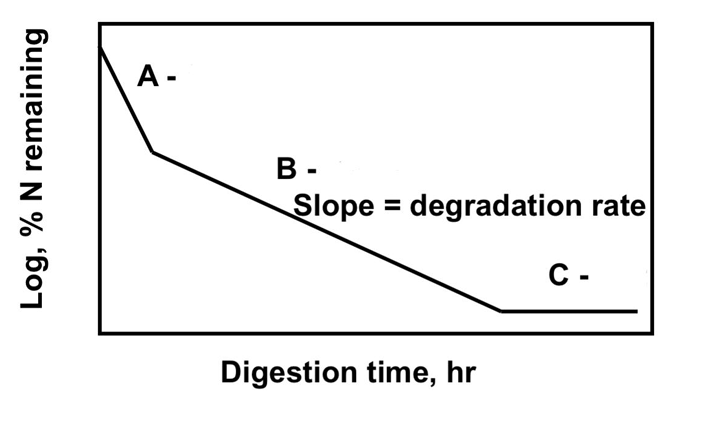
What does fraction A, B, and C represent?
A is non-protein nitrogen; it is completely degraded. B is a true protein; it is partially degraded. C is an insoluble or undegradable protein.
 Note
Note  Flashcards (50)