herbivores
 Studied by 0 people
 Call with Kai
 Learn
Learn Practice Test
 Spaced Repetition
 Match
Match Flashcards
 Knowt Play
1/19

There's no tags or description
Looks like no tags are added yet.
Name | Mastery | Learn | Test | Matching | Spaced | Call with Kai |
|---|
No study sessions yet.
20 Terms
Types of plant eaters
1. Leaf-eating - folivorous insects,
browsing and grazing
vertebrates
- Examples:
- Larvae of butterflies
- Leaf cutter ants in tropics
- Wild and domesticated ungulates
- Leaf miners
2. granivores- seed eaters
3. frugivores - fruit eaters
4. phloem feeders
5. root feeders (nematodes,
beetle larvae etc.)
What herbivores make the biggest global
impact
Hypotheses:
1) it’s probably some subset of arthropods (given abundance, observed
impacts in some places)
2) Livestock have a disproportionate impact compared to wild mammals
– especially when you consider the plants fed them
Herbivores can consume, consistently:
forests - 5 to 15% of leaf area
grasslands- 25 to 30% of leaves
and up to 90% for a short period of time.
So with all these herbivores, why is the world still green?
Two general answers:
1) Plants are mostly poor food – hard-to-digest fiber, secondary
compounds, low percent N – this limits the growth rates of
individual herbivores and herbivore populations
2) Herbivores have enemies that prey on them and sometimes
regulate their populations
top-down and bottom-up control,,
“Top-down” regulation of herbivore abundance
Predators can keep herbivores in check
“from above”
• Example: Yellowstone wolves and elk
• Wolves reduce numbers of elk and also change their
behavior
• This can produce a “trophic cascade” that affects
plants: willows and aspen recover and grow faster
when wolves are present
Bottom-up” regulation of plant abundance: Plant quality can control herbivore populations from “below”
Example: leaf-feeding scale insects – demographic rates of scale insects
depend strongly on plant nutritional quality
types of plant defenses:
1. mechanical factorsspines
thorns
trichomes
tough leaves
2. Chemical defenses
a. Digestibility reducers
b. Toxins
Constitutive vs. Induced Defenses
Constitutive defenses are those that are present in a plant regardless of herbivore damage
Induced defenses (qualitative) are elicited by an attack of herbivores
Induced defense example: snail grazing on white clover (Trifolium repens) ---> plants produce
cyanogenic glycosides.
---> high snail density is correlated with high proportion of cyanogenic plants
Quantitative defenses”
a. Digestibility reducers“Quantitative defenses”
• Abundant -- can be 80-90% of dry
weight
• Immobile -- can’t be deployed
quickly after threat detected
cellulose
hemicellulose
tannins
lignins
“Qualitative defenses”
Toxic – effective at lower concentrations
Mobile -- can be deployed fast to area of
attack (especially the N-based toxins)
Nitrogen based:
alkaloids
toxic amino acids
cyanogenic glycosides
Carbon based:
terpenes
phenols
steroids
ecdysone- an insect hormone
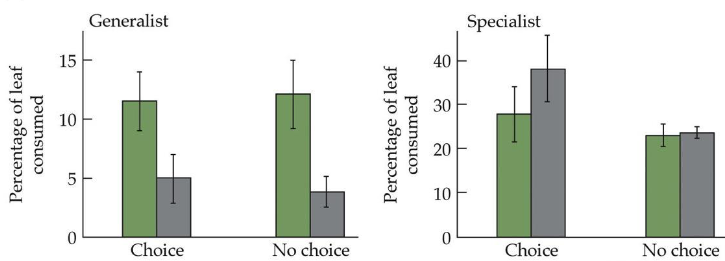
generalist vs specialist induced defense
This experiment showed that induced defenses were effective against a
generalist herbivore, but not against a specialist herbivore (Pieris rapae)
the selection pressure on
a specialist herbivore is going to be way stronger than the
selection pressure on a generalist herbivore to tolerate
this type of toxin that this plant produces
What plant tissue is made of:
8 major types of
compounds and their energy costs:
– Lipids (highest)
– Soluble phenolics (high)
– Organic N compounds / protein (high)
– Lignin (medium)
– Structural carbohydrates (cellulose) (low)
– Non-structural carbohydrates (starch) (low)
– Organic acids (very low)
– Minerals (0)
Leaves are usually more or less expensive to make compared
to other plant tissues
more
So it’s costly to lose them
But defending leaves from herbivory also has costs
There’s a tradeoff between growth and defense
Growth/defense tradeoffs
Plants have limited resources (carbon/energy, nitrogen). They must choose
how much to invest in defense vs growth, storage, and reproduction
plants and herbivores have co-evolved
Specialist herbivores face strong selection pressure to overcome their
host’s defense. Specialists more likely to tolerate/overcome defenses
c. Growing bigger can itself be a defense
Sometimes tolerating some herbivory and growing larger is the best
defense
Plant apparency theory
a. Apparent (common, easily found) plants must invest heavily in defense
1. These defenses are quantitative – they take a lot of materials to work.
tough leaves
lignin, etc.2. A classic example is oak trees that fill their leaves with tannins
b. Unapparent (rare, short-lived) can get by with less investment in defense
1. These defenses are qualitative toxins -- effective at low concentrations
-- good against generalists but not specialists2. escape specialist herbivores by being unapparent (that is, hiding)
3. short-lived meadow plants that may avoid herbivory by being around
only a short time
Resource availability theory
Investment in herbivore protection depends
on the availability of resources
A. High resource availability in the environment
1. Fast-growing plants can quickly replace lost parts
2. their loss is less costly so less investment in defense is needed
- if a plant uses a defense, it’s often a qualitative, induced defense
if plants have lots of resources,
it may not pay off to
spend a bunch on defense anyway.
B. Low resource availability in the environment
1. Plants grow more slowly and have longer lived leaves that are
relatively more costly to replace
2. Greater investment in defense is required.
Tends to favor quantitative, immobile, constitutive defenses
Though this is not always true: some slow-growers have N-based
qualitative defenses.
overall prediction for resource availability theory
if you are a plant
that has a slow maximum growth rate and depending how
much defense you make you'll actually grow fastest if you
make them invest as much as you can in defense whereas
for faster growing plants the optimal strategy is like,
spend very little on the fence and just keep growing fast.
Understory plants
low carbon
availability, so quantitative C-based
defense compounds too expensive.
Favors N-based, qualitative defense
(e.g. Piper plants in Central America)
Overstory trees with high
photosynthetic rates
abundance
carbohydrates relative to nitrogen.
Favors qualitative defense based on
Carbon-rich secondary compounds
(e.g. oaks, chaparral shrubs)
 Note
Note  Flashcards (29)