DP2: Motivation Theories
 Call Kai
 Learn
Learn Practice Test
 Spaced Repetition
 Match
Match Flashcards
 Knowt Play
1/7

There's no tags or description
Looks like no tags are added yet.
Name | Mastery | Learn | Test | Matching | Spaced | Call with Kai |
|---|
No analytics yet
Send a link to your students to track their progress
8 Terms
Motivation
The drive a person has to work hard towards the achievement of business or personal goals.
Maslow’s Hierarchy of Needs
Consists of 5 levels, suggesting that people are motivated to fulfil basic needs before moving on to more advanced, emotional and growth-oriented needs.
Lower needs must be satisfied before an individual can move on.
Once a need is met, it no longer motivates and the employee moves up the hierarchy.
About external factors.
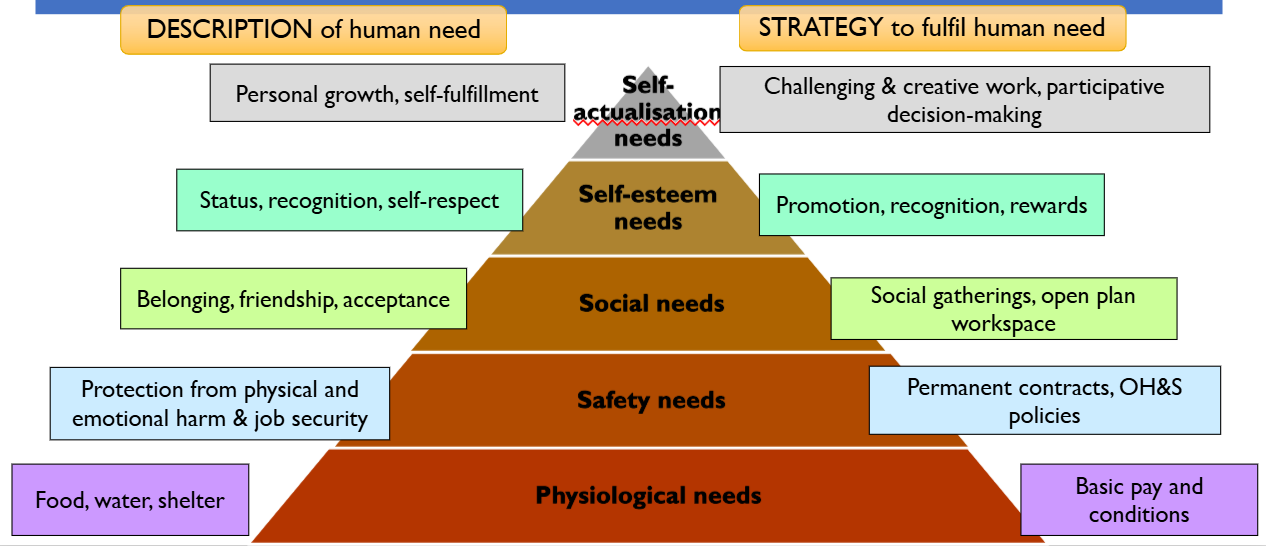
Maslow’s Hierarchy of Needs [Advantages and Disadvantages]
Advantages:
Tailored to each employee’s needs by identifying their level and matching strategies to specifically motivate them.
Social and esteem needs emphasise good relationships, improving corporate culture.
Can motivate employees by physiological needs, which can easily be provided by the business.
Disadvantages:
Needs of all employees are not uniform.
Time consuming and difficult to work out where each employee is on the hierarchy. Difficult to assess when a level has been ‘satisfied’.
Locke & Latham’s Goal Setting Theory
A motivation theory that focuses on the process of setting and attaining goals.
States that the setting of goals leads to increased effort, task focus and persistence which leads to improved organisational performance.
Clarity, challenge, commitment, feedback, task complexity.
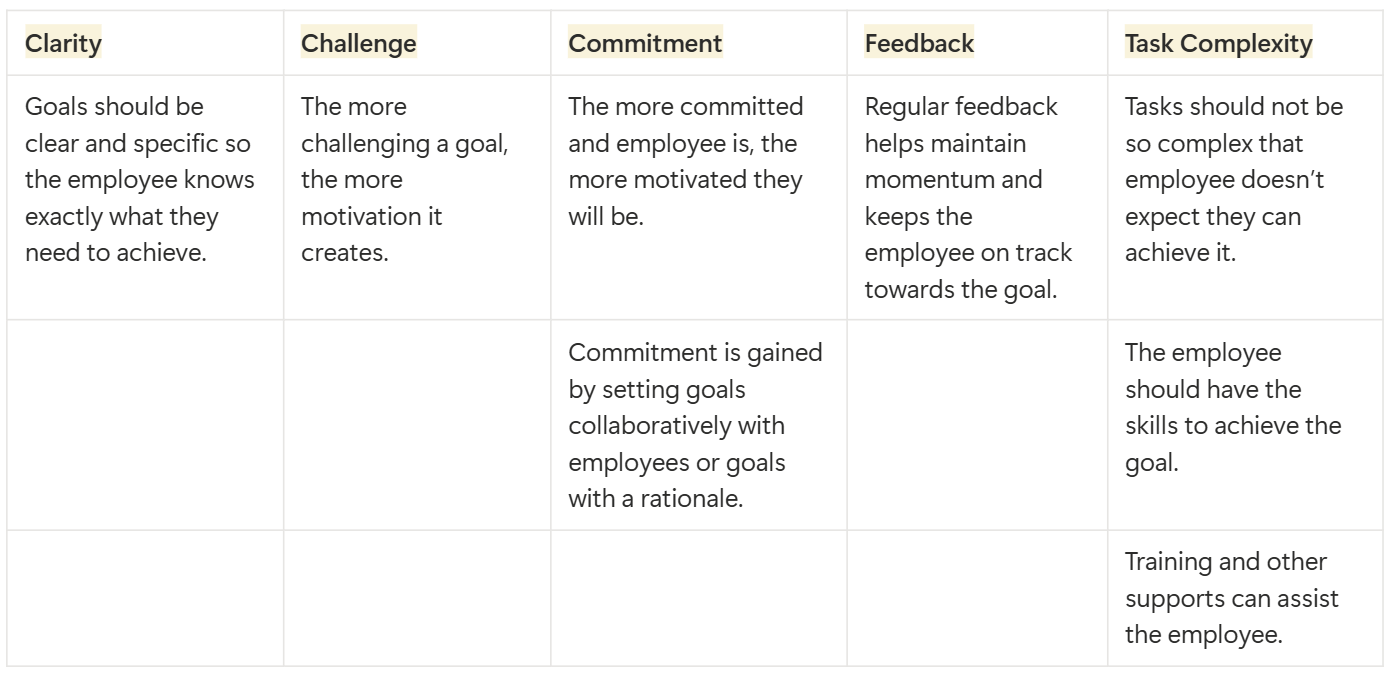
Locke & Latham’s Goal Setting Theory [Advantages and Disadvantages]
Advantages:
Goals align with organisational objectives meaning staff are more effective.
Feedback improves relationships between managers and employees.
Disadvantages:
Time consuming to periodically meet with employees to set goals and provide feedback.
It may be difficult to align personal goals with organisational goals.
Lawrence & Nohria’s Four Drive Theory (BALD)
Theory has identified four basic motivational drives 9drive to acquire, bond, defend and learn).
The level to which these needs are satisfied directly affects our emotions and behaviour.
The four drives act independently of each other but are present in each individual.
About what you have within you already.
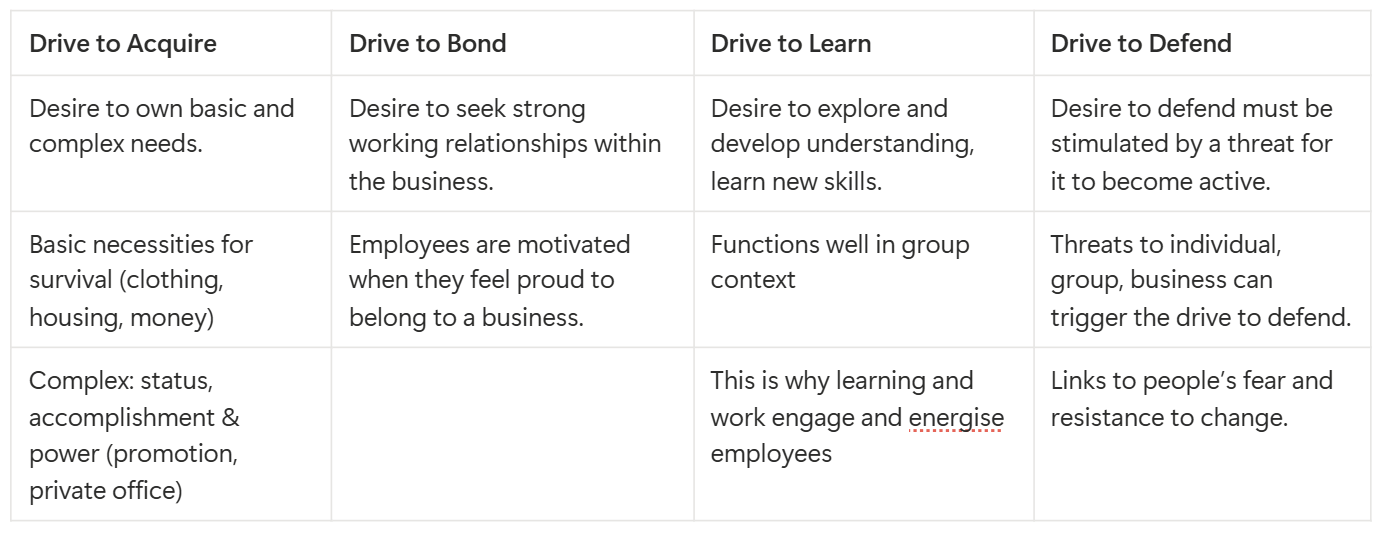
Four Drive Theory Strategies
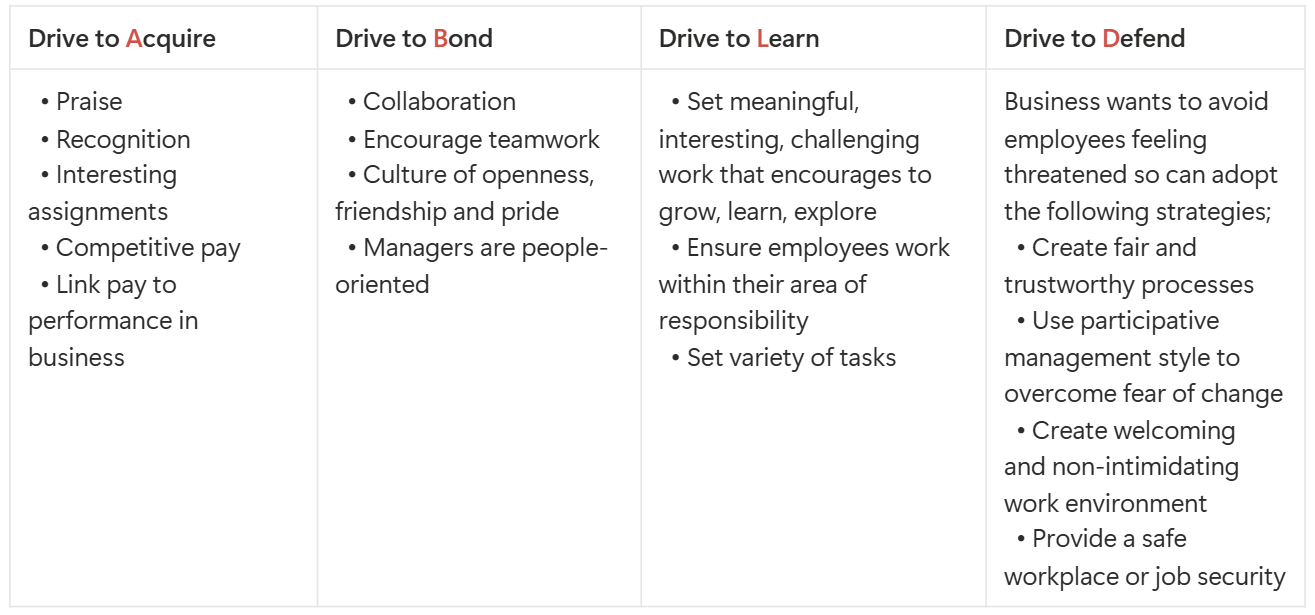
Four Drive Theory [Advantages and Disadvantages]
Advantages:
Drive to bond emphasises teamwork and good relationships, improving corporate culture.
Drive to learn offers opportunities for training and development, increasing morale.
Drive to learn: employees motivated to perform if given challenging jobs, resulting in lower staff absenteeism and staff turnover.
Drive to defend: if properly focused on, it can be a source of motivation and energy.
Disadvantages:
Teamwork and culture of openness in drive to bond can result in conflict due to different ideas.
Desire to learn could be expensive because may involve training of employees.
Purpose isn’t addressed in this theory. Purpose has been shown to be a key motivator in research.
The relative strength of each drive varies in individuals and varies over time in an individual. It is difficult for the manager to know the strength of each drive in an employee and therefore how to motivate an employee.
Explore top notes

