Managing Cross-Cultural Communication and Negotiation
 Studied by 0 people
 Call Kai
 Learn
Learn Practice Test
 Spaced Repetition
 Match
Match Flashcards
 Knowt Play
1/9

There's no tags or description
Looks like no tags are added yet.
Name | Mastery | Learn | Test | Matching | Spaced | Call with Kai |
|---|
No analytics yet
Send a link to your students to track their progress
10 Terms
The Overall Communication Process
Communication is the process of transferring meanings from sender to receiver. On the surface, this appears to be a fairly straightforward process. On analysis, however, there are a great many problems in the international arena that can result in the failure to transfer meanings correctly.
There are a great many problems in the international arena that can result in the failure to transfer meanings correctly.
In addition, the means and modes of communication have changed dramatically in recent decades.
Verbal Communication Styles
Context surrounds and helps convey the message.
High-context societies have coded and implicit messages.
Low-context societies have explicit messages.
In indirect verbal styles, messages are implicit and indirect.
In direct verbal styles, messages are explicit and direct.
When the verbal style is elaborate, talk is of high quality.
When verbal style is exacting, there is a moderate amount of talk
When verbal style is succinct, there is a low amount of talk.
A contextual style focuses on the speaker and role relationships.
A personal style focuses on the speaker and personal relationships.
The affective style is process-oriented and receiver-focused.
The instrumental style is goal-oriented and sender-focused.
Interpretation of Communications
The effectiveness of communication in the international context often is determined by how closely the sender and receiver have the same meaning for the same message.
If their meanings are different, effective communication will not occur.
A U.S. firm wanted to increase production in their Japanese plant so they began an individual incentive plan effective in the United States.
The plan flopped in Japan as workers were accustomed to working in groups and being rewarded as a group.
Communication Flows
Downward Communication is the transmission of information from manager to subordinate. The primary purpose of the manager-initiated communication flow is to convey orders and information. Managers use this channel to let their people know what is to be done and how well they are doing. The channel facilitates the flow of information to those who need it for operational purposes.
Upward communication is the transfer of information from subordinate to superior. The primary purpose of this subordinate-initiated, upward communication is to provide feedback, ask questions, or obtain assistance from higher-level management. In recent years, there has been a call for and a concerted effort to promote more upward communication in the United States. In other countries, such as in Japan, Hong Kong, and Singapore, upward communication has long been a fact of life. Managers in these countries have extensively used suggestion systems and quality circles to get employee input and always are available to listen to their people’s concerns.
Communication Barriers - Language
If managers do not understand the language that is used at headquarters, they likely will make a wide assortment of errors.
Language training continues to lag in the United States.
Increasingly, European countries have multilingual young people.
The ability to speak the language used at headquarters is often not enough to ensure that the personnel are capable of doing the work.
Many MNC’s place importance on an applicant’s ability to speak English—not considering if they can interact with others.
Culture is routinely not taken into account during interviews.
Non-native speakers may know the language, but not be fluent.
Poor writing is proving to be a greater barrier than poor talking.
Advancements in technology may eliminate many language barriers.
Communication Barriers - Culture
A significant number of native speakers in the United States might deviate from the standard business communication practices of other cultures.
Even in English-speaking countries, there are different approaches to writing letters.
When compared to Asians, many American writers are far more blunt and direct.
Perceptions of others may play a major role in the context of international management in the effects of the ways that international managers perceive their subordinates and their peers.
Culture affects communication through values and misinterpretation.
In Middle Eastern countries, people do not relate to and communicate with each other in a loose, general way as do people in the United States.
Relationships are intense and binding and class and status matter.
Another cultural value is the way that people use time.
In the United States, people believe time is an asset and is not to be wasted.
An idea with limited meaning in some other cultures.
Cultural differences can cause misinterpretations both in how others see expatriate managers and in how the latter see themselves.
The informal approach used in the United States is not used everywhere.
Many Americans also have difficulty interpreting the effect of national values on work behavior.
Communication Barriers - Perceptual
Perception is a person’s view of reality.
In international incidents, perception and misperceptions are critical.
A failure to understand home-country perceptions can result in disastrous advertising programs.
In Taiwan, “Come alive with Pepsi” frightened consumers as it literally meant “Pepsi will bring your ancestors back from the grave.”
Managers must be careful when translating messages.
Common phrases in one country will not mean the same in others.
Perception influences how individuals “see” others.
Communication Barriers - Nonverbal Communication
Nonverbal communication Transfers meaning through body language and physical space.
Kinesics is body movement and facial expression.
Communicating through eye contact/gaze is oculesics.
Communicating through bodily contact is known as haptics.
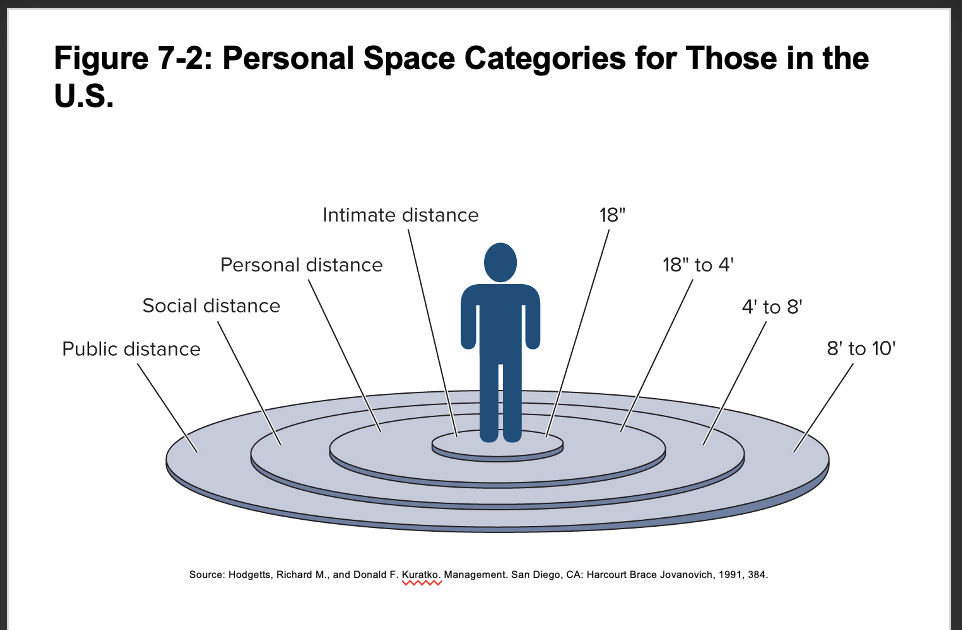
Proxemics - people use physical space to convey messages.
Intimate distance, personal distance, social distance, and public distance.
Chronemics refers to the way in which time is used in a culture.
In a monochronic time schedule, things are done in a linear fashion.
In a polychronic time schedule, people multitask and place higher value on involvement than on completion.
Chromatics is the use of color to communicate messages.
Such knowledge can help you avoid embarrassing situations
Achieving Communication Effectiveness
A number of steps can be taken to improve communication effectiveness in the international arena.
One of the most important ways of improving effectiveness in the international context is to open up feedback systems.
Personal—face-to-face meetings, phone conversations, and e-mail.
Impersonal—reports, budgets, and plans.
Another way to make communication more effective in the international arena is through language training.
Another way is to provide cultural training.
To improve understanding, increase flexibility, and cooperation.
Managing Cross-Cultural Negotiations
Negotiation is the process of bargaining with one or more parties for the purpose of arriving at a solution acceptable to all.
Distributive negotiations are when two parties with opposing goals compete over a set value.
Both sides are trying to get the best deal, but a gain for one side is a loss for the other.
Integrative negotiations involves cooperation to integrate interests, create value, and invest in the agreement.
This is the most useful tactic when dealing with business negotiation.
 Note
Note  Flashcards (290)