Bio1110 Circulatory Systems
 Call Kai
 Learn
Learn Practice Test
 Spaced Repetition
 Match
Match Flashcards
 Knowt Play
1/26

There's no tags or description
Looks like no tags are added yet.
Name | Mastery | Learn | Test | Matching | Spaced | Call with Kai |
|---|
No analytics yet
Send a link to your students to track their progress
27 Terms
What is the function of a circulatory system?
the body’s transportation system, delivers O2, removes CO2, transports nutrients, distributes hormones, maintains homeostasis
What are the main parts to a circulatory system?
Circulatory fluid, set of tubes(vessels), muscular pump, areas to onload and offload, it pairs with the respiratory, digestive, and excretory systems
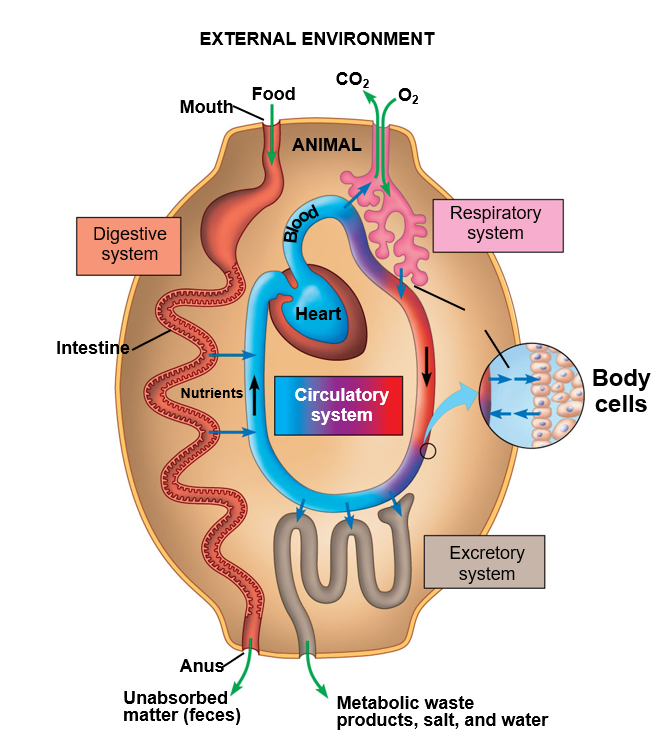
Do animals with a gastrovascular cavity have a circulatory system?
no, they don’t need it since everything (all their cells) are close enough for simple diffusion
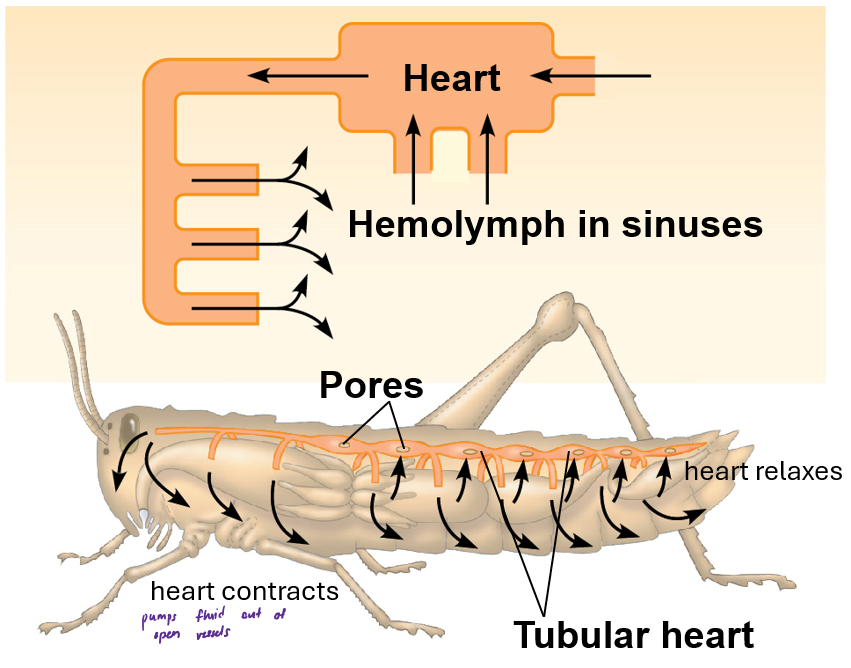
What is an open circulatory system?
When fluid passes through open ended vessels into sinuses and cavities, circulates hemolymph (not blood and also acts as the interstitial fluid) by heart and movement, is a lower pressure system, mollusks and arthropods have this
What is a closed circulatory system?
blood does not also act as the interstitial fluid(what fills body cavities), has branching vessels with directionality, a heart with an atrium and ventricles, is a higher pressure system, includes vertebrates, annelids, and cephalopods
Open circulatory systems use what kind of heart?
A tubular shaped one
We distinguish blood vessels by the …
direction they go in, not whether or not they carry deoxygenated or oxygenated blood
In closed circulatory systems, arteries carry blood …
away from the heart
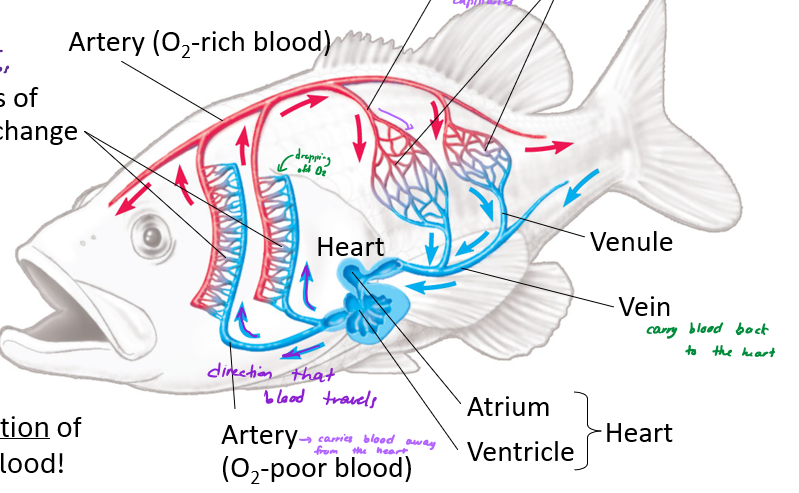
What are arterioles?
smaller vessels that extend from arteries into capillaries
Venules and veins carry blood …
toward the heart
What are venules?
small vessels that carry blood from the exchange site into the larger vessels that go back to the heart called veins
What is the function of the heart?
pumps blood throughout the body, generates the pressure needed to pump the blood
What does the atrium of the heart do?
the receiving chambers of the heart, it still receives deoxygenated and oxygenated blood
What does the ventricle of the heart do?
send blood out, the ventricle is the “muscular engines” that actually move the blood
What color is our blood?
Red, blood color is based primarily on respiratory pigments, hemoglobin is red so our blood is red, looking through skin makes our veins look blue, but blood is NOT blue
animals blood can be what colors
red, blue, green or violet
Insect hemolymph is what color?
clear-ish
Singular circulation =
a two chambered heart, one ventricle and one atrium, all blood flows the same path (1 circuit), pressure drops in the capillaries, muscle movement is needed for movement in the circuit, fish have this
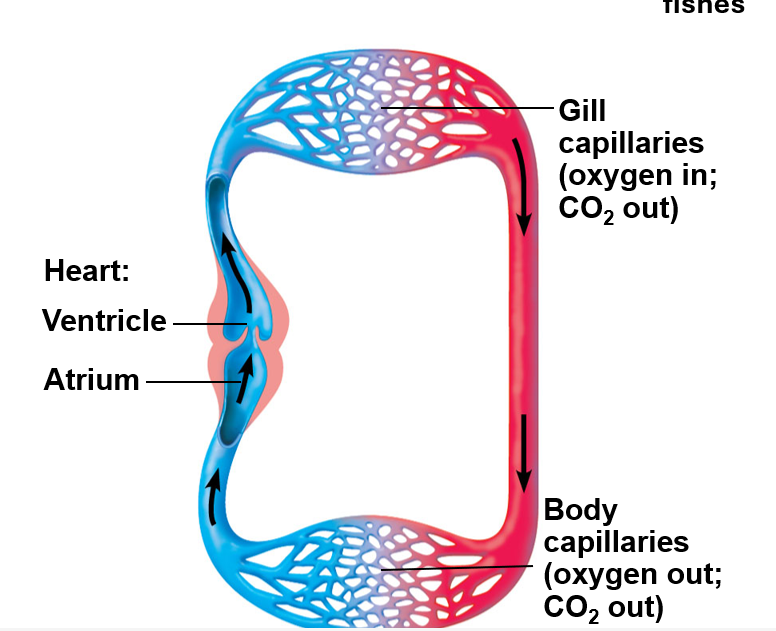
In a single circuit circulatory system, blood moves slower by the time it …
goes through the two capillary beds because when blood moves it puts pressure on the blood
Double Circulation for amphibians
2 circuits, a three chambered heart, pressure drops in gas exchange capillaries, these ones are on a different circuit then, includes the Pulmocutaneous circuit and the systemic circuit
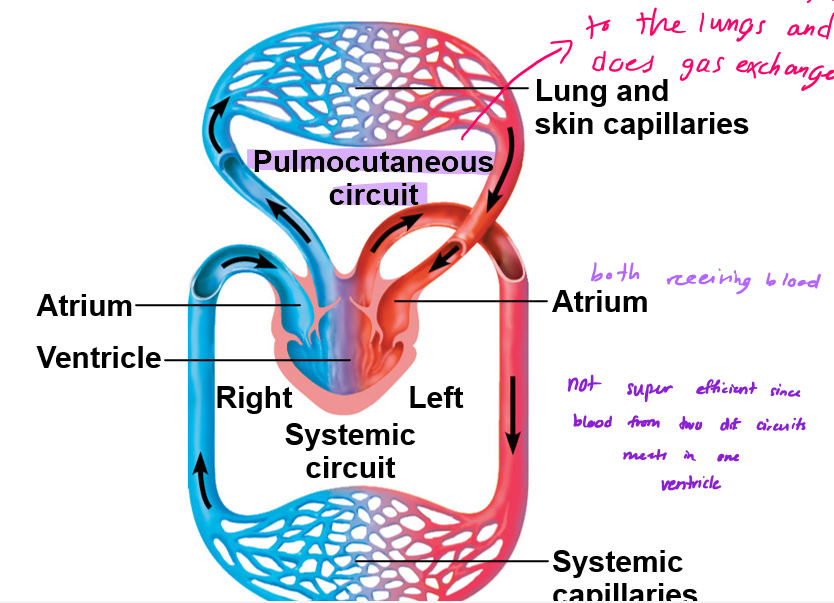
Pulmocutaneous circuit
brings blood to the lungs to be oxygenated and then back to the heart
Systemic circuit
sends oxygenated blood to the rest of the body
The more divided the ventricle …
the more efficient it is
Amphibians system is not as efficient because …
blood from two different circuits mixes in one ventricle
Double circulation in reptiles
have a 3 or 4 chambered heart, can regulate blood traveling to the pulmonary circuit, why they can hold their breath for so long
Double circulation in birds and mammals
4 chambered heart, blood always runs to the pulmonary circuit, came as a result of convergent evolution for high metabolism in endotherms, different from amphibians because there is not mixing of O2 rich and poor blood in the heart
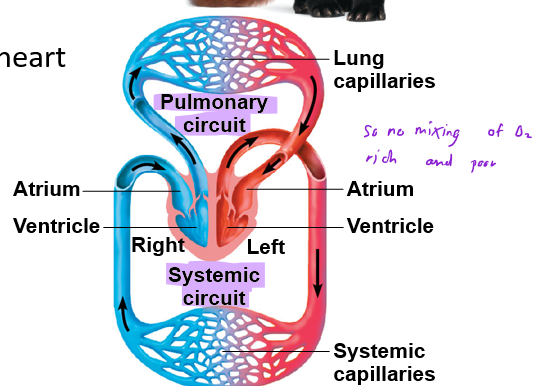
Amphibians, reptiles, and mammals systemic circuits run …
simultaneously with the pulmocutaneous circuit, except reptiles can shunt blood depending on activity, timing wise they are the same, but anatomy differs

