Trade unions
 Call Kai
 Learn
Learn Practice Test
 Spaced Repetition
 Match
Match Flashcards
 Knowt Play
1/19

There's no tags or description
Looks like no tags are added yet.
Name | Mastery | Learn | Test | Matching | Spaced | Call with Kai |
|---|
No analytics yet
Send a link to your students to track their progress
20 Terms
what are trade unions?
A trade union is an organisation which aims to protect the interests of its worker members with regard to terms & conditions of their employment including pay.
howd oes trad eunion work?
Each employee who wishes to join a trade union must pay an annual fee, which contributes towards the costs and expenses that the trade union incurs when it provides services to its members, and supports industrial action by the workers.
examples of what workers may want?
-maximise wages/salary
work in a safe and healthy environeemnt
have good terms and conditions at work
maximise theri non wage benefits
have job security at work
trade union structure
members - people who pay a subscription to belong to a union
shop stewards - sometimes called union representatives - who are elected by members of the union to represent them to management
branches - which support union members in different organisations locally. There is usually a branch secretary who is elected by local members
district and/or regional offices - these are usually staffed by full time union officials. These are people who are paid to offer advice and support to union members locally
a national office - the union's headquarters which offers support to union members and negotiates or campaigns for improvements to their working conditions. At the top of the organisation there is usually a General Secretary and a National Executive Committee, elected by the union's members.
aims of trade unions?
Trade unions have a number of aims:
To improve the pay of its members.
To improve the working conditions and the working practices of its members.
To support the training and the professional development of its members.
To ensure that their members’ interests are considered by the employers when any decision is made which will affect the workforce.
types of trade unions
1. General unions. These are prepared to accept anyone and are for skilled and unskilled workers performing different jobs in different industries and areas (e.g. cleaners, clerical staff, transport workers.) It tends to have a very large membership of unskileld members.
2. Industrial unions. These represent all the different workers in the same industry irrespective of their skills and the type of work done ot (e.g. the National Union of Miners (N.U.M), covering workers at all levels in the hierarchy).
3. Craft Unions. These are fairly small unions for skilled workers, performing the same or similar work in different industries (e.g. musicians). Organised according to their particualr skill
4. White-collar unions. These are for ‘white-collar’ or professional, administrative, clerical staff and other non manual workers who perform the same or similar tasks in different industries (e.g. teachers, scientists,banking. civil service and local government).
why do some professions not have trade unions?
soem professions such as engineering,law and medicine dont have trade unions bcs such work is governed by a professional body which sets entry requirements in terms of examianiton,training and level of experience. The entry requriements are high and therefore the number of workers in each profession are controlled
trade unions role
Trade Unions act as a means of communication and negotiation between employers and employees through a process known as collective bargaining.
examples of trade unions roles and responsibilities?
The primary role of a trade union is to protect the interests of its members:
1. Bargaining with employers for pay rises and better terms & conditions
2. Ensuring equipment at work is safe and that workers are given sufficent training to enabel them to perform theri role at work safely
3. Ensuring members are given legal advice when necessary
4. Giving support to members when made redundant
5. Providing financial & legal support to unfairly dismissed employees
6. Persuading the government to pass legislation in favour of workers e.g min wage,pension rihgts and the retirement age
main role of trade unions
they act as a means of communciation and negotiation between employers and employees through colelctive bargaining. This is becasue a collective voice is more powerful than each worker negotiatign individually with the employer
what is collective bargaining
collective bargaining is the process of trade union representatives negotiating on behalf of their worker members with employer representatives for better pay and conditions
factors affecting strenght of trade unions
1. Their number of members-trade unions with high membership tend to be mroe powerful. If strogn trade unuons make full use of theri bargainign power they may succeed in getting larger and/or more freqeunt wage increases than weaker unions
2. Their level of unity( how well they support each other)-the larger and more united the union the better its bargaining posiiton tends to be. Unions may be affiliated to a larger organisation which negotiates with teh government
reasons for a highoer level of trade union memberships?
growth in manufacturing jobs-manufacturing industry is often unionised as workers typically recieve low pay and have poor working conditions
a widening wealth gap and higher costs of living which have caused workers to petition for higher wages and better workign conditions
reasons for declining trade union membership
government legislation which seeks to reduce trade union influence
a decline in manufactuing jobs int ehse coutnries as manufacturign is traditionally unionised
growth in part time employment as part time workers are less lielky to join trade union
a growing number of firms idnependently agreeing to fairere terms an dconidtion sof employment as part of theri corporate social responsibility wihtout negotiatign with trade unions
an increase in umemployment
an increase in employment in small firms as it si mroe difficult to organsie trade unions within such organsiations
an icnrease in the number of self employed people and hwoa re therefore not trade union memebrs
what is corporate social responsibility
corporate social repsonsibility (CSR) refers to the ethical approach taken by firms towrds their stakeholders (such as employees and custoemrs) and the envirnonment (such as adopting green technologies)
advanatges of trad eunion membership
they act as a channel of communciation btw employers (firms) and employees (workers). Through negotiatiosn and collective bargaining, they help to solve disputes and settle pay claims harmoniusly and efficently
they negotite with employers on behalf of hteir members for better pay and working conditions. This benefits the government as productivity also improves. Overall there is a positive imapct on standrards of living
they neogtiate with the governemnt fo rht eintroduction of or an increase in minimum wage which can also help to increase standards of living for hte poorest workers. Increased pay and investments in working conditions may lead to a better motivated workforce and result in an icnrease in the profits of firms
Unions cna help to reduce conflict and develop improved industrial relations which ultimately benefit firms through improved labour productivity and higher employee motivation and loyalty
they offer legal support and advice to workers who may have lsot their jobs or be facing the threat of redundacies (job losses)
negative impacts of trade unions
trade unions are often portrayed in the emdia as having a negative role in an eocnomy when they take industrial action and can cause serious disruption to firms and the wider economy
from an employers point of view a trade union’s demand for better pay and conditions for its members may inrease the firms production costs and therefore reduce its profits. If so govebnrment tax revenue will also fall
what may the cliam for higher wages and colelctive bargaingin process be based on
a rise in the cost of living due to inflation which reduces the real wage of trade union members
workers in comparable occupations who have recived a wage increase
increased profits of hte firm and industry as a whole justifying a hgiher return for labour services
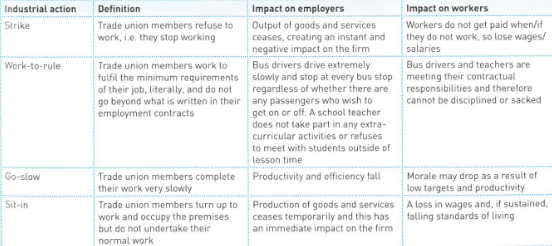
what is industrial action
industrial action refers to measures taken by trade union memebrs as a result of major disagreements or disputes with their employers eg strike action
types of industrial action and impacts