WGS 291 Exam 2
 Call Kai
 Learn
Learn Practice Test
 Spaced Repetition
 Match
Match Flashcards
 Knowt Play
1/51

There's no tags or description
Looks like no tags are added yet.
Name | Mastery | Learn | Test | Matching | Spaced | Call with Kai |
|---|
No analytics yet
Send a link to your students to track their progress
52 Terms
Gender socialization
The internalization of the social expectations and attitudes associated with on’es perceived gender
Behavioral theories
Consider how aspects of the environment influence behavior, including gender development
Operant conditioning
Suggests that gender/sex develops when certain behaviors are reinforced and others are punished
Social learning theories
Suggest that learning takes place in a social setting even when children aren’t directly being reinforced or punished
Observational learning
Occurs when children learn from watching what others do
Gender buffet
Occurs when parents (especially LGBTQ+ parents) make explicit attempts to model and let their children explore different gender expressions
Cognitive development theory
Argues that children’s understanding of gender/sex develops corresponding to the development of cognitive skills; children are active participants in their attempts to understand and take on gender roles
Self socialization
Children’s progress of continually observing social cues in order to develop an understanding Of gender/sex and how they should actually behave; children quickly figure out that gender/sex is one of the most important variables in distinguishing people and then pick up associated characteristics
Gender labeling
The ability to identify someone’s gender and their own within gender/sex binary (around 30 months); after self labelling occurs kids act in accordance with gender/sex norms
Sources of gender socialization
Toys, families, peers, schools, the media
Gender segregation
Tendency for children to segregate on the basis of actual or perceived gender identity
Identity segregation
Preferences for socializing with peers of their same age, gender, and race
Hidden curriculum
The ways school environment indirectly teaches norms, beliefs, and values (eg. Dress codes enforced more for girls, black students disciplined more
Social support
A feeling of being cared for and having support and assistance from people around us, including family, friends, and romantic partners; consistently related to increased physical and mental health
Types of social support
Informational: giving advice or ideas to help people find strategies or resources to better cope with life events
Instrumental: providing tangible assistance in terms of money, goods, or services
Emotional: enabling others to feel nurtured and/or cared for
Benefits of friendship
increased life satisfaction
Improved health and well-being
Better academic achievement
Mitigate negative effects of discrimination
Provide comfort following the loss of loved ones
Identity x friendships
We tend to form friendships with people who share our social identities and our interests, people tend to have more same-gender/sex friends than other gender/sex friends
Cross identity friendships promote flexibility in thinking by offering new perspectives; individuals with socially privileged identities are less likely to form these friendships
Dinner & Seligman (2002)
recruited 222 college students at the U of Illinois
Compared the upper 10% of consistently very happy people with average and very unhappy people
The very happy people were highly social and had stronger romantic and other social relationships than other groups
PRESCRIPTIONs about romance via the media
P - partner is predestined
R - right away you know
E - expression not necessary
S - sexual perfection
C - centerfolds preferred (look like model to attract)
R - role of gender/real men (men = taller, more powerful, richer, older)
I - into a prince (love can change a man)
P - pugilism (fighting) = passion
T - totally opposite values fine
I - incomplete without mate
O - often, actors = roles
N - no effect (like this media doesn’t effect you)
Eaton & Rose (2011)
Reviewed all research on heterosexual dating published in Sex Roles journal 1975-2010; found
dome changes in pattern like women asking out more
But in general traditional gender-typed script was largely unchallenged and unchanged
Also found over consuming romantic media leads to less happy relationships and unreasonable expectations
Benefits of marriage
stable source of social support, shared commitments, emotional connection
Tax benefits
Increased earnings
Access to inheritance and social security + next of kin benefits
Wedding ring x misogyny
Financial inequity: ties a woman’s worth to a man’s spending power
One-sided marking: only women are social expected to wear engagement rings, functioning as a “claimed” status marker
Compulsory monogamy
Expectation that everyone, but especially women, should strive to find one partner to marry who can exclusively fulfill all desires, wants, and needs
Consensually non-monogamous relationships
Committed romantic relationships among partners who agree that they can have sexual and/or emotional commitments with other people
Polygamy
One husband having many wives; often tied to religious belief or cultural practices
Polyamorous relationships
Consensual romantic and or sexual relationships with multiple partners
Swinging
The practice of both partners in an emotionally committed relationships agreeing to and participating in sex with other individuals usually at the same time (like partner swapping)
Dating scripts
Descriptions of supposedly “normal” behaviors in the context of date; tend to be overwhelmingly heteronormative (eg. Who asks who, who pays, how it ends etc)
Open relationships
Usually take the form of one primary and emotionally exclusive relationship in which both partners freely consent to one of both partners having sexual relations but not emotional bonds with others
Precarious Masculinity Theory (Vandello & Bosson)
Masculinity is hard won - elusive and must be earned
Masculinity is easily lost - tenuous and must be routinely re-proven
Masculinity is public and determined by others - must be explicitly demonstrated
Masculinity as Anti-Femininity
Masculinity constructed as the complementary opposite of femininity, boys must repel anything considered culturally as feminine (includes emotion)
Masculinity threat
The experience of routinely having one’s masculine authenticity questioned, bu women or other men > lowers psychological well-being
Learned responses to masculinity threat
bargaining - overemphasizing some more masculine traits
Risk taking and dangerous behaviors
Violence and aggression
The hierarchy of masculinity
Hegemonic masculinity: culturally dominant/ideal conception of masculinity
Complicit masculinity: dont fully embody dominant ideals but still benefit from patriarchal gender order
Marginalized masculinity: forms of male identity that are devalued or excluded from hegemonic ideal (usually related to race, class, sexuality etc)
Subordinate masculinity: defined by non conformity to hegemonic ideals of masc
Role of women in perpetuating hegemonic masculinity
girls and women socialized to contribute to the gender policing of boys and men
Often endorse and look for traits of hegemonic masculinity in their partners
Why?
Femininity is often tied to ability to find sufficiently asculine men
The manosphere
Relatively diverse community united over adherence to traditional or hegemonic conceptions of masculinity and frustration with women and kinship
men’s rights activists (MRAs)
Alphas
Incels
Men going their own way (MGTOW)
Objectification
The viewing of a person as an object to be looked at rather than as a full human being, women are commonly objectified through the male gaze and thru media that reinforces that perspective
Male gaze
Visual attention to women’s bodies that may come from a heterosexual man or that may represent internalization of the idea that women are sexual objects to be looked at for men’s pleasure
Objectification Theory (Fredrickson & Roberts 1997)
Theory that many women are sexually objectified and then acculturated to internalize such perspectives and view themselves as objects to be evaluated by others 9self-objectification)
Normative discontent
The idea that because body dissatisfaction is so common it is the normal state for women to be unhappy or dissatisfied with their bodies
Tripartite model of social influence
Combination of parents, peers, and the media constitutes the key influence on body image
Promotes thinness and symmetry and white racialized features are most valued.
Killing Us Softly advertisement points
Ads present unrealistic ideal image of woman
Women’s bodies are frequently treated as objects in ads
Particular attention is placed on breasts in ads
Women’s looks are often portrayed as her most important trait
Ads shame women for eating/what they eat
Sexualization of little girls and infantilization of adult women
Women encouraged to see sexualization as their own choice/empowermeneent
Double bind: women should be sexy yet innocent
Objectified women are shown as fragile/vulnerable compared to men portrayed as strong and powerful
Eroticized violence against women
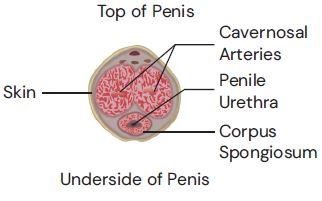
Corpora Cavernosa
Becomes followed with blood and becomes stiff and rigid when man is sexually aroused which leads to an erection
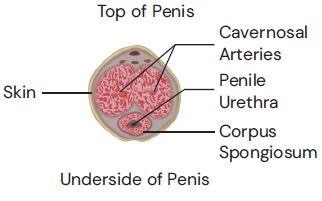
Corpus spongiosum
Also fills with blood during arousal causing an erection but remains spongy and soft to keep urethra open for ejaculation
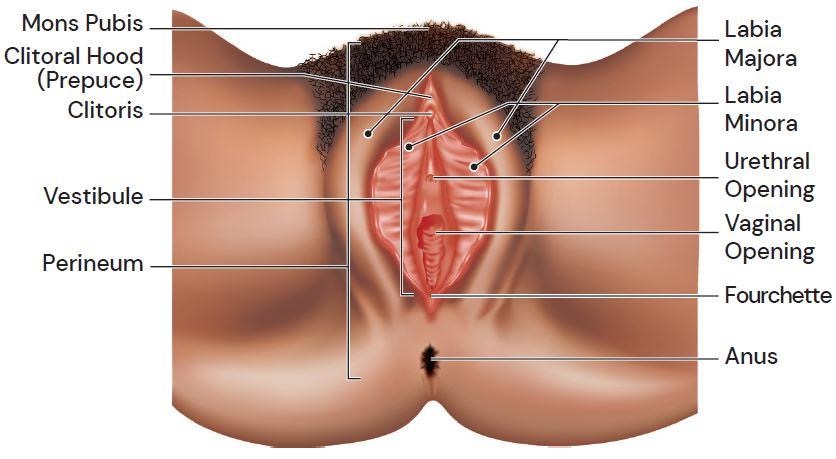
Mons Pubis
Fatty pad of tissue covering the junction on top of the pubic bone, covered in hair during puberty to demonstrate maturity and provide safety from infection and friction
Rowen et al. (2016)
Surveyed a bunch of women in the US and found that 84% engage in some public grooming, 62% had removed all at least once
59% said they did it for hygiene reasons but removal of public hair is actually linked to unhygienic shit like increased spreading of STDs
Labia majora + minora
Majora: outer lips, provide protection for clitoris, labia minora, and vagina
Minora: inner lips, often extend outward between major, remain closed to protect inner parts, when aroused open up and expose vaginal opening
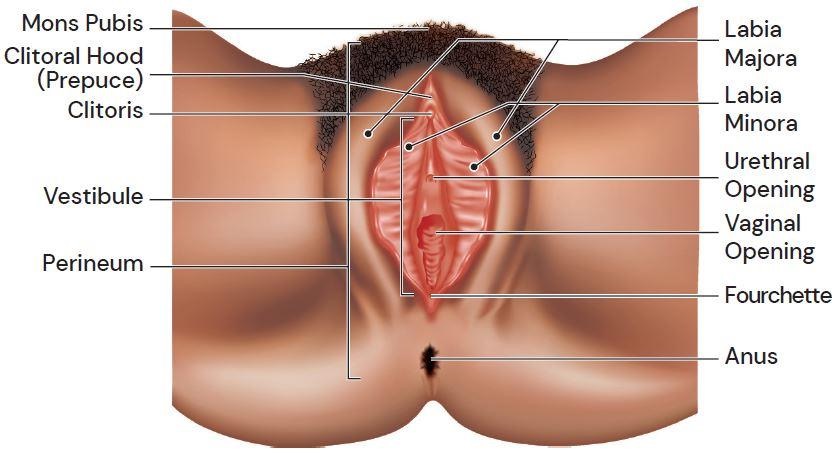
Clitoral glans
Very sensitive to stimulation and is integral to sexual pleasure of people with clitorises, only external part of the greater clitoral structure
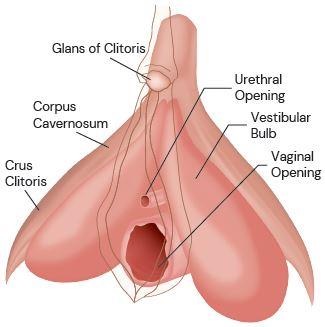
Corpora cavernosum (in clitoris)
Engorge/swell with blood when aroused, get rigid and erect/enlarge clitoris, delivers sensations to brain
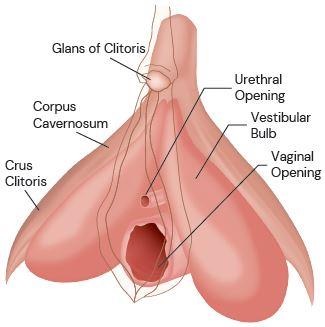
Vestibular bulbs
Filled with blood when aroused to increase sensations in the area, stays spongy and soft, contracts rhythmically during orgasm
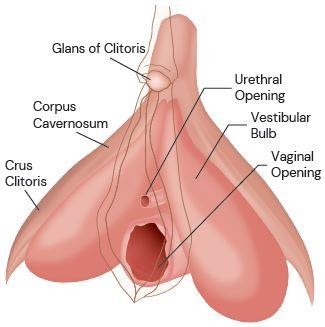
Vagina x balloon
Vagina is a canal that starts at the vaginal opening and extends up and tilts slightly backward toward the base of the spine, in unaroused state its like a deflated balloon, expands when aroused
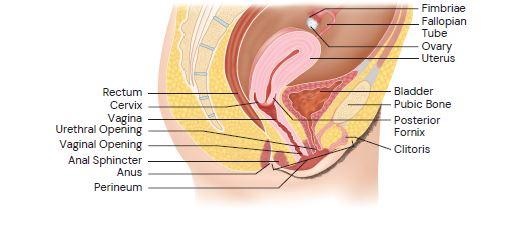
Purpose of vaginal lubrication
When aroused heightened blood flow to vagina causes it to discharge clear liquid from walls
Functions of this:
Enhances likelihood of conception by alkalinizing vagina (which is naturally acidic)
Enhances sexual pleasure by preventing irritation and minor tears

