BIO311D - Unit 1 Instapoll/HW/DQ
 Call Kai
 Learn
Learn Practice Test
 Spaced Repetition
 Match
Match Flashcards
 Knowt Play
1/86

There's no tags or description
Looks like no tags are added yet.
Name | Mastery | Learn | Test | Matching | Spaced | Call with Kai |
|---|
No analytics yet
Send a link to your students to track their progress
87 Terms
HW 1] In a certain species, 2n = 50. If one diploid cell in this species undergoes meiosis, the products will be
A. 2 cells, each with 25 chromosomes
B. 2 cells, each 50 chromosomes
C. 4 cells, each with 25 chromosomes
D. 4 cells, each with 50 chromosomes
C. 4 cells, each with 25 chromosomes
HW 1] Which of the following is true about the two members of a homologous pair of chromosomes?
A. they are identical DNA molecules
B. they form two sides of one double helix
C. they separate from one another during meiosis II
D. they contain the same gene loci in the same order
E. two of these are true
D. they contain the same gene loci in the same order
HW 1] Which of the following is false concerning twin chromatids (= sister chromatids)?
A. The formation of twin chromatids doubles the amount of DNA in a cell.
B. Twin chromatids consist of two identical copies of a single homolog.
C. Twin chromatids are held together at the centromere.
D. Twin chromatids form during the S phase of the cell cycle
E. In meiosis twin chromatids separate from one another during meiosis I.
E. In meiosis twin chromatids separate from one another during meiosis I.
HW 1] (old exam question) For a species with a haploid number (n) of 23 chromosomes, how many different combinations of maternal and paternal chromosomes are possible for the gametes based on the independent assortment of chromosomes during meiosis? Ignore effects of crossing over.
A. 23
B. 46
C. about 1000
D. about 8 million
D. about 8 million
HW 1] In mice, short hair trait is completely dominant, and long hair is a simple recessive trait. If a short-hair individual is mated with a long-hair individual and both long-hair and short-hair offspring result, then just from looking at the offspring you learn that:
A. the short-hair individual was homozygous
B. the short-hair individual was heterozygous
C. the long-hair individual was heterozygous
D. more offspring are required in order to decide
B. the short-hair individual was heterozygous
HW 1] Which statement about an individual that is homozygous for a specific allele is NOT true?
A. Each of its cells possesses two copies of that allele
B. Each of the gametes it produces contains one copy of that allele.
C. Both of its parents had to be homozygous for that allele.
D. It will pass that allele to all offspring
C. Both of its parents had to be homozygous for that allele.
HW 2] [modified from text Ch 12] A man with red-green color-blindness (recessive, X-linked condition) marries a woman with normal vision whose father was color-blind. (a) What is the probability that their first daughter will be color-blind? (b) What is the probability that their first son will be color-blind?[Just write out the correct Punnett square and answer from it; don't use the rule of multiplication]
A. (a) 1/4 (b) 1/4
B. (a) 1/4 (b) 1/2
C. (a) 1/2 (b) 1/2
D. (a) 1/2 (b) 1/4
C. (a) 1/2 (b) 1/2
HW 2] Identical twin girls could express an X-linked trait differently in different cells if
A. they experienced different new mutations in their X chromosomes
B. the trait was sometimes dominant and sometimes recessive
C. the cells had different X chromosomes inactivated
D. some cells were homozygous and others heterozygous for the trait
C. the cells had different X chromosomes inactivated
HW 2] In a family neither parent has red-green color-blindness but all their children, three sons, are color-blind. From this information, which of the following extended family members is most likely to be colorblind?
A. The mother's brother
B. The father's father
C. The mother's mother
D.The father's mother
A. The mother's brother
HW 2] Tom and his wife Liz both have other members of their families with PKU, a metabolic disorder that can be treated successfully a with corrective diet. PKU is inherited as an autosomal (not X-linked) simple recessive allele. Tom and Liz have been tested and know they both are carriers though neither has the disease. Tell (a) the probability in fractions their first child will be born with PKU; and (b) the probability that if they have two children, both children will have PKU.
A. 1/4, 1/8
B. 1/2, 1/4
C. 1/4, 1/2
D. 1/4, 1/16
D. 1/4, 1/16
HW 2] [from text, ch 21] A fruit fly population has a gene with two alleles, A1 and A2. Tests show that 70% of the gametes produced in the population contain the A1 allele. If the population is in Hardy-Weinberg equilibrium, what proportion of the flies carry both A1 and A2?
A. 0.70
B. 0.49
C. 0.42
D. 0.21
C. 0.42
HW 2] A gene in humans has two alleles, M and N, that are co-dominant and code for slightly different red blood cell surface proteins. If the frequency of allele M is 0.2, according to the Hardy-Weinberg equation, the frequency of the genotype MN in the population should be what?
A. 0.16
B. 0.20
C. 0.32
D. 0.40
0.80
C. 0.32
HW 2] In the Hardy-Weinberg equation, which term gives the recessive allele frequency?
A. p
B. q
C.2pq
D. p^2 (p squared)
E. q^2 (q squared)
B. q
HW 2] In a population of mice in Hardy-Weinberg equilibrium, 4% (= 0.04) of individuals are albino (show the recessive a trait); the rest show the dominant agouti (A). What is the frequency of agouti A allele?
A. 0.04
B. 0.20
C. 0.40
D. 0.80
E. 0.96
D. 0.80
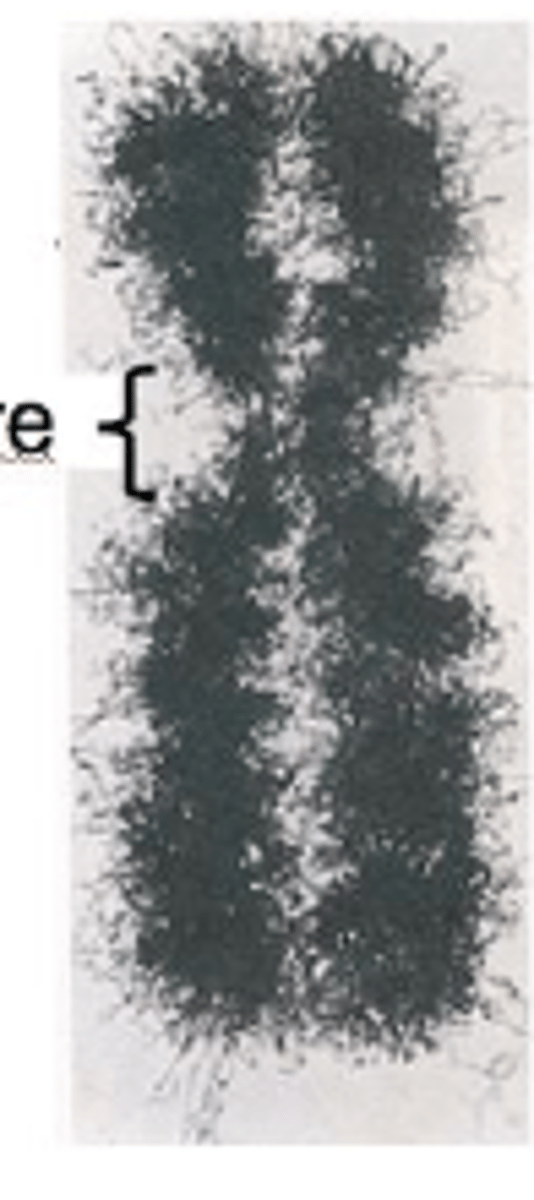
This chromosome contains which?
A. two single-stranded DNA molecules
B. one double-stranded DNA molecule
C. two double-stranded DNA molecules
D. many double-stranded DNA molecules
C. two double-stranded DNA molecules
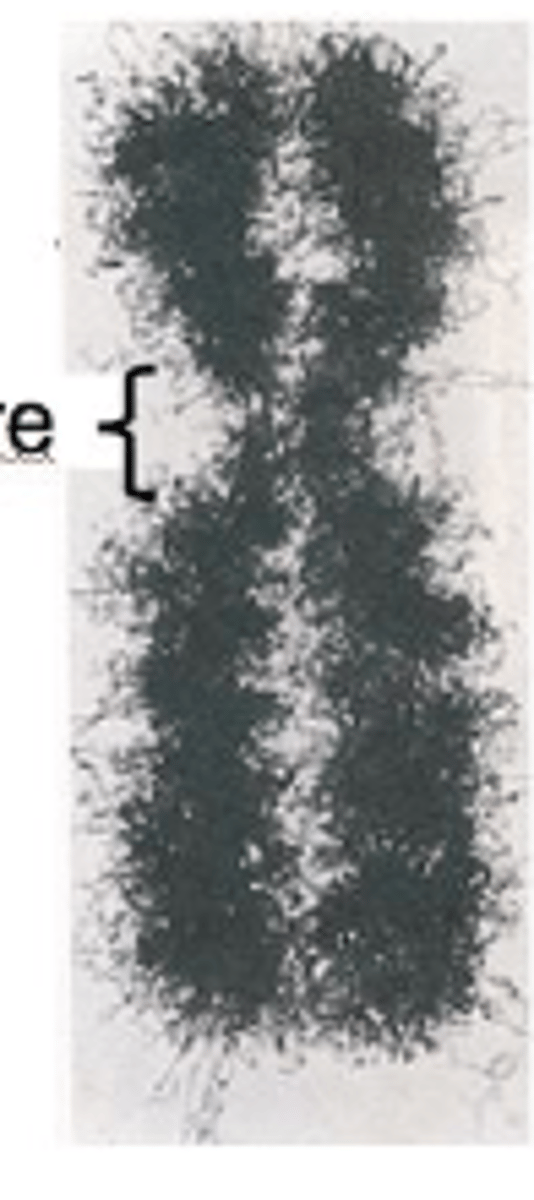
The image shown here contains which?
A. DNA from one of your parents on the left and DNA from the other parent on the right.
B. DNA from only one of your parents
B. DNA from only one of your parents
With respect to meiosis, when does DNA replication occur?
A. Before meiosis I only
B. After meiosis I only
C. Before and after meiosis I
D. After meiosis II
A. Before meiosis I only
Which of the following best describes the two members of a homologous pair?
A. they have identical DNA
B. they have genes controlling the same type of characters
C. they were inherited from the same parent
D. they move together in Meiosis II
B. they have genes controlling the same type of characters
If a cell with genome of 20 pairs of chromosomes undergoes normal meiosis, how many cells result, and how many chromosomes are in each of the resulting cells?
A. Two cells, each with 20 chromosomes
B. Two cells, each with 40 chromosomes
C. Four cells, each with 10 chromosomes
D. Four cells, each with 20 chromosomes
E. Four cells, each with 40 chromosomes
D. Four cells, each with 20 chromosomes
If a cell with 24 pairs of chromosomes undergoes meiosis, how many cells result?
A. two
B. four
B. four
If a cell with 24 pairs of chromosomes undergoes meiosis, how many chromosomes are in each resulting cell?
A. 12
B. 24
C. 48
D. none of these
B. 24
When n is the number of homologous pairs, the number of possible combinations of parental chromosomes in gametes is which? (choose a formula)
A. 2n
B. n^2 (n squared)
C. 2^n (2 to the n power)
C. 2^n (2 to the n power)
What is a common normal process that contributes to genetic variability during mitosis?
A. independent assortment
B. mutation
C. both A and B
D. none
D. none
What is a common normal process that contributes to genetic variability during meiosis?
A. independent assortment
B. crossing over
C. both A and B
D. none
C. both A and B
The two alleles for one trait (e.g., pod color) in a single parent organism do not move together into the same gamete in meiosis. This describes which of Mendel's Laws?
A. Law of Segregation
B. Law of Independent Assortment
C. Both of these
D. Neither of these
A. Law of Segregation
The alleles for two traits (e.g., pod color & pea color) in a single parent organism move into gametes independently from one another.
A. Law of Segregation
B. Law of Independent Assortment
C. Both of these
D. Neither of these
B. Law of Independent Assortment
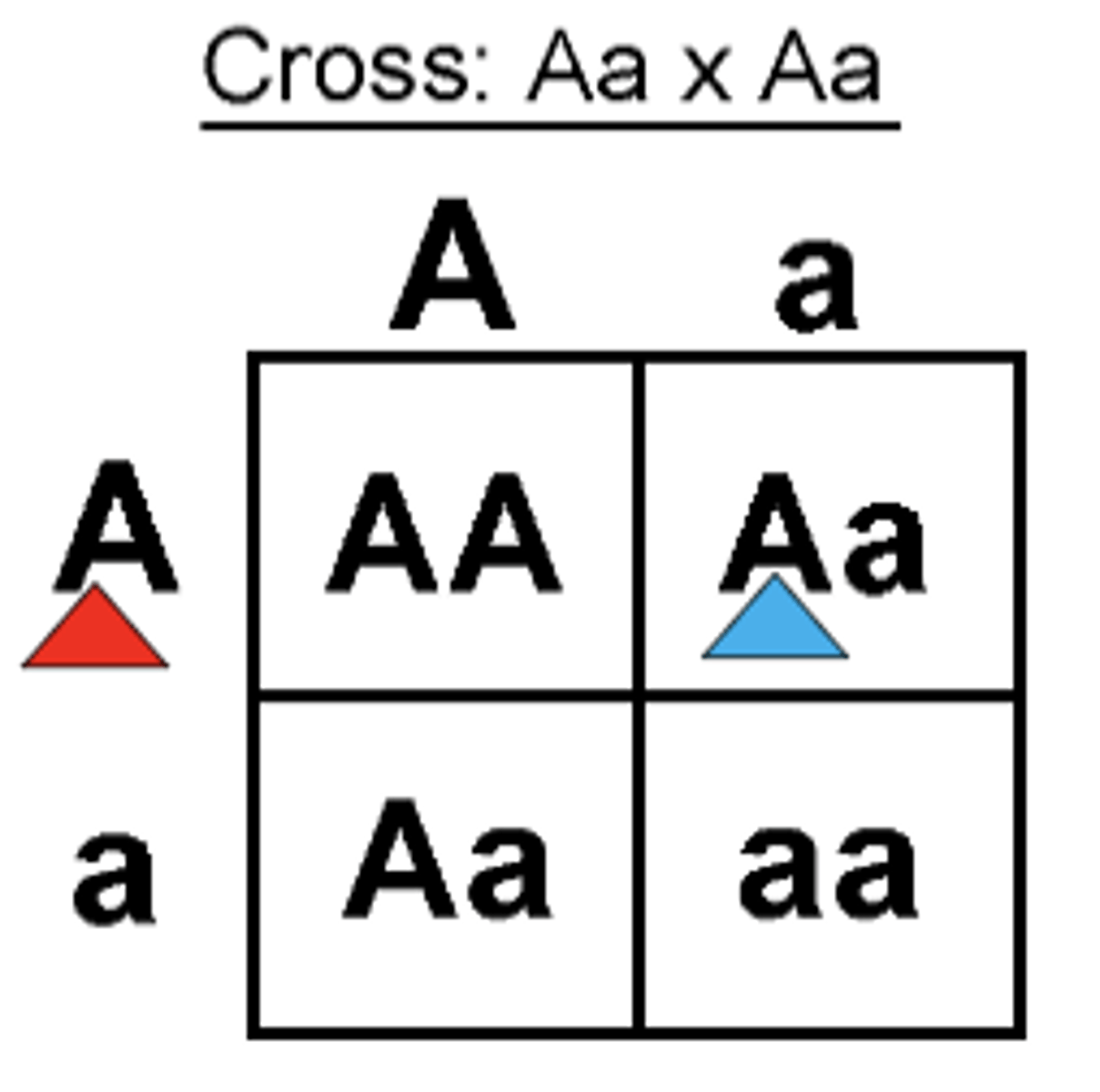
In this Punnett square showing a monohybrid cross, the A tagged in blue represents which?
A. Allele in a gamete
B. Allele in a parent genotype
C. Allele in an offspring genotype
D. Phenotype in either parent or offspring
C. Allele in an offspring genotype
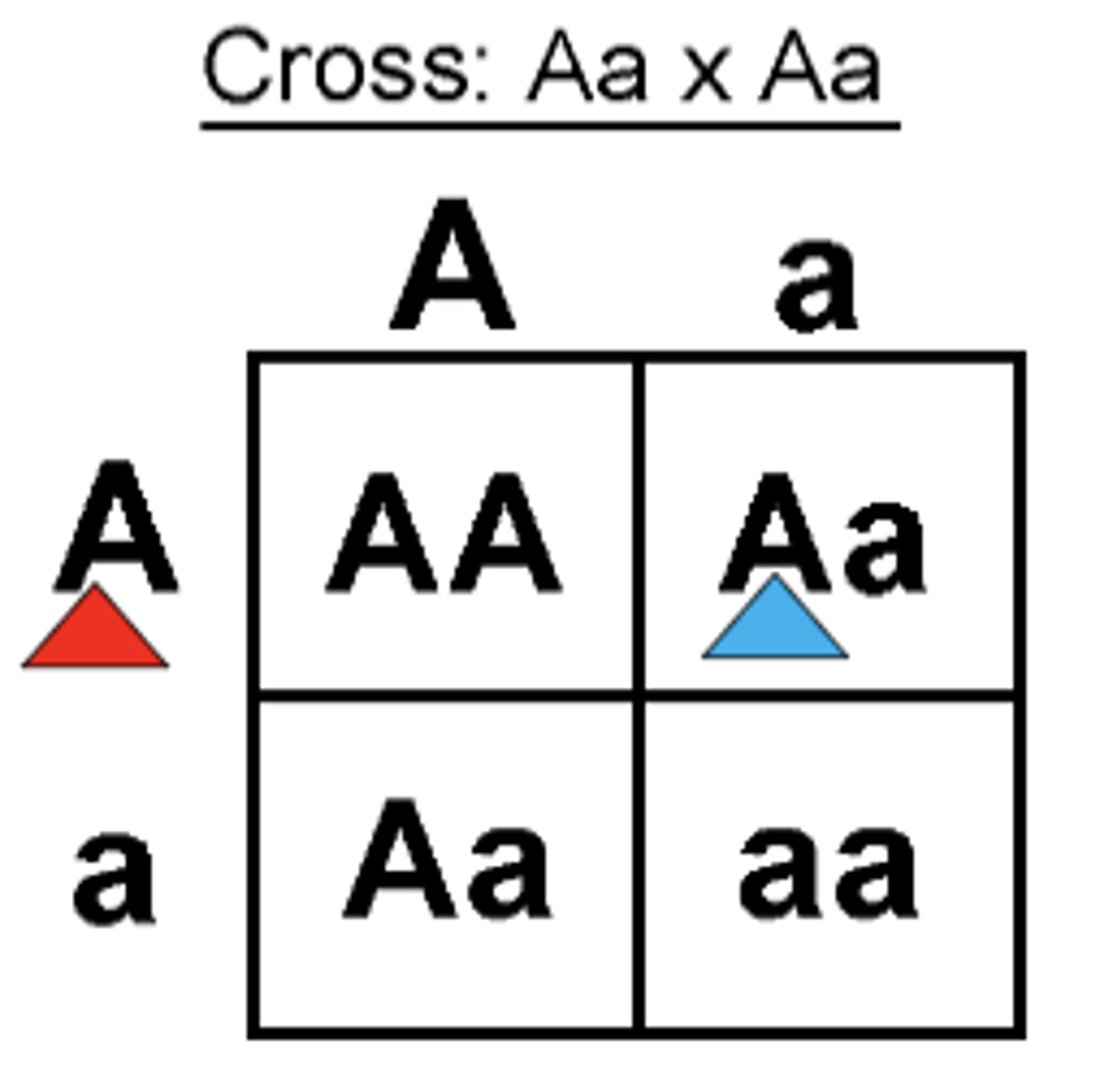
In this Punnett square showing a monohybrid cross, the A tagged in red represents which?
A. Allele in a gamete
B. Allele in a parent genotype
C. Allele in an offspring genotype
D. Phenotype in either parent or offspring
A. Allele in a gamete
In humans, which parent gives the sex-determining trait to the child?
A. Mother
B. Father
C. Could be either parent
D. Both parents
E. The stork
B. Father
In the mating cross Bb x Bb, what fraction of the offspring will have the genotype "bb"?
A. 0
B. 1/4
C. 1/2
D. 3/4
E. 1
B. 1/4
In the mating cross Tt x TT, what is the probability of their offspring having genotype "tt"?
A. 0
B. 0.25
C. 0.50
D. 0.75
E. 1
A. 0
One of the two sisters shown here is albino, a simple recessive trait inherited from heterozygous non-albino parents. What is the probability that the sister with normal coloration is a carrier of the albinism allele?
A. 0
B. 0.25
C. 0.33
D. 0.50
E. 0.66
F. 0.75
G. 1
E. 0.66
A mouse shows the dominant black phenotype but has unknown genotype. To do a test cross, you would mate this individual with which of these?
A. any black mouse
B. any brown mouse
C. a mouse that you think has the same genotype
D. not enough information here to set up a test cross.
B. any brown mouse
Which of these sets of parents (blood type phenotype given) is probably NOT correctly matched to their child (by blood type)
A. Parents A and B, child AB
B. Parents A and O, child AB
C. Parents A and O, child O
D. Parents A and B, child O
E. Parents AB and B, child AB
B. Parents A and O, child AB
In this Punnett square (figure on slide), what is the probability (fraction) that if these heterozygote parents (both carriers) have two children, they will have two albino children?
A. 0
B. 1/16
C. 1/8
D. 1/4
E. 1/2
B. 1/16
Which of the following is the best explanation of why a Siamese cat has some parts of the body that are dark and some light?
A. Only some of the cells contain genes for dark pigment
B. Only some of the cells are expressing the genes for dark pigment
C. Fur in only parts of the body were painted black by its owner
D. Both A and B are true
B. Only some of the cells are expressing the genes for dark pigment
Why are X-linked recessive traits more likely to appear in the phenotypes of males than phenotypes of females?
A. Recessive alleles become dominant in male individuals because of male hormones
B. Because of female hormones, females never express recessive alleles.
C. Males have only one allele for X-linked traits.
D. X chromosomes in males generally have more mutations than X chromosomes in females.
C. Males have only one allele for X-linked traits.
A woman does not have hemophilia but is heterozygous for the recessive X-linked gene for hemophilia. Her husband is not affected by hemophilia. What proportion (fraction) of their sons will have hemophilia?
A. None
B. 1/4
C. 1/2
D. 3/4
E. All
C. 1/2
A woman (who does not have hemophilia) is heterozygous for the recessive X-linked gene for hemophilia. Her husband is not affected by hemophilia. What proportion of their daughters will be carriers for the hemophilia allele?
A. None
B. 1/4
C. 1/2
D. 3/4
E. All
C. 1/2
Which of these must be true for a female mammal to be a mosaic for a particular X-linked trait?
A. She must have more than one X chromosome
B. She must be heterozygous for that trait
C. Both A and B must be true
C. Both A and B must be true
Which of these would be an evolutionary advantage to having the X-chromosome inactivation system?
A. It would decrease expression of only harmful X-linked traits
B. It would decrease expression of only helpful X-linked traits
C. It would make the amount of expression of all X-linked traits about the same in males and females
D. It would make the mutation rate of X-linked traits about the same as that of Y-linked traits.
C. It would make the amount of expression of all X-linked traits about the same in males and females
The A allele frequency is 0.7 - this means which?
A. the proportion of individuals showing the A trait in their phenotype
B. the proportion of individuals with any A alleles in their genotype?
C. the proportion of A alleles in the total gene pool
C. the proportion of A alleles in the total gene pool
The AA genotype frequency is is 0.7 – this means?
A. the proportion of individuals showing the A trait in their phenotype
B. the proportion of individuals with genotype AA
C. the proportion of A alleles in the total gene pool
B. the proportion of individuals with genotype AA
There are two alleles for a certain gene locus, A and a. 70% of the alleles in a particular gene pool are A. What is the allele frequency of a ?
A. 0.20
B. 0.30
C. 0.50
D. 0.70
B. 0.30
In this population where 60% of the alleles are dominant, p is closest to and q is closest to:
0.6 and 0.4
Within a population of butterflies, the color brown (B) is dominant over the color white (b), and 25% of all butterflies are white.
The value of q is what?
A. 0
B. 0.25
C. 0.50
D. 0.75
C. 0.50
Within a population of butterflies, the color brown (B) is dominant over the color white (b), and 25% of all butterflies are white.
The percentage of butterflies in the population that are heterozygous is
A. 0%
B. 25%
C. 50%
D. 75%
E. 100%
C. 50%
In the H-W equation p + q = 1, the term "p" can refer to which?
A. frequency of individuals showing the dominant trait
B. frequency of individuals showing recessive trait
C. frequency of the dominant allele in the gene pool
A. frequency of individuals showing the dominant trait
In the H-W equation p^2 + 2pq + q^2, the term "2pq" refers to the frequency of which?
A. individuals showing the dominant trait
B. individuals that are heterozygotes
C. individuals showing the recessive trait
B. individuals that are heterozygotes
In a population of 1000 diploid individuals, the gene pool for one trait like eye color would consist of how many alleles?
A. 500
B. 1000
C. 2000
D. another number
C. 2000
Within a population of butterflies, the color brown (B) is dominant over the color white (b), and 25% of all butterflies are white.the percentage of homozygous dominant individuals is
A. 0%
B. 25%
C. 50%
D. 75%
E. 100%
B. 25%
Inbreeding increases the percentage of which genotypes in a population?
A. Only homozygous dominant
B. Only homozygous recessive
C. Only heterozygotes
D. Both homozygotes
D. Both homozygotes
(red lynx) How did your results (final A1 frequency values) in small populations differ from result in large population size?
A. About the same
B. Small population resulted in higher A1 frequency
C. Small population resulted in lower A1 frequency
D. Some small population results were higher and some were lower than in large population.
E. I didn't get any results
D. Some small population results were higher and some were lower than in large population.
(red lynx) How did your results (final A1 frequency) with a positive selection coefficient (c) differ from result in large population with no selection (a)?
A. About the same
B. Somewhat higher A1 frequency
C. Much higher A1 frequency
D. Somewhat lower A1 frequency
E. Much lower A1 frequency
C. Much higher A1 frequency
(red lynx) How did your results (final A1 frequency) with a negative selection coefficient (e) differ from result in large population with no selection (a)?
A. About the same
B. Somewhat higher A1 frequency
C. Much higher A1 frequency
D. Somewhat lower A1 frequency
E. Much lower A1 frequency
E. Much lower A1 frequency
Evolution by genetic drift involves:
A. Small populations
B. Chance, random events
C. Selective loss of individuals with genetic-based traits
D. Two of these
E. All three of these
D. Two of these
Which of these individuals (within the same population) has the highest relative fitness?
A. Individual that lives the longest
B. Individual that acquires the most food and other resources
C. Individual that produces the most offspring
When a new mutation (new allele) appears in an individual in the population, what is fate of that allele in the population?
A. It will usually increase in frequency and become fixed
B. Just because it is so rare, it will usually decrease in frequency and disappear
C. Its future allele frequency depends upon whether it is favorable, deleterious or neutral in the environment.
C. Its future allele frequency depends upon whether it is favorable, deleterious or neutral in the environment.
Why must a population have some genetic variability in order for evolution by natural selection to work? (Concept check 21.1)
A. because selection has a greater effect in small populations
B. because the direction of selection can change in different environments
C. because selection can only occur immediately after a random mutation occurs
D. so selection can have different effects on individuals with different genetic-based traits
D. so selection can have different effects on individuals with different genetic-based traits
What happens if you take penicillin (antibiotic against peptidoglycan cell walls) when you have a viral infection?
A. It will cure your viral infection but have no effect on bacteria
B. It will neither cure your viral infection nor have an effect on bacteria
C. It will kill only harmful bacteria in your body
D. It will kill both harmful and helpful bacteria in your body
E. None of these is correct
D. It will kill both harmful and helpful bacteria in your body
If the bacterium Staphylococcus aureus experiences an energetic cost for maintaining one or more antibiotic-resistance genes, what would happen to these bacteria in environments that have no antibiotics?
A. These genes would be maintained just in case the antibiotics appear.
B. These bacteria would be outcompeted and replaced by bacteria that have lost these genes.
C. These bacteria would try to make the cost worthwhile by locating and migrating to microenvironments where traces of antibiotics are present.
B. These bacteria would be outcompeted and replaced by bacteria that have lost these genes.
Why don't all unfavorable alleles disappear immediately from a population?
A. They will only disappear in chance events
B. After a couple of generations the unfavorable alleles will become favorable alleles
C. They will remain in the population in heterozygotes.
C. They will remain in the population in heterozygotes.
Predict what happens to the frequency (q) of the sickle-cell globin allele in populations that move away from malaria areas but still get sickle cell anemia
A. q will increase
B. q will decrease
C. no significant change
B. q will decrease
In areas of Africa in which malaria is prevalent, many human populations exist in which the allele that produces sickle-cell disease and the allele for normal red blood cells both occur at constant frequencies, despite the fact that sickle-cell anemia disease frequently causes death at an early age. This is an example of which of these?
A. the founder effect.
B. heterozygote advantage
C. mutation
D. nonrandom mating
E. gene flow.
B. heterozygote advantage
The Biological Species Concept describes a "species" as which of these?
A.Populations of organisms that have similar body structure
B. Populations of organisms that can potentially interbreed with each other
C. Populations of organisms that are geographically separate from others
B. Populations of organisms that can potentially interbreed with each other
Distinguishing which set of species would be most difficult when specifically using only the Biological Species Concept?
A. Species that are small
B. Species in which males and females look alike superficially
C. Species that only reproduce asexually
D. Species that live in parts of the world that are inaccessible
C. Species that only reproduce asexually
Reproductive isolating mechanisms/barriers block gene flow between species. Which of these is an evolved adaptation to prevent reproduction between individuals of closely related species?
A. some species live in Asia and others live in North America
B. some species live in aquatic habitats and others live on land
C. different species have different specialized feeding organs
D. different species have copulation organs that do not fit
D. different species have copulation organs that do not fit
If the barrier is removed from two populations that were formed by allopatric speciation, what characteristic would allow one to determine IF the two populations had become separate species?
A. Different body structures
B. Different microhabitat specialization
C. Inability to interbreed
D. Competition for resources
C. Inability to interbreed
Is a geographic barrier alone a reproductive isolating mechanism?
A. Yes, because it is currently keeping the two populations apart.
B. Yes, because the two populations would always adapt to different environments on different sides of the barrier
C. No, because if the geography changes and the two separate populations are together, they can still potentially interbreed.
C. No, because if the geography changes and the two separate populations are together, they can still potentially interbreed.
DQ1. If a cell with genome of 20 pairs of chromosomes undergoes normal mitosis, how many cells result, and how many chromosomes are in each of the resulting cells?
A. Two cells, each with 20 chromosomes
B. Two cells, each with 40 chromosomes
C. Four cells, each with 10 chromosomes
D. Four cells, each with 20 chromosomes
E. Four cells, each with 40 chromosomes
B. Two cells, each with 40 chromosomes
DQ1. If a cell with genome of 20 pairs of chromosomes undergoes normal meiosis, how many cells result, and how many chromosomes are in each of the resulting cells?
A. Two cells, each with 20 chromosomes
B. Two cells, each with 40 chromosomes
C. Four cells, each with 10 chromosomes
D. Four cells, each with 20 chromosomes
E. Four cells, each with 40 chromosomes
D. Four cells, each with 20 chromosomes
DQ1. Which of the following is a difference between plant and animal life cycles?
A. Only one has a meiosis step
B. One has two fertilization steps
C. Only one has a haploid stage
D. Only one has a diploid stage
E. Only one has a multicellular haploid stage
E. Only one has a multicellular haploid stage
DQ1. If animal life cycles were similar to plant general life cycles, which of these, which does not occur in animals, would be analogous to the multicellular haploid stage of plant life cycles?
A. Multicellular diploid embryo
B. Multiple sperm fertilize one egg
C. Multicellular sperm
D. Extra fertilization step in the life cycle.
C. Multicellular sperm
DQ2. Flower color alleles in snapdragons show incomplete dominance. When red-flowering snapdragons are crossed with white-flowering snapdragons, all the offspring have pink flowers. When two pink snapdragons are crossed, what proportion of their offspring would be expected to be pink?
A. 0 (none)
B. 0.25
C. 0.50
D. 0.75
E. 1.0 (all)
C. 0.50
DQ2. A woman with blood type A gave birth to a child with blood type AB. It is uncertain which of three men is the father of the child. Person X has blood type A, person Y has blood type O, and person Z, has blood type B.
Can one or more of these men (X, Y, Z) be eliminated as the father of the child based on ABO blood group data?
A. Only Person X can be eliminated
B. Only Person Y can be eliminated
C. Only Person Z can be eliminated
D. Persons X and Y can be eliminated
E. Persons X and Z can be eliminated
F. Persons Y and Z can be eliminated
D. Persons X and Y can be eliminated
DQ3. If the frequency of alleles in a gene pool is 90% A and 10% a, what is the frequency of individuals with the genotype AA?
A. 0.90
B. 0.81
C. 0.50
D. 0.09
E. 0.01
B. 0.81
DQ3. In a population in Hardy-Weinberg equilibrium there is a gene locus with a dominant allele B and a recessive allele b.84% of the individuals in the population show the dominant trait in their phenotype (simple, complete dominance, not sex-linked). In a sample of 100 individuals from this population, about how many would be homozygous for the dominant allele?
A. 16
B. 24
C. 36
D. 48
D. 84
C. 36
HW 3] If 4% of individuals in a population show the recessive trait, what percent of the population consists of heterozygotes? [practice question from Discussion 3]
A. 8%
B. 16%
C. 32%
D. 64%
E.96%
C. 32%
HW 3] The initial allele frequency for a trait in a certain population was q=0.2. The environment changes, and individuals with that trait now have a selective advantage of + 0.01. After 500 generations, the allele frequency q for that trait would be closest to which of these four values? [Recall our results in the Red Lynx simulation]
A. 0.1
B. 0.2
C. 0.3
D. 0.6
D. 0.6
HW 3] In a population of mice, 9% of individuals are albino (show recessive a trait); the rest show agouti color (A). What is the frequency of agouti A allele? [just checking to see if you can answer this now]
A. 0.03
B. 0.09
C. 0.30
D. 0.70
0.91
D. 0.70
HW 3] In a population of beetles, 25% of individuals are pale green (show the recessive g trait in their phenotype); the rest show dark green color (G). If the population has 1000 individuals, what is the expected number of G alleles in the gene pool? [Note: this was a free-response question on last year’s test worth 2 points. Could you have answered it without the multiple-choice options?]
A. 250
B. 500
C. 1000
D. 1500
E. 1750
C. 1000
HW 3] Which one of the following conditions would PREVENT the opportunity for evolution by natural selection?
A. All members of the population are genetically identical
B. The environment often changes conditions.
C. Some individuals have a much higher reproductive fitness than others.
A. All members of the population are genetically identical
HW 3] Which of the following would be an exception to the principle of independent assortment?
A. crossing over
B. segregation of alleles
C. co-dominant alleles
D. linked genes
D. linked genes
HW 3] There are 40 individuals in small population 1, all with genotype A1A1, and there are 25 individuals in population 2, all with genotype A2A2. Assume that these populations are located very far from each other and that their environmental conditions are about the same. Based on the information given here, the observed genetic variation is most likely the result of which? [modified from last year's exam]
A. genetic drift
B. gene flow
C. differential natural selection
D. equilibrium
A. genetic drift
HW 3] In comparing several different populations of the same species, the population with the greatest genetic variation would have the: [modified from last year's exam]
A. greatest number of genes in its genome
B. greatest number of heterozygotes
C. greatest number of population members
D. largest gene pool.
B. greatest number of heterozygotes
DQ4. In areas of Africa in which malaria is prevalent, many human populations exist in which the allele that produces sickle-cell disease and the allele for normal red blood cells occur at constant frequencies, despite the fact that sickle-cell anemia disease frequently causes death at an early age. This is an example of
A. the founder effect
B. balancing selection
C. mutation
D. non-random mating
E. gene flow
B. balancing selection
DQ4. There is a large population of organisms. Ten females and two males wander off and join another large population. This is an example of:
A. gene flow
B. genetic drift
C. sexual selection
D. artificial selection
E. non-random mating
A. gene flow

