Mod 5 (Ch 4) - Coping with Environmental Variation: Temperature and Water
 Studied by 25 people
 Call Kai
 Learn
Learn Practice Test
 Spaced Repetition
 Match
Match Flashcards
 Knowt Play
1/70

Earn XP
Description and Tags
included on exam 1
Name | Mastery | Learn | Test | Matching | Spaced | Call with Kai |
|---|
No analytics yet
Send a link to your students to track their progress
71 Terms
examples of abiotic (physical) factors that constrain the geographic range of species
climate
water
disturbance (e.g. fire, temperature, water)
examples of biotic (biological) factors that constrain the geographic range of species
interactions with other organisms
food availability
results of suboptimal conditions
suboptimal conditions → physiological stress → suboptimal physiological performance → reduced survival, growth, or reproduction
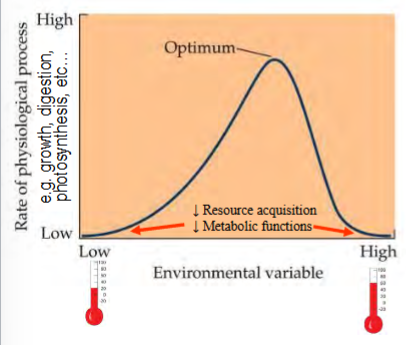
physiological stress
suboptimal physiological performance that results from suboptimal conditions
decreased resource acquisition, decreased metabolic functions
(not the same as psychological stress)
i.e. you might have to divert extra energy to adjusting for suboptimal conditions, you might be uncomfortable, etc.
3 options for reaction to physiological stress
avoidance
tolerance
death
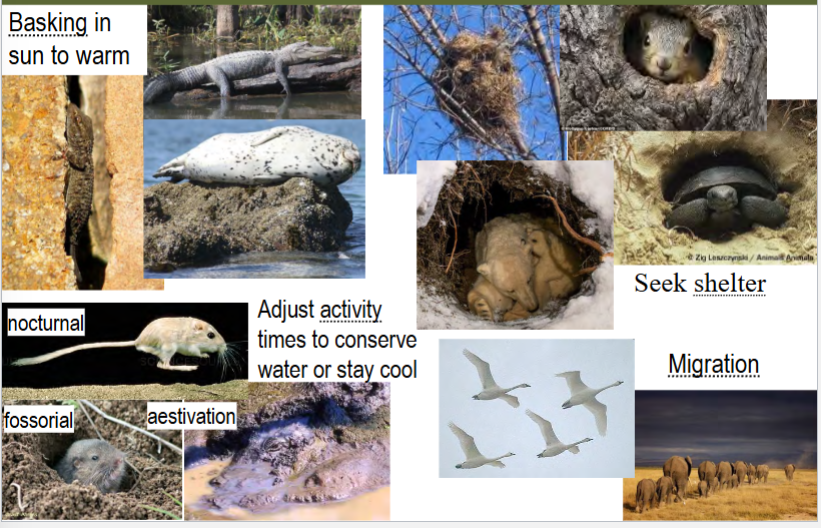
avoidance
one option in response to physiological stress
lessens effects of stress via behavioral/physiological activity that minimizes exposure to the stress
typically a behavioral response (e.g. basking in the sun, adjusting activity times, migrating, seeking shelter)
tolerance
one option in response to physiological stress
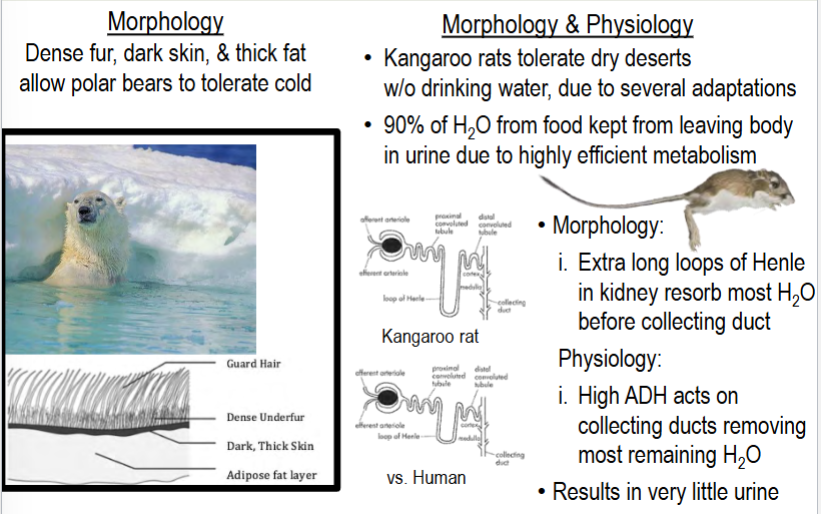
the ability to survive physiologically stressful abiotic conditions
typically via morphological or physiological adaptation (e.g. skin and fur of polar bears, nephrons of kangaroo rats; understand these examples)
range of tolerances
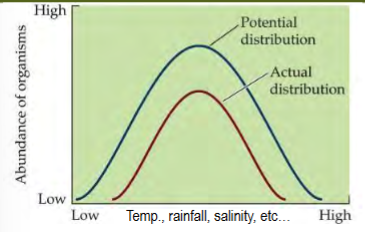
the extremes to which a species can tolerate varying abiotic factors (e.g. how hot and how cold, or how wet and how dry)
influences potential distribution and abundance of that species
actual species distribution vs potential distribution
actual distribution is usually narrow than potential distribution
due to extreme climatic conditions, disturbance, species interactions
(e.g. most individuals might not be able to handle the extremes, thus species distribution will not extend into those extreme potential areas)
how adaptations are produced
natural selection acts on individual phenotypes → chooses traits that allow avoidance or tolerance of suboptimal conditions (reduce physiological stress)
adaptations can be behavioral, morphological, or physiological, because natural selection acts on those three things
acclimatization
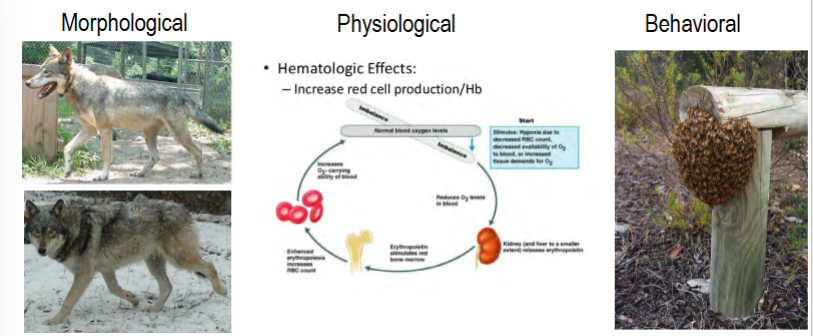
relatively rapid, temporary phenotypic change in individuals to reduce effects of physiological stress
individual (NOT entire species) response to abiotic variation
occurs over a relatively short time period
can and will reverse if the stress is eliminated
can be morphological, physiological, or behavioral adjustment
does not eliminate physiological stress
amount is limited by the level of phenotypic plasticity
e.g. growing thicker fur in winter, increasing erythrocyte production, bees forming a ball to keep warm
adaptation
genetic change in the entire population
population (NOT individual) response to abiotic variation
natural selection for particular phenotypes that increase survival/reproduction
may be morphological, physiological, and/or behavioral
can allow later generations of a population to return to pre-stress levels (even if the stress does not go away, adaptation makes the population better able to handle the stressor with a lower level of physiological stress)
sometimes irreversible, sometimes reversible (but takes several generations)
e.g. over time, in colder environment, population size increases and shows more countercurrent circulation and tendency to bask in the sun
e.g. the ability to acclimatize (not the act of acclimatization itself)
phenotypic plasticity
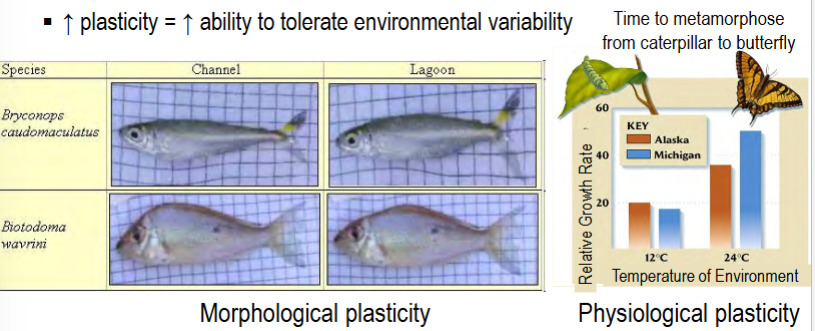
the range of phenotypes that can be displayed by a genotype in response to environmental variation
i.e. flexibility in response to environmental change
varies between individuals, populations, and species
direct correlation with ability to tolerate environmental variability
e.g. ability to change body shape based on living conditions when young, time to metamorphose
similarities between acclimatization and adaptation
reduce stress; morphological, physiological, and/or behavioral
increase survival probability and/or reproductive output
relatively long-term/permanent in contrast to an acute response
differences between acclimatization and adaptation
type of change (phenotypic vs genotypic)
scale of change (individual vs population)
speed of response (rapid vs over generations)
reversibility
(see the chart on slide 13, know specifics of differences)
trade-off between acclimatization and growth
energy used for acclimatization means less energy available for growth/survival/reproduction
only populations in variable environments (who would need to acclimatize) evolve the ability to acclimatize
populations in constant environments do not evolve the ability to acclimatize
correlation between phenotypic plasticity and environmental conditions
ability to acclimatize and level of phenotypic plasticity reflects range of conditions naturally experienced
(greater variation between conditions results in greater plasticity and ability to acclimatize)
^due to the energy trade-off of acclimatization and growth
distinction between acute response, acclimatization, and adaptation
acute response is a response, immediate and short-term
acclimatization is the adjustment of a response within an individual, i.e. an acute response happens differently
adaptation is the long-term adjustment of an acclimatized trait; e.g. the ability to acclimatize or show an acute response
(see the sweat example on slide 20)
how temperature affects physiological activity
changes the rate or occurrence of chemical reactions
affects cell membranes
increases water loss
how temperature affects rate or occurrence of chemical areactions
directly
indirectly: altering enzyme activity or denaturing enzymes
how temperature affects cell membranes
cell membranes lose function at lower temperatures
membranes leak → lose their filtering function
transport proteins lose function → affect mitochondrial, chloroplast, and other processes
how temperature of an organism is determined
by exchanges of energy with the external environment (gain or loss)
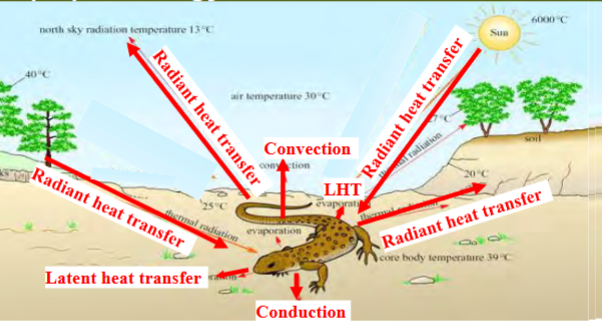
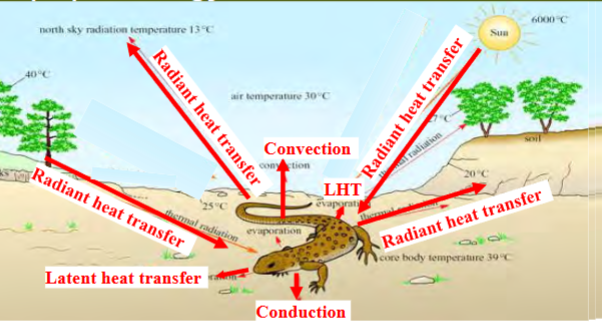
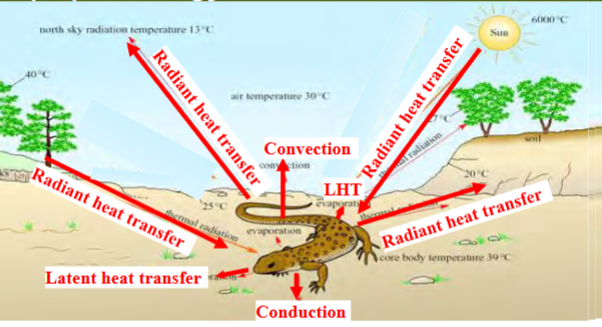
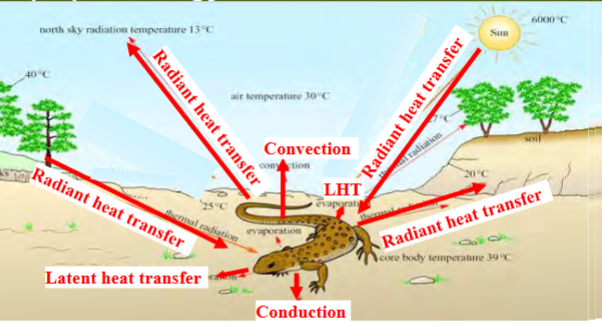
4 mechanisms of heat transfer
conduction
convection
latent heat transfer
radiant heat transfer
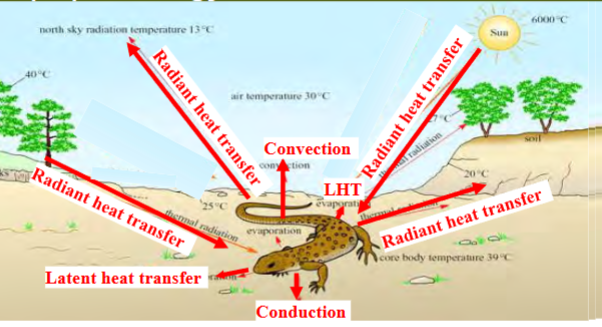
conduction
one mechanism of heat transfer
transfer of heat via direct contact of molecules
e.g. between a warm hand and a cold table
convection
one mechanism of heat transfer
conduction + fluid/gas flow
e.g. baking within an oven
latent heat transfer
one mechanism of heat transfer
heat loss from evaporation or evapotranspiration (liquid → gas)
e.g. sweating
radiant heat transfer
one mechanism of heat transfer
movement of heat via electromagnetic waves (solar + thermal)
e.g. warming beside a fire or the sun, infrared cameras detecting an animal’s body heat
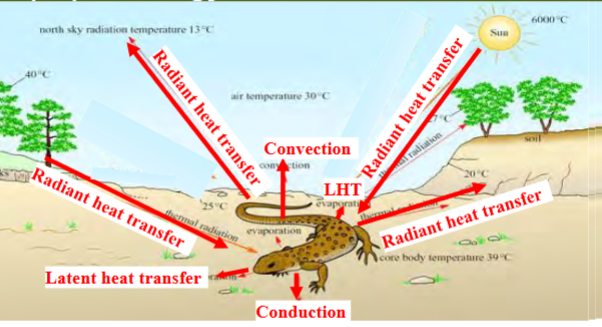
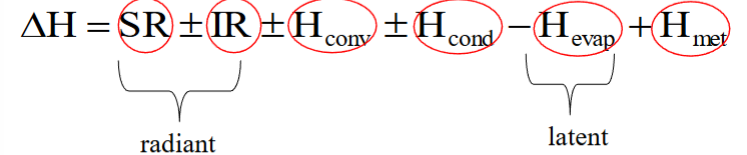
overall temperature change
heat from solar radiation is always gained
heat from infrared radiation can be gained or lost
heat from convection can be gained or lost
heat from conduction can be gained or lost
latent heat from evaporation is always lost
heat from metabolism is always gained
(see the picture for equation)
rates at which plants lose/gain heat
depends on morphological physiological attributes that affect their rate of transpiration, rate of convection, and reflective abilities
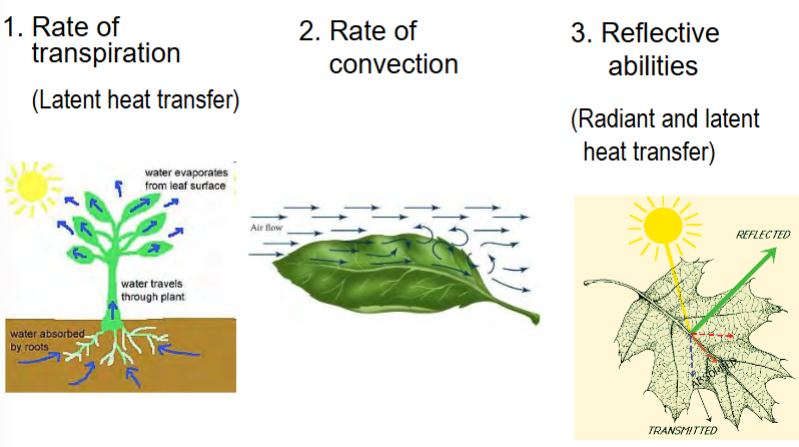
morphological/physiological attributes affecting rate of transpiration
number of stomata
degree of stomatal opening
cuticle thickness
leaf orientation
leaf closure
transpiration
water uptake + evaporation
can be used to lower temperature
not good in dry areas, where new water is not readily available to replenish lost water
some plants drop their leaves to avoid excess transpiration → use other methods to control body temperature
boundary layer
nonmoving air around a leaf
thicker boundary layer = less air movement = convective heat loss
affected by size, shape, texture, orientation leaves toward/away from wind or sun
how some plants reduce convective heat loss in cold weather
some plants grow low to the ground
some plants develop pubescence
light reflective properties affecting rate of radiant and latent heat transfer
pubescence increases reflected sunlight → lowers heat gain due to radiant heat transfer (keeps the plant cooler)
positive and negative effects of pubescence
benefit: can keep plant warmer or cooler, depending
solar radiation for photosynthesis is lost
convective cooling is less effective
resuls:
summer-acclimatized plants have increased pubescence
pubescence is less common in climates/seasons that are wet or have less sunlight
temperature regulation in animals
regulation depends on where heat comes from (ectotherm vs endotherm) and how body temperature varies (poikilotherm vs homeotherm)
ectotherm
an animal in which body heat is derived from the environment
can augment costs behaviorally or via morphological/physiological changes (i.e. can keep animal warm without needing to use energy) (e.g. basking, turning dark during the day and light at night)
e.g. most reptiles
cost of being ectothermic
activity is limited when cold
many enzymes and physiological adaptations are needed to function at varying temps (these enzymes and adaptations require energy to produce)
endotherm
an animal in which body heat is derived from its own metabolism
e.g. birds, mammals
poikilotherm
an animal in which body heat varies with ambient temperature
homeotherm
an animal in which body heat remains constant
e.g. humans
animals that are poikilothermic ectotherms
most microorganisms, invertebrates, cartilaginous and bony fish, amphibians, reptiles
(if outside temp gets hot, the animal gets hot)
(most '“cold-blooded” animals)
animals that are poikilothermic endotherms
many subterranean rodents (have limited O2 and heat, maintain low BMR and body temperature near ambient)
animals that are homeothermic ectotherms
many smaller oceanic fish in stable temperatures (functionally homeothermic)
animals that are homeothermic endotherms
most birds and mammals
heterotherm
an animal that is poikilothermic and homeothermic
usually these animals are most often homeothermic and sometimes poikilothermic
animals that are heterothermic ectotherms
many bees, moths, some reptiles (they shiver sometimes)
some large fish use countercurrent circulation in some muscles
some plants increase respiration (thus heat) in late winter
animals that are heterothermic endotherms
mammals and birds (poikilothermic during torper or hibernation)
critical temperatures (lower and upper)
environmental temperatures at which an endotherm’s metabolic rate has to increase to maintain body temperature
heat loss =/= heat gain
in between these temperatures is the thermoneutral zone
for lower CT: heat loss > heat gain (shivering occurs)
for upper CT: heat gain > heat loss (sweating occurs)
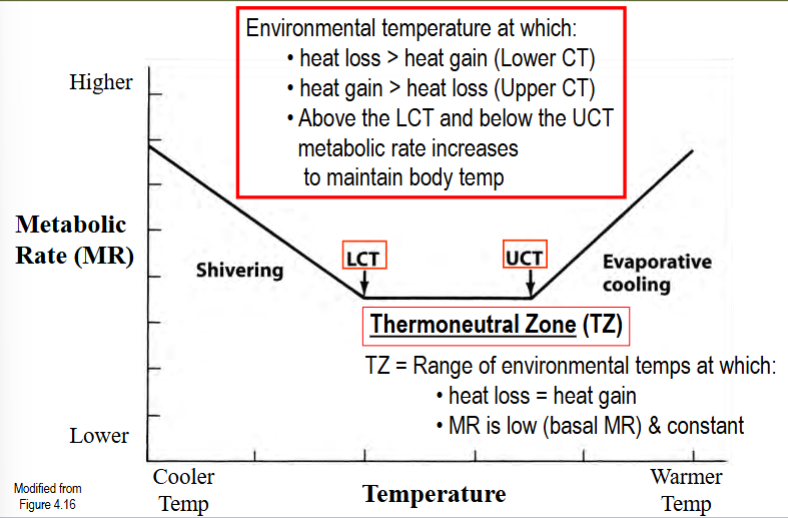
thermoneutral zone
the range of environmental temps at which an endotherm’s metabolic rate is low (basal) and constant
heat loss = heat gain
in between the upper and lower critical temps
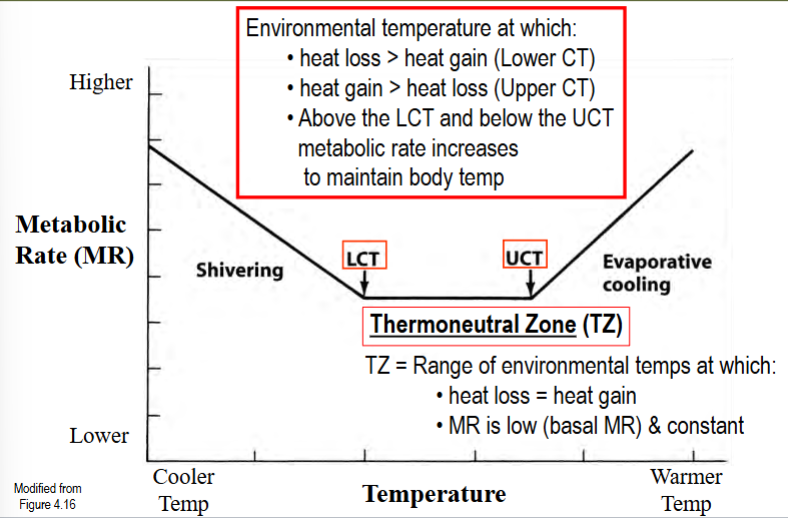
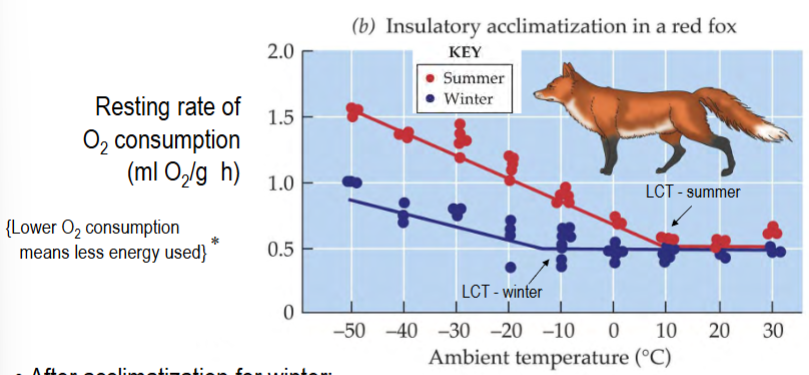
how acclimatization changes acute response
by lowering upper or critical temperature → less energy consumption
e.g. by growing thicker fur or bulking for winter, energy consumption is reduced and increased energy isn’t needed until colder temperatures
how lower critical temp for animals varies
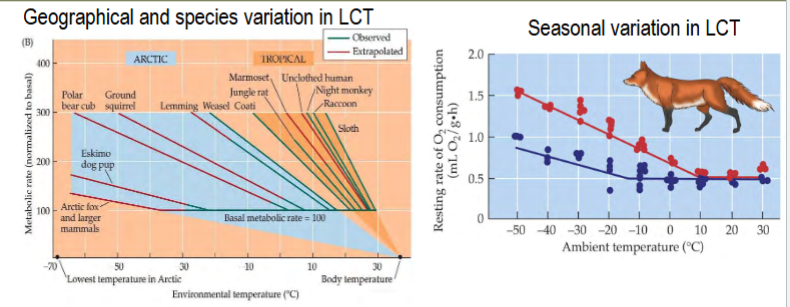
varies geographically, seasonally, and among species, depending on energy needs and food availability
lower LCT → wider TNZ → less energy used
lower in animals with higher energy demands or less access to food (to conserve energy)
what happens to animals that can’t sufficiently augment heat loss?
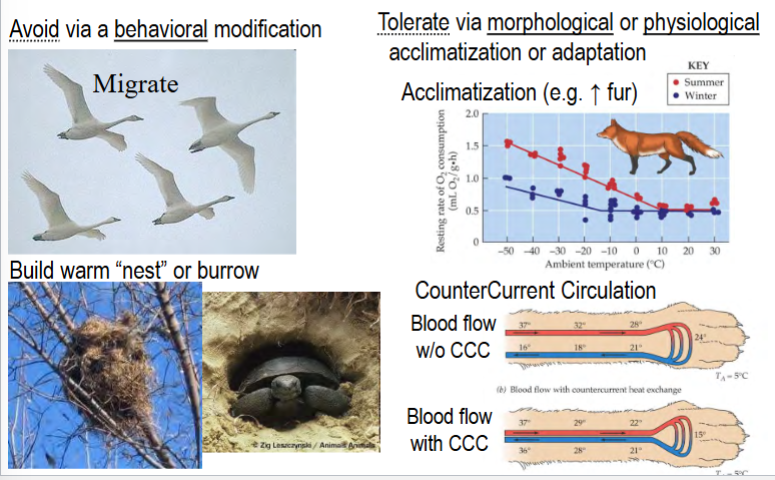
if animals can’t increase their metabolic rate to augment heat loss: they must avoid or tolerate conditions, or die
i.e. by behavioral modification or morphological/physiological acclimatization/adaptation
osmoregulation
balance of uptake and loss of water and solutes to regulate body fluid composition and pH
affected by exchanges with external environment
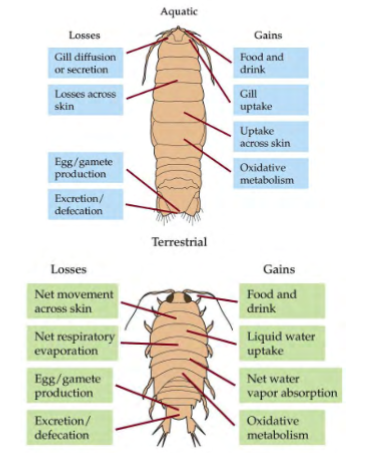
differences in water uptake/loss in aquatic vs terrestrial animals
aquatic animals gain water through: food and drink, gill uptake, uptake through skin, oxidative metabolism
terrestrial animals gain water through: food and drink, liquid water uptake, net water vapor absorption, oxidative metabolism
aquatic animals lose water through: gill diffusion/secretion, losses across skin, egg/gamete production, excretion/defecation
terrestrial animals lose water through: net movement across skin, net respiratory evaporation, egg/gamete production, excretion/defecation
(note: the main differences are in absorption/loss across skin and gills)
how plants osmoregulate in water-stressed environments
they regulate when their stomata are open (daytime) and closed (nighttime)
daytime: dehydration
stomata open to let CO2 in and O2 out
evaporative water loss > uptake through roots (except in very humid air)
nighttime: rehydration
stomata mostly close
evaporation slows → water loss < uptake through roots
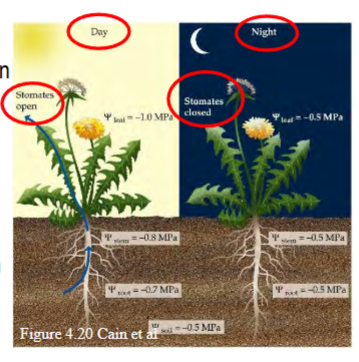
acclimatizations for plants to minimize water loss and maximize water gains in dry environments
adjustment of cell wall and cuticle thickness (reduces water loss)
shedding of leaves in dry periods (reduces water loss, requires less nutrients)
adjustment of root biomass to optimize water uptake (maximize water gains; dryer environment → greater root mass)
mycorrhizal fungi
symbiotic fungi that attach to plant roots (myco = mushroom/fungus, rhiz- = root/rhizome)
affect water balance in plants
large surface area of fungi increases water absorption for plants
fungi take some food from plants
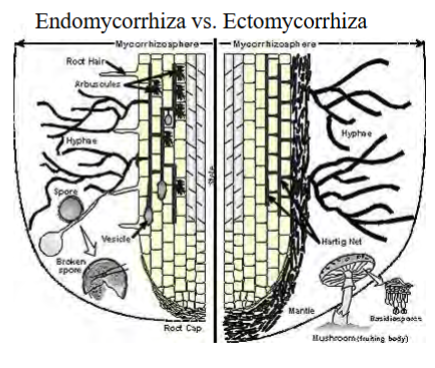
osmosis
the diffusion of water from areas of lower solute concentration to higher solute concentration
(the water moves, not the solutes)
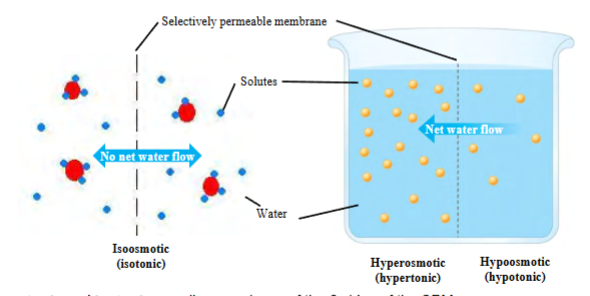
osmoregulation in freshwater vs saltwater fishes
osmosis creates imbalance
drinking, eating, excretion, and active transport compensate for these gains/losses
saltwater fish are hypotonic to their environment; gain water from food and drinking seawater; excrete salt from gills (active transport), lose water through gills and body surfaces, excrete excess salt and a little bit of water
freshwater fish are hypertonic to their environment; gain water and ions in food, uptake slat by gills, uptake water through gills and body surfaces; diffuse salt from gills, excrete lots of water and some ions
how amphibians avoid water loss through their thin skin
live in moist environment
increase skin thickness (must breath faster to compensate for reduced oxygen intake)
have highly vascularized and/or bumpy ventral (stomach) skin to increase water absorption
have thick and bumpy dorsal skin to reduce convective water loss (toads (terrestrial frogs))
how reptiles avoid water loss
shedding (increases thickness of all skin layers, especially the outermost)
have scales to provide protection and reduce water loss
excrete dry solid urine
shells are leathery/hard (resist drying) and have storage areas for wastes
surface area:volume ratio and rate of heat/water gain/loss
small animals have a higher SA:V ratio than large animals → more prone to water loss and rapid temperature shifts
SA:V ratio also affected by body shape and appendages
elongated animals and elongated appendages → higher SA:V ratio
ectothermic dinosuars: probable or improbable?
improbable
because of low SA:V ratio
Bergmann’s rule
body mass increases with latitude and colder climate
larger animals retain heat better than small animals
e.g. deer; much larger in Wisconsin than Florida
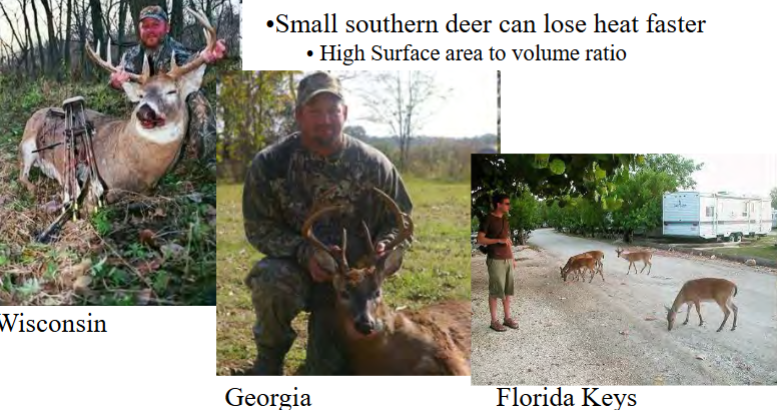
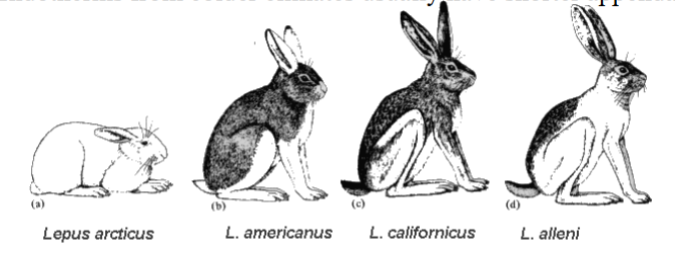
Allen’s rule
endotherms from colder climates usually have shorter appendages
e.g. jackrabbits vs arctic hares, see their leg lengths
torpor
a reduced state of activity and metabolic rate, below basal metabolic rate (BMR)
may occur over short or long periods of time
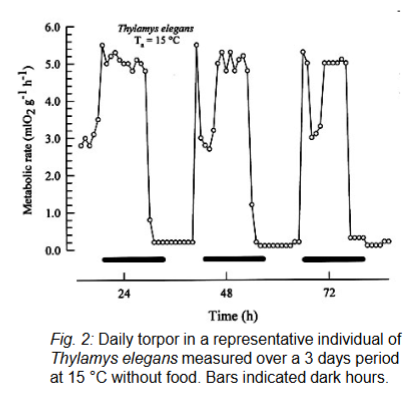
daily torpor
a short-term torpor that occurs in many bats, small mammals, birds
small mammals can lower body temp to near freezing, but wake up every days to eat and excrete
hibernation
a type of long-term torpor
a response to cold and food scarcity
e.g. bears can hibernate for 7 ½ months without waking up
aestivation
a type of long-term torpor
response to heat and water scarcity
e.g. in lungfish, caiman, early proto-amphibians
some cold-tolerating acclimatizations/adaptations
frozen frogs
torpor
 Note
Note  Flashcards (20)