Lecture 16: Sequences and Series
 Studied by 0 people
 Call Kai
 Learn
Learn Practice Test
 Spaced Repetition
 Match
Match Flashcards
 Knowt Play
1/11

There's no tags or description
Looks like no tags are added yet.
Name | Mastery | Learn | Test | Matching | Spaced | Call with Kai |
|---|
No analytics yet
Send a link to your students to track their progress
12 Terms
What plays a huge role in motor control and learning
Attention
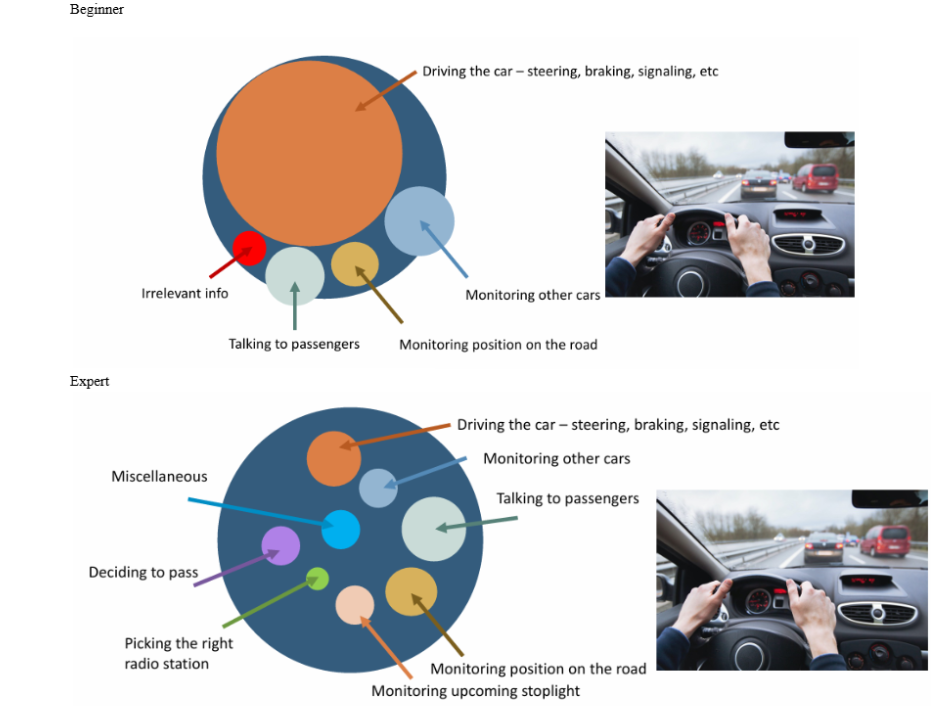
What is the Fixed Capacity Model (attention theory 1) and what does it suggest about human attention when performing multiple tasks during early learning and late learning while driving?
The Fixed Capacity Model: suggests that humans have a limited amount of attentional resources available to perform tasks and gather information.
Beginner drivers: Allocate most of their limited attentional resources to the core task of driving the car (steering, braking, signaling, etc.), leaving fewer resources available for other tasks. They also tend to spend some attention on irrelevant information, which can further reduce efficiency.
Expert drivers: Distribute attention more evenly across multiple tasks. The attentional demand for the primary driving task is much smaller for experts because it has become more automatic. This frees up attentional resources to handle additional tasks and distractions more effectively, allowing for smoother and safer driving. Reducing the cognitive load on core activities and enabling better multitasking.
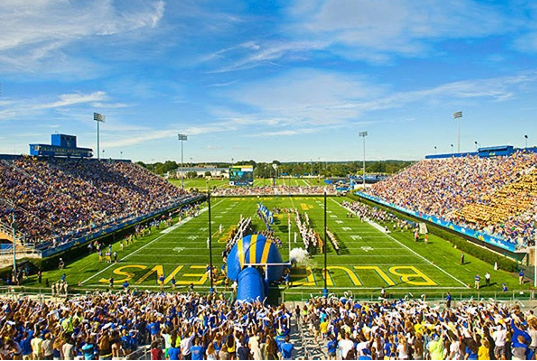
What is the bottle neck theory (filter theory, attention theory 2) and how does it explain the process of filtering visual information? Use this image of a football game as an example.
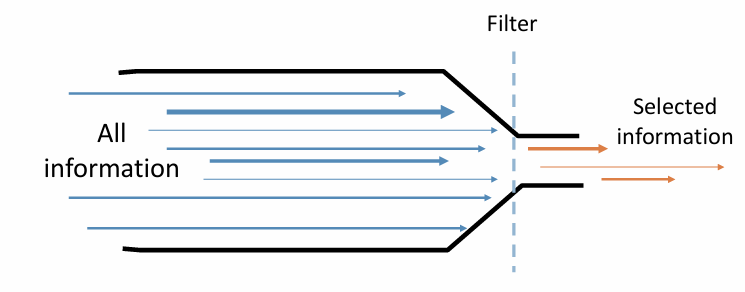
Bottleneck Theory: Humans have a limited amount of attentional resources due to processing that happens in serial order (i.e., only one thing can be processed at a time)
When we receive visual input, photoreceptors in the retina initially take in the entire visual scene —> information is transmitted to the visual areas of brain, where neurons fire to process it. However, because of limited processing capacity, the brain reduces this flood of information to only the most important features.
Picture: At football game, might initially see everything: Friend beside you, the goal posts, players running. Brain filters this down to about 10–20 key items that you consciously become aware of, such as friend and blue sky. Brain only focuses on relevant and meaningful stimuli, preventing overload and allowing effective attention and perception. Brain’s limited processing resources, acting like a funnel that narrows down information from the entire scene to what is most important.
What is change blindness, and how does selective attention explain why people often fail to notice large changes in their environment during complex tasks?
Change blindness is the Inability to detect large changes in details of our environment, such as objects or scenes, even when those changes are obvious. It occurs because selective attention limits what we perceive—when people focus on a complex or demanding task, their attentional resources are heavily engaged, reducing their ability to notice unexpected events or changes around them. For example, in an experiment where participants counted basketball passes, those performing a harder counting task were less likely to notice an unexpected person (like an umbrella woman or gorilla) because their attention was focused elsewhere, illustrating how selective attention can cause change blindness.
How can humans focus on a single conversation in a noisy environment, and what is this phenomenon called?
Humans can focus on one conversation in a busy, noisy environment through selective attention, which allows the brain to filter out irrelevant sensory information while concentrating on the target stimulus. This phenomenon is known as the Cocktail Party Effect. For example, at a crowded party, you can attend to the person speaking to you while largely ignoring other conversations, background music, and ambient noise. The brain prioritizes the auditory information from the attended speaker, enabling comprehension despite the surrounding distractions.
How did early studies demonstrate selective attention in auditory tasks, and what theory was proposed to explain it?
Early studies, such as Cherry (1953), presented different streams of speech to each ear (dichotic listening). Subjects were instructed to attend to one ear and repeat the speech while ignoring the other. Participants were able to accurately repeat the attended speech but could not recall details from the ignored ear, demonstrating selective attention. Broadbent (1958) proposed the filter theory, suggesting that the attention system has a limited-capacity channel that functions like a gate, allowing some information through for processing while filtering out irrelevant information. This explains how we can focus on one stream of information in a busy environment.
What are the differences between bottom-up and top-down attentional control, and how do reaction times differ in visual pop-out versus visual search tasks?
Bottom-up control is stimulus-driven: attention is automatically drawn to salient targets that “pop out” from their surroundings (exogenous control-attention is naturally/automatically drawn to the stimulus). Pre-attentive (The process of detecting stimuli in the visual field (usually in the periphery) to guide future attention) processes in the visual field detect these stimuli, often in the periphery, and guide attention. Reaction times are very fast in visual pop-out tasks because the target is immediately noticeable.
Top-down control is user-driven and task-dependent (endogenous control-attention directed to the stimulus voluntarily). Attention is directed voluntarily based on goals, instructions, or expectations. Visual search tasks, which require identifying a target among distractors using top-down control, have longer reaction times (~40 ms or more) because neurons must process and locate the target deliberately.
In summary, bottom-up attention is automatic and fast, whereas top-down attention is voluntary and slower, reflecting the cognitive effort required to find a target.
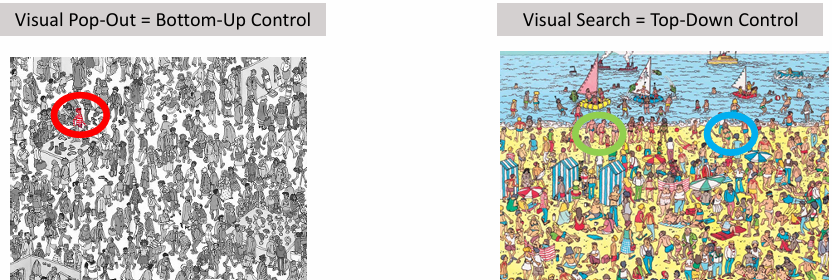
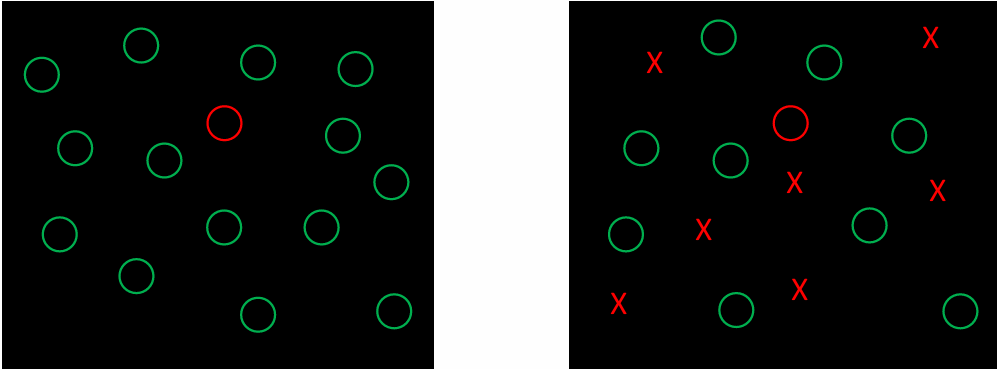
What is the difference between a “pop-out search” and a “conjunction search” in visual attention tasks? Which image is an example of a pop out search and which is a conjunction search.
Pop-out search: Occurs when the target can be identified by a single, salient feature (e.g., color). It is fast and relies on bottom-up, stimulus-driven attention, as the target automatically stands out from the distractors (left).
Conjunction search: Occurs when the target must be identified using a combination of features (e.g., color and shape). This requires top-down, voluntary attention, is more cognitively demanding, and typically results in longer reaction times because the visual system must actively scan and compare multiple items (right).
How does increasing the number of distractors affect reaction time in pop-out versus conjunction visual searches, and why?
Increasing the number of distractors does not affect reaction time in pop-out searches because the target is easily identifiable by a single salient feature, allowing it to stand out automatically (bottom-up attention).
In contrast, increasing distractors increases reaction time in conjunction searches because the target must be identified using a combination of features (e.g., color and shape). This requires a serial, item-by-item search using a voluntary “spotlight” of attention (top-down attention) to detect the target among distractors.
What are two important things that attention can do?
Enhance Detection
Influence Reaction Time
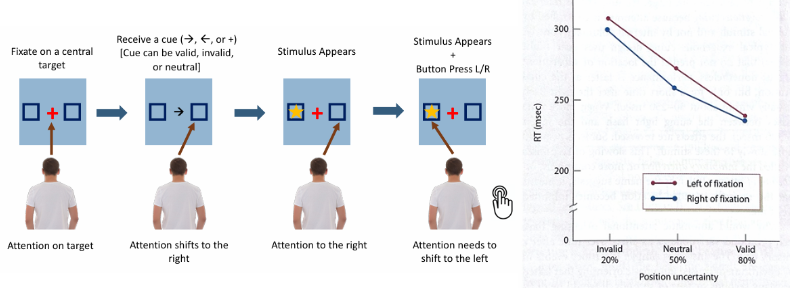
How does directing attention to a specific location affect detection and reaction time, according to Posner’s 1980 study?
Directing attention to a specific location enhances detection and reduces reaction time for stimuli appearing at that location. Posner found that when subjects expected a stimulus at a valid location, they responded faster and more accurately. Conversely, if attention was directed to an invalid location, detection was reduced and reaction times increased. This shows that focusing attention prior to a stimulus accelerates neural processing and improves behavioral responses.
What is visuospatial neglect, and how does it manifest in patients after a stroke?
Visuospatial neglect is an attentional disorder in which patients fail to acknowledge objects or events in the space opposite (contralateral) to their brain lesion. It commonly occurs after a right hemisphere stroke, causing patients to ignore the left side of their environment. A prominent feature is extinction, where the patient cannot perceive or respond to stimuli on the neglected side, such as missing lines on a line cancellation task.
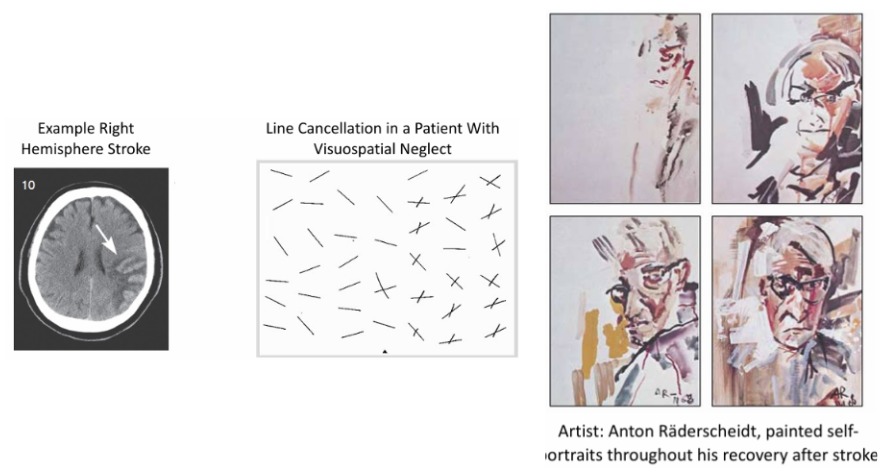
 Note
Note  Flashcards (31)