tools, methods, assessments
 Studied by 0 people
 Call Kai
 Learn
Learn Practice Test
 Spaced Repetition
 Match
Match Flashcards
 Knowt Play
1/21

There's no tags or description
Looks like no tags are added yet.
Name | Mastery | Learn | Test | Matching | Spaced | Call with Kai |
|---|
No analytics yet
Send a link to your students to track their progress
22 Terms
quick method often used during brief patient encounters is a linear wound measurement. This method is simple, reliable, costs little to implement, and is portable. However, it can have limited sensitivity to change in wound size, and limited information is gathered on wound shape.
Perpendicular Method -
is a technique that is more sensitive to changes in wound size than the perpendicular method.
Planimetry -
. The wound is considered as a face of a clock with the position of the wound based on the standard anatomical position of the patient
Clock Method -
Tool that represents a biologically accurate, easy-to-use, and clinically practical instrument for tracking pressure ulcer status over time. It is also designed to monitor three critical parameters that are most indicative of healing: surface area (length × width, in centimeters squared), exudate (none, light, moderate, or heavy), and type of tissue present at the wound bed (i.e., closed or resurfaced, epithelial tissue, granulation tissue, slough, or necrotic tissue [eschar]).
Pressure Ulcer Scale for Healing (PUSH) Tool
Tool used to assess and monitor healing of all types of wounds. which is specifically designed for use in assessing pressure ulcers only. It consists of 15 items (location and shape are not scored). The scored items are size, depth, edges, under mining, necrotic tissue type, necrotic tissue amount, exu date type, exudate amount, skin color, edema, induration, granulation, and epithelialization. Each item is scored from 1 to 5, with a lower score being preferable. The 13 subscores are totaled to get a total score. A BWAT score can be used to give an indication of the wound severity.
Bates-Jensen Wound Assessment Tool (BWAT)
Bates-Jensen Wound Assessment Tool (BWAT)
13-20
MININMAL SEVERITY
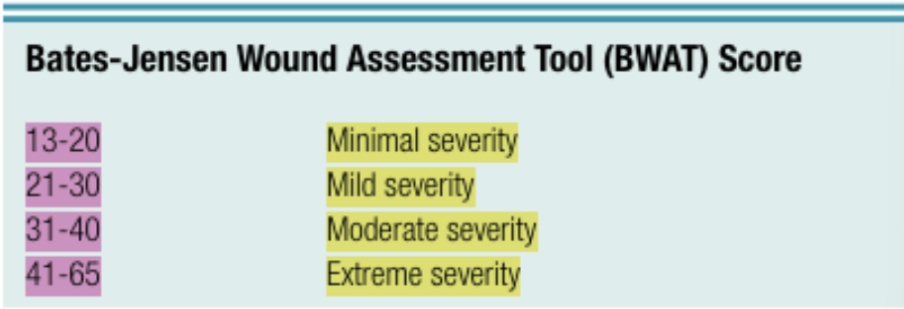
Bates-Jensen Wound Assessment Tool (BWAT)
21-30
MILD SEVERITY
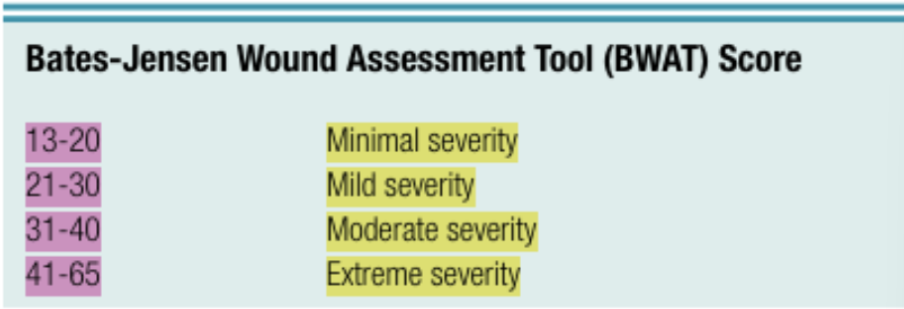
Bates-Jensen Wound Assessment Tool (BWAT)
31-40
MODERATE SEVERITY
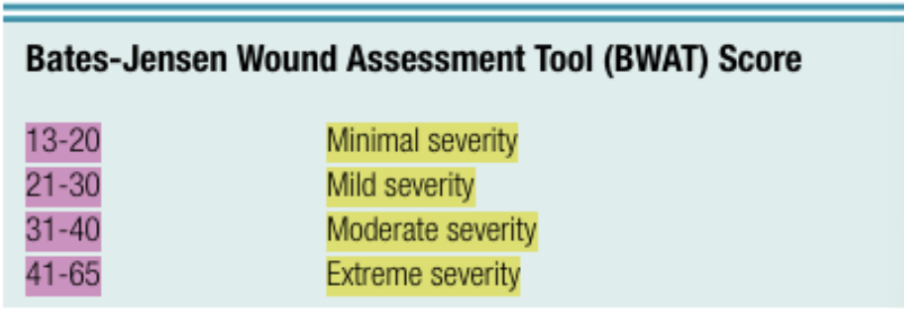
Bates-Jensen Wound Assessment Tool (BWAT)
41-65
EXTREME SEVERITY
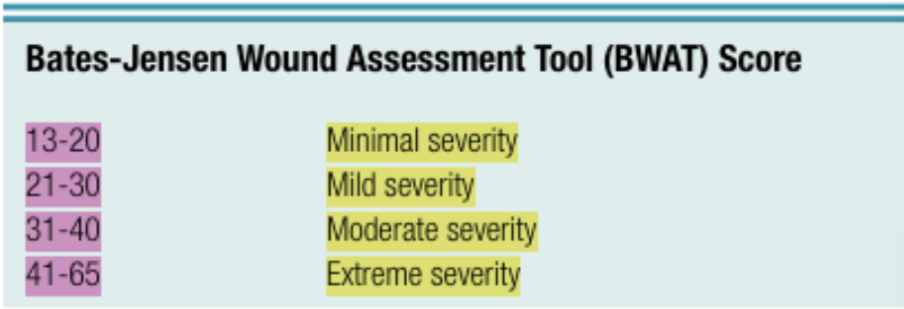
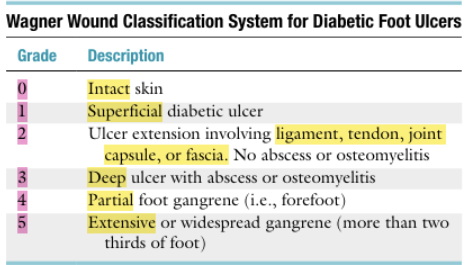
Tool used to assess ulcer depth and the presence of osteomyelitis or gangrene by using a grading system. However, the disadvantage of this system is that it does not consider the presence of ischemia or infection of the ulcer
Wagner Wound Classification System for Diabetic Foot Ulcers
Wagner Wound Classification System for Diabetic Foot Ulcers
Intact skin
Grade 0
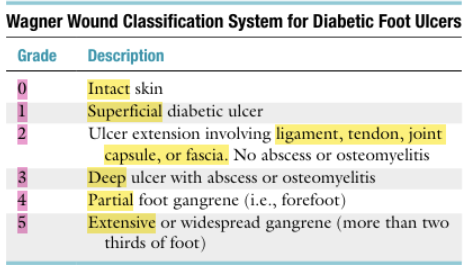
Wagner Wound Classification System for Diabetic Foot Ulcers
Superficial diabetic ulcer
Grade 1
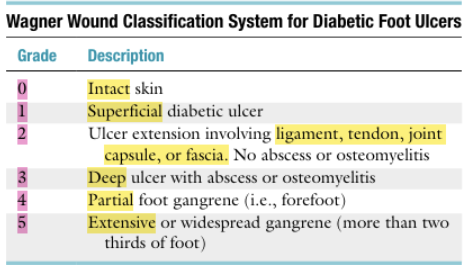
Wagner Wound Classification System for Diabetic Foot Ulcers
Ulcer extension involving ligament, tendon, joint capsule, or fascia. No abscess or osteomyelitis
Grade 2
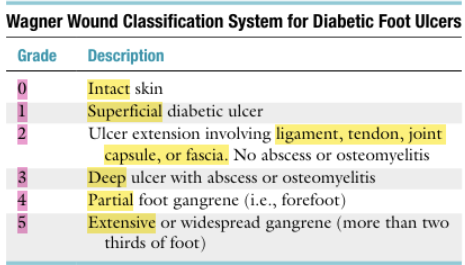
Wagner Wound Classification System for Diabetic Foot Ulcers
Deep ulcer with abscess or osteomyelitis
Grade 3
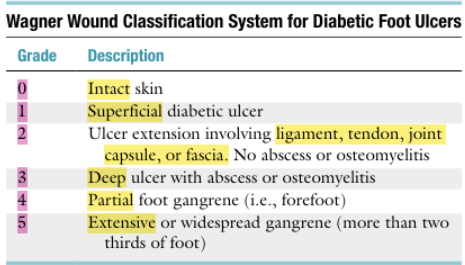
Wagner Wound Classification System for Diabetic Foot Ulcers
Partial foot gangrene (i.e., forefoot)
Grade 4
Wagner Wound Classification System for Diabetic Foot Ulcers
Extensive or widespread gangrene (more than two thirds of foot)
Grade 5
Tool that is defined as a simple system for wound evaluation in chronic wounds or surgical sites. This system classifies wounds that are healing by secondary or delayed primary intention as red, yellow, black, or mixed.
Red wounds may be in the inflammatory phase, proliferation phase, or maturation phase of wound healing.
Wounds that are not ready to heal are yellow wounds, which are infected or may contain fibrinous slough,
black wounds are those that contain necrotic tissue or eschar.
Red-Yellow-Black (RYB) Color Classification System
What tool is this?
a standard clinical method for determination of the percentage of the body affected by a burn.
quick way of estimating medium-to-large burns in adults, but it is not as accurate in children
Using a diagram, each region of the body is divided into regions representing 9% of the total body surface.
Wallace Rule of Nines or Rule of Nines
What tool is this?
most accurate assessment of a burn area when used correctly.
consists of two drawings of the human body, one of the anterior body surface area and one of the posterior body surface area.
Lund-Browder (LB) Chart
What method is this?
uses the surface area of the hand to estimate the surface area of a burn.
The palmar surface area, including the fingers, represents roughly 1% of the total body surface area
Palmar Surface Method
This is defined as the direct delivery into the wound of a cleansing solution or irrigant under pressure produced by a single-patient use, battery-powered device
Pulsed lavage -
This is defined as the vacuum-sealing technique, sealed surface wound suction, vacuum-assisted closure, or vacuum pack technique. It involves the application of subatmospheric pressure to a healing wound. This dressing is placed in direct contact with the wound with a drain attached to the vacuum device. A polyurethane covering should extend approximately 2 cm beyond the wound edges to provide an airtight seal.
Negative Pressure Wound Therapy (NPWT) -
 Note
Note  Flashcards (130)