Music History exam
 Note
Note Call Kai
 Learn
Learn Practice Test
 Spaced Repetition
 Match
Match Flashcards
 Knowt Play
1/36

Earn XP
Description and Tags
Listenings and Terms
Name | Mastery | Learn | Test | Matching | Spaced | Call with Kai | Chat |
|---|
No analytics yet
Send a link to your students to track their progress
37 Terms
Francesca Caccini’s Lasciatemi Qui
An aria in strophic form, featuring baroque monody (including basso continuo), of a voice with accompaniment, rhythm tied close to that of speech, mostly conjunct with chromaticism, mostly tonal/functional, also an example of Secondary practicca
Jean-Baptiste Lully’s Le Bourgeois Gentilhomme
A homophonic hoax to poke fun at Turkish marches which failed when it sounded too French, this piece with no vocals is in duple meter with an AAB form, it is very conjunct with three long notes beginning phrases, it is tonal with minor harmonies,
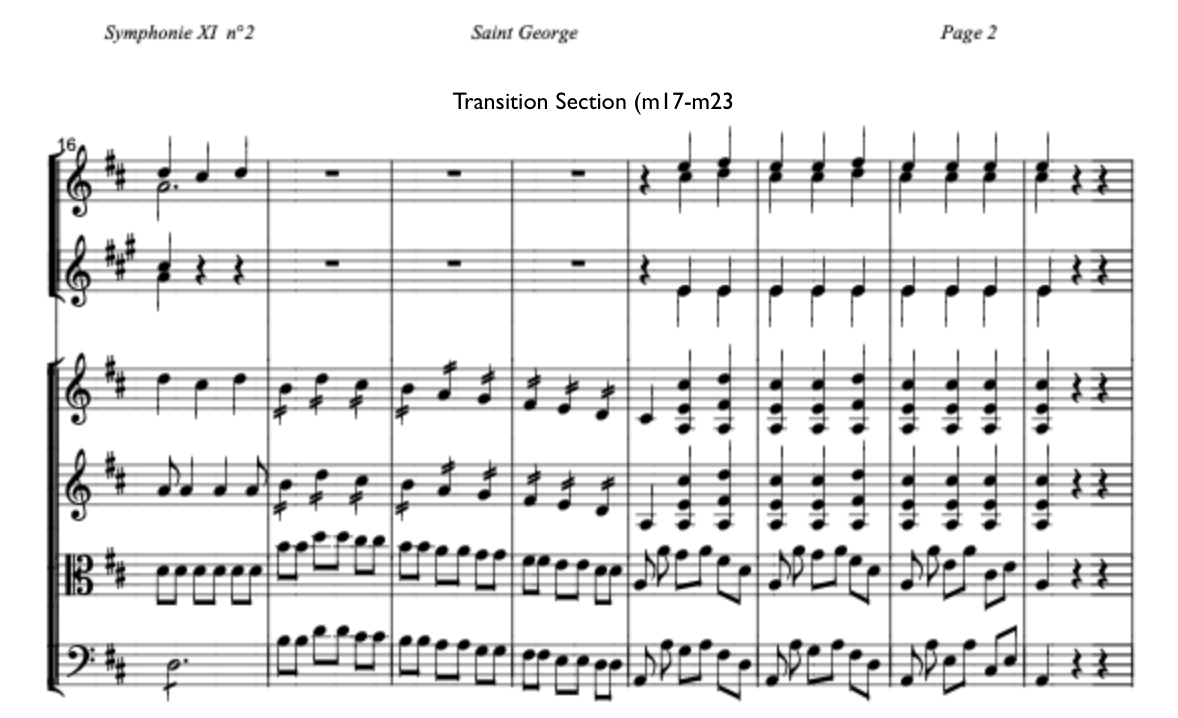
St. George’s Symphony Op. 11 in D major (Bologne) (check score)
A piece with all the hallmarks of a classical symphony, it is in sonata form, Theme 1- Transition- Theme 2- Closing, its first movement served as an overture,
Antonio Vivaldi’s Concerto for two Violoncellos in G minor
Concerto in ritornello form, in duple meter with both conjunct and disjunct passages, this is typically scored for a full ensemble and contains varied segments with the same motifs in different keys,
Zumaya’s, Celebren, Publiquen
Villancico which is in ABBA form (one estribillo and two coblas), the estribillo returns after the two coblas in resemblance of a ritornello, the estribillo is a tutti section with a seven voice choir, trumpet, three violins, and bass, the following colas are alto/tenor duet sections.
Sonata (form)
form composed of an exposition (tonic key, modulation to the dominant), a development (modulating to relatives minor), and a recapitulation (return to original theme)
Ritornello
“return”, repeated musical ideas with a repeated refrain
ABBA
composed of an A and B theme beginning with the A followed by two B sections and another A functioning as a ritornello
Rondo
a fast form in triple meter
Symphony
a genre of music with 3-4 movements depending on the era, a spirited movement in sonata form, a slow lyrical one with tenuto markings, a trio and minuet with sparse orchestration, and a movement in sonata form reaching a presto tempo, it was also closely tied to enlightenment and evolved from opera overtures
Sonata (genre)
a genre containing sonata form usually written for solos or duets with accompaniment and was closely tied to enlightenment
Villancico
Old genre of spanish music now almost exclusively associated with Christmas in ABBA form, with A being estribillos and B being coblas
Concerto
a genre of music surrounding a featured instrument/s with a supporting background ensemble, usually containing three movements in the order of fast, slow, fast, this genre also has two types, solo and grasso (a melody is passed between a group of soloists)
Opera
a genre of music containing Arias, Recitatives, and Choruses, mainly surrounded a stage play and also preserves ideals of classical antiquity
Oratorio
a genre of music surrounding a large story based work but without the staging and theatrics of opera, passion is a type of this genre and this also contains speak singing
Cantata
a genre strongly associated with Bach and Strozzi with mostly solo work and alternation of Recitatives and Arias
Basso continuo
a repeated and underlying baseline implying other melodies which can be found in monody which shows a homophonic solo line over this supporting line
Mehter
Janissary music of Turkey which is very percussive and contains a monophonic vocal line expressing melodic ideas
Recitative
Music which heavily focused on text as opposed to melodic material
Aria
Music focusing heavily on melodic material and virtuosity over text
Seconda Prattica
A style of music that focused on the emotional and expressive aspect of music as opposed to counter point rules, this allowed for meter following speech, a lot of ornamentation, and sudden tonal shifts, it also often featured a solo line over basso continuo (homophonic monody)
Patronage
Rich people giving composers money to make music, like a commission, was sometimes very limiting to the patron’s preference, Haydn was its poster child and this was vital for his secure job position
Baroque Era
from 1600-1750, its name derives from the Portuguese word for misshapen pearl, (its notable figures were Claudio Monteverdi, Antonio Vivaldi, J.S. Bach, George Handel, Giulio and Francesca Caccini, and Biagio Marini), this era focused on emphasizing emotion and expression in music and introduced Operas, Oratorios, Cantatas, Concertos, and Suites
Classical Era
from 1750-1820, its name derives from the world “classicus” meaning highest class, it closely intertwined with ideas of classical antiquity and sought discipline and excellence, the term in the future became associated with western art music, it was opposed by Romanticism in the 19th century (and is identified with Haydn Mozart and Beethoven), featured Sonata form, Symphonies, string quartets, and Concertos, had a lot of homophony opposing its predecessor’s polyphonic tendencies in order to make it easier to follow clear melodies, greatly emphazised instrumental music and focused on simplicity having less ornaments and more order like dynamic contrast markings and question-answer like melodies
Antonio Vivaldi
(1678-1741) One of the most influential Baroque era composers known for his formation of the Concerto and for his religious compositions
Manuel Zumaya
(1678-1755) Most famous Mexican composer of the colonial period of New Spain, established stile Antico and stile moderno, helped increase the number of instruments used by Cathedrals, and composed the first Italian opera
Joseph Bologne Chevalier de Saint George
(1745-1799) Mixed French African composer/violinist born to an enslaved African woman and a plantation owner, almost became the music director of the Paris Opera but was objected due to his race, ran a professional ensemble which commissioned Haydn’s Symphonies
Wolfgang Amadeus Mozart
(1756-1791) Famous Viennese composer of Arias Symphonies and Concertos, one of his most famous being Piano Sonata No. 11 in A major, wrote over 1800 classical compositions representing most of the genres of his time
Franz Joseph Haydn
(1732-1809) Austrian born composer who focused on Symphonies and string quartets, thanks to his aristocratic patronage he managed to get a job at the Esterhazy family estate, and once his patron died he was able to travel and became the most celebrated composer in Europe until his death
Estaban Salas y Castro
(1725-1803) Cuban composer who exclusively composed sacred music, he became a choirmaster at Santiago de Cuba Cathedral, and composed Christmas Villancico where the estribillo represents a crowd fighting fire while the coblas is the calm image of Jesus
Francesca Caccini
(1587-1641+) First female composer with a surviving Opera, she composed Lasciatemi qui Solo which is an Aria from her 1618 “First Book of Music”
Barbara Strozzi
(1619-1677) One of the first Women to have music published entirely under her name, she mainly worked on Madrigals, Cantatas, and Arias
Jean Baptiste Lully
(1632-1687) Louis XIV’s primary court composer whose collaboration with Moliere led to many successful comedies-ballets, he attempted to make a parody of Turkish marches but failed as his interpretation was too French sounding
Claudio Monteverdi
(1567-1643) Active composer in Mantua and Venice who was the influence for Seconda Prattica which he would use in his fifth book of Arias, and composed the piece, Cruda Amarilli, which is about two lovers who are having a long dialogue
Johan Sebastian Bach
(1685-1750) A German born composer who considered himself writer of sacred music, he was known as an organ virtuoso, organ construction consultant, and keyboard composer
C.P.E. Bach
(1714-1788) A composer who followed the legacy of his father and was more famous than him during his lifetime, he was less baroque driven than his father and was more of a bridge between baroque, classical, and romantic, he took part in two musical movements, Empfindsamkeit which served to achieve intimate and sensitive expression, the other is Sturm und Drag which served to frighten, stun, and overwhelm, despite its main use in Opera which he did not actively write for, his music greatly resembled it
Ludwig Van Beethoven
(1770-1827) Greatly idolized composer with a tragic story regarding the loss of some of his senses, he popularized things such as syncopations, bold modulations and dissonances, he also was viewed to have three strands of impact due to his myth as a hero, the influence his music had on later music, and the unfortunate political appropriations of his music