AP Euro Absolutism/Constitutionalism Terms Part 2
 Studied by 0 people
 Call Kai
 Learn
Learn Practice Test
 Spaced Repetition
 Match
Match Flashcards
 Knowt Play
1/18

There's no tags or description
Looks like no tags are added yet.
Name | Mastery | Learn | Test | Matching | Spaced |
|---|
No study sessions yet.
19 Terms
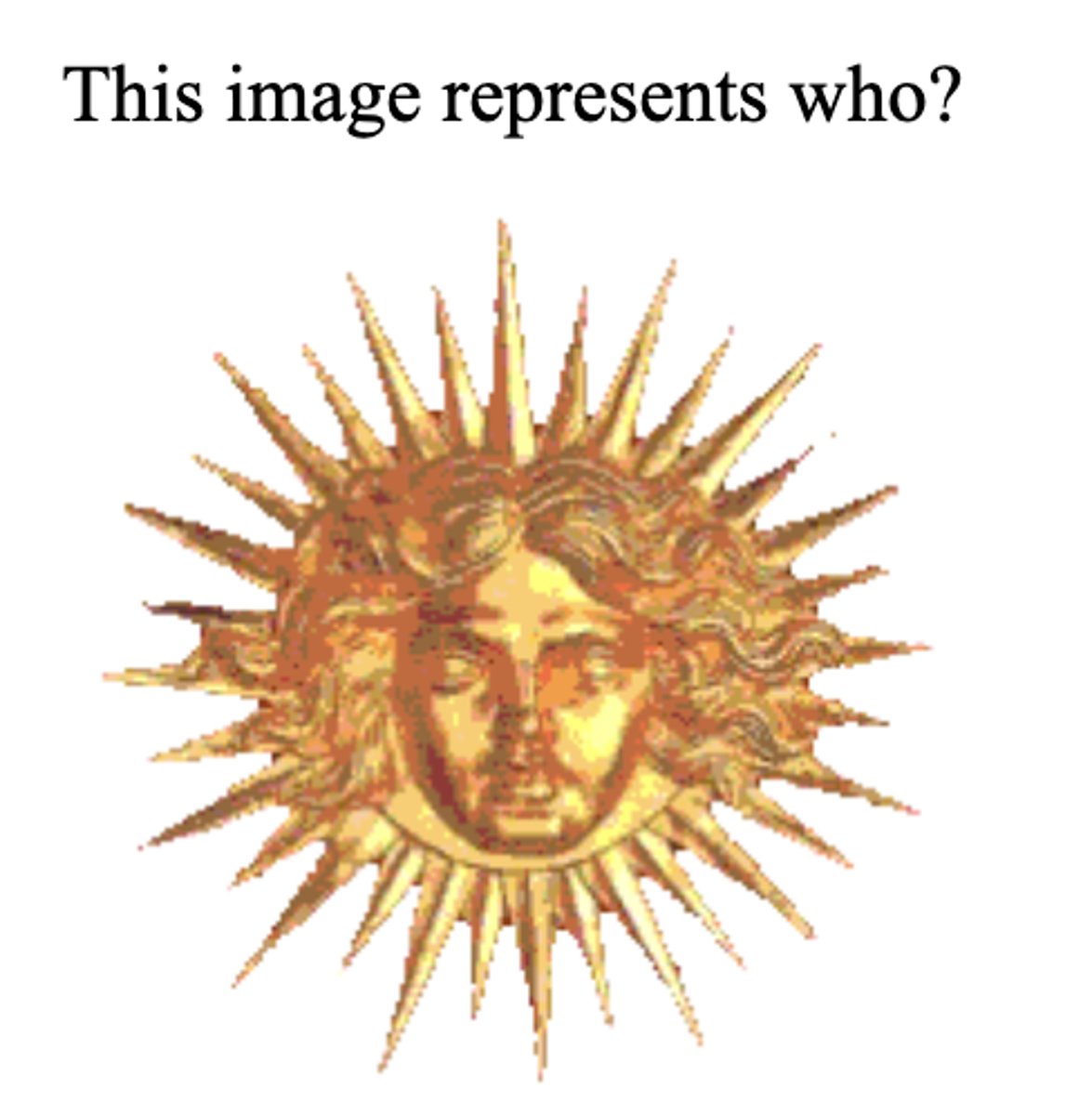
(Image) Louis XIV (The Sun King) - Absolute monarch of France who ruled from 1643 to 1715. He used the sun as his symbol to show his power and control, built the Palace of Versailles, and made France the most powerful nation in Europe.
French Wars of Religion
Civil wars (1562-1598) between French Catholics and Huguenots caused by rising Protestant influence and weak royal power. Ended when Henry IV took the throne and issued the Edict of Nantes to restore unity.
Catherine de Medici
Powerful queen and mother of three French kings who tried to keep peace during the religious wars. Her political schemes, including the St. Bartholomew's Day Massacre, worsened tensions between Catholics and Protestants.
Henry of Navarre / Henry IV
First Bourbon king of France who converted from Protestantism to Catholicism to end the wars, saying "Paris is worth a Mass." He issued the Edict of Nantes and rebuilt France's economy and royal authority.
Huguenots
French Calvinists who faced persecution from the Catholic monarchy. Many fled after Louis XIV revoked the Edict of Nantes in 1685, hurting France's economy and skilled workforce.
Saint Bartholomew's Day Massacre
In 1572, thousands of Huguenots were murdered in Paris and across France, likely encouraged by Catherine de Medici. It reignited the French Wars of Religion and ended hopes for peace.
The Edict of Nantes
Law issued by Henry IV in 1598 granting limited religious toleration to Huguenots and ending the French Wars of Religion. Revoked by Louis XIV in 1685, leading to renewed persecution.
Cardinal Richelieu
Chief minister to Louis XIII who strengthened royal power by reducing the influence of nobles and Huguenots. He centralized government and entered the Thirty Years' War to weaken Habsburg power.
Louis XIV
The Sun King, France's most powerful absolute monarch. He centralized authority, built Versailles, and controlled the nobility. His wars expanded French influence but left the country in debt.
Cardinal Mazarin
Successor to Richelieu who ruled for the young Louis XIV. Faced the Fronde revolts, which reinforced the need for strong royal authority and shaped Louis's absolutist rule.
The Fronde
Series of noble and urban uprisings (1648-1653) against Mazarin's government. Though unsuccessful, they convinced Louis XIV that France needed a powerful, centralized monarchy.
Divine Right
The belief that monarchs receive their power directly from God, making rebellion against them a sin. Used by absolute rulers like Louis XIV and James I to justify their authority.
Palace of Versailles
Lavish palace built by Louis XIV to display royal power and control the nobility. It became the political, social, and cultural center of France under absolutism.
Jean-Baptiste Colbert
Finance minister under Louis XIV who practiced mercantilism—boosting trade, manufacturing, and colonial wealth to fund the monarchy and strengthen the French economy.
War of Spanish Succession
European war (1701-1714) fought after the death of Spain's Charles II over who would inherit the Spanish throne. The Treaty of Utrecht ended the war, allowing a Bourbon on Spain's throne but preventing union with France.
Council of Trent
Catholic council (1545-1563) that reaffirmed core Catholic beliefs, corrected abuses like indulgence sales, and improved priest training. It defined the Counter-Reformation and revitalized the Church.
Thirty Years' War
War (1618-1648) that began as a religious conflict in the Holy Roman Empire and turned into a power struggle across Europe. It devastated Germany and ended with France rising as a major power.
Treaty of Westphalia
Peace treaty of 1648 ending the Thirty Years' War. It recognized the independence of German states, allowed rulers to choose their religion, and established the modern state system in Europe.
Treaty of Pyrenees
1659 treaty ending the war between France and Spain. France gained territory like Roussillon, marking Spain's decline and France's emergence as Europe's dominant power.
 Note
Note  Flashcards (35)