Unit 6: Functions
 Call Kai
 Learn
Learn Practice Test
 Spaced Repetition
 Match
Match Flashcards
 Knowt Play
1/39

There's no tags or description
Looks like no tags are added yet.
Name | Mastery | Learn | Test | Matching | Spaced | Call with Kai |
|---|
No analytics yet
Send a link to your students to track their progress
40 Terms
Interval Notation
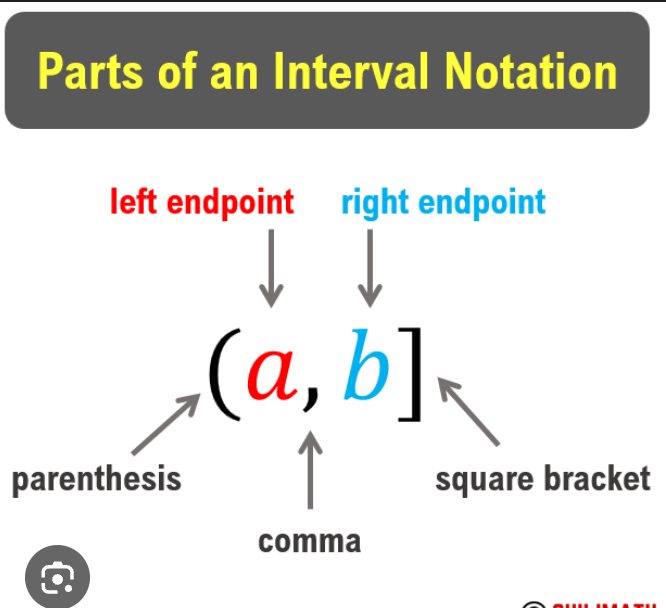
Set Notation
{x<0}. {-4<x<0}
How to identify the domain of a function algebraically?
Terms under a radical can’t be less than 0. Set up a number line and test integers.
Denominators can’t equal 0.
Radical in denominator: set expression under the radical greater than 0.
Domain and Range: (y = x)
D: all real numbers
R: all real numbers
Domain and Range: (y = x²)
D: all real numbers
R: [Vertex, positive/negative infinity)
Domain and Range: (y = radical x)
D: [0, positive infinity), R: [0, positive infinity)
Domain and Range: (y = lxl)
D: all real numbers, R: [0, positive infinity)
Domain and Range: (y = x³)
D: all real numbers, R: all real numbers
Domain and Range: (y = 1/x)
D: all real numbers except 0, R: all real numbers except 0
When the value is added outside the function
Shifts up
When the value is subtracted outside the function
Shifts down
When the value is added inside the function
Shifts left
When the value is subtracted inside the function
Shifts right
When multiplying by a constant on the outside
Stretches the graph, multiply the y’s
When multiplying by a negative on the outside
Flips vertically over horizontal axis
When multiplying by a negative on the inside
flips horizontally over vertical axis
y = k(x-h)
Shift right h units
y = k(x+h)
Shift left h units
y = k(x)+h
Shift up h units
y = k(x)-h
Shift down h units
y = ak(x)
Multiply the y’s by a
y = -k(x)
Reflect over the x-axis
y = k(-x)
Reflect over the y-axis
Average range of change
Slope formula
When determining when the graph is increasing or decreasing
Look at the x coordinates
Absolute Maximum
Highest point in graph
Absolute Minimum
Lowest point in graph
Local maximum
A high point in the middle of the graph
Local minimum
A low point in the middle of the graph
(f + g)(x)
f(x) + g(x)
(f - g)(x)
f(x) - g(x)
(f * g)(x)
f(x) * g(x)
(f/g)(x)
f(x) / g(x)
Composition function
f * g(x) = f(g(x))
g * f(x) = g(f(x))
Inverse functions
Functions that reverse each other's effects, such that if f(g(x)) = x and g(f(x)) = x.
f^-1(x) = f(x)
Calculating the inverse of f(x)
Switch x and y
Solve for y
If a function, replace y with f^-1(x)
One-to-one Function
Every input has one output and every output has one input. Must pass the vertical line and horizontal line test.
When do we use a domain restriction when finding the inverse of f(x)?
When the range of the original function doesn’t match the domain of the inverse we find.

